Category: Uncategorized

  • Leaflet Distribution for Professional Services London: The 2026 Strategy

    Leaflet Distribution for Professional Services London: The 2026 Strategy

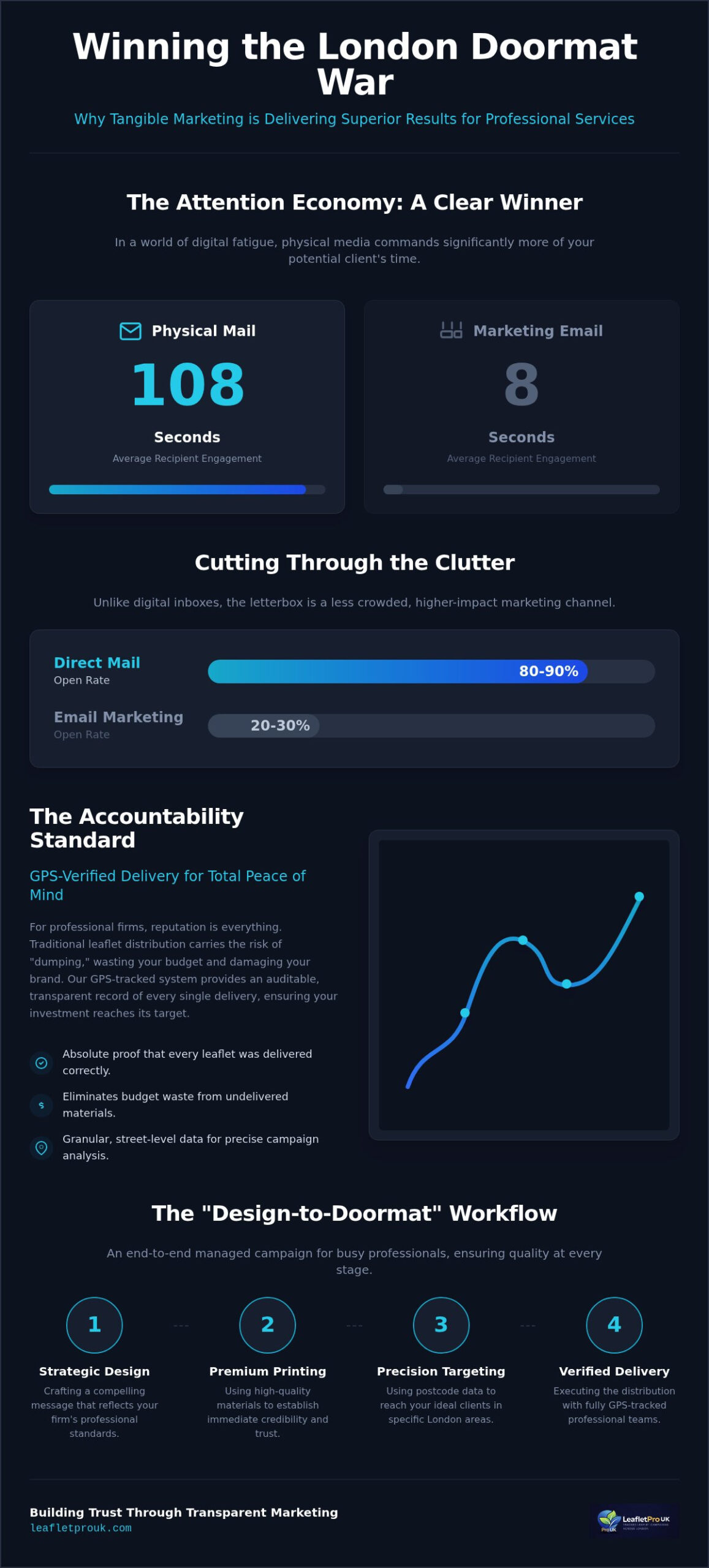
    Did you know that the average recipient spends 108 seconds engaging with physical mail, compared to a mere eight seconds for a marketing email? In a city where digital ad auctions are increasingly crowded and expensive, professional firms are finding it harder to cut through the noise. You’ve likely felt the frustration of watching your marketing budget vanish into “black hole” digital campaigns or, worse, worrying that your physical flyers ended up in a bin rather than a letterbox. Successfully executing leaflet distribution for professional services London requires more than just printing paper; it demands a level of transparency that traditional methods often lack.

    We understand that for a London business, reaching affluent households in gated blocks or high-density postcodes is a logistical challenge that requires precision. This guide will show you how to bypass digital fatigue and secure high-quality local enquiries using GPS-verified targeting. We’ll explore the 2026 strategy for building brand trust through accountable, data-driven distribution that proves every penny of your investment reached its destination.

    Key Takeaways

    • Understand why physical marketing is outperforming digital channels for London professional firms in 2026 by securing significantly higher engagement and local trust.
    • Discover how GPS-tracked delivery provides absolute verification for your campaign, eliminating the risk of undelivered flyers and ensuring your budget is fully utilised.
    • Learn to navigate London’s unique residential landscape by using precise postcode targeting to reach your ideal clients in high-density or gated areas.
    • Master a strategic approach to leaflet distribution for professional services London that combines expert design with high-quality printing to establish an authoritative brand presence.
    • Explore the efficiency of a “Design-to-Doormat” workflow, allowing busy business owners to manage end-to-end campaigns with professional precision and minimal operational friction.

    Beyond Digital: Why Flyer Distribution for Services Wins in 2026

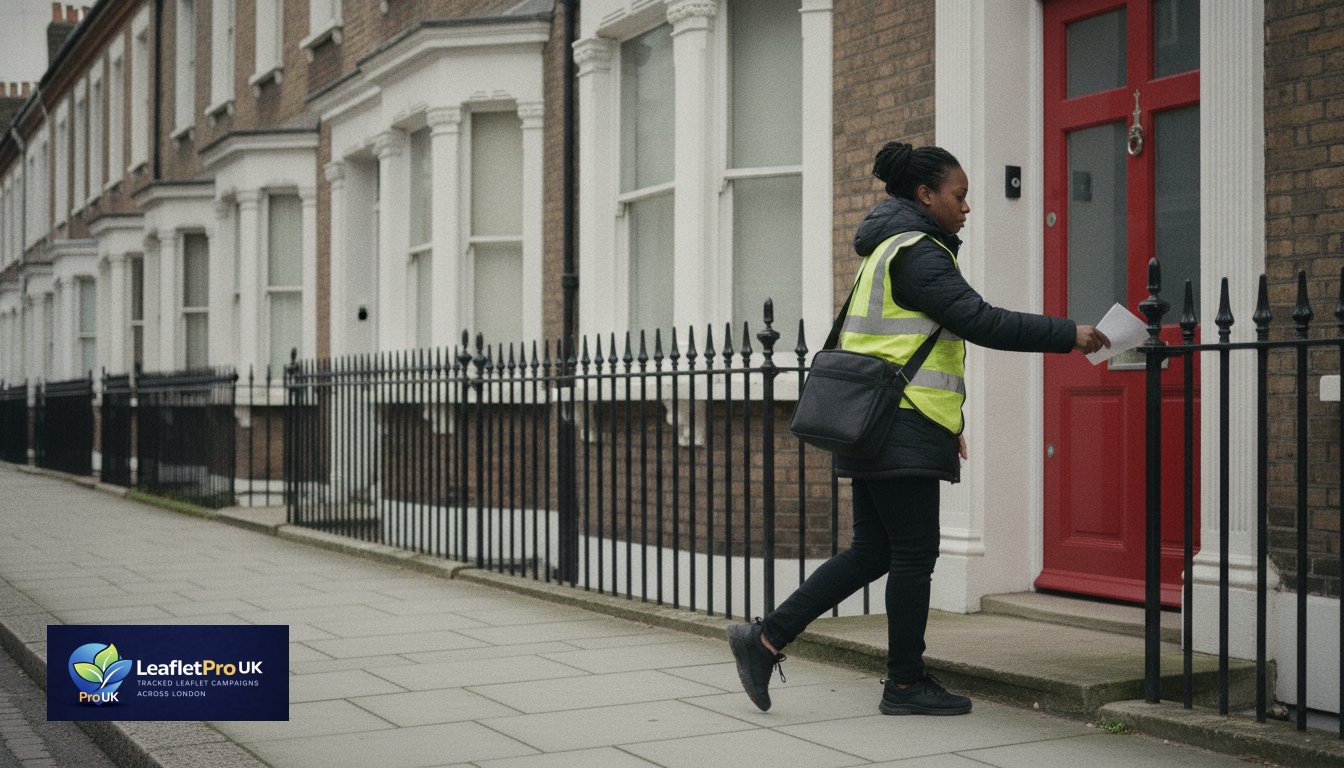
    Leaflet distribution for professional services London operates as a high-trust acquisition channel that connects established firms with local residents. In an era where digital noise has reached a breaking point, the physical presence of a well-crafted document offers a level of authority that screens cannot match. For London-based solicitors, accountants, and estate agents, the doormat represents a direct line to the household decision-makers. By 2026, the phenomenon of “digital fatigue” has led many Londoners to subconsciously filter out online advertisements, making the tactile nature of a Flyer (pamphlet) a refreshing and more memorable alternative.

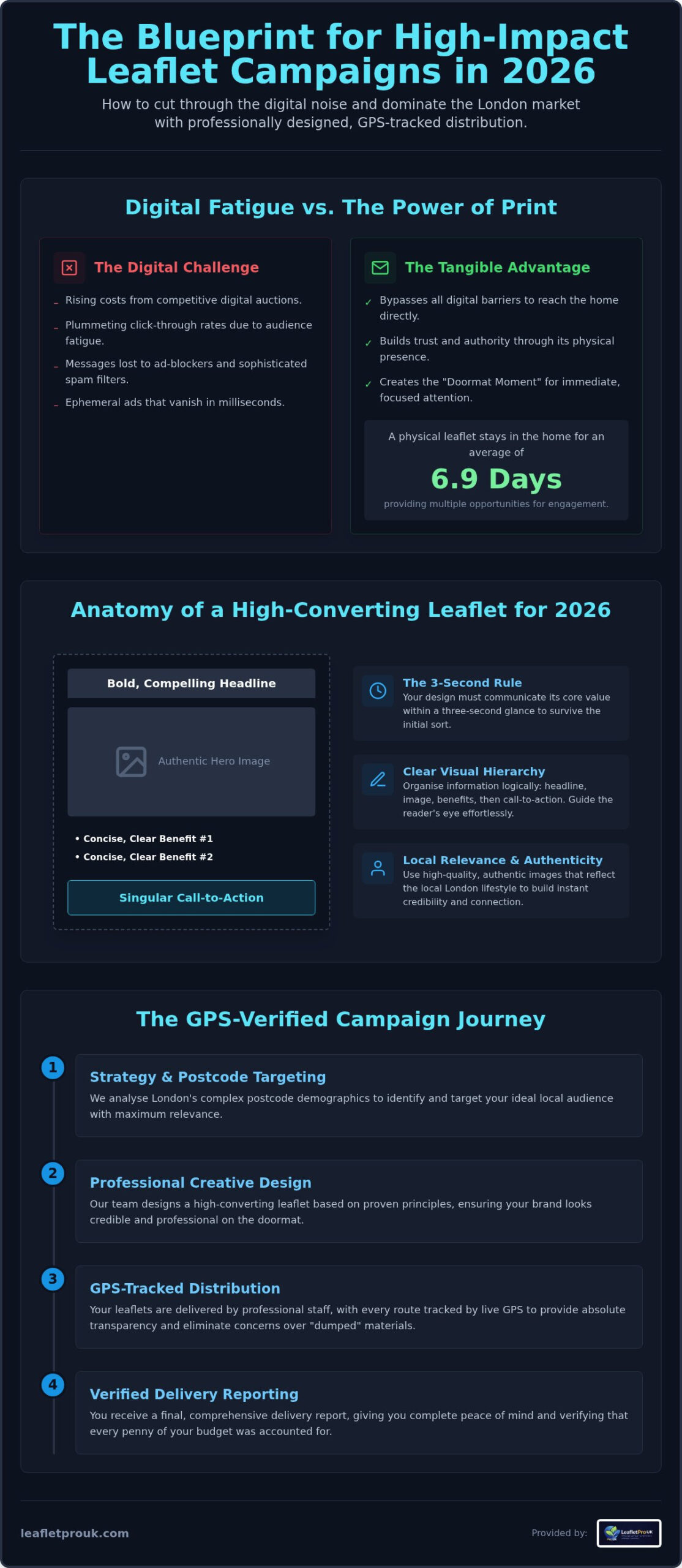
    Physicality provides a distinct advantage in terms of longevity. Whilst a digital ad disappears as soon as the user scrolls, a high-quality leaflet often resides in the home for several days. Research indicates that direct mail has an open rate of 80 to 90 per cent, which dwarfs the 20 to 30 per cent typically seen in email marketing. This extended “shelf life” ensures that your professional brand remains visible during the exact moments when a family or business owner is ready to discuss their service needs.

    Cutting Through the London Digital Noise

    London’s digital ad auctions are amongst the most competitive in the world, with Cost-Per-Click (CPC) rates for professional keywords often reaching unsustainable levels. Physical distribution offers a stable alternative with predictable costs that bypass ad-blockers and overflowing email inboxes. The psychology of the “kitchen table” is central here; this is the space where London households make significant financial and legal decisions. When your flyer lands on that table, it isn’t just an advert. It’s a tangible invitation to a professional partnership that arrives in a clutter-free environment.

    The Tangible Advantage for Professional Brands

    For service providers, the quality of the paper and the precision of the print are direct reflections of their work standards. Using premium finishes and professional layouts helps establish immediate credibility before the recipient even reads the first sentence. It’s about projecting a sense of local legitimacy and permanence. To ensure your campaign meets these high expectations, it’s vital to utilise professional leaflet design and distribution London experts who understand the nuances of the local market. This integrated approach ensures that every drop reinforces your reputation for excellence and meticulous attention to detail.

    The Accountability Standard: GPS Tracking and Professional Integrity

    The most persistent anxiety for any business owner investing in physical marketing is the “dumping” factor. You’ve likely heard stories of thousands of flyers ending up in a recycling bin rather than reaching their intended audience. For high-value sectors, this isn’t just a waste of budget; it’s a risk to your brand’s reputation. This is why GPS-tracked leaflet distribution for professional services London has evolved from a premium feature into an essential security standard. It provides the empirical evidence required to prove that every single piece of collateral was delivered to the correct doorstep.

    Professional integrity relies on transparency. By utilising live tracking, we transform a logistical process into a visible, auditable service. This level of scrutiny ensures that distributors remain diligent, adhering to the official UK government guidance regarding responsible distribution. It establishes a foundation of trust where you no longer have to guess about the reach of your campaign. GPS proof acts as a mandatory safeguard, ensuring your professional message is handled with the same care you apply to your own client work.

    How GPS Verification Works in Practice

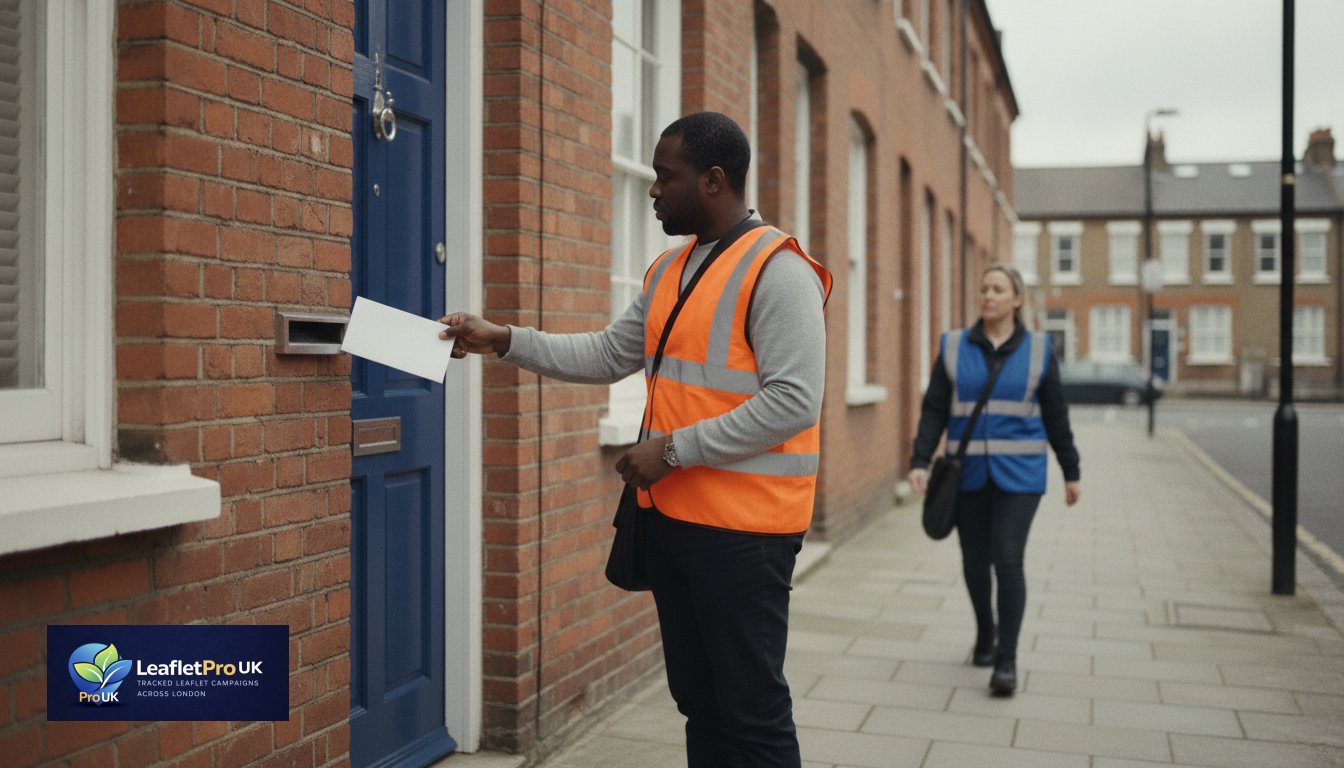
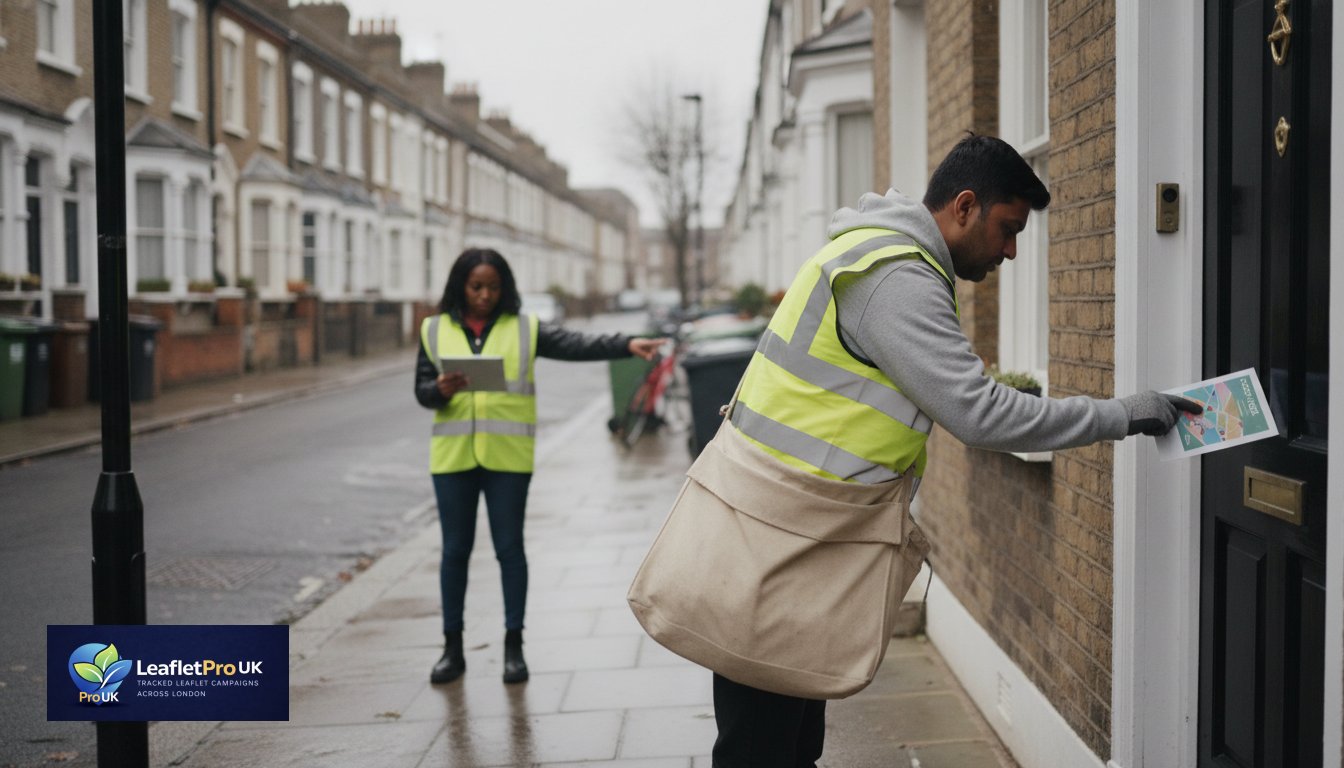
    Distributors carry specialised GPS devices that record their exact movements in real-time. Unlike basic area tracking, which only shows a general presence in a postcode, granular street-level data captures the specific path taken to every letterbox. This ensures “cleanliness of work,” a term we use to describe the professional standard of delivery. It means flyers are pushed fully through the door rather than being left hanging or discarded in communal areas. You can verify our distribution standards to see how this precision protects your professional image.

    Auditing Your London Campaign Results

    Once a drop is complete, you receive a comprehensive report featuring the raw GPS data. This allows you to cross-reference the delivery path against your target postcodes. By knowing exactly where your flyers landed, you can correlate incoming enquiries with specific streets, allowing for a far more accurate calculation of ROI. This data-led approach is explored further in our GPS Tracked Leaflet Distribution Guide. Having access to this level of detail empowers you to refine future campaigns, focusing your budget on the areas that generate the highest volume of qualified leads for your firm.

    Strategic Roundup: Tailoring Campaigns for London Service Sectors

    A “one-size-fits-all” template rarely succeeds in the capital’s nuanced market. When planning leaflet distribution for professional services London, your strategy must align with the specific expectations of your target demographic. High-value sectors like wealth management or legal firms often benefit from “Solus” distribution. This exclusive approach ensures your brand isn’t diluted by being bundled with unrelated flyers. Meanwhile, shared drops offer a balanced way for local businesses to maintain a steady presence amongst residents. A well-timed drop can be the difference between a forgotten ad and a confirmed appointment. Ensuring your campaign follows UK government guidelines on leaflet distribution is a fundamental step in maintaining professional standards.

    Estate Agents and Property Professionals

    London property professionals require collateral that feels as substantial as the investments they manage. High-gloss, premium cardstock is essential for projecting a high-end image. Strategy involves targeting high-value postcodes for valuations or “Just Sold” notices to create local momentum. By including a QR code, you can offer residents an instant digital property valuation, turning a static flyer into a dynamic lead-generation tool. This integrated approach is a hallmark of a professional leaflet distribution company service.

    Healthcare, Dental, and Wellness Clinics

    For dental, healthcare, and wellness clinics, the primary goal is building local familiarity. Drops should be concentrated within a 10-15 minute walking radius of the facility to capture the most relevant footfall. Trust is the currency of health. Highlighting professional qualifications, CQC ratings, and “First Consultation Free” offers lowers the barrier for new patients. It’s about presenting your clinic as a safe, credible choice for the local community.

    Home Improvements and Professional Trades

    Home improvement services find success by matching their message to seasonal demands. Promoting boiler servicing in autumn or roofing repairs before winter sets in is a proven tactic. Authority is built through evidence. Including Trustpilot logos alongside a mention of a recent project on a nearby street provides the social proof Londoners look for. A clear, time-sensitive CTA like “Book by October 1st” provides the necessary nudge to move from interest to enquiry.
    Leaflet Distribution for Professional Services London: The 2026 Strategy

    Precision Targeting: Using London Postcodes to Reach Your Ideal Customer

    London is a unique landscape composed of thousands of distinct postcode micro-markets. For a professional firm, a blanket approach is rarely cost-effective and often leads to significant budget wastage. Success hinges on precise postcode-targeted delivery. This method ensures your message reaches specific demographics, such as affluent homeowners or growing families, rather than being scattered across irrelevant areas. Identifying these high-potential streets requires a data-driven approach that looks beyond simple geography to understand the socio-economic profile of each neighbourhood. By focusing on specific sectors within a borough, you can optimise your spend and increase the likelihood of generating high-quality enquiries from residents who actually need your services.

    Identifying Your London ‘Goldmine’ Areas

    Postcode maps are the foundation of any strategic campaign. There’s a stark difference between the established, high-net-worth households of SW postcodes like Chelsea or Wimbledon and the rapidly emerging professional markets in East London. Mapping these areas allows you to align your service offering with the local resident profile. For instance, a private dental clinic might target different postcodes than a high-end estate agency. To explore this further, consult our Household Targeted Leaflet Distribution London Guide, which outlines how to refine your reach using 2026 demographic data.

    Maximising Coverage in High-Density London

    London presents unique logistical hurdles, particularly gated communities and high-rise blocks with restricted access. Many national distributors struggle with these complexities, leading to missed opportunities and wasted stock that never reaches a doormat. Maximising coverage requires a distributor with hyper-local London knowledge and the patience to navigate complex residential layouts. We understand the specific access protocols for different boroughs, ensuring your leaflets reach the doormats of residents in even the most exclusive developments. This niche expertise is what separates a professional leaflet distribution for professional services London campaign from a generic, unreliable drop. Using a London-exclusive partner means your campaign is executed by specialists who navigate these streets daily, ensuring no letterbox is overlooked due to a lack of local familiarity or access insight.

    From Concept to Doormat: Organising a Full-Service Campaign

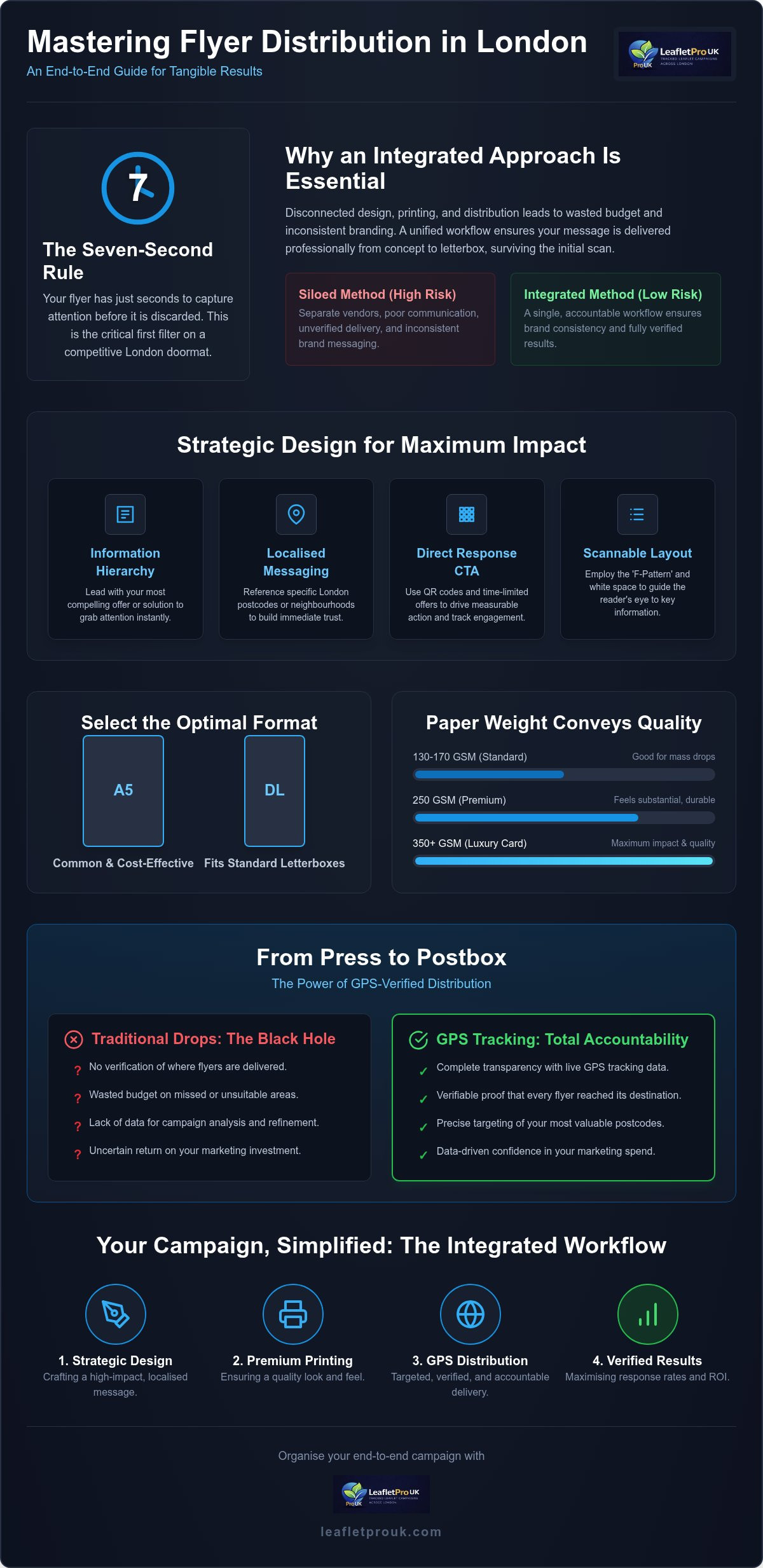
    For a busy London business owner, marketing should be a seamless extension of their professional standards rather than a logistical burden. Transitioning from a marketing concept to a physical doormat presence requires a coordinated “Design-to-Doormat” approach. This ensures that the high-trust reputation you’ve built isn’t compromised by poor execution or a lack of oversight. By integrating design, printing, and distribution into a single, verified workflow, you eliminate the friction of managing multiple vendors. This systematic reliability is essential when executing leaflet distribution for professional services London, where every household interaction is a reflection of your firm’s credibility.

    The physical “hand-feel” of your marketing material communicates your brand’s value before a single word is read. Using thin or low-quality flyers can inadvertently signal a lack of permanence, which is particularly damaging for premium service providers like law firms or private clinics. A heavier paper weight combined with a silk or gloss finish provides the tactile authority required to stand out amongst household post. It’s about projecting a sense of established authority through every detail of the process.

    Professional Design and Print Standards

    Expert design support ensures your message isn’t just aesthetically pleasing but also structured for conversion. Unlike automated templates that lack local nuance, bespoke design allows for a clear hierarchy of information and a professional layout that builds immediate trust. Choosing the right finish is equally vital for professional credibility. Silk finishes often project a sophisticated, understated elegance that suits legal or financial services, whilst gloss can make high-resolution property photography or vibrant wellness branding pop. These choices are fundamental to establishing a professional brand that local residents feel comfortable inviting into their homes.

    The LeafletPro UK Distribution Process

    Our methodology is built on transparency and precision, guiding you through a structured three-step journey. First, we provide a consultation to select the most relevant postcodes based on your specific service niche, ensuring you don’t waste stock on uninterested demographics. Second, we assist in designing a high-converting flyer that features a clear, local Call to Action (CTA) tailored to your London audience. Finally, our team carries out GPS-tracked delivery, providing you with the full accountability reporting required to verify your investment. This end-to-end service allows you to focus on your clients whilst we handle the complex logistics of local market engagement.

    Securing Your Local Market Presence in 2026

    Building a sustainable pipeline of local enquiries in 2026 requires a return to tangible, high-trust marketing. We’ve explored how a physical presence on the doormat bypasses the exhaustion of digital ad auctions, provided every drop is backed by empirical evidence. By implementing GPS-tracked leaflet distribution for professional services London, your firm moves from guesswork to a verified acquisition model that respects your budget and protects your reputation. Our specialised London-only logistics expertise ensures your collateral reaches the right households, even within the city’s most complex residential blocks.

    Success depends on the integrity of the process. By utilising a full end-to-end service that covers design, print, and delivery, you ensure a consistent standard of quality that builds immediate credibility with local residents. With GPS-tracked route reports provided for every drop, you gain the visibility needed to calculate accurate ROI and refine your local outreach with confidence.

    It’s time to reclaim your local market and establish a lasting connection with the residents who matter most to your business. We’re ready to help you deliver results with precision and care.

    Frequently Asked Questions

    Is leaflet distribution still effective for professional services in London?

    Physical marketing remains highly effective because it bypasses the “digital noise” that often overwhelms London residents. Unlike a fleeting social media ad, a physical flyer stays in the home for several days, offering a tactile reminder of your brand. For leaflet distribution for professional services London, this translates to higher engagement levels. Direct mail has a significantly higher open rate than email, providing a reliable way to build local trust and authority.

    How does GPS tracking prove my leaflets were actually delivered?

    GPS tracking provides empirical proof of delivery by logging the exact path taken by our distributors. Every letterbox interaction is recorded using live devices, which generate a granular route report for your review. This “Accountability-as-a-Service” model eliminates the industry fear of “dumping” and ensures your investment is fully utilised. You’ll receive transparent data showing exactly which streets were covered, providing the peace of mind that your message reached its destination.

    Can I target specific affluent postcodes in London for my campaign?

    You can absolutely target specific affluent postcodes to ensure your campaign reaches your ideal household profile. London’s micro-markets vary significantly, so we use demographic data to identify high-potential areas such as established SW postcodes or emerging professional hubs. This postcode-targeted delivery prevents budget wastage on irrelevant areas. By focusing on specific streets rather than blanket drops, you increase the likelihood of securing enquiries from qualified local leads.

    What is the difference between solus and shared distribution for services?

    Solus distribution is an exclusive service where your flyer is delivered on its own, ensuring the recipient’s undivided attention. This is often preferred by premium professional brands to maintain high-end positioning. Shared distribution involves delivering your leaflet alongside a few non-competing flyers, making it a more cost-effective option for consistent local presence. Both methods utilise our GPS-tracked standards, allowing you to choose the approach that best fits your brand strategy.

    Do you provide professional design and high-quality printing services?

    LeafletPro UK provides a complete end-to-end solution that includes professional design support and high-quality printing. We understand that the “hand-feel” of your flyer is a direct reflection of your service standards. Our team helps you create high-converting layouts with clear calls to action, which are then produced using premium finishes. Managing the entire journey from concept to doormat ensures a consistent, professional brand image that builds immediate credibility with Londoners.

    How long does a typical London leaflet distribution campaign take?

    The duration of a campaign typically depends on the volume of leaflets and the specific postcodes targeted. Once your design and printing are finalised, most distribution phases are completed within one to two weeks. We prioritise a methodical pace to ensure every letterbox is reached with the required “cleanliness of work.” We’ll provide a clear timeline during your initial consultation so you can coordinate your internal resources to handle the resulting enquiries.

    What is the best time of year for a service business to distribute flyers?

    The optimal timing for a campaign often depends on your specific service sector and seasonal demand. For example, home improvement trades often see higher conversion in autumn, whilst property professionals may target the busy spring market. However, repetition is key to building lasting brand recognition in London’s competitive landscape. Success often involves at least three drops to the same area to build the familiarity and trust needed to drive a meaningful response.

    How do I measure the ROI of my flyer distribution campaign?

    Measuring ROI is straightforward when you integrate trackable elements into your flyer design. We recommend using unique QR codes, dedicated phone numbers, or specific landing pages to monitor which enquiries originate from your leaflet distribution for professional services London campaign. By cross-referencing these leads with our GPS delivery reports, you can identify which postcodes are generating the highest returns. This data-led approach allows you to refine future drops for even greater efficiency.

  • Hello world!

    Welcome to WordPress. This is your first post. Edit or delete it, then start writing!

  • Leaflet Design Best Practices: A 2026 Guide to London Campaign Success

    Leaflet Design Best Practices: A 2026 Guide to London Campaign Success

    A leaflet that lands on a London doormat has exactly two seconds to justify its existence before it meets the recycling bin. You’ve likely felt the frustration of investing in a campaign only to see your hard-earned budget produce silence instead of sales. In a city as fast-paced as ours, generic flyers often fail because they lack the visual authority needed to capture attention. Understanding leaflet design best practices is no longer just about aesthetics; it’s about survival in a competitive physical marketplace where every millimetre of paper must work for your brand.

    This guide provides the technical clarity and creative strategies required to turn your marketing materials into high-conversion sales channels. We’ll demystify complex print terms like bleed and CMYK whilst showing you how to maintain brand consistency across every London postcode. You’ll learn how to bridge the gap between professional design and seamless distribution, ensuring your next campaign delivers the measurable response rates your business deserves. From doormat-ready layouts to GPS-tracked delivery standards, we’re outlining the roadmap for your 2026 campaign success.

    Key Takeaways

    • Learn how the three-second rule dictates campaign success by capturing attention on competitive London doormats before the recipient reaches the recycling bin.
    • Master leaflet design best practices including visual hierarchy and colour psychology to guide potential customers from the initial hook to the final action.
    • Avoid expensive production errors by understanding the technical requirements of print, from CMYK colour profiles to essential bleed and quiet zones.
    • Discover how to integrate QR codes and high-value offers that turn a physical flyer into a trackable digital conversion tool.
    • Understand the benefits of an integrated workflow where design decisions are informed by local London postcode data and GPS-tracked delivery insights.

    Why Professional Leaflet Design Support is Essential for London Campaigns

    London letterboxes are battlegrounds for attention. Every day, households in boroughs like Kensington or Fulham receive a high volume of marketing material. Your headline must win the battle of the doormat instantly; you have roughly three seconds before a recipient decides whether to read on or recycle. This narrow window is why generic flyers fail. Adhering to leaflet design best practices ensures your message survives this initial sorting process by presenting a clear, authoritative value proposition that resonates with a busy urban audience.

    Professional design builds immediate trust through the psychology of tangibility. The history and uses of flyers show that physical marketing’s strength lies in its ability to create a lasting impression in a way digital ads cannot. A well-constructed leaflet feels substantial and credible. If a flyer looks cheap, cluttered, or poorly aligned, the recipient subconsciously transfers that lack of quality to your business. High standards in your creative assets signal that you’re an established and dependable brand.

    Design shouldn’t exist in a vacuum. It must be informed by the eventual GPS-tracked distribution area to be truly effective. At LeafletPro UK, we believe leaflet design support should be a collaborative process that considers the specific streets your flyers will land on. When your design is synchronised with your logistical strategy, you create a seamless journey from the doormat to the sale.

    The Risk of DIY Templates

    Generic online templates often ignore the nuances of the London market. These “off-the-shelf” designs frequently fail to resonate with local audiences because they lack a specific aesthetic hook tailored to the city’s diverse boroughs. Beyond the visuals, DIY tools often overlook critical technical requirements like print bleed and quiet zones. If your design is cut incorrectly during the printing process, your contact details or call to action might be lost. Using a template might seem cost-effective initially, but the hidden cost of a failed campaign far outweighs the savings. A flyer that doesn’t fit the letterbox or looks disjointed from your website damages your professional standing and breaks brand consistency.

    London-Specific Audience Targeting

    Effective campaigns tailor their visual language to specific demographics. A flyer designed for a young professional in Shoreditch should look and feel different from one targeting a family in Richmond. Professional designers use local insights to choose imagery and typography that converts within these distinct micro-markets. Localised design is the alignment of creative assets with specific postcode demographics. By matching your creative approach to the household’s expectations, you increase the likelihood of a positive response. This targeted approach ensures your budget isn’t wasted on generic messaging that fails to connect with the people most likely to use your services.

    Core Visual Principles: Hierarchy, Colour, and White Space

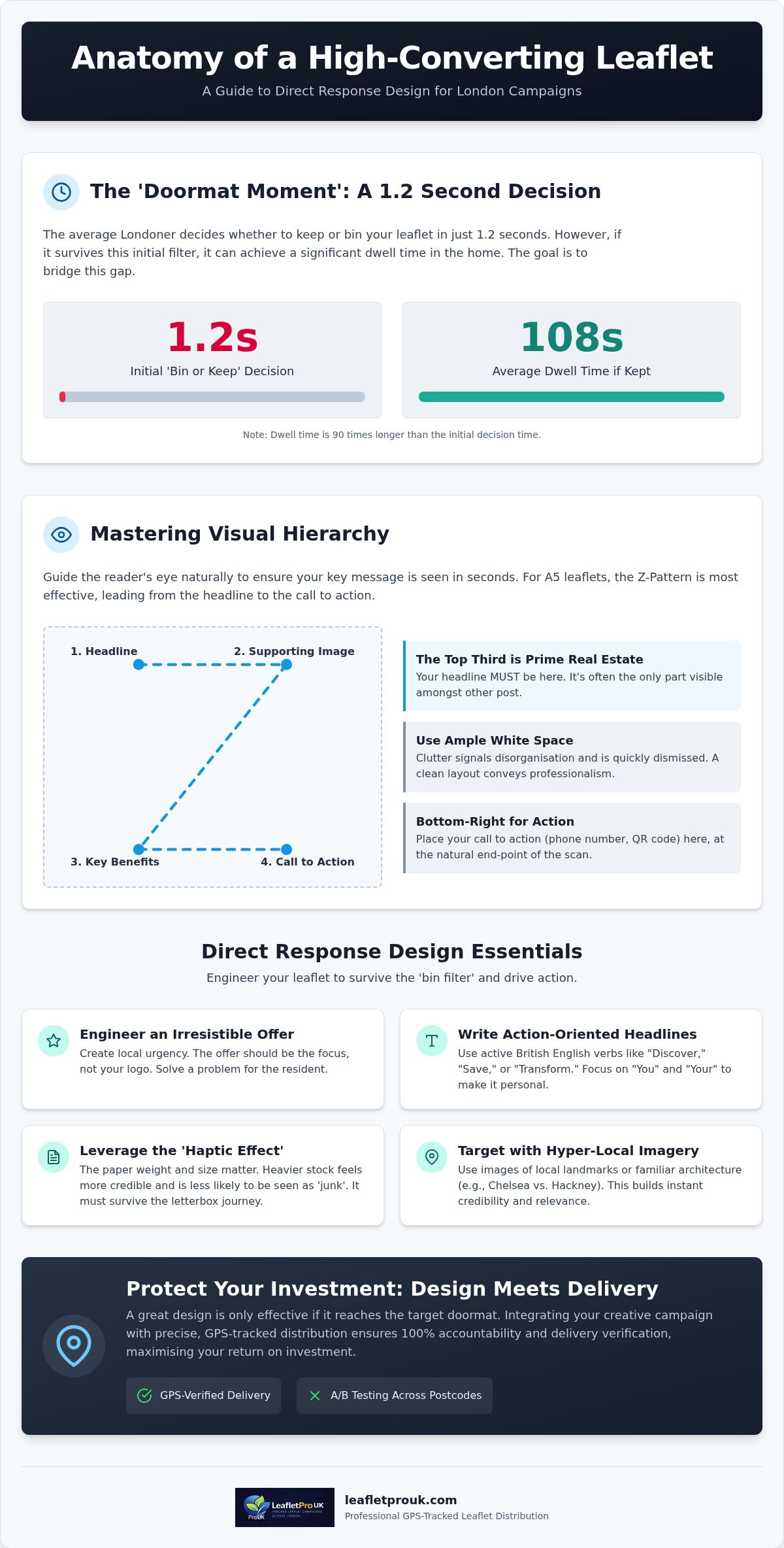
    Applying leaflet design best practices ensures your message is not only seen but processed in the few seconds before a recipient reaches their kitchen table. A professional layout functions as a silent guide, directing the reader’s eye through a logical sequence of information. This starts with a dominant “Hook” to grab attention, followed by a concise “Offer” to build interest, and concludes with a clear “Action”. Without this structured hierarchy, even the most compelling discount becomes lost in a sea of competing text.

    Strategic use of colour and white space is what separates a premium brand from junk mail. Whilst it’s tempting to fill every millimetre of paper to maximise value, a cluttered flyer suggests a disorganised business. White space, or negative space, provides the visual “breathing room” required for the brain to focus on your primary message. Similarly, your colour palette should evoke specific emotional responses whilst adhering to your brand guidelines. For example, deep blues often project reliability and security, which is essential for service-based businesses operating in London’s competitive residential markets.

    Typography also plays a critical role in conversion, particularly in the unique environment of London housing. Many recipients will first view your leaflet in dimly lit communal hallways or porches. Choosing clean, sans-serif fonts ensures legibility at a glance. Avoid overly decorative scripts that sacrifice clarity for style. If you’re struggling to balance these creative elements with your marketing goals, our leaflet design support provides the expertise needed to create a layout that commands professional respect.

    Creating a “Focal Point” that Works

    Your leaflet needs a singular hero image to anchor the design. Using a collage of small, low-resolution photos creates confusion and dilutes your impact. Position your primary offer near this focal point so it’s impossible to miss. We recommend using a “Z-Pattern” layout, which follows the natural way Londoners scan physical documents: starting at the top-left, moving across to the top-right, and then sweeping down to the bottom-right for the final call to action. This methodical approach ensures the most important details are positioned exactly where the eye naturally lands.

    Branding and Credibility

    Trust is a primary driver for response rates in London’s boroughs. To build this, your logo and contact details must be prominent but integrated into the design rather than appearing as an afterthought. You can enhance credibility by including trust signals, such as professional associations or even subtle imagery of local London landmarks relevant to your target postcode. This creates an immediate sense of local presence. Maintaining a clean, organised aesthetic reflects a reliable business, giving the homeowner peace of mind that they are dealing with an established professional rather than a fly-by-night operation.

    Technical Best Practices: Preparation for High-Quality Printing

    Adhering to leaflet design best practices requires a transition from creative vision to technical precision. Even the most striking layout will fail if the file isn’t prepared correctly for the physical printing process. One of the most common errors involves colour profiles. Digital screens display images in RGB (Red, Green, Blue), whilst professional printers use CMYK (Cyan, Magenta, Yellow, Key/Black). If you don’t convert your design to CMYK before sending it to print, the final colours may appear dull or distorted compared to what you see on your monitor.

    Protection against cutting errors is equally vital. “Bleed” refers to the extra 3mm of background design that extends beyond the final trim line, ensuring no white edges appear if the cutting blade shifts slightly. Similarly, “quiet zones” are the margins inside the trim line where no critical text or logos should be placed. By maintaining these zones, you ensure your contact details remain intact and legible once the leaflets are finished and ready for distribution across London.

    Image quality is a non-negotiable standard. For professional London marketing, 300dpi (dots per inch) is the minimum resolution required to avoid pixelation. Low-resolution images suggest a lack of care, which can damage your brand’s credibility before the recipient has read a single word. To ensure the highest fidelity, we require print-ready PDFs as the industry standard. This format embeds all fonts and high-resolution assets, providing a stable file that translates perfectly from the designer’s desk to our high-quality printing presses.

    Choosing the Right Paper Stock (GSM)

    The weight of your paper, measured in Grams per Square Metre (GSM), significantly influences the “hand-feel” and perceived value of your brand. A 130gsm stock is the reliable choice for high-volume distributions, providing a professional look whilst remaining cost-effective. However, for premium London boroughs, upgrading to 250gsm or higher creates a sense of luxury and durability. You can explore our full range of options in our guide to Leaflet Printing Finishes London.

    Finishes that Demand Attention

    Selecting the right finish depends on your industry and brand identity. Gloss finishes offer vibrant colours and a high-shine look, whilst matte or silk options provide a more understated, sophisticated feel. Beyond aesthetics, specialised coatings play a functional role by protecting your leaflets from scuffing or moisture during the door-to-door delivery process. As we move through 2026, many London residents also expect a commitment to the environment. Choosing sustainable, FSC-certified paper and vegetable-based inks demonstrates that your business is both professional and eco-conscious.

    Leaflet Design Best Practices: A 2026 Guide to London Campaign Success

    Designing for Response: CTAs and Tracking Integration

    A visually stunning leaflet is only successful if it triggers a measurable response. In the competitive London market, leaflet design best practices must bridge the gap between creative aesthetics and distribution logistics. Many businesses treat design and distribution as separate silos, but a high-conversion campaign requires these elements to work in tandem. By integrating specific tracking mechanisms directly into your layout, you transform a physical flyer into a data-rich marketing channel that justifies every penny of your investment.

    Tracking ROI is essential for verifying the effectiveness of your campaign. You can achieve this by using unique phone numbers or dedicated landing pages for different London postcodes. Alternatively, unique discount codes allow you to attribute every sale to a specific distribution wave. These leaflet design best practices ensure your marketing remains accountable and transparent. To prevent your leaflet from sitting indefinitely on a sideboard, employ the scarcity principle. Including a clear expiry date creates a sense of urgency, prompting the recipient to act whilst your brand is still fresh in their mind. This methodical approach to data collection provides the evidence needed to refine future campaigns.

    Optimising QR Codes for Conversion

    QR codes are the most efficient way to link physical leaflets to your London-specific landing pages. However, their placement must be strategic. The code should be large enough to scan easily but shouldn’t dominate the visual hierarchy. Most importantly, you must provide a compelling reason to scan. A prompt such as “Scan for 20% off your first London order” provides immediate value and encourages engagement. For more inspiration on how to phrase these prompts, see our 45+ Leaflet Call to Action Examples.

    The Offer-Centric Layout

    The “What’s in it for me?” factor must be the most prominent text on your page. If a recipient cannot identify the benefit within two seconds, they’ll likely discard the flyer. Use bold subheadings to break up copy and highlight secondary benefits, ensuring the main offer remains the focal point. Direct Response Design is a layout focused on a single, measurable user action. This approach removes friction and guides the reader toward a specific outcome, whether that’s a phone call, a website visit, or an in-store redemption. By simplifying the decision-making process, you increase the likelihood of a conversion.

    Maximising ROI with LeafletPro UK’s Integrated Design Service

    Choosing an integrated partner ensures your campaign moves flawlessly from the initial concept to the final letterbox. Whilst many agencies treat creative work and logistics as separate entities, LeafletPro UK operates an end-to-end solution that keeps design, print, and distribution under one roof. This unified approach eliminates the risk of technical translation errors and ensures that every element of your flyer adheres to leaflet design best practices from the very first draft. By managing the entire lifecycle of your marketing material, we provide a level of accountability that fragmented services cannot match.

    Our creative decisions are uniquely informed by the logistical data we gather daily across London postcodes. We use insights from previous GPS-tracked campaigns to suggest the best creative approach for your specific target area. If a particular borough responds better to certain imagery or specific paper finishes, our designers incorporate these findings into your layout. This data-led strategy ensures your design isn’t just attractive; it’s technically optimised for the specific demographics you intend to reach, providing the peace of mind that your investment is grounded in evidence.

    Quality control remains a priority throughout the process. We ensure your leaflets are printed to the exact standards required for our distribution teams, avoiding common issues like thin paper that jams in letterboxes or finishes that smudge in transit. From the first pixel of your design to the final doormat in London, we provide the visibility and systematic reliability necessary for a successful campaign. This integrated workflow saves time and reduces the confusion often associated with managing multiple vendors.

    Working with LeafletPro UK Designers

    Our collaborative process is designed to turn your business goals into professional creative assets. We work closely with you to ensure your campaign is “distribution-ready”, meaning every file meets our rigorous technical standards for print and delivery. This proactive approach prevents the delays and errors often associated with generic DIY templates. For a deeper look at how we synchronise these elements, read our Professional Leaflet Design and Distribution London guide.

    The Final Step: GPS-Tracked Delivery

    A high-quality design deserves a delivery method that is equally sophisticated. Once your design is finalised and printed, our GPS-tracked teams take over, providing the ultimate proof that your material reached its target. These reports offer a level of transparency that gives you total confidence in your marketing spend. By closing the loop between design and delivery, we ensure your brand message lands exactly where it’s needed, supported by a diligent partner who values results over vague promises.

    Future-Proofing Your London Leaflet Campaigns

    Success in the capital’s competitive market requires more than just high-quality paper. It demands a strategic alignment of visual hierarchy, technical precision, and measurable response mechanisms. By implementing leaflet design best practices, you ensure your brand survives the initial doormat sort and drives tangible engagement through trackable calls to action. Moving beyond generic templates allows your business to project the authority and credibility that London residents expect.

    Our integrated approach provides the peace of mind that your campaign is handled with professional scrutiny from the first pixel to the final delivery. With an expert London-based design team and GPS-tracked delivery data for 100% transparency, we manage the entire lifecycle of your marketing material. This end-to-end management ensures your creative vision is never compromised by technical errors or unreliable distribution.

    Transforming your marketing into a high-conversion sales channel starts with a commitment to professional standards. We’re ready to help you turn every London letterbox into a new opportunity for growth.

    Frequently Asked Questions

    What is the best size for a business leaflet in London?

    A5 is widely considered the most effective size for London-based campaigns. This format provides enough space for a clear visual hierarchy whilst remaining compact enough to fit through standard residential letterboxes without being damaged. Whilst A4 or A6 options are available, A5 strikes the perfect balance between printing costs and impact. It’s a versatile choice that allows for bold headlines and clear calls to action, ensuring your brand message remains professional and legible.

    How much does professional leaflet design support cost?

    The cost of professional design support depends on the specific requirements of your campaign and the complexity of the creative brief. Investing in expert design is a strategic move that helps you avoid the common pitfalls of DIY templates which often fail to convert. At LeafletPro UK, we focus on creating assets that are “fit for the doormat”, ensuring your budget isn’t wasted on materials that lack the visual authority needed to capture attention.

    Can I provide my own design for printing and distribution?

    You are welcome to provide your own artwork for our printing and distribution services. To maintain our high standards of quality control, your files must meet specific technical requirements, such as including a 3mm bleed and using the CMYK colour profile. We recommend reviewing leaflet design best practices before submission to ensure your layout is optimised for our GPS-tracked delivery teams. Our experts can perform a basic check to confirm your files are distribution-ready.

    What file format should I use for my leaflet design?

    A high-resolution, print-ready PDF is the industry standard and our preferred format for all leaflet campaigns. This file type ensures that your fonts, images, and layout remain stable during the transition from design to print. It’s essential that all images within the PDF are at least 300dpi to prevent pixelation. Using a PDF format allows us to maintain the integrity of your brand’s colours and sharp details, providing a professional finish that reflects your business quality.

    How do I ensure my leaflet design is print-ready?

    Ensuring your design is print-ready involves checking several technical benchmarks. You must confirm that your document uses the CMYK colour space rather than RGB to ensure colour accuracy on paper. Additionally, include a 3mm bleed around all edges and keep critical text within a “quiet zone” away from the trim line. Verification of image resolution is also vital; every graphic should meet the 300dpi standard. These steps prevent production delays and ensure a clean, professional final product.

    What is the difference between a flyer and a leaflet in design terms?

    In design terms, the words “flyer” and “leaflet” are often used interchangeably, though subtle differences exist. A flyer is typically a single-sheet, flat document used for high-volume distribution. A leaflet may involve more complex designs, such as folds or premium paper stocks, and is often used for more detailed service descriptions. Regardless of the terminology, the core leaflet design best practices remain the same: you need a strong hook, a clear offer, and a compelling call to action.

    How many words should be on a standard A5 leaflet?

    For a standard A5 leaflet, we recommend keeping your copy concise to avoid a cluttered look. Aim for a maximum of 150 to 200 words. This allows for a dominant headline, a few punchy bullet points highlighting your primary benefits, and a clear call to action. Space is a premium commodity on a physical flyer; using too much text can overwhelm the reader and lead to your message being ignored. Clear, brief messaging always performs better.

    Can you help with the copy and headlines for my leaflet?

    Yes, our professional design support includes guidance on crafting effective headlines and persuasive copy. We understand that the right words are just as important as the visual layout for driving conversions. Our team uses local insights from across London postcodes to help you phrase offers that resonate with your specific target audience. We focus on creating a “What’s in it for me?” factor that grabs attention instantly and encourages the recipient to take the next step.

  • Leaflet Printing Finishes London: The 2026 Guide to Premium Campaign Quality

    Leaflet Printing Finishes London: The 2026 Guide to Premium Campaign Quality

    In the competitive London market, the finish of your leaflet acts as a physical handshake that determines whether your brand is trusted or immediately trashed. When a potential customer picks up your marketing from their doormat, they make a split second judgement based on how that paper feels. If it feels flimsy or looks dull, your message is lost before it’s even read. Selecting the right leaflet printing finishes London is the most effective way to ensure your campaign survives the “bin-adjacent” sorting culture found in high density flats and communal entrances.

    You likely recognise the frustration of investing in a distribution campaign only to worry that the final product looks cheap or won’t withstand a rainy afternoon letterbox drop. It’s common to feel overwhelmed by technical jargon like Spot UV, Soft Touch lamination, or varying GSM weights. This guide simplifies those choices, showing you how to choose premium finishes that reflect your true brand value and drive maximum ROI. We’ll explore which textures suit your specific industry and how high quality coatings prevent damage during the GPS tracked distribution process, ensuring every flyer arrives in pristine condition.

    Key Takeaways

    • Understand how premium finishes act as a physical handshake to build immediate trust with London householders.
    • Master technical specifications like GSM and lamination to select the ideal leaflet printing finishes London for your specific campaign goals.
    • Learn how to align your physical marketing materials with your digital brand to create a consistent and credible customer experience.
    • Discover why durable finishes are vital for ensuring your flyers survive the physical distribution process without being damaged or discarded.
    • Explore how combining professional print with GPS-tracked delivery provides the transparency and accountability needed for a high-ROI campaign.

    Understanding Leaflet Printing Finishes for London Campaigns

    A “finish” refers to the final coating or texture applied to your marketing material during the paper finishing processes. In a city where households receive multiple flyers daily, standard paper is no longer enough to secure engagement. High quality leaflet printing finishes London are essential because they transform a simple piece of paper into a professional brand asset. Without a deliberate finish, your message risks blending into the background of generic post that Londoners discard without a second thought.

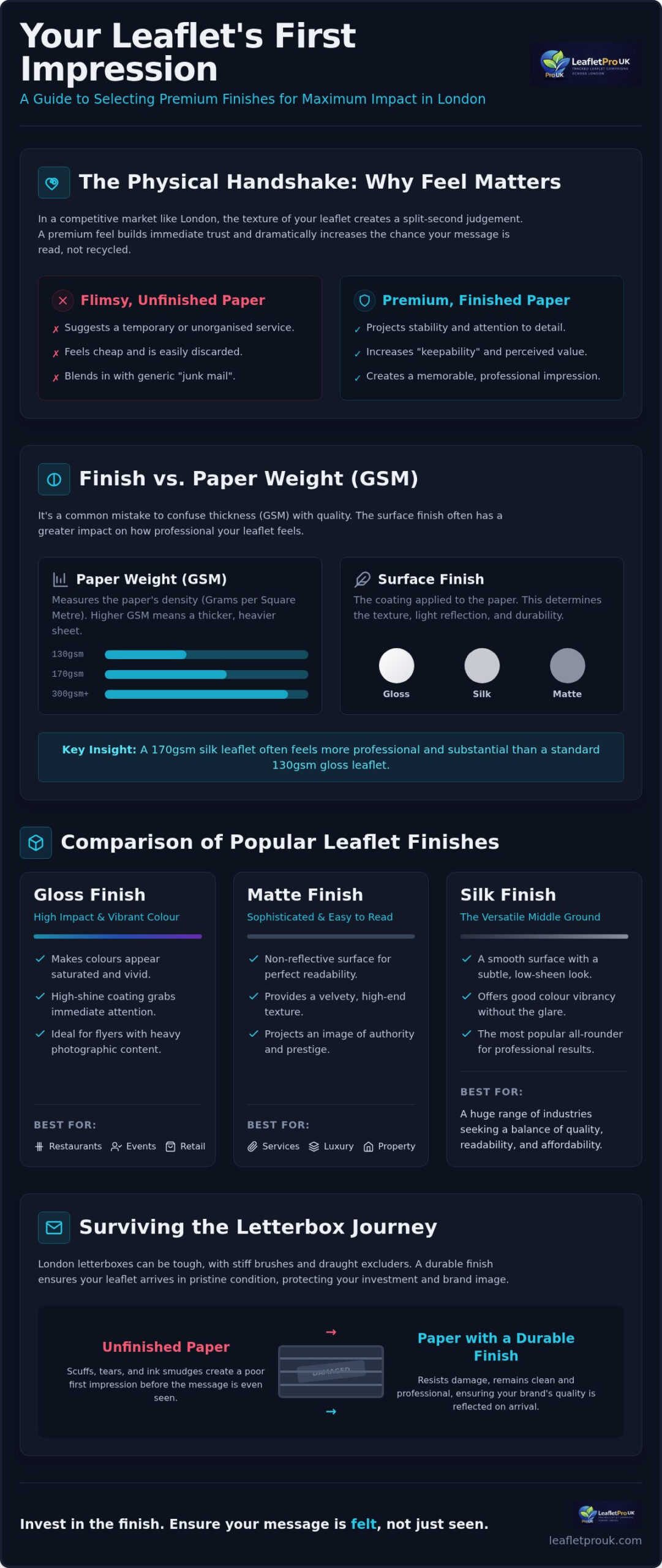
    Think of your leaflet as a physical handshake. When a resident picks it up from their mat, the tactile feedback tells them everything they need to know about your business before they read a single word. A flimsy, untreated flyer suggests a temporary or unorganised service. Conversely, a leaflet with a premium finish projects stability and attention to detail. This initial touch is the first step in building the trust required for a successful leaflet printing finishes London campaign.

    Beyond aesthetics, finishes provide a functional shield. London letterboxes often feature stiff draught excluders or heavy brushes that can easily scuff or tear unprotected paper. A durable finish ensures your message remains legible and professional, even after being pushed through a tight entrance. It prevents the ink from rubbing off on a recipient’s hands, maintaining the cleanliness and credibility of your brand throughout the distribution process.

    The Psychology of Tactile Marketing

    Premium textures significantly increase the “keepability” of your marketing material. When an item feels substantial, people are less likely to discard it immediately. This sensory input creates a stronger memory link than a digital advert. Amongst the clutter of daily post, a thicker, finished leaflet signals that your business is established and credible. High quality sensory input is directly linked to higher response rates because it makes the recipient feel that the offer is more valuable.

    Finishes vs. Paper Weight (GSM)

    It’s vital to distinguish between paper weight (GSM) and the surface finish. While GSM measures the actual thickness and weight of the paper, the finish determines the texture and light reflection. For high volume London postcode drops, a 170gsm silk leaflet often feels more professional than a 130gsm gloss one, despite being only slightly heavier. The silk finish offers a smooth, low-glare surface that makes contact details easier to read under domestic lighting. Choosing the right combination ensures your brand values are reflected in the physical product without unnecessary expenditure.

    Selecting the right leaflet printing finishes London involves balancing visual appeal with practical durability. The three industry-standard options, gloss, matte, and silk, each offer distinct advantages depending on your campaign goals. Choosing the wrong one can lead to poor readability or a flyer that looks worn before it even reaches the kitchen table. According to neuroscience studies on print marketing, the physical quality of your material directly affects brand recall, making this technical choice a vital part of your marketing strategy.

    Gloss Finish: High Impact and Vibrant Colour

    Gloss captures attention. It uses a high-shine coating that makes colours appear more saturated and vibrant. This finish is the standard choice for restaurant menus, event flyers, and retail promotions where photographic content is the primary focus. While it offers a brilliant look, it can produce significant glare under the bright lights of modern London flats. Fingerprint marks are also more visible on gloss surfaces, which might detract from the “clean” look of your brand if the leaflet is handled frequently.

    Matte Finish: Sophisticated and Easy to Read

    Matte is often the favourite for professional services, luxury brands, and high-end property agents. It provides a non-reflective, velvety surface that ensures your message is clear under any lighting condition. Readability is the greatest strength here. It’s vital to distinguish between matte paper and matte lamination; lamination is a premium plastic film that adds a significant layer of protection against scuffing. If you’re targeting affluent postcodes with a message of prestige, a matte laminated finish projects the necessary authority.

    Silk Finish: The Versatile Middle Ground

    Silk is the most popular choice for London door-to-door campaigns. It offers a smooth texture that sits comfortably between the shine of gloss and the flatness of matte. This balance provides excellent colour reproduction without the distracting glare, making it highly versatile for most business sectors. Silk is also the most practical choice if your campaign includes vouchers or “fill-in” forms. Unlike gloss, which repels most inks, silk surfaces are much easier to write on with a standard ballpoint pen.

    If you’re unsure which texture fits your brand values, our team at LeafletPro UK can provide guidance on the best combinations for your specific London postcode drop. Each finish has a different cost-benefit profile, but the goal remains the same: ensuring your leaflet looks as professional on the doormat as it did on the screen.

    Matching Your Finish to Your London Industry

    Selecting the right leaflet printing finishes London isn’t just a matter of personal taste. It’s a strategic decision rooted in the competitive landscape of your specific sector. In London’s high-density postcodes, where households receive a large volume of marketing, your flyer must immediately distinguish itself from generic “junk mail”. Aligning the physical texture of your leaflet with your digital brand presence ensures a seamless customer journey from the doormat to your website. For a deeper look at creating high-performing assets, consult our Effective Flyer Design and Print London: The 2026 Conversion Guide.

    Choosing a finish that contradicts your industry expectations can confuse potential customers. A luxury boutique using thin, high-gloss paper may inadvertently signal a discount brand. Conversely, a local service might find premium matte lamination too formal for a quick-service model. The goal is to match the physical expectations of your London audience with the professional standards of your trade.

    Estate Agents and Property Developers

    Property developers and estate agents dealing with high-value London listings must project authority and trust. Standard paper weights won’t suffice here. Using a 250gsm or 350gsm stock paired with matte lamination or Spot UV creates a premium “coffee table” effect. This ensures the material is kept for future reference rather than being immediately recycled. The tactile weight suggests a business that is established and capable of handling significant investments.

    Local Restaurants and Takeaways

    Local restaurants and takeaways rely on visual temptation to drive sales. Gloss finishes are particularly effective here because they make food photography look appetising and fresh by deepening the colour saturation. Practically, gloss also provides a layer of resistance against kitchen spills and grease, ensuring the menu remains legible in a busy household. To drive immediate orders, pair this vibrant finish with one of our 45+ Leaflet Call to Action Examples for London Sales 2026.

    Health, Beauty, and Wellness Centres

    Health, beauty, and wellness centres benefit from finishes that evoke a sense of calm and luxury. Soft-touch lamination is a popular choice for premium London spas as it feels velvety and sophisticated to the touch. For medical or dental practices, silk finishes provide a clean, modern, and professional look that aligns with a hygienic brand image. These speciality finishes act as a silent indicator of the high-quality service clients can expect at your clinic or studio.

    Leaflet Printing Finishes London: The 2026 Guide to Premium Campaign Quality

    The Impact of Finishes on Distribution Success and ROI

    High quality leaflet printing finishes London represent the first critical stage of any professional GPS-tracked campaign. Whilst many businesses view printing and distribution as separate silos, the physical integrity of your leaflet determines whether your tracking data translates into actual business results. A GPS report might confirm a flyer entered a building, but it cannot show if that flyer arrived in a crumpled, illegible state. Investing in premium finishes ensures that the high-level accountability we provide is matched by a high-level physical product that commands respect upon arrival.

    The relationship between paper quality and “door-to-bin” time is well-documented in local marketing. In high-density London postcodes, where residents are often overwhelmed by generic post, a leaflet that feels substantial is less likely to be immediately discarded. This perceived value extends the life of your marketing material, keeping it on a kitchen counter or fridge for longer periods, which naturally increases the likelihood of a conversion.

    Protecting Your Investment During the Drop

    The journey from a distributor’s bag to a London resident’s hallway involves significant mechanical stress. Many London properties feature heavy-duty letterbox brushes or stiff draught excluders that act like sandpaper on unfinished flyers. Flimsy, 130gsm uncoated paper often tears or scuffs during this process. Lamination acts as a protective skin, providing the structural rigidity needed to slide through narrow openings without damage. This protection also prevents ink transfer and smudging, which often occurs when hundreds of flyers are sorted and handled in high volumes before the drop.

    Maximising Response Rates with Premium Finishes

    Londoners are more likely to engage with a leaflet that “feels” expensive because tactile quality is subconsciously linked to brand credibility. When a recipient feels a smooth silk finish or a velvety soft-touch laminate, they associate that quality with your service standards. This is particularly important for businesses in competitive sectors like property or wellness, where trust is the primary barrier to sale. For a comprehensive look at how these physical assets integrate with our delivery systems, read our guide on GPS Tracked Leaflet Distribution: The Complete Guide to London Campaigns.

    LeafletPro UK manages this process end-to-end to guarantee that your premium flyers reach the right doormats in pristine condition. By combining professional print support with postcode-level targeting, we ensure your investment isn’t just delivered, but actually seen by your target audience. Our commitment to transparency through GPS tracking ensures you can verify every stage of your campaign’s physical journey across the capital.

    Why Choose LeafletPro UK for Your London Print and Distribution

    Choosing LeafletPro UK means partnering with a diligent team that understands the specific logistical challenges of the capital’s geography. We provide an integrated, end-to-end service that eliminates the friction between print production and physical delivery. By managing both stages, we ensure your chosen leaflet printing finishes London are perfectly suited to the demands of a high-volume distribution campaign. Our focus remains on providing a transparent, accountable service that turns your marketing investment into measurable local engagement.

    From Professional Design to Verified Delivery

    Successful campaigns begin with artwork that is technically optimised for its physical form. Our design support team works closely with you to ensure your graphics and typography complement your selected finish. For instance, we help adjust colour profiles to ensure they don’t lose vibrancy on silk stocks or become obscured by the high-shine glare of gloss coatings. This systematic approach ensures your brand’s visual identity remains consistent across every letterbox in your target postcode.

    Transparency is the cornerstone of our operations. We provide peace of mind through GPS-tracked delivery, offering a level of visibility that unorganised competitors simply cannot match. Because we focus exclusively on London residential marketing drops, we possess deep knowledge of local housing densities and access requirements. This specialised expertise allows us to organise postcode-targeted campaigns with surgical precision, ensuring your premium leaflets reach the right households without delay or damage.

    Get Started with Your High-Quality Campaign

    Initiating your next campaign is a straightforward process designed to respect your time and budget. We begin with a consultation to identify the perfect finish and paper weight for your specific industry and goals. Whether you require the rugged durability of gloss for a restaurant menu or the sophisticated touch of matte lamination for a property listing, we help you find the most cost-effective solution. You can request a comprehensive quote for our integrated print and distribution packages directly through our platform.

    Our commitment to your success extends beyond the physical drop. We act as a knowledgeable guide, simplifying complex logistics so you can focus on handling the increased response rates our campaigns generate. For a broader perspective on how we integrate these services, please explore our Professional Leaflet Design and Distribution London: The Complete 2026 Guide. When you’re ready to elevate your brand presence, visit LeafletPro UK to begin planning your high-impact London campaign.

    Elevate Your London Campaign with Premium Finishes

    Selecting appropriate leaflet printing finishes London is the first step in ensuring your marketing material survives the journey from the doormat to the kitchen table. We have explored how specific textures like matte lamination or high-gloss coatings protect your investment from the mechanical stress of letterbox brushes whilst establishing immediate brand credibility amongst residents. By aligning your physical product with your industry standards, you create a tactile experience that commands attention in high-density London postcodes where generic post is often ignored.

    Our end-to-end service integrates professional design support, high-quality printing, and GPS-verified distribution to provide 100% transparency for every drop. It’s a systematic approach that ensures your premium flyers are not only delivered but arrive in pristine condition to drive maximum response rates. Expert London postcode targeting allows you to focus your resources precisely where they’ll have the greatest impact on your ROI. Peace of mind comes from knowing every stage of the process is handled with professional scrutiny and care.

    We look forward to helping you build a campaign that reflects the true value of your business and delivers tangible results across the capital.

    Frequently Asked Questions

    What is the best leaflet printing finish for a London business?

    The ideal finish depends on your specific industry and campaign goals. Silk is often the preferred choice for general London campaigns because it offers a professional, low-glare surface that is easy to read under domestic lighting. Luxury brands often opt for matte lamination to project authority, whilst restaurants favour gloss to make food photography appear vibrant. Selecting the right leaflet printing finishes London ensures your brand values are communicated effectively upon the first touch.

    Does the finish of a leaflet affect the cost of distribution?

    The specific finish, such as gloss or matte, typically doesn’t influence the base cost of your distribution. However, the choice of finish often correlates with paper weight, which can affect the total weight of the delivery load. At LeafletPro UK, our distribution rates are primarily determined by the volume of leaflets and the specific London postcodes targeted rather than the aesthetic coating. This ensures you can choose the best finish for your brand without worrying about hidden delivery surcharges.

    What is the difference between silk and matte leaflet finishes?

    Silk finishes possess a slight sheen that enhances colour without the intense glare of high-gloss paper. Matte finishes are entirely non-reflective and provide a more understated, velvety texture. Whilst both are professional, silk is often more durable for high-volume handling during a door-to-door drop. Matte is frequently chosen for text-heavy leaflets or high-end services because it offers superior readability under the varying lighting conditions found in residential hallways and communal entrance areas.

    Can I write on a glossy leaflet if I have a voucher code?

    Writing on a high-gloss surface is difficult because the reflective coating repels most standard ballpoint inks. If your campaign requires customers to fill in a form or write a unique voucher code, we recommend choosing a silk or uncoated finish. These textures allow for much better ink absorption. This ensures that your call to action remains functional and that residents can easily engage with your offer without the frustration of smudged ink or illegible handwriting.

    How do I ensure my leaflets don’t get damaged during a London delivery?

    Protecting your materials requires a combination of adequate paper weight and a durable finish. London letterboxes often have stiff brushes that can scuff unprotected paper. Choosing a laminated finish, such as matte or gloss lamination, provides a protective layer that resists tearing and ink transfer. We also suggest using at least 170gsm paper to ensure the leaflet has the structural integrity to slide through narrow openings without crumpling or folding during the distribution process.

    Is Spot UV worth the extra cost for a local flyer campaign?

    Spot UV is highly effective for premium campaigns where you need to highlight specific design elements like a logo or a key offer. It applies a high-gloss varnish to selected areas of a matte-finished leaflet, creating a striking tactile contrast. Whilst it involves a higher production cost, the increased “keepability” and professional impact often lead to higher engagement rates. It is particularly valuable for London businesses in competitive sectors like property or high-end wellness centres.

    What paper weight (GSM) should I choose for a premium London drop?

    For a truly premium feel, we recommend choosing a paper weight between 250gsm and 350gsm. This thickness feels more like a card than a flyer, which immediately signals quality to the recipient. For high-volume postcode drops where budget is a factor, 170gsm silk provides a professional balance of durability and cost-effectiveness. The weight of the paper, combined with premium leaflet printing finishes London, determines how long your marketing stays in the home before being discarded.

    How does LeafletPro UK track the delivery of my high-quality flyers?

    We provide 100% transparency through our systematic GPS-tracked delivery process. Every distributor carries a tracking device that records their exact route as they move through your targeted London postcodes. Once the campaign is complete, you receive a detailed report showing the verified coverage of your drop. This evidence-based approach ensures that your high-quality flyers have actually reached the intended doormats, giving you peace of mind that your investment is being handled with professional scrutiny.

  • 45+ Leaflet Call to Action Examples for London Sales 2026

    45+ Leaflet Call to Action Examples for London Sales 2026

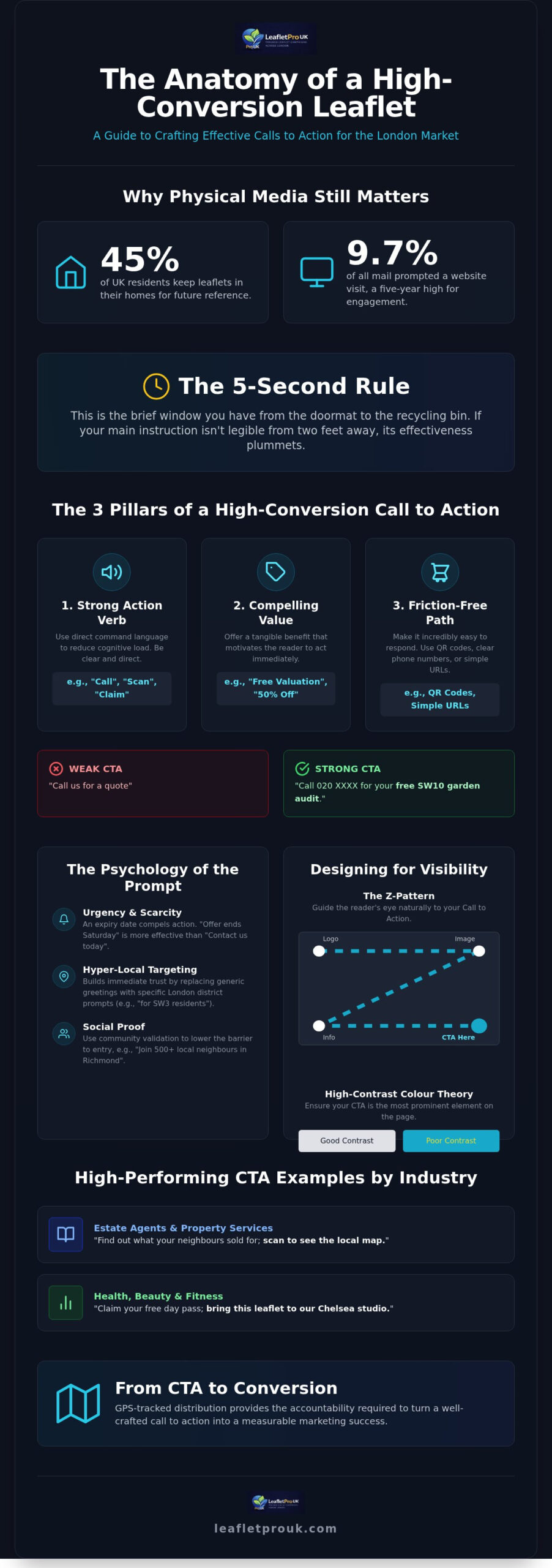
    Did you know that 45% of UK residents keep leaflets in their homes for future reference? Whilst it’s easy to assume that physical mail gets lost in the “junk” pile, the reality is that 9.7% of all mail prompted a website visit in late 2025, marking a five-year high for engagement. You likely understand the frustration of a campaign that fails to land, especially when you can’t be certain if your flyers even reached the doormat. We agree that a professional distribution strategy is worthless if your message doesn’t compel the reader to act immediately.

    In this guide, we promise to provide you with over 45 high-conversion leaflet call to action examples specifically tailored for the competitive London market in 2026. You’ll discover how to move beyond generic phrases and utilise hyper-local postcode prompts that resonate with residents in specific boroughs. We will preview the essential design principles that make your CTA pop and explain how GPS-tracked delivery ensures your investment translates into measurable results. From discount codes to digital-physical integrations, you’ll gain the exact tools needed to transform your next London drop into a high-performing sales channel.

    Key Takeaways

    • Understand why physical CTAs require a distinct psychological approach compared to digital buttons to effectively bridge the gap between the doormat and the checkout.
    • Access a curated list of over 45 leaflet call to action examples categorised by industry to inspire your next high-performing London campaign.
    • Learn how hyper-local postcode targeting builds immediate trust with residents by replacing generic greetings with specific London district prompts.
    • Master visual design techniques, including the Z-pattern and high-contrast colour theory, to ensure your call to action remains the focal point of your flyer.
    • Discover how GPS-tracked distribution provides the accountability required to turn a well-crafted CTA into a measurable marketing success.

    The Anatomy of a High-Conversion Leaflet Call to Action

    A Call to action (CTA) serves as the vital bridge between your marketing message and the customer’s eventual purchase. Unlike a digital button that allows for instant clicking, a physical leaflet requires a more robust psychological nudge. You aren’t just asking for a click; you’re asking a London homeowner to pause their routine and engage with a physical object. To succeed, your leaflet call to action examples must balance three core pillars: a strong action verb, a compelling value proposition, and a friction-free method of contact. If any of these elements are missing, the bridge breaks. For instance, “Call us for a quote” is significantly weaker than “Call 020 XXXX for your free SW10 garden audit.”

    In the fast-paced London environment, your flyer faces the “5-second rule.” This is the brief window of time it takes for a resident to walk from their front door to the recycling bin. If the primary instruction isn’t legible from a distance of at least two feet, the campaign’s effectiveness drops. Clarity is the foundation of credibility. If a reader has to hunt for the phone number or website amongst the graphics, they will likely move on. We prioritise a layout where the CTA is the most prominent element on the page, ensuring the path to conversion is unmistakable.

    The Psychology of the Prompt

    Direct command language reduces cognitive load for the busy London homeowner. Clear instructions like “Bring this flyer to our Chelsea shop” or “Scan for your SW3 discount” perform better than passive suggestions. We recommend using urgency to drive immediate behaviour. Whilst research shows 45% of UK residents keep leaflets for future reference, an expiry date ensures that “future” becomes “today.” Phrases such as “Offer ends Saturday” create a necessary sense of scarcity that “Contact us today” simply lacks.

    Choosing Your Conversion Path

    Selecting the right path depends on your specific business goals and target borough. Direct response remains ideal for local tradespeople; a prominent phone number encourages immediate local trust. Digital bridges, such as QR codes, are now essential for linking physical media to London-specific landing pages. This allows for precise tracking of ROI. Finally, social proof prompts like “Join 500+ local neighbours in Richmond” use community validation to lower the barrier to entry. By combining professional leaflet design support with these leaflet call to action examples, you ensure your message isn’t just seen, but acted upon.

    45+ Leaflet Call to Action Examples Categorised by Industry

    Generic instructions often result in poor engagement because they fail to address the specific needs of a local audience. To achieve high response rates, your prompts must align with the effective flyer design and print London principles, ensuring the instruction is both visually clear and contextually relevant. Industry data highlights the effectiveness of direct mail when the message provides immediate, tangible value to the recipient. These leaflet call to action examples are designed to cut through the noise of a busy London household by offering clear, low-friction next steps.

    Estate Agents and Property Services

    Property marketing relies on establishing local authority and trust. Your CTA should offer expertise that a homeowner cannot find through a simple web search.

    • “Book your free SE1 property valuation today; call [Number].”
    • “Find out what your neighbours sold for; scan to see the local map.”
    • “Thinking of moving in 2026? Get our free local market report.”
    • “Register for off-market SW19 listings; text ‘HOME’ to [Number].”
    • “Claim your free landlord compliance checklist; visit [URL].”

    Health, Beauty, and Fitness

    For wellness businesses, the goal is to lower the barrier to entry. Using physical leaflets to offer “taster” experiences is a proven method for building a local client base.

    • “Claim your free day pass; bring this leaflet to our Chelsea studio.”
    • “First haircut half price; book online using code LONDON50.”
    • “Start your 6-week transformation; only 10 spots left for [Neighbourhood] residents.”
    • “Scan for a virtual tour of our new Islington spa.”
    • “Bring a friend for free this Friday; show this flyer at reception.”

    Restaurants, Cafes, and Local Shops

    Hospitality CTAs should focus on immediate gratification and community exclusivity. Postcode-specific offers make residents feel like “local insiders.”

    • “Dinner is on us; Buy one main, get one free this Tuesday.”
    • “Scan for our secret local menu; only for our [Postcode] neighbours.”
    • “Show this flyer at the till for a free coffee with any pastry.”
    • “Book your Sunday Roast table; call 020 XXXX to secure your spot.”
    • “Get 20% off your first takeaway order; use code LOCAL20.”

    These leaflet call to action examples work most effectively when they are delivered with precision. To ensure your message reaches the correct doormats, it is essential to partner with a professional leaflet distribution company that understands the nuances of London’s diverse boroughs. By combining a compelling offer with verified delivery, you can transform a simple flyer into a reliable lead-generation tool for your business.

    Hyper-Local CTAs: Using London Postcodes for Better Response

    In London’s dense urban market, generic greetings like “Dear Neighbour” often feel like mass-produced noise. Residents are more likely to engage when they feel a message is crafted specifically for their street or borough. By using hyper-local identifiers, you transform a standard marketing piece into a community-relevant notice. This approach taps into the psychology of effective calls to action, where familiarity breeds trust and reduces the mental friction of responding. When a resident sees their own postcode on a flyer, the perceived relevance of the offer increases immediately.

    The Postcode Power Play

    Mentioning a specific postcode district, such as “Attention SW19 Residents,” immediately anchors your service in the reader’s physical reality. This level of precision is most effective when paired with household targeted leaflet distribution London, ensuring your flyers reach high-density areas where your service is most needed. You don’t just want a broad reach; you want a relevant reach. Consider these leaflet call to action examples that leverage local geography:

    • “Exclusive N1 residents discount: 20% off your first booking.”
    • “Free lawn health checks for TW9 homeowners this week.”
    • “New boutique opening near Victoria Park; scan for your opening night invite.”

    Mentioning a local street or a well-known park increases the “keepability” of a leaflet. Residents are less likely to discard a flyer that mentions their specific micro-neighbourhood, as it feels like a bespoke service rather than a cold solicitation.

    Trust through Local Presence

    Trust is the currency of the London doormat. Proving you are a genuine local entity rather than a faceless national chain can significantly boost response rates. One effective method is referencing local landmarks or transit hubs to provide a mental map for the customer. A CTA like “Visit us on the High Street, just a 2-minute walk from Angel Station” makes the visit feel convenient and low-risk. It tells the reader exactly where you are without them needing to open a map app.

    Historical presence also matters in a city that is constantly changing. Using phrases like “Serving the Bromley community since 2010; see our local reviews” provides the credibility residents look for. Additionally, using a traditional 020 landline number rather than a mobile number reinforces a sense of permanence and professional standards. Whilst mobile numbers are common, the London landline suggests an established office or shopfront. These subtle leaflet call to action examples work because they provide the tangible proof Londoners require before picking up the phone.

    Finally, remember that London’s 33 boroughs have vastly different demographics. A CTA for a luxury service in Chelsea should focus on “Bespoke consultations for SW3 residents,” whereas a student-focused offer in Camden might use “Flash this flyer for a free drink.” Tailoring your language to the specific borough ensures your message resonates with the local culture and economic profile of the area.

    45+ Leaflet Call to Action Examples for London Sales 2026

    Designing Your CTA for Maximum Visibility

    A well-crafted message only works if the reader’s eye is physically led to it. Most London residents scan a piece of mail in less than five seconds before deciding its fate. To capture this brief window of attention, you must utilise established reading patterns. The Z-pattern is particularly effective for flyers with minimal text, guiding the eye from the headline across the page and down to the bottom-right corner. This is where your primary leaflet call to action examples should be positioned for maximum impact. If your design is more information-heavy, an F-pattern layout ensures the reader encounters your instruction whilst scanning the left-hand margin.

    Colour theory plays a vital role in making your instruction stand out against the background. We recommend using high-contrast colour pairings that separate the CTA from the rest of the design. For example, a bright orange action button on a deep blue background creates a visual vibration that is difficult to ignore. Typography should follow a similar logic of clarity. Bold, sans-serif fonts are the standard for action words because they remain legible even in low light or from a distance. Clutter is the ultimate enemy of conversion; using “white space” around your CTA ensures the message isn’t swallowed by secondary graphics or lengthy paragraphs.

    QR Codes: The Modern CTA

    QR codes have become the standard for linking physical media to digital results. To ensure your QR code is doormat-friendly, place it at least 2cm away from the edge of the flyer to prevent it from being clipped during the high-quality printing process. Always include a clear “Scan Me” instruction alongside the code to remove any ambiguity. For a sophisticated London campaign, we suggest creating unique landing pages for different postcodes. This allows you to track exactly which boroughs are generating the most engagement, providing the data needed to refine your future distribution strategy.

    Visual Cues and Directional Elements

    Directional elements act as silent guides for the reader. Using arrows that point toward your phone number or website can increase response rates by physically directing the eye to the next step. If your leaflet includes photography of people, ensure their eyeline is directed toward the CTA text rather than looking off-page. For limited-time offers, a “burst” or “sticker” effect can highlight a discount whilst creating a sense of urgency. Visual hierarchy is the strategic arrangement of design elements to lead the reader’s eye toward the conversion point, serving as the hidden engine behind physical marketing ROI.

    Measuring Success: From CTA to GPS-Tracked Conversion

    A persuasive message is only a theoretical success until it physically reaches the doormat. We prioritise transparency because we understand that even the best leaflet call to action examples fail if the distribution process lacks integrity. To accurately calculate your response rates, you need a verified “denominator”, which is the exact number of homes that received your flyer. This is why GPS tracked leaflet distribution serves as the essential baseline for measuring marketing effectiveness. Without tracked proof, you cannot distinguish between a flawed creative strategy and a failure in the logistical delivery chain.

    Measuring response requires a systematic approach to data collection. You should utilise unique tracking mechanisms for every campaign, such as dedicated phone numbers or borough-specific promo codes. Dedicated URLs or QR codes that lead to hidden landing pages are particularly effective for London businesses looking to segment their results. These tools allow you to attribute every lead to a specific drop, providing the evidence needed to justify your marketing spend. If a low response rate occurs despite 100% verified delivery, you’ll know it’s time to adjust the offer or the design rather than the distribution partner. This systematic verification ensures that every marketing decision is based on tangible results rather than vague assumptions.

    The Accountability Standard

    Our commitment to visibility ensures you never have to guess about the status of your campaign. By using GPS reports to verify that every letterbox in your targeted London postcodes was reached, you gain the peace of mind that your investment was handled with precision. You can cross-reference these delivery timestamps with spikes in your website traffic or incoming enquiries to see the immediate impact of your drop. This data-driven approach helps you avoid common leaflet marketing mistakes London companies face when they rely on unverified “blind” drops. Accountability is not just a feature; it is the baseline for professional marketing standards.

    A/B Testing Your CTAs

    The diversity amongst London’s boroughs provides a unique opportunity to refine your leaflet call to action examples through A/B testing. You might test a “20% off” offer in Wandsworth whilst running a “Buy One Get One Free” promotion in a demographically similar area of Battersea. GPS data ensures these test zones are truly comparable in terms of housing density and economic profile. By analysing the results from these two distinct areas, you can identify which psychological trigger resonates most with your target audience. Scaling your success becomes a logical, methodical process once you have identified the highest-performing prompt through rigorous local testing.

    Optimising Your London Marketing Strategy for 2026

    A successful campaign requires more than just a creative headline; it demands a systematic integration of clear visual hierarchy, hyper-local messaging, and verifiable delivery. By applying these leaflet call to action examples, you can effectively bridge the gap between a resident’s doormat and your business’s bottom line. We’ve established that trust in the London market is built through accountability and professional standards. Specialist London postcode targeting ensures your message reaches the intended demographic, whilst dedicated design support ensures your instruction remains the focal point of every flyer.

    Physical marketing in 2026 is no longer a matter of guesswork. With GPS-tracked delivery data provided for every campaign, you can move forward with the confidence that your investment is being handled with absolute integrity. It’s time to transform your flyers into reliable sales tools that drive measurable results across the capital.

    Frequently Asked Questions

    What is the best call to action for a local business leaflet?

    The most effective call to action for a local business is one that combines a clear command with a tangible local benefit. For instance, “Book your free Richmond boiler service” is superior to a generic “Call us.” We recommend focusing on a low-friction entry point that addresses a specific need within your London borough. This approach reduces the mental effort required for the resident to take the next step towards your business.

    How many CTAs should I include on a single flyer?

    You should generally stick to one primary call to action to avoid confusing the reader. Whilst it’s tempting to offer multiple contact methods, a single dominant instruction typically yields higher response rates. If you must include a secondary option, ensure it doesn’t compete for visual attention. A clear hierarchy allows the London homeowner to understand exactly what they need to do within the first few seconds of engagement.

    Does a QR code work better than a phone number on a leaflet?

    QR codes and phone numbers serve different demographic preferences, so the best choice depends on your target London audience. Younger residents often prefer the speed of a QR code that links to a mobile-optimised landing page. Conversely, older homeowners or those seeking urgent local services may prefer a traditional 020 landline number. We suggest including both to ensure you don’t exclude potential customers based on their preferred communication method.

    How can I track how many people responded to my leaflet campaign?

    Tracking response rates is best achieved through unique identifiers like borough-specific promo codes or dedicated landing page URLs. By assigning a different code to each London postcode drop, you can precisely measure which areas generate the most leads. You can also use dedicated tracking phone numbers. These methods provide the hard data needed to refine your leaflet call to action examples for future campaigns and calculate your exact ROI.

    What words should I avoid in a leaflet call to action?

    Avoid passive or vague language like “Click here” or “Contact us for more details.” These phrases lack a value proposition and fail to motivate immediate action. You should also steer clear of overly aggressive sales jargon that can appear untrustworthy to London residents. Instead, use active verbs that promise a benefit, such as “Claim,” “Discover,” or “Receive,” which feel more like an invitation than a hard sales pitch.

    How do I make my CTA stand out on a crowded leaflet design?

    Making your instruction stand out requires the strategic use of high-contrast colours and generous white space. If your design is crowded, the eye won’t know where to land, which often leads to the flyer being discarded. Use a bold, sans-serif font for your primary action word and ensure it’s at least 20% larger than the surrounding body text. Our design support team focuses on creating this visual hierarchy to ensure your message pops.

    Is it better to put the CTA on the front or the back of the leaflet?

    You must place your primary call to action on the front of the leaflet to ensure it’s seen immediately upon delivery. Since many flyers are scanned whilst walking from the doormat to the bin, you cannot rely on the reader turning the page over. However, repeating a secondary version of the CTA on the back can reinforce the message for those who take the time to read the full content of your leaflet call to action examples.

    How do I know if my leaflets were actually delivered in London?

    The only reliable way to verify delivery is through GPS-tracked distribution reports that show the exact route taken by the distributor. At LeafletPro UK, we provide this transparent data for every campaign we handle across London. This reporting allows you to see exactly which streets were reached and at what time. It eliminates the industry anxiety regarding “blind” drops and provides the accountability you need for your marketing investment.

  • Effective Flyer Design and Print London: The 2026 Conversion Guide

    Effective Flyer Design and Print London: The 2026 Conversion Guide

    How many thousands of pounds are currently sitting at the bottom of recycling bins across Greater London because a marketing campaign lacked accountability? It’s a common frustration for many business owners who feel that physical marketing is a black hole where budgets disappear without a trace. You likely understand that whilst a well-crafted message is vital, the logistical gap between a printer and a potential customer’s doormat often feels impossible to bridge with any real certainty. Managing separate designers, printers, and distributors only adds to the complexity and risk of your investment.

    This guide will show you how to master effective flyer design for distribution London by integrating professional aesthetics with rigorous, GPS-verified delivery systems. You’ll learn how to stop guessing and start seeing tangible response rates from your most valuable local postcodes. We will explore the critical design elements that prevent your materials from being discarded and explain how transparent tracking ensures every penny of your marketing spend is accounted for. By the end of this article, you’ll have a clear roadmap for creating physical marketing that commands attention and delivers verified results in the competitive 2026 market.

    Key Takeaways

    • Understand why integrating design, print, and distribution into a single workflow prevents campaign failure and ensures brand consistency from concept to doormat.
    • Master the “Seven-Second Rule” and information hierarchy to create effective flyer design for distribution London that captures attention before it reaches the recycling bin.
    • Learn how to select the optimal paper weight and format, such as A5 or DL, to balance a premium feel with cost-effective delivery across London postcodes.
    • Discover how GPS-tracked distribution provides complete transparency, allowing you to verify that every flyer has reached its intended destination with absolute precision.
    • See how an end-to-end management approach saves time and reduces the logistical hassle of coordinating multiple vendors for your local marketing campaigns.

    The London Doormat Challenge: Why Design and Print Integration Matters

    The competition on a London doormat is exceptionally high. On any given day, a resident in Fulham or Islington might find several pieces of mail waiting for them. This environment has birthed the “Seven-Second Rule”, a critical window where a recipient decides to either keep your flyer or move it directly to the recycling bin. Achieving effective flyer design for distribution London isn’t just about aesthetics; it’s about surviving this initial filter through immediate visual impact and physical quality.

    Many campaigns fail because they treat design, print, and distribution as separate silos. When these elements aren’t aligned, the results are often disappointing. A designer might create a beautiful layout that doesn’t account for the physical “grip” required by a distributor, or a printer might use ink that smudges in the damp London air. When these phases don’t communicate, you risk a final product that looks unprofessional by the time it reaches the customer. An integrated approach ensures that the visual strategy matches the logistical reality of the city’s letterboxes.

    London Household Behaviour in 2026

    Londoners’ decision-making processes have become increasingly refined. In high-density areas like Hackney or Wandsworth, communal entrances and shared hallway tables create a “bin-adjacent” sorting culture. If your flyer feels flimsy or looks like a generic national advertisement, it’s unlikely to make it past the front door. High-quality paper weights and London-centric messaging are essential for building trust. Referencing specific local postcodes or neighbourhood landmarks signals that your business is part of the community, which significantly outperforms one-size-fits-all marketing templates.

    The Synergy of Professional Design and GPS Delivery

    The physical condition of your marketing material speaks volumes about your brand’s standards. A crisp, uncreased flyer delivered through a letterbox suggests a professional and diligent business. However, visual quality is only half the battle. Without GPS verification, you’re essentially operating in the dark. Integrating effective flyer design for distribution London with GPS-tracked delivery from a specialist provider like LeafletPro UK provides the accountability that London businesses need. It moves the campaign away from unverified mass drops and toward targeted precision, where every delivery is logged and verified. This systematic approach ensures that your investment is protected and your reach is proven by data rather than vague promises.

    Strategic Flyer Design for Maximum Response Rates

    Creating effective flyer design for distribution London requires a strategic hierarchy that respects the recipient’s limited time. Your primary message must be visible within the first second of contact. This means your headline shouldn’t be your company name; it should be your most compelling offer or solution. If you provide a service in a specific borough, mentioning that location prominently creates an instant connection and increases the likelihood of the flyer being kept. Londoners respond best to messaging that feels tailored to their specific neighbourhood rather than a generic city-wide blast.

    A “Direct Response” call-to-action (CTA) is the engine of your campaign. In a local context, this might be a time-limited discount or a specific invitation to a local event. To bridge the gap between physical and digital, QR codes are indispensable. They provide a frictionless path to your website whilst allowing you to track exactly which postcodes are driving traffic. This data-led approach ensures you can refine your strategy for future drops. Colour choice also plays a role in standing out amongst the morning post. High-contrast schemes often work better than muted tones, provided they align with your brand’s professional identity and don’t feel visually aggressive.

    Layout Essentials for Quick Scanning

    The “F-Pattern” is a proven layout strategy for A5 and A6 leaflets. Readers typically scan across the top, then down the left side, and across the middle. Placing your most vital information along these paths ensures it’s seen. White space is equally important. In a cluttered London environment, a clean design suggests a well-organised business. Using bold typography to highlight specific boroughs, such as “Serving Greenwich since 2010”, immediately signals local relevance and authority. It’s about making the information as easy to digest as possible during that short walk from the front door to the kitchen table.

    Trust Signals and Credibility

    Londoners are naturally discerning and often skeptical of unsolicited mail. Including trust signals like customer reviews or local industry certifications can mitigate this. A physical London address on the design provides a sense of permanence and accountability that a mobile number alone cannot offer. You can also include a “GPS Verified” badge on your artwork. This signals to the recipient that your business values transparency and systematic execution, which sets you apart from less organised competitors. Incorporating these elements is a fundamental part of effective flyer design for distribution London, as it moves the conversation from a vague promise to a credible offer. If you’re unsure how to balance these elements, seeking professional design support can help ensure your flyer communicates reliability from the moment it’s picked up.

    Selecting Premium Print Specifications for London Campaigns

    A well-executed layout is only as strong as the substrate it is printed on. When your marketing material arrives on a London doormat, the recipient’s first impression is tactile rather than visual. Choosing the right paper stock is a logistical decision that directly impacts the success of your effective flyer design for distribution London. If the paper feels flimsy or cheap, the brand perception follows suit. Conversely, a substantial, high-quality flyer suggests a business that is established and dependable.

    The Perceived Value of Paper Stocks

    For most professional London distributions, 150gsm (grams per square metre) is considered the industry sweet spot. It provides enough rigidity to survive the journey through a letterbox without creasing, yet it remains cost-effective for high-volume campaigns. If you are operating in premium sectors such as luxury real estate or high-end home renovations, moving to a 250gsm or 300gsm card stock can significantly elevate your brand’s authority. These heavier weights feel more like an invitation than an advertisement, which often leads to higher retention rates in affluent postcodes.

    The choice of finish also dictates how your message is received. Silk finish is frequently the preferred choice for London businesses because it reduces glare and resists fingerprints, ensuring the text remains legible under various lighting conditions. Whilst gloss finishes can make colours appear more vibrant, they can sometimes feel overly commercial or “loud.” A silk or matt finish often projects a more sophisticated, modern aesthetic that aligns with contemporary London design trends. Selecting the right “feel” ensures your flyer is not just seen, but respected as a professional piece of communication.

    Sustainability in 2026 Print

    Environmental responsibility is no longer a niche concern; it’s a core expectation for many Londoners. Utilising FSC-certified paper stocks is a transparent way to demonstrate your brand’s commitment to ethical sourcing. In 2026, the quality of recycled paper has reached a point where it is virtually indistinguishable from virgin stock in terms of vibrancy and durability. You can even turn these “green” credentials into a design feature by including a small sustainability mark on your artwork. This builds immediate rapport with eco-conscious residents and positions your business as a forward-thinking entity. By combining high-quality printing with sustainable practices, you create a marketing tool that is both effective and ethically sound.

    Effective Flyer Design and Print London: The 2026 Conversion Guide

    From Press to Postbox: Integrating Print with GPS-Tracked Distribution

    Many London businesses invest heavily in high-end production only to falter at the final hurdle: delivery. Even the most effective flyer design for distribution London loses its value if it never reaches the intended doormat. This is where GPS tracking becomes a non-negotiable standard for any high-volume campaign. It provides a level of transparency that replaces vague assurances with hard data. By integrating your print process with a verified distribution network, you ensure that your marketing spend is protected by a systematic audit trail.

    A GPS distribution report shouldn’t be a confusing map of lines; it’s a tool for business owners to verify coverage and identify gaps. You should look for consistent track logs that mirror the street layout of your targeted London postcodes. This data also allows for sophisticated A/B testing. You might distribute a design featuring luxury imagery to affluent SW postcodes whilst using a more value-driven layout in emerging areas. By linking specific designs to tracked routes, you can accurately measure which creative approach generates the highest response. This logistical precision is what separates a professional campaign from a generic mail drop.

    Understanding Postcode Targeting

    London’s geography is unique, with residential streets often sitting directly adjacent to strictly commercial zones. Effective distribution requires excluding industrial estates or office blocks where flyers are likely to be discarded by receptionists. This precision ensures your print quantities are optimised for households, reducing wastage and increasing the density of your reach. To refine your strategy further, you can learn more about targeted leaflet drops in London and how they maximise local engagement.

    Accountability in Distribution

    The “GPS Proof” standard is the antidote to industry-standard “blind” delivery. At LeafletPro UK, we provide comprehensive tracking as a standard feature, ensuring 100% doormat coverage across your chosen areas. This level of accountability has saved numerous London businesses from wasted budgets. For example, a local restaurant recently used our GPS data to identify that a specific neighbourhood was under-performing despite high delivery rates. This allowed them to pivot their effective flyer design for distribution London to a different demographic, ultimately doubling their redemption rate. Whether you choose a “Solus” drop for maximum impact or a “Shared” drop for cost-efficiency, verification remains the core of our process.

    Organising Your End-to-End Campaign with LeafletPro UK

    Managing separate designers, printers, and distributors often creates unnecessary friction and increases the risk of campaign failure. LeafletPro UK provides a streamlined solution by acting as your single point of contact for the entire process. This integrated model ensures that the strategic goals established during the design phase are carried through to the physical print and final delivery. By maintaining oversight from concept to doormat, we eliminate the communication gaps that often lead to delays or quality issues. You gain a partner who is responsible for the entire workflow, allowing you to focus on managing the resulting enquiries.

    Our methodology is built on a foundation of local expertise. National agencies often apply a generic template to every city, but we focus exclusively on the London market. We understand the specific demographic profiles of different boroughs and how these should influence your effective flyer design for distribution London. Our process begins with detailed postcode mapping to identify your ideal audience and ends with a comprehensive GPS report that verifies every delivery. This systematic approach provides the accountability that modern businesses require, moving beyond vague promises to evidence-based results.

    Professional Design Support

    Working with our in-house team allows you to refine your layout for maximum engagement. We ensure your brand voice remains consistent whilst optimising the visual elements for the London letterbox. This design phase is directly integrated with our GPS tracked distribution service, ensuring that the final product is built for the specific logistical path it will take. By considering the physical journey during the design stage, we help you avoid common pitfalls like illegible text or poor colour contrast in low-light hallways. This synergy between creative and logistical planning is essential for achieving a high return on investment.

    Peace of Mind Delivery

    The LeafletPro UK guarantee is rooted in transparency and reliability. We focus exclusively on London residential doormats, avoiding the wastage associated with commercial drops or unverified distribution methods. This specialisation allows us to provide a service that is both targeted and reliable. Every campaign is backed by GPS evidence, giving you absolute certainty that your materials have reached their destination. To begin briefing your first 2026 campaign, you can reach out to our team to discuss your specific goals. We will guide you through the mapping process and provide a custom quote for an integrated design, print, and distribution package tailored to your postcode requirements.

    Securing Your Competitive Edge in the London Market

    Mastering the transition from a digital concept to a physical doormat requires a blend of creative strategy and logistical precision. You’ve seen how integrating high-quality print specifications with rigorous delivery standards eliminates the typical “blind spots” of traditional marketing. By focusing on effective flyer design for distribution London, you ensure your message doesn’t just reach the letterbox but commands the attention of your specific target demographic. This level of coordination is what defines a professional presence in the capital.

    Accountability is the foundation of every successful campaign in 2026. Utilising GPS-tracked delivery reports for every drop provides the transparency you need to verify your return on investment with absolute certainty. Our comprehensive design-to-doormat service is built on years of London postcode targeting expertise, ensuring your brand stands out in the capital’s most competitive neighbourhoods. It’s time to move away from unverified mass drops and embrace a systematic approach that delivers tangible, verified results. You deserve a marketing partner that values evidence over empty promises.

    We look forward to helping you transform your local engagement with a campaign that is as reliable as it is impactful.

    Frequently Asked Questions

    How much does flyer design and print in London typically cost?

    Costs depend on several variables, including your choice of paper weight, the total volume required, and the level of design support needed. Whilst it’s tempting to seek the lowest price, a poorly printed flyer often results in lower response rates. We focus on providing a transparent, integrated service where the cost reflects the professional standards and systematic verification required for a successful London campaign. Requesting a custom quote ensures the pricing aligns with your specific postcode targets.

    What is the best flyer size for door-to-door distribution in London?

    A5 remains the most popular and effective choice for residential drops because it provides enough surface area for a clear information hierarchy and a compelling call-to-action. DL formats are also highly effective for premium service sectors, as they often stand out amongst standard post. Your choice should depend on your brand’s aesthetic and the amount of detail required to communicate your offer clearly to London households without appearing cluttered or unprofessional.

    How long does a full design, print, and distribution campaign take to launch?

    A comprehensive campaign generally takes between one and two weeks to move from the initial briefing to the first doormat. This timeline allows for a professional design phase, followed by high-quality printing and logistical scheduling. We prioritise a methodical approach to ensure that every aspect of the campaign, from postcode mapping to GPS setup, is executed with the precision necessary for a high-impact launch across your chosen London neighbourhoods.

    Can I provide my own design for you to print and distribute?

    You are welcome to submit your own artwork, provided it meets our technical print specifications. Our team will conduct a professional review to ensure the layout is optimised for effective flyer design for distribution London. We look for elements like clear typography and a strong local message that will resonate with residents in your chosen boroughs. If adjustments are needed to improve conversion, we will provide guidance before proceeding to the printing stage.

    How do I know my flyers have actually been delivered in London?

    We eliminate the uncertainty of physical marketing by providing detailed GPS tracking reports as a standard feature of every campaign. These reports show the exact routes taken by our distributors, offering transparent proof that your materials have reached every intended doormat. This systematic verification process ensures complete accountability and gives you the confidence that your marketing budget is being utilised with maximum efficiency across your specifically targeted London areas and postcodes.

    What is the minimum quantity for a GPS-tracked London campaign?

    Minimum quantities are determined by the specific density of your chosen London postcodes and whether you select a Solus or Shared distribution model. We focus on providing targeted precision, so we work with you to establish a volume that ensures meaningful reach within a specific neighbourhood. This approach prevents wastage and ensures that your campaign maintains the high professional standards required for a successful local engagement strategy in the competitive London market.

    Should I choose gloss or matt finish for my London leaflets?

    Whilst gloss is vibrant, a silk or matt finish is often the more sophisticated choice for modern London campaigns. Silk finishes are particularly effective because they resist fingerprints and reduce glare, ensuring your message remains professional and legible even in dimly lit residential entrances. This tactile quality contributes to the perceived value of your brand and helps your flyer survive the transition from the letterbox to the recipient’s kitchen table.

    Do you offer hand-to-hand distribution in Central London?

    Our services are focused exclusively on door-to-door residential distribution within the London area. We don’t offer hand-to-hand or street-level distribution because residential drops offer a more tangible and lasting connection with the recipient. By delivering directly to the home, your marketing materials have a much higher chance of being kept and acted upon. This focus allows us to maintain the highest levels of GPS-tracked accountability and precision for every client.

  • Professional Leaflet Design and Distribution London: The Complete 2026 Guide

    Professional Leaflet Design and Distribution London: The Complete 2026 Guide

    In a 2026 market saturated by digital noise, the most valuable advertising space for your brand isn’t a smartphone screen; it’s the physical doormat of a London home. You’ve likely felt the sting of rising digital costs and the fatigue of online campaigns that fail to convert as they once did. It’s understandable to feel hesitant about physical mail when the industry has long been clouded by concerns over unreliable staff or “dumped” materials that never reach their target.

    We agree that transparency is the only way to build a successful campaign. This guide will show you how to combine high-impact creative with precision GPS-tracked delivery to dominate the local market. By choosing a professional leaflet design and distribution London service, you can ensure every penny of your budget is accounted for through verified data. We’ll preview the essential steps for postcode-targeted success, from the initial design phase to receiving your final delivery reports, providing you with the peace of mind that your brand is being presented exactly where it belongs.

    Key Takeaways

    • Learn why professional design acts as the primary antidote to digital marketing fatigue and how it secures immediate engagement on the doormat.
    • Discover the core design principles for 2026 that ensure your brand message is understood and absorbed within a three-second glance.
    • Understand how integrated leaflet design and distribution London services use GPS tracking to provide absolute transparency and campaign verification.
    • Gain insights into London’s complex postcode demographics to tailor your creative tone and maximise local relevance for every campaign.
    • Explore a streamlined end-to-end campaign process that simplifies local logistics from initial strategy through to final reporting.

    The Value of Professional Leaflet Design in London’s Competitive Market

    Professional leaflet design is far more than an aesthetic choice; it’s a calculated strategic tool for local engagement. In a city as fast-paced as London, a well-executed Flyer (or flier) serves as a tangible anchor for your brand. Whilst digital advertisements often vanish in a millisecond, a physical leaflet isn’t so easily ignored. Research indicates that a physical leaflet stays in the home for an average of 6.9 days. This provides multiple opportunities for your message to be seen and considered by every member of the household, rather than being swiped away into obscurity.

    This longevity creates what we call “The Doormat Moment”. It’s that specific second when a resident picks up their post and decides which items deserve their attention. If your design looks systematic and credible, it survives the initial sort. Successful leaflet design and distribution London campaigns rely on this psychological threshold. By presenting a professional brand image on the doormat, you establish an immediate sense of reliability before the customer even reads your headline.

    To better understand this concept, watch this helpful video:

    Why Digital Brands are Retreating to Physical Media

    Digital marketing fatigue is a documented reality in 2026. Consumers are increasingly shielding themselves from online clutter through ad-blockers and sophisticated spam filters, leading to plummeting click-through rates. Physical media bypasses these digital barriers entirely. The tactile nature of high-quality print builds a level of trust that pixels simply cannot replicate. Because a leaflet occupies physical space in a customer’s environment, it carries a weight of authority that makes your brand feel established and dependable. Many businesses are shifting budgets back to print because it offers a clean, uninterrupted channel to reach their local audience without the rising costs of competitive digital auctions.

    The London Factor: Cutting Through the Urban Noise

    London represents one of the most competitive marketing environments in the world. Residents here are bombarded with thousands of brand impressions every day, leading to a high level of scrutiny. In such a sophisticated urban market, “cheap” or unconsidered design is often equated with a lack of professional standards. To truly cut through the noise, you need a cohesive strategy that prioritises quality and clarity. Investing in professional leaflet design London ensures that your first impression is one of cleanliness and credibility. It allows you to position your brand as a premium choice amongst a sea of generic competitors, turning a simple leaflet design and distribution London delivery into a high-impact business opportunity.

    Anatomy of a High-Converting Leaflet: Design Principles for 2026

    A high-converting leaflet functions as a silent salesperson. In the three seconds following the “Doormat Moment” discussed earlier, your layout must communicate value without requiring cognitive effort from the reader. This is achieved through a clear hierarchy of information: a bold headline, a supporting hero image, a concise benefit, and a singular call-to-action. Successful leaflet design and distribution London campaigns rely on this systematic approach to ensure that the message isn’t just seen, but understood and acted upon.

    Imagery plays a critical role in establishing immediate credibility. Whilst generic stock photos are easily ignored, authentic, high-quality images that reflect the local London lifestyle build a sense of security. Whether it’s a specific architectural style found in Kensington or a service being performed on a recognisable London street, local relevance creates a psychological connection. This attention to detail is part of the professional standards required to operate within the legal framework, including obtaining the correct permission to distribute free printed material where local authorities require it.

    Colour psychology should be tailored to your target postcode to maximise resonance. For premium services in West London, deep navies and golds evoke a sense of established authority and trust. Conversely, vibrant greens might resonate better with eco-conscious residents in North London or those interested in home improvement. The “Golden Rule” of any design is to make the next step effortless; a singular, clear CTA such as a QR code or a bold phone number ensures the customer knows exactly how to proceed. If you’re unsure how to balance these elements, our leaflet design support can help refine your creative strategy for maximum impact.

    The Headline and Hero Image: Your 2-Second Window

    Your headline has a two-second window to solve a local London problem immediately. Phrases that address specific regional needs, such as “Secure your Victorian home” or “Reliable garden maintenance in Richmond”, perform significantly better than vague, non-specific promises. The hero image must act as a visual mirror to this headline, providing proof of the service or product in a real-world context. In a standard A5 flyer, the eye-path typically follows a Z-pattern, starting at the top-left headline and ending at the bottom-right call-to-action.

    Typography and Readability on the Move

    Amateur designs often fall into the trap of the “wall of text”, which leads to immediate disposal. Professional leaflet design and distribution London avoids this by using varied font weights to guide the reader’s attention to the most important offer. White space is not “wasted” space; it’s a deliberate design tool that creates a premium brand feel and prevents the reader from feeling overwhelmed. By keeping your copy punchy and your layout organised, you ensure your message remains legible even for a busy Londoner on the move.

    Integrated Design and Distribution: Why GPS Tracking Changes the Game

    For a campaign to succeed, design and delivery cannot exist as separate silos. When you plan these stages together, your creative strategy aligns perfectly with your logistical reach. High-impact visuals mean little if they don’t reach the correct letterbox; conversely, a perfectly delivered flyer fails if its message is unclear. By utilising GPS tracked leaflet distribution, you gain an evidence-based view of how your physical marketing interacts with the real world. This data-driven approach allows you to validate your creative strategy by seeing exactly where your leaflet design and distribution London materials are landing.

    Adhering to UK advertising standards for leaflets is essential for maintaining brand integrity and legal compliance. Integrated services ensure that your leaflet design and distribution London campaign meets these rigorous standards from the first sketch to the final delivery. This systematic oversight prevents common pitfalls like misleading claims or poor-quality print that could damage your reputation. By linking tracking data back to your design performance, you can refine future iterations based on which postcodes responded best to specific visual triggers.

    Accountability: Seeing Your Campaign in Real Time

    Accountability is the foundation of a successful partnership. GPS reports provide a granular view of your campaign’s progress, showing every street and doormat reached by our teams. This transparency provides the peace of mind that your investment isn’t being wasted on “dumped” materials. We ensure 100% coverage in your targeted sectors by monitoring routes in real time and verifying every delivery. This level of visibility transforms a traditional marketing method into a modern, verifiable business process.

    The Pros and Cons of Integrated End-to-End Services

    Choosing an end-to-end model offers several distinct advantages for businesses seeking verified flyer distribution London. A unified brand voice is maintained throughout the process, and logistics are significantly simplified since you only manage one point of contact. This integration leads to better ROI tracking as design and delivery data are synthesised into a single report. However, there are considerations to keep in mind. These services often involve a higher initial cost than a DIY approach and require more upfront planning to ensure every detail is correct. Despite this, the end-to-end model remains the industry standard for those who value systematic reliability and professional results over vague promises.

    Professional Leaflet Design and Distribution London: The Complete 2026 Guide

    London’s demographic landscape is uniquely diverse, meaning a one-size-fits-all approach inevitably leads to wasted budget. Effective leaflet design and distribution London depends on tailoring your message to specific postcode data. This ensures your “Tone of Voice” matches the expectations of the resident. For instance, a campaign in Kensington requires a different visual language than one in Hackney. Whilst a West London homeowner might value tradition and understated elegance, a resident in East London may respond better to vibrant, community-centric creative. Achieving this level of precision is only possible through household targeted leaflet distribution London, which aligns your creative output with the specific socio-economic profile of each street.

    Targeting Affluent ABC1 Households

    Design cues for high-net-worth individuals should prioritise minimalism and superior paper quality. In areas like Belgravia or Chelsea, your leaflet acts as a physical representative of your brand’s prestige. Messaging should focus on exclusivity and time-saving benefits rather than purely on price. Utilising premium finishes, such as spot UV or heavy-weight silk stock, reinforces this sense of quality. It’s about establishing a professional brand image that survives the initial “Doormat Moment” in a high-value environment. When your delivery is verified and the design is impeccable, you build the trust necessary to engage these sophisticated audiences.

    High-Density Residential Marketing: Engaging the Modern Londoner

    When marketing to high-density urban areas, your design must account for a faster pace of life. Modern Londoners often engage with physical media whilst on the move or during a brief moment of downtime. Integrating QR codes is a systematic way to bridge the gap between the physical flyer and your digital presence, making the transition effortless. This approach helps you avoid common leaflet marketing mistakes London, such as over-cluttering the layout or providing no clear digital path. A well-considered leaflet design and distribution London strategy ensures your brand remains relevant amongst the urban noise by keeping the design punchy and the call-to-action visible.

    The End-to-End Campaign Journey: Partnering with LeafletPro UK

    Partnering with an integrated provider simplifies the complex logistics of local marketing. Our end-to-end journey is designed to remove uncertainty, replacing vague promises with a systematic process that prioritises your ROI. By handling every stage in-house, we ensure that your leaflet design and distribution London strategy remains cohesive and professionally executed from the first consultation to the final delivery report.

    The process follows four distinct phases to ensure accountability and precision:

    • Consultation and Strategy: We use postcode data to identify the sectors that offer the highest potential for your specific business goals.
    • Professional Design Support: Our creative team works to finalise a layout that adheres to the 2026 principles of readability and visual impact.
    • High-Quality Printing: We produce your materials using premium finishes that reinforce a sense of brand authority on the doormat.
    • GPS-Tracked Distribution: Our teams deliver your message with real-time verification to ensure every targeted household is reached.

    This methodical approach ensures that your leaflet design and distribution London campaign isn’t left to chance. By linking the creative phase directly to the logistical execution, we maintain a level of quality control that fragmented services cannot match.

    From Concept to Doormat: The Integrated Process

    Our design team doesn’t just create a flyer; they build a strategic touchpoint that aligns with your specific brand goals. High-quality printing acts as the final bridge to conversion, as the physical weight and finish of the paper communicate value before a single word is read. Our exclusive focus on the London market allows us to navigate local nuances that national providers often miss, positioning us as the best leaflet distribution company for businesses seeking precision and accountability.

    Analysing Your Results: The Post-Campaign Report

    Transparency doesn’t end when the last leaflet is delivered. We provide comprehensive reports that allow you to read your GPS tracking data and understand the exact reach of your campaign. By measuring ROI through direct response triggers, such as unique QR codes or specific offer mentions, you can identify which postcodes yielded the highest engagement. This evidence-based approach allows you to optimise your next London drop, ensuring that every future campaign is built on a foundation of proven data rather than guesswork.

    Maximise Your Local Impact through Precision and Transparency

    Success in the 2026 London market requires more than just high-quality creative; it demands a systematic approach to physical delivery. By integrating professional design with rigorous GPS verification, you eliminate the guesswork that often undermines traditional marketing efforts. Specialist postcode knowledge and end-to-end management ensure your brand reaches the right doormat with absolute credibility and professional poise.

    Choosing a dedicated partner for your leaflet design and distribution London campaign provides the peace of mind that every penny of your budget is working toward a tangible result. Our integrated model covers everything from initial layout finalisation to high-quality printing and tracked delivery. With GPS-tracked route data provided for every drop, you maintain total visibility over your investment and can plan future growth with confidence.

    We are ready to help you secure your market position through a campaign built on accountability and expert local execution.

    Frequently Asked Questions

    Is professional leaflet design really worth the extra cost?

    Yes, investing in professional design is essential for protecting your distribution budget. A well-considered layout ensures that your brand survives the initial doormat sort by communicating value within a three-second window. Professional designers understand the hierarchy of information required to drive conversions, preventing the common mistake of over-cluttering the page. By establishing immediate credibility, you significantly increase the likelihood of a resident keeping your leaflet for future reference.

    How does GPS tracking prove my leaflets were delivered?

    GPS tracking provides a transparent, data-driven record of the distributor’s route at a granular level. Our teams carry specialized loggers that record their exact path as they reach every targeted doormat. This information is then compiled into a comprehensive report, allowing you to verify that your materials reached the intended postcodes. This systematic approach eliminates the anxiety of “dumped” leaflets and provides the evidence-based peace of mind that your investment is being handled with precision.

    Can you help with both the design and the printing of my flyers?

    Yes, we provide an integrated end-to-end service that includes design support and high-quality printing. By managing the entire process, we ensure that the technical specifications for print align perfectly with the creative vision. This unified approach maintains a consistent brand voice and simplifies your logistics, as you only have a single point of contact. Our leaflet design and distribution London model is built to ensure a seamless transition from concept to the physical doormat.

    What is the best size for a London leaflet campaign?

    A5 is generally considered the industry standard for London campaigns because it offers the ideal balance between space and cost-effectiveness. It provides enough room for a bold hero image, a clear headline, and a visible call-to-action without feeling overwhelming. Whilst A6 can work for punchy, single-offer flyers, A5 remains the favourite for businesses seeking to establish a premium brand image. We help you choose the size that best suits your specific marketing goals and budget.

    How do I choose which London postcodes to target?

    Targeting should be based on a systematic analysis of your ideal customer’s demographic profile. We use postcode data to identify sectors that match your target audience, whether you are looking for affluent ABC1 households in West London or young professionals in high-density urban developments. By matching your creative tone to the specific socio-economic characteristics of a postcode, you maximise local relevance. This precision ensures that your leaflet design and distribution London materials land in the most receptive letterboxes.

    How long does a full design and distribution campaign take to launch?

    A typical integrated campaign usually takes between two and three weeks to launch from the initial consultation. This timeline allows for the strategic identification of target postcodes, professional design finalisation, and high-quality printing. Once the materials are ready, the logistical setup for GPS-tracked distribution is organised to ensure 100% coverage in your chosen sectors. Choosing an end-to-end partner streamlines this process, as it removes the delays often caused by managing multiple separate suppliers.

    Do you offer shared or solus distribution in London?

    We provide both solus and shared distribution options to suit different budget requirements and campaign goals. Solus distribution means your leaflet is the only item delivered, ensuring maximum attention, whilst shared distribution involves your flyer being delivered amongst one or two non-competing brands. Both methods utilise the same rigorous GPS tracking and reporting standards. This ensures that regardless of the delivery type you choose, you receive the same level of transparency and verified proof of delivery.

    What is the average response rate for a London leaflet drop in 2026?

    Response rates are influenced by several factors, including the strength of your offer, the quality of the design, and the accuracy of your targeting. Whilst industry professionals report that well-executed campaigns outperform generic drops, we focus on providing the systematic tools to maximise your specific ROI. By using direct response triggers like QR codes and tracked phone numbers, you can measure your results with precision. This data-driven approach allows you to refine future campaigns based on proven local engagement.

  • Budgeting for London Leaflet Distribution: 2026 Guide

    Budgeting for London Leaflet Distribution: 2026 Guide

    In the competitive London market, the cheapest quote for leaflet distribution is often the most expensive mistake a business can make. Understanding how to budget for leaflet distribution London requires looking beyond the initial price per thousand to focus on verified doormat delivery and demographic precision. You likely recognise that physical marketing is a powerful tool for connecting with local residents, yet the logistical hurdles of the capital often lead to concerns about wasted spend or flyers being discarded by unreliable distributors.

    We believe that peace of mind comes from knowing your investment is handled with total transparency and care. This 2026 guide will help you master the complexities of London pricing to build a high-ROI campaign whilst avoiding common pitfalls. We will explore how to navigate the differences between inner and outer borough logistics, the necessity of GPS tracking for accountability, and the ways postcode-targeted precision can significantly boost your response rates. By the end, you will have a clear framework for a predictable, effective marketing budget that delivers tangible results for your business.

    Key Takeaways

    • Understand the “Cost per 1,000” (CPT) metric and why London’s specific labour and congestion factors necessitate a higher baseline for reliable delivery.
    • Evaluate the financial merits of shared versus solus distribution to determine which model best balances your brand’s visibility requirements with your available capital.
    • Account for London’s unique housing geography, including gated communities and high-density flats, to ensure your budget reflects the actual time required for successful letterbox access.
    • Learn how to budget for leaflet distribution London by integrating professional design, high-quality printing, and mandatory GPS tracking into a single, transparent investment plan.
    • Apply the “Three-Drop Rule” to your financial planning to move beyond one-off flyers and establish a consistent, high-ROI presence amongst your target demographics.

    Breaking Down the Cost per 1,000 for London Letterbox Drops

    Understanding how to budget for leaflet distribution London starts with mastering the industry’s primary unit of measurement: Cost per Thousand (CPT). Whilst the broader history of what is direct mail shows various ways to reach consumers, CPT remains the most reliable metric for physical distribution. It allows businesses to compare quotes on a like-for-like basis. However, you must distinguish between the headline price on a quote and the effective price of your campaign. If a provider offers a low headline rate but fails to deliver 30% of your materials, your effective price per successful doormat hit actually increases significantly.

    In the context of 2026 London logistics, CPT represents the total investment required to physically transport one thousand marketing assets from a storage facility directly into the letterboxes of a specific geographic demographic. To better understand this concept and how it fits into a wider strategy, watch this helpful video:

    Why London Pricing Differs from the Rest of the UK

    London presents a unique set of logistical challenges that naturally inflate the CPT compared to regional towns. Reputable distribution teams prioritise the London Living Wage to ensure staff are motivated and diligent, which is a fundamental cost that “budget” firms often bypass. Additionally, logistics providers must account for the daily costs of the Ultra Low Emission Zone (ULEZ) and the Congestion Charge when moving stock between boroughs. Even housing density plays a role; whilst Inner London has more households per square mile, the prevalence of high-rise flats and complex security codes means distributors often cover only 150 to 200 letterboxes per hour, making the process more labour-intensive than suburban rounds.

    The Risks of “Too Good to Be True” Pricing

    When you are researching how to budget for leaflet distribution London, you will inevitably encounter prices that seem unusually low. These providers often maintain their margins by “dumping” leaflets or skipping difficult-to-access streets, which results in a 0% ROI for those discarded items. A failed campaign isn’t just a loss of the distribution fee; it’s the wasted cost of design, paper, and printing. We view GPS verification as a non-negotiable budget insurance policy. By using GPS tracked leaflet distribution, you gain systematic proof that every flyer reached its intended destination, ensuring your budget is spent on genuine engagement rather than empty promises.

    Choosing Your Delivery Method: Shared vs Solus Budgeting

    Selecting the most appropriate delivery method is a pivotal decision when determining how to budget for leaflet distribution London. Your choice dictates the level of exclusivity your brand enjoys at the letterbox and directly influences your overall campaign cost. Whilst shared distribution offers a more accessible entry point for businesses focused on volume, solus delivery provides a premium platform where your message is the only one encountered by the resident. Following the DMA Code of Practice ensures that regardless of the method, your campaign maintains professional standards and ethical engagement with the public.

    Solus Distribution: Premium Impact for London Brands

    Solus distribution is the gold standard for businesses offering high-value services, such as estate agents, luxury home improvements, or private clinics. By ensuring your flyer is delivered entirely on its own, you eliminate the risk of being overshadowed by other marketing materials. This method typically results in the highest brand recall because it captures the recipient’s undivided attention the moment they pick up their post. When you plan your 2026 budget, view solus drops as a strategic investment in brand authority. We integrate GPS tracking as a non-negotiable layer for these campaigns, providing a digital audit trail that confirms every single doormat hit with absolute precision.

    Shared Distribution: Cost-Effective Volume

    If your primary objective is to achieve maximum reach across diverse London postcodes whilst managing a tighter budget, shared distribution is a sensible alternative. In this model, your leaflet is delivered alongside a small number of non-competing items. The logical trade-off is a higher level of competition for the resident’s attention. To maintain effectiveness, you should budget for higher print volumes to offset potentially lower response rates. This volume-led strategy works particularly well for local restaurants, retail promotions, or community events where broad awareness is more important than total exclusivity. It allows you to spread your message across a wider geographic area without an exponential increase in your distribution spend.

    Regardless of the delivery model you select, GPS tracking serves as the primary safeguard for your marketing capital. It transforms a vague promise into a verified logistical event, ensuring that your flyers are actually reaching households rather than being discarded. This level of accountability is why sophisticated brands prioritise transparency and proof over the lowest possible headline price. If you want to ensure your investment translates into genuine engagement, you might organise GPS tracked leaflet distribution to secure the peace of mind that comes with a well-executed, visible process.

    Factoring in London-Specific Logistics and Access Challenges

    London’s unique urban geography means that a campaign in the capital requires more nuanced planning than in any other UK city. When you are learning how to budget for leaflet distribution London, you must account for the physical architecture of your target postcodes. A distributor moving through a street of terraced houses in Croydon will achieve a much higher delivery rate per hour than someone navigating the secure apartment blocks of Canary Wharf. Understanding these variations is essential for setting realistic expectations and ensuring your campaign remains compliant with UK direct marketing regulations regarding access and resident privacy.

    The speed of distribution is the primary driver of labour costs. In suburban areas, a professional can often reach the higher end of the 150 to 200 letterboxes per hour industry average. However, in dense urban centres, this rate can drop significantly due to security gates, intercom systems, and concierge desks. This “Access Factor” is why certain postcodes carry a higher CPT. If you ignore these logistical realities, you risk underfunding your campaign, which often leads to distributors cutting corners to meet impossible targets. Precision in your budget allows for the diligence required to navigate these challenges properly.

    Inner vs Outer London: Budgeting for Density

    Targeting Inner London boroughs like SE1 or E14 offers incredible household density, which can reduce travel time between drops. However, this density is often accompanied by “letterbox fatigue,” where residents in high-traffic areas receive a higher volume of marketing mail. To cut through this noise, your budget may need to prioritise solus delivery over shared drops. Conversely, Zone 6 suburbs require more travel time but often yield higher engagement rates because residents receive fewer flyers. Balancing these factors ensures your investment is allocated where it will generate the most significant response for your specific industry.

    The “Gated” Premium: Access and Accountability

    In affluent areas like Chelsea or parts of the Docklands, “100% coverage” is often a logistical myth. Many high-end developments are gated or managed by concierges who may refuse entry to unaddressed mail. Professional teams handle this by using “Selected Street” drops, focusing on accessible high-value properties rather than wasting budget on unreachable units. We recommend budgeting for a slightly higher volume than your absolute target to compensate for these “no-access” zones. This strategic padding ensures your campaign hits its required reach without overspending on impossible doormats. For a deeper look at how we plan these complex routes, you can read our guide to GPS Tracked Leaflet Distribution, which explains the technology we use to verify every successful delivery.

    Budgeting for London Leaflet Distribution: 2026 Guide

    Integrated Budgeting: Design, Print, and GPS-Tracked Delivery

    A successful marketing campaign is a cohesive system rather than a series of isolated purchases. When you evaluate how to budget for leaflet distribution London, you must look at the integrated costs of design, high-quality printing, and the distribution itself. Choosing an end-to-end service provider ensures budget transparency and eliminates the hidden costs of managing multiple vendors. If you invest in premium distribution but use a poorly designed flyer, you are essentially paying to put a missed opportunity through someone’s door. A unified approach prevents budget creep and ensures that every pound spent on paper and ink works as hard as the pound spent on GPS-tracked delivery.

    Leaflet Design: Investing in the “First Impression”

    Professional design support is a strategic one-time cost that yields long-term ROI. In the competitive London market, your flyer has roughly two seconds to capture interest before a resident moves it from the doormat. Essential elements like a clear headline, a compelling offer, and a direct call-to-action are vital for success. For layout advice that maximises your physical space, you can review these Direct Response Leaflet Design Tips. Avoiding common leaflet marketing mistakes, such as cluttered visuals or missing contact details, protects your distribution investment from being ignored by your target audience.

    Printing Costs and Paper Quality

    Printing costs are heavily influenced by volume and material choice. Often, printing 10,000 units offers significantly better value than 5,000 due to the initial setup costs involved in professional lithographic printing. The physical format also dictates your spend; whilst A6 is compact, A5 remains the industry standard for providing enough space for a persuasive message without feeling intrusive. Paper weight, measured in gsm (grams per square metre), affects the perceived quality of your brand. A 130gsm or 170gsm flyer feels substantial and survives the journey through a letterbox better than thinner alternatives. In 2026, many brands are also budgeting for recycled paper options to align with the sustainability values of London residents. Choosing a matt or gloss finish can further protect the ink from damp weather, ensuring your message arrives in pristine condition.

    Calculating how to budget for leaflet distribution London accurately means accounting for these physical production variables from the outset. By consolidating these services, you maintain better control over the final outcome and ensure that the “credibility” of your print matches the precision of your delivery.

    Calculating Your Potential ROI and Finalising Your Campaign Spend

    Finalising your investment requires a shift in perspective from mere expenditure to projected return. To determine how to budget for leaflet distribution London effectively, you should first establish a “break-even” response rate. This is calculated by dividing your total campaign cost by the average profit generated per new customer. If your campaign requires a specific number of conversions to cover its costs, knowing this figure allows you to set realistic benchmarks for success. It transforms your marketing from a speculative cost into a controlled business process where every doormat hit has a measurable value.

    In the high-density London market, brand awareness often requires multiple exposures to convert a lead. We recommend the “Three-Drop Rule,” which involves delivering to the same postcode three times over a three-month period. This repetition builds the trust and familiarity necessary for residents to engage with your brand amongst the daily noise of the capital. Following these initial drops, you can use GPS data to refine your future budgets. By identifying specific streets or zones with higher engagement, you can reallocate funds towards these high-response areas whilst scaling back on less productive postcodes. For a comprehensive tracking setup, you can refer to our ROI Framework.

    The Value of Postcode-Targeted Precision

    Targeting the right demographics is a far more efficient use of capital than blanket coverage. By using London census data, you can align your budget with the specific housing types, income levels, or family structures that match your ideal customer profile. It is a logistical fact that 5,000 targeted flyers delivered to the correct audience will consistently outperform 20,000 untargeted ones. This precision reduces your total spend whilst increasing the likelihood of a high response rate, ensuring your marketing materials reach the hands of those most likely to value your services. It is about the quality of the reach, not just the quantity of the paper.

    Next Steps: Requesting a Transparent Quote

    To receive an accurate and transparent quote for your London campaign, you should provide details on your target postcodes, the desired delivery method, and the total volume of leaflets. We integrate GPS verification into every campaign budget to provide systematic proof of delivery, giving you the security that your investment is being handled with professional care. This accountability is the foundation of a successful marketing partnership. If you are ready to move from planning to execution, you can contact LeafletPro UK for a bespoke London campaign plan that prioritises precision and tangible results.

    Securing Your Brand’s Future in the Capital

    Mastering the nuances of the capital’s landscape ensures that every marketing pound is spent with purpose. By prioritising GPS-tracked accountability and focusing on postcode-targeted precision, you move away from the uncertainty of blanket coverage. Integrated services that combine expert design, high-quality print, and reliable delivery provide the transparency needed to maintain a predictable budget whilst maximising doormat impact. It’s clear that success in 2026 depends on verified data and a methodical approach to local engagement rather than vague promises.

    Understanding how to budget for leaflet distribution London is the first step toward building a sustainable and high-ROI campaign. Our specialist London postcode knowledge ensures your message reaches the most relevant demographics with absolute precision. By combining these logistical insights with our commitment to 100% accountability, we help you transform your physical marketing into a dependable growth engine for your business.

    Your next successful campaign starts with a plan rooted in data and logistical integrity. We look forward to helping you grow your brand across the capital with confidence and the peace of mind that comes from a well-executed process.

    Frequently Asked Questions

    How much does leaflet distribution cost per 1,000 in London?

    Industry rates for a London campaign depend on the delivery model and the specific borough’s density. Whilst some providers offer low headline figures, these often exclude essential verification or the London Living Wage for staff. When you research how to budget for leaflet distribution London, consider that inner boroughs typically command a higher rate due to congestion and access complexities. A reliable quote should reflect the actual labour time required for successful doormat delivery.

    Is it cheaper to use Royal Mail or a private London distribution company?

    Royal Mail often provides a lower entry price for unaddressed mail, yet they lack the geographic precision and accountability of a specialist private firm. Private companies offer GPS tracking and the ability to target specific postcodes rather than entire sectors. This targeted approach ensures your budget isn’t wasted on unsuitable demographics. For businesses seeking a high ROI, the transparency and verification provided by a private partner often outweigh the initial cost savings.

    Does the price of leaflet distribution include the cost of printing?

    Most distribution quotes are separate from production costs, although integrated providers offer combined packages for better budget visibility. Choosing an all-in-one service for design, print, and delivery simplifies your logistics and ensures the paper quality meets distribution standards. This approach prevents unexpected costs and ensures that the physical marketing assets are ready for the specific challenges of London letterboxes, such as weather resistance and an appropriate, professional paper weight.

    What is the minimum volume for a GPS-tracked leaflet drop in London?

    To generate statistically significant response data, most professional campaigns require a minimum volume of 5,000 leaflets. This threshold ensures that the GPS tracking data provides a comprehensive overview of the delivery route and household engagement. Smaller volumes often lead to a higher cost per thousand because the logistical setup and travel time remain constant. Budgeting for a larger initial drop is generally more cost-effective for businesses looking to establish a presence.

    How can I verify that my leaflets were actually delivered in London?

    Verification is achieved through detailed GPS logs that track the distributor’s exact path in real-time. This technology provides systematic proof that every leaflet reached the intended doormat, offering 100% accountability for your marketing spend. Unlike unverified services, GPS-tracked drops allow you to view digital maps of the covered streets. This level of visibility addresses the common fear of flyers being discarded and ensures your investment is handled with total professional integrity.

    Why is Solus distribution more expensive than Shared distribution?

    Solus distribution carries a higher price because your leaflet is the only item being delivered to the household. The distributor’s labour costs are covered entirely by your campaign, rather than being shared amongst multiple clients. This exclusivity ensures your brand has the resident’s undivided attention, which typically leads to higher response rates. Whilst shared delivery is a budget-friendly alternative, solus is the preferred choice for premium brands requiring maximum visibility and impact.

    Should I budget for more than one leaflet drop to the same London area?

    Yes, budgeting for multiple drops is a core component of how to budget for leaflet distribution London effectively. The “Three-Drop Rule” suggests that residents need to see your message at least three times to build trust and brand recognition. A single flyer can easily be overlooked, but repeated exposure over several months significantly increases the likelihood of conversion. Consistent presence in a postcode helps your business become a familiar, reliable local option.

    Are there extra costs for delivering flyers to London apartment blocks?

    Delivering to high-rise apartment blocks and gated communities often requires more time and labour, which can affect the overall campaign cost. These access challenges mean a distributor covers fewer households per hour compared to a street of traditional terraced houses. Whilst there isn’t always a specific surcharge, a transparent quote will account for the increased labour required to navigate security systems. Accurate budgeting must reflect these physical logistical realities to ensure full coverage.

  • Direct Mail Advertising London: Digital vs Physical Hyperlocal Strategies

    Direct Mail Advertising London: Digital vs Physical Hyperlocal Strategies

    Did you know that 80% to 90% of direct mail is opened, whilst the average piece of physical marketing remains in a London household for seven days? In a city where digital saturation leads to instant ad-fatigue, the most effective way to reach your neighbours might be through their letterboxes rather than their screens. You likely already feel the frustration of seeing your digital budget wasted on impressions that occur miles outside your actual service area. It’s a common anxiety for business owners who need tangible proof that their message has landed where it matters most.

    This article provides a detailed comparison of London’s hyperlocal advertising channels to help you decide between digital reach and the accountability of direct mail advertising London. We’ll establish a clear framework for comparing costs and explain how GPS-verified delivery provides the same level of scrutiny you expect from online analytics. By the end of this guide, you’ll understand how to secure higher conversion rates from local residents through systematic, professional distribution that prioritises visibility and results.

    Key Takeaways

    • Compare the extended shelf-life of physical leaflets against the fleeting nature of digital ads to maximise your brand’s presence in London households.
    • Learn to target specific London postcodes with precision, ensuring your marketing budget is spent only on the residents within your actual service area.
    • Discover how GPS-tracked distribution provides the verified accountability needed to make direct mail advertising London as transparent and measurable as digital campaigns.
    • Understand the framework for creating hyperlocal hooks and using QR codes to bridge the gap between physical mail and digital conversions.
    • Explore how an end-to-end service, from professional design to audited delivery, simplifies local logistics and ensures the integrity of your campaign.

    The Evolution of Hyperlocal Advertising in London

    Hyperlocal advertising defines the practice of targeting a specific street, postcode, or community within a very tight radius. For businesses operating in the capital, this level of precision is essential because London represents the most competitive market in the UK. High population density creates a unique environment where a broad city-wide approach often fails to deliver a return on investment. By contrasting broad marketing with street-level precision, brands can ensure their message reaches the right door at the right time. Traditional Direct Mail Advertising remains a cornerstone of this strategy, providing a physical anchor in a crowded marketplace. This evolution has made direct mail advertising London a sophisticated alternative to expensive digital bidding wars. This approach relies on two main pillars: digital hyperlocal strategies, such as location-based social media ads, and physical hyperlocal strategies, specifically door-to-door distribution.

    To better understand how physical formats can stand out in a local market, watch this helpful video:

    Why Local is No Longer Enough for London Brands

    London is not a monolith; it’s a collection of distinct villages and boroughs. Targeting “South London” is far too broad when the consumer profile in SE1 differs significantly from SE11. Broad targeting leads to budget bleed, especially in high-cost areas like the West End where competition for attention is fierce. Modern strategies focus on postcode-level precision, such as distinguishing between SW19 and SW20. This allows for a more efficient allocation of resources, ensuring that marketing materials are only delivered to households that fall within a specific catchment area. When planning direct mail advertising London campaigns, understanding these local nuances is the first step toward achieving a reliable outcome.

    The Rise of the Distracted Consumer in the Capital

    A typical Londoner encounters a staggering volume of digital ads daily whilst commuting on the Tube or browsing at home. This digital saturation has led to a rise in distracted consumers who reflexively ignore online banners and skip through social media stories. Physical touchpoints are regaining value because they offer a tangible presence that digital spaces can’t replicate. A well-designed flyer on a kitchen counter commands attention in a way a fleeting social media post cannot. It’s a physical object that requires an action, making it inherently more engaging. However, execution is key. It’s helpful to review Common Leaflet Marketing Mistakes in London: A 2026 Strategy Guide to ensure your physical campaign doesn’t fall into generic traps. By combining digital hyperlocal tactics with physical distribution, brands create a comprehensive presence that cuts through the noise and establishes credible local authority.

    Digital vs Physical: Comparing Hyperlocal Channels for London Brands

    Choosing the right channel requires an understanding of how attention is captured and held. A social media ad typically flashes before a user’s eyes for mere seconds. Once the scroll continues, that impression is gone. Physical leaflets offer a different dynamic. They often occupy space on a kitchen counter or hallway table for several days. This extended shelf-life ensures your brand remains visible during the household’s natural decision-making process. For businesses investing in direct mail advertising London, this persistence provides a significant edge over fleeting digital notifications.

    Cost structures also differ vastly between these mediums. Digital advertising in the capital is often dictated by bidding wars, where cost-per-click rates can spike unexpectedly due to high competition. Physical distribution relies on fixed costs, allowing for more precise financial planning. Beyond the budget, the trust factor plays a vital role. Consumers frequently perceive physical mail as more legitimate for local services. This sentiment is backed by the revival of direct mail, as residents appreciate the tangible nature of a professional flyer. To match the reporting standards of digital platforms, modern physical campaigns now utilise ‘Verified Flyer Distribution London’ through GPS tracking to ensure every drop is accounted for.

    Digital Hyperlocal: SEO, Social, and Mobile

    Digital channels are excellent for reaching people who need a solution immediately. Their primary strengths include:

    • Pros: Deployment is instant, A/B testing is straightforward, and demographic filters allow for granular targeting.
    • Cons: London sees some of the UK’s highest CPCs; additionally, ad-blockers and “banner blindness” can reduce your actual reach.
    • Best for: Emergency services like locksmiths or plumbers, and short-term flash sales that require an immediate response.

    Physical Hyperlocal: GPS-Tracked Leaflet Distribution

    Physical marketing excels at building a presence within a specific community. It offers a direct line into the home that digital ads cannot bypass.

    • Pros: You achieve 100% household penetration in a postcode without worrying about ad-blockers. The tactile nature of the paper creates a stronger sensory connection with the brand.
    • Cons: Lead times are longer than digital posts because they require design, printing, and logistical co-ordination.
    • Best for: Establishing long-term local authority for estate agents, gyms, and home renovation specialists.

    If you’re looking to build a dependable presence in your local postcode, considering a leaflet distribution service London can provide the verified precision your brand needs to stand out.

    The Power of Postcode Precision: Why GPS-Tracked Distribution Wins

    London postcodes such as N1, E8, and W1 represent the gold standard for hyperlocal targeting. These identifiers allow businesses to segment the capital into manageable, high-value zones that reflect specific consumer behaviours. Unlike digital movement data, which merely tracks where people walk, postcode-level distribution ensures you reach residents exactly where they live. To maintain the highest standards of professional integrity, all campaigns should be conducted in alignment with UK direct marketing laws. This ensures that your physical outreach remains both compliant and welcomed by the local community. By focusing on these micro-markets, direct mail advertising London becomes a surgical tool for local growth.

    When planning your campaign, you must choose between Shared and Solus distribution. Solus distribution involves your leaflet being delivered alone, granting your brand 100% of the recipient’s attention at the doormat. Shared distribution, whilst more cost-effective, involves your material being delivered alongside a maximum of two other non-competing flyers. Both methods provide a physical presence that digital ads cannot match, but the choice depends on whether you prioritise maximum impact or broader reach within your budget.

    The GPS Proof Standard in 2026

    Satellite technology has transformed physical marketing into a measurable science, providing the same level of accountability as a digital dashboard. GPS-tracked distribution is the process of using satellite data to verify 100% household coverage in a targeted London postcode. These reports provide a granular view of the distributor’s path, showing the exact route taken down to the individual doormat. This level of visibility effectively removes the ‘missing leaflet’ anxiety that has historically plagued the industry. It provides the peace of mind that your investment has been handled with total precision. For a deeper look at this technology, consult our guide on GPS Tracked Leaflet Distribution: The Complete Guide to London Campaigns.

    Postcode Targeting: Navigating Londons Micro-Markets

    Success in direct mail advertising London depends on a sophisticated understanding of local demographics. The consumer profile in Richmond is vastly different from that in Hackney; consequently, your targeting must reflect these distinctions. Effective campaigns rely on street-level knowledge to avoid industrial estates, uninhabited areas, or commercial zones where residential engagement is low. This systematic approach ensures every flyer is placed in the hands of a potential customer. By refining your strategy to focus on specific residential clusters, you increase the likelihood of a higher response rate. You can find more specific postcode strategies in our Household Targeted Leaflet Distribution in London: The 2026 Strategic Guide.

    Direct Mail Advertising London: Digital vs Physical Hyperlocal Strategies

    Designing a Hyperlocal Campaign: A Framework for London Success

    Building on the postcode precision discussed in previous sections, the design phase must address the unique architectural landscape of the capital. Navigating high-density apartment blocks in areas like Canary Wharf requires a different creative strategy than targeting the terraced streets of Fulham or Richmond. The “Hyperlocal Hook” serves as your most effective tool for engagement. An offer such as “Free coffee for SE10 residents” creates instant relevance and builds immediate trust with the recipient. This level of personalisation ensures that direct mail advertising London remains a high-performing channel for local businesses seeking to establish a presence in their immediate community.

    A strategic bridge between physical and digital worlds is essential for modern campaigns. By integrating QR codes, you can direct residents to specific landing pages, allowing for precise tracking of offline-to-online conversions. However, the success of these conversions often relies on frequency rather than raw reach. In the competitive London market, hitting the same 5,000 doors three times is significantly more effective than reaching 15,000 households once. Repetition builds the familiarity required for a resident to act. For detailed creative guidance on engineering your flyers for maximum impact, review Direct Response Leaflet Design Tips: Engineering Your London Campaign for ROI in 2026.

    Creative Elements That Convert Londoners

    Londoners are naturally discerning and often time-poor. To stand out from generic junk mail, your campaign must prioritise high-quality printing and professional finishes that convey credibility. Using recognisable local landmarks or neighbourhood names in your headline builds instant rapport. You must design for the “three-second rule” at the doormat. This means your primary offer and brand identity must be legible the moment the flyer is picked up. A clean, systematic layout suggests a professional business, which is vital for establishing long-term local authority and peace of mind for the customer.

    Measuring ROI in a Hyperlocal Context

    Transparency in results is just as critical as transparency in delivery. You can measure the success of your campaign by using unique discount codes or dedicated phone lines for different postcodes. Analysing footfall lift in your physical store during and after a distribution period also provides tangible proof of impact. This systematic approach to direct mail advertising London allows for a clear connection between the creative hook and the final conversion. For businesses seeking a more structured approach, Tracking Leaflet Distribution Response Rates in London: The 2026 ROI Framework offers specific templates for measurement. This evaluation ensures every pound of your budget is working toward a clear, verifiable outcome.

    LeafletPro UK acts as a diligent partner for businesses navigating the capital’s unique marketing landscape. By specialising exclusively in London, we ensure every campaign benefits from deep-rooted local expertise and a sophisticated understanding of neighbourhood dynamics. Our end-to-end service integrates professional design support with high-quality printing, followed by GPS-tracked delivery. This systematic approach simplifies complex local logistics, allowing business owners to focus on their core operations whilst we manage the intricacies of direct mail advertising London. Every stage of the journey is handled with a high level of scrutiny to ensure the final outcome meets established professional standards.

    Our postcode-targeted method ensures zero budget waste for London SMEs by restricting distribution to specific residential clusters. Instead of broad, unverified drops, we prioritise precision and accountability in every direct mail advertising London campaign. The peace of mind guarantee is central to our model, provided through transparent GPS reporting that serves as the physical equivalent of a digital impression. Every doormat reached is a verified data point in your campaign’s success, ensuring your investment is handled with the integrity it deserves. This level of visibility provides a grounded confidence that your message is being delivered exactly where it’s needed most.

    Why a London-Exclusive Partner Matters

    Navigating the complexities of London housing requires more than just a map; it demands an intimate knowledge of the city’s physical barriers. Our team understands the nuances of gated communities, concierge desks, and high-density apartment blocks that often pose challenges for national providers who lack boots-on-the-ground experience. Local knowledge proves invaluable when timing drops for maximum impact, ensuring materials are delivered when residents are most likely to engage with their mail. By acting as a transparent expert, LeafletPro UK manages the entire process with the professional boundary and systematic reliability required to maintain your brand’s credibility in a crowded marketplace. We don’t just deliver flyers; we ensure your business gains a foothold in the capital’s most competitive streets.

    Getting Started: Your First London Postcode Drop

    Initiating a campaign is a straightforward, three-step process designed to reduce friction and provide immediate clarity. First, we consult with you to identify the most lucrative postcodes for your specific goals, using local data to guide our recommendations. Second, we provide the necessary design and printing support to ensure your message stands out at the doormat with a professional finish. Finally, we execute the distribution with full GPS oversight, providing you with the evidence-based results you need to measure success. This logical sequence ensures you’re fully informed at each stage of the integrated customer journey. You can request a custom quote based on your specific London target area to begin your journey toward higher local conversion rates.

    Securing Your Hyperlocal Advantage in the Capital

    The choice between digital reach and physical precision isn’t about choosing one over the other; it’s about identifying where your message will have the most significant impact. Whilst digital ads offer speed, the tactile presence and extended shelf-life of physical mail provide a level of household penetration that screens cannot match. By utilising GPS-tracked delivery reports as standard, you can now approach direct mail advertising London with the same data-driven confidence as any online campaign.

    Choosing a partner specialised exclusively in the London market ensures that your logistics are handled with the scrutiny required for high-density urban environments. From initial design and high-quality print support to the final audited drop, an integrated approach removes the anxieties of wasted spend and unverified delivery. You now have a clear framework to choose between fleeting impressions and verified physical precision, ensuring your investment is handled with the integrity it deserves.

    We look forward to helping you build a dependable presence in your local community through systematic and transparent distribution.

    Frequently Asked Questions

    What is considered a hyperlocal area in London?

    A hyperlocal area refers to a specific street, postcode sector, or a tightly defined community radius within a larger borough. In the context of direct mail advertising London, this often means targeting specific sectors like N1 1 or E8 2. This precision allows businesses to focus on the exact catchment area of their physical store or service zone, avoiding the budget bleed associated with broad, city-wide marketing efforts.

    How does GPS tracking prove my leaflets were delivered to London homes?

    GPS tracking provides a digital audit of the physical distribution process by recording the distributor’s exact path in real-time. Every few seconds, a satellite data point is logged, creating a comprehensive route map that shows every street and doormat visited. After the campaign, you receive a detailed report that serves as systematic proof of delivery. This level of visibility ensures your investment is handled with total accountability and professional integrity.

    Is physical leaflet distribution more expensive than London Facebook ads?

    Costs vary based on the scale and targeting, but physical distribution often proves more cost-effective when considering engagement and shelf-life. Whilst digital ads have a lower entry cost, they face high competition and “banner blindness” in London. Physical leaflets remain in the home for an average of seven days, providing multiple impressions for a single fixed cost. This avoids the unpredictable bidding wars often associated with digital hyperlocal platforms in the capital.

    Can I target specific demographics within a London postcode?

    Yes, postcode-targeted distribution allows you to select specific residential clusters based on demographic profiles like housing type or affluence. For example, you might target the terraced streets of SW19 whilst avoiding nearby industrial zones or commercial centres. This surgical approach ensures your direct mail advertising London reaches the households most likely to convert, making it a highly efficient alternative to broad-reach digital filters that often capture non-residents.

    How long does a typical hyperlocal leaflet campaign take to organise?

    A typical campaign takes approximately 7 to 10 working days to organise from the initial consultation to the first drop. This timeframe allows for professional design support, high-quality printing, and the logistical planning of the GPS-tracked routes. Whilst digital ads can be launched faster, the preparation involved in a physical campaign ensures a higher level of quality and credibility, which is vital for establishing long-term local authority in your area.

    What is the average response rate for a London hyperlocal flyer drop?

    Response rates vary by industry, but direct mail sent to cold lists in the UK typically sees an average response rate of 0.9% as of August 2026. Warm lists, such as existing customers, can reach up to 7.2%. In a hyperlocal context, these rates are often bolstered by the high relevance of the offer to the specific neighbourhood. Using a “Hyperlocal Hook” ensures your message resonates with residents’ immediate needs and local identity.

    Do I need to provide my own design for the leaflets?

    You don’t need to provide your own design, as we offer full design support as part of our end-to-end service. Our team understands the “three-second rule” at the doormat and can engineer your layout for maximum local impact. We focus on creating a professional, clean aesthetic that prioritises your call-to-action. If you already have artwork, we can review it to ensure it meets high-quality printing standards before the distribution begins.

    What happens if a London building has a No Junk Mail sign?

    Professional distributors respect “No Junk Mail” or “No Unsolicited Mail” signs to maintain the integrity of your brand and comply with best practices. Delivering to these households can cause friction and damage your local reputation. Our team is trained to identify and bypass these properties whilst ensuring 100% coverage of the remaining accessible households in your targeted postcode. This ethical approach ensures your marketing is only seen by those open to receiving it.

  • Direct Response Leaflet Design Tips: Engineering Your London Campaign for ROI in 2026

    Direct Response Leaflet Design Tips: Engineering Your London Campaign for ROI in 2026

    Did you know that 89% of people remember receiving a flyer, yet the average Londoner spends just 1.2 seconds deciding whether to keep it or bin it? Whilst the average marketing email is forgotten in seconds, a physical leaflet enjoys a dwell time of 108 seconds if it survives that initial “doormat moment.” You’ve likely felt the frustration of seeing a significant investment in print yield unclear results, or perhaps you’re worried about the high “bin rate” of previous campaigns. It’s a common anxiety for businesses that value the tangibility of mail but require the accountability of modern logistics.

    In this article, you’ll discover essential direct response leaflet design tips to help you transform a simple flyer into a high-converting asset. We’ll show you how to apply direct response psychology to capture attention and drive measurable action in the 2026 regulatory environment. We’ll also preview how pairing professional design with GPS-verified distribution ensures your investment is handled with precision. By following this structured approach, you’ll learn to engineer a London campaign that prioritises ROI and delivers a steady, reliable flow of new leads.

    Key Takeaways

    • Master the visual hierarchy of your flyer by using Z-pattern layouts that prioritise your headline in the most valuable real estate of the top third.
    • Apply professional direct response leaflet design tips to engineer irresistible offers that utilise local urgency to drive immediate customer engagement.
    • Leverage the “haptic effect” by selecting the correct paper weight and size to ensure your brand feels credible and survives the physical letterbox journey.
    • Ensure your creative investment is protected by integrating design with GPS-tracked distribution for 100% accountability and delivery verification.
    • Refine your campaign’s ROI by using A/B testing across neighbouring London postcodes to identify which messaging generates the highest response rates.

    Understanding the ‘Doormat Moment’: The Psychology of Direct Response

    The “doormat moment” is the precise second a resident picks up their post. In that fleeting window, your marketing asset is either categorised as a priority or dismissed as clutter. Direct response leaflet marketing differs from general brand awareness because it’s engineered with a single, trackable goal in mind. Whether you want a QR code scan or a phone call, every element must drive that specific action. For a foundational perspective, you can read this overview of advertising mail to see how physical media remains a staple of direct marketing. This design-led approach only yields results if the physical delivery is as precise as the creative, which is why we prioritise GPS-verified distribution to ensure your assets actually reach the doormat.

    Success depends on the 1.2-second rule. This is the time it takes for a recipient to subconsciously filter their mail. In London, this physical interaction varies by property type. A flyer pushed through a draught-excluded Victorian door in Dulwich might land face-down; one dropped into a communal mailroom in a Nine Elms high-rise might sit amongst dozens of others. You must design for these variables. Reducing cognitive load is essential. If a recipient has to work to understand your offer whilst sorting their bills, they’ll simply bin it. Less is always more when you’re competing with the daily post.

    The ‘Bin or Keep’ Filter

    To survive the initial sort, your design must avoid looking like “junk.” This means moving away from cluttered, neon-soaked templates. Professional direct response leaflet design tips often suggest that your brand logo should never be the most prominent element. The recipient cares about their own problem, not your branding. Instead, use colour psychology to create contrast. Since many London hallways feature neutral tones, grey carpets, or wooden floors, using a bold, sophisticated palette helps your asset stand out from the floorboards without appearing garish or unprofessional.

    Targeting Postcodes with Relevant Imagery

    London is a patchwork of micro-markets. A design that resonates in the polished streets of Chelsea won’t necessarily work in the vibrant, industrial-chic areas of Hackney. Effective direct response leaflet design tips include using imagery that reflects the local architecture or specific landmarks. Seeing a familiar park or a recognisable street scene builds instant credibility. It signals that you’re a local expert rather than a distant national corporation. Tailoring your visuals to specific postcode demographics ensures your message feels personal and relevant. Using hyper-local imagery significantly reduces the “bin rate” by transforming a generic flyer into a community-focused message.

    Mastering Visual Hierarchy: How to Guide a Londoner’s Eye

    Visual hierarchy acts as the strategic roadmap for your recipient’s attention. Whilst many designers focus solely on aesthetics, effective direct response leaflet design tips prioritise the natural scanning habits of the human eye. For a standard A5 flyer, the Z-pattern is usually the most effective layout. It guides the reader from the top-left corner across to the right, then diagonally down to the bottom-left before finishing at your call to action in the bottom-right. This flow ensures no critical information is missed during the quick sort at the front door, whereas the F-pattern is often too restrictive for the limited space of a physical leaflet.

    Your headline must occupy the top third of the page. This is the most valuable real estate because it’s often the only part visible if the leaflet is partially covered by other post on the mat. To maintain professional credibility, ensure your claims align with truthful advertising standards; transparency is the foundation of local trust. Complement this with ample white space. Clutter creates visual claustrophobia, which signals a lack of organisation. A clean, spacious layout suggests a business that is methodical, reliable, and respectful of the reader’s time.

    Headline Secrets for Quick Action

    Success starts with active verbs and British English power words that prompt immediate movement. Words like “Discover,” “Save,” or “Transform” create a sense of momentum. Shift the focus from your business to the resident by using “You” and “Your” throughout the copy. A Power Headline for a local London plumber might be: “Restore your home’s heating today with our 60-minute emergency repair service in Islington.” This headline identifies the problem, offers a specific solution, and establishes local relevance instantly.

    Image and Graphic Placement

    Hero images should anchor the reader’s attention by visualising the outcome of your service. Place your primary image where it naturally intersects with the Z-pattern flow, usually in the centre or top-right. Use directional cues, such as the eyeline of a person in the photo or subtle arrows, to point directly toward your contact details. Icons are also highly effective for breaking up dense service descriptions into digestible points. If you’re struggling to balance these layout principles, our experts offer leaflet design support that integrates these psychological triggers into every campaign.

    The Anatomy of a High-Converting Offer and Call to Action

    The offer serves as the engine of your marketing asset. Whilst many businesses assume a generic discount suffices, sophisticated direct response leaflet design tips focus on solving a specific resident problem. An “Irresistible Offer” might be a free structural survey for Victorian terrace owners in Fulham rather than a vague percentage off. This approach builds credibility and establishes you as a knowledgeable guide. To validate your strategy, you should be tracking leaflet distribution response rates London to see which hooks resonate most. Creating urgency through postcode-specific specials, such as “Exclusive to E1 Residents this Week,” encourages immediate engagement before the leaflet is forgotten.

    Trackable Response Mechanisms

    Accountability relies on precise measurement. QR codes have become a standard in 2026, but they must be large enough to scan in low-light hallways. Aim for a minimum size of 20mm by 20mm. Don’t simply direct people to your homepage; use dedicated landing pages that continue the conversation started on the doormat. Unique offer codes are another reliable method for tying a sale back to a specific London distribution zone. This level of visibility ensures you aren’t guessing which areas of the city are driving your growth.

    The ‘Golden Rule’ of Single-Action Design

    Asking for multiple actions kills your conversion rate. If you request a phone call, a website visit, and a social media follow, the recipient often chooses none. Focus on one frictionless path. Even on physical paper, you can use a “Big Button” design by placing your CTA in a high-contrast, rounded box that mimics a digital interface. This makes the next step obvious. Always include a “What Happens Next” promise to manage expectations. Stating that a customer will receive a “Fixed-price quote within 4 hours” removes the friction of uncertainty and reinforces your brand’s reputation for reliability.

    Direct Response Leaflet Design Tips: Engineering Your London Campaign for ROI in 2026

    Physical Specifications: Why Paper Weight and Size Impact Response

    The physical sensation of your marketing asset is often the first tangible interaction a Londoner has with your brand. This is known as the “haptic effect.” Research into consumer behaviour suggests that the weight and texture of a piece of mail directly influence the perceived value of the service offered. If your leaflet feels substantial, your business is perceived as established and reliable. Conversely, a flimsy sheet suggests a lack of permanence. Integrating these physical considerations into your direct response leaflet design tips ensures that your creative work isn’t undermined by poor production choices.

    Choosing between A5 and DL sizes depends on your specific campaign goals. A5 is the industry standard for London residential drops because it provides enough surface area for high-impact “hero” images whilst remaining easy to handle. DL (tri-fold) leaflets are better suited for service-heavy businesses, such as estate agents or renovation firms, who need to present detailed information without cluttering the layout. Regardless of size, your leaflet must be durable enough to survive the mechanical brushes of a letterbox and the occasional London rain. A silk finish is typically preferred for its professional, non-reflective surface that enhances readability under hallway lights.

    Choosing the Right GSM (Grams per Square Metre)

    Paper weight is measured in GSM, and finding the right balance is a logistical necessity. Whilst 150gsm is a cost-effective baseline that offers decent durability, moving to a 250gsm or 300gsm stock provides a premium, card-like feel that demands attention. Flimsy paper is the fastest route to the recycling bin. It lacks the structural integrity to stand out amongst other post. There is also a direct link between paper thickness and delivery accountability. Heavier stock is less likely to crumple or tear during the distribution process, ensuring that our GPS-tracked teams can deliver your message in pristine condition.

    Folded vs. Single Sheet

    A single-sheet A5 flyer is ideal for bold, time-sensitive offers where the goal is a quick QR code scan. However, if your business requires a more methodical explanation of complex services, a folded DL leaflet provides a structured journey for the reader. This format allows you to categorise information across six distinct panels, guiding the resident through your value proposition with logical transitions. By applying these direct response leaflet design tips to your physical specifications, you create a more professional and persuasive asset. If you’re unsure which format best suits your postcode-targeted campaign, our team provides expert Professional Leaflet Design London to align your specifications with your ROI goals.

    Integrating Design with GPS-Tracked Distribution for Maximum Accountability

    Even the most scientifically engineered creative fails if it never reaches the intended letterbox. To avoid common leaflet marketing mistakes in London, you must view design and distribution as two halves of a single system. GPS-tracked delivery provides the empirical evidence required to trust that your investment is actually performing. Without this verification, you can’t distinguish between a design that didn’t resonate and a distribution that didn’t happen. Professional direct response leaflet design tips only provide value when the physical asset is delivered with systematic precision.

    Using GPS data allows for sophisticated A/B testing across neighbouring London postcodes. You can distribute one design variation in SW6 and a second in SW10, then monitor which call to action generates more traffic. This systematic approach identifies “Goldmine Areas,” which are specific clusters of streets where your messaging resonates most strongly. By cross-referencing GPS reports with your response data, you gain a high level of visibility into the habits of your target audience. It allows you to move away from guesswork and towards a model based on tangible results and verified coverage.

    The Power of GPS Proof

    Transparent reporting transforms vague promises into tangible proof. When you review a GPS distribution map, you’re looking at a granular record of every street traversed by the delivery team. This level of scrutiny ensures 100% accountability for your campaign. Matching response spikes to specific delivery times allows you to understand the lag between the “doormat moment” and the customer’s action. This process builds long-term trust, as you can see precisely how your budget is being utilised across the city’s complex logistics network. It’s about ensuring your direct response leaflet design tips are backed by a reliable delivery mechanism.

    Refining Your Strategy for the Next Drop

    Data-driven refinement is the key to sustained ROI. The “Iterative Loop” involves four distinct stages: design, deliver, track, and improve. After your first drop, use the response data to tweak your next design iteration. Perhaps a specific headline worked better in Hackney than in Islington, or a certain paper weight saw higher engagement in residential areas. By constantly analysing these variables, you turn every campaign into a learning opportunity that sharpens your competitive edge. When you’re ready to scale your results, book your GPS-tracked London campaign today to ensure your next distribution is handled with professional precision.

    Transforming Your London Marketing into a High-Converting Asset

    Mastering the “doormat moment” requires a methodical blend of psychological triggers and physical quality. By applying these direct response leaflet design tips, you ensure your message survives the initial sort and prompts immediate engagement through a frictionless call to action. Success isn’t just about aesthetics; it’s about the connection between a well-engineered offer and the integrity of the delivery process. We provide a complete design, print, and distribution solution that simplifies complex local logistics for your business.

    Our expert London postcode targeting ensures your message reaches the right households, whilst our GPS-verified delivery for every household provides the transparency you need to measure ROI accurately. This systematic approach allows you to iterate and improve your results with every drop. You can now move forward with the confidence that your marketing investment is being managed with professional precision and care.

    We look forward to helping you build a reliable and scalable lead generation engine in the heart of the capital.

    Frequently Asked Questions

    What is the best size for a direct response leaflet in London?

    A5 is the most effective size for standard London residential drops because it provides the ideal surface area for bold visual hierarchy without being cumbersome. It fits easily through the diverse range of letterbox types found in Victorian houses and modern apartments. Whilst DL is useful for service-heavy businesses needing six panels of information, A5 remains the standard for high-impact offers that require immediate attention during the initial sort.

    How many words should be on a high-converting flyer?

    Aim for 50 to 100 words to ensure your message is digestible within the 1.2-second decision window. High-converting flyers prioritise clarity over volume. You should focus on a “Power Headline,” three key bulleted benefits, and a single, clear call to action. Overloading the page with text increases cognitive load, which often leads to the recipient discarding the asset before they have even understood your core value proposition.

    Do QR codes actually work on physical leaflets?

    QR codes are highly effective in 2026 for bridging the gap between physical media and digital analytics. To ensure they work, place them in a high-contrast area and maintain a minimum size of 20mm by 20mm. Using a QR code allows you to direct residents to a dedicated landing page, making it much easier to track the specific ROI of your postcode-targeted campaign compared to general website traffic.

    What paper weight (GSM) should I use for a professional look?

    Use 250gsm to 300gsm paper stock if you want to project a premium and established brand image. This weight provides a card-like feel that survives the letterbox journey in pristine condition. Whilst 150gsm is a functional baseline for mass distribution, heavier stock leverages the “haptic effect,” where the physical weight of the paper increases the recipient’s perceived value of your service and builds instant credibility during the first interaction.

    How do I track the ROI of my leaflet distribution campaign?

    Tracking ROI requires the integration of specific response mechanisms into your design. You can use unique offer codes, dedicated landing page URLs, or tracked phone numbers to tie every lead back to a specific distribution zone. By following professional direct response leaflet design tips, you ensure that these tracking elements are prominent. Cross-referencing this data with our GPS distribution reports allows you to calculate the exact cost per lead for each London postcode.

    Should I use a professional designer or a template?

    Professional designers are recommended for campaigns where ROI is the primary objective. Whilst templates are cost-effective, they often lack the psychological engineering required to overcome the “bin or keep” filter. A designer who understands direct response principles can customise your visual hierarchy and imagery to suit specific London demographics. This bespoke approach ensures your asset looks like valuable information rather than generic junk mail, which significantly reduces your campaign’s bin rate.

    How does GPS tracking prove my leaflets were delivered?

    GPS tracking provides a digital footprint of the distribution team’s exact route through your target London postcodes. Every household reached is logged, creating a transparent map that verifies 100% coverage. This system eliminates the industry anxiety regarding “dumping” and provides empirical proof that your investment reached the doormat. It allows you to match response spikes to specific delivery times, ensuring complete accountability for your marketing spend across the city.

    What is the average response rate for a London leaflet drop?

    Typical response rates for a cold acquisition door drop in the UK range from 0.5% to 2% according to 2026 industry benchmarks. However, these figures vary based on the relevance of your offer and the precision of your targeting. Campaigns sent to a “warm” house file of existing customers often see much higher rates. Using direct response leaflet design tips to refine your messaging helps you stay at the higher end of these averages.