Tag: flyer campaign

  • Budgeting for London Leaflet Distribution: 2026 Guide

    Budgeting for London Leaflet Distribution: 2026 Guide

    In the competitive London market, the cheapest quote for leaflet distribution is often the most expensive mistake a business can make. Understanding how to budget for leaflet distribution London requires looking beyond the initial price per thousand to focus on verified doormat delivery and demographic precision. You likely recognise that physical marketing is a powerful tool for connecting with local residents, yet the logistical hurdles of the capital often lead to concerns about wasted spend or flyers being discarded by unreliable distributors.

    We believe that peace of mind comes from knowing your investment is handled with total transparency and care. This 2026 guide will help you master the complexities of London pricing to build a high-ROI campaign whilst avoiding common pitfalls. We will explore how to navigate the differences between inner and outer borough logistics, the necessity of GPS tracking for accountability, and the ways postcode-targeted precision can significantly boost your response rates. By the end, you will have a clear framework for a predictable, effective marketing budget that delivers tangible results for your business.

    Key Takeaways

    • Understand the “Cost per 1,000” (CPT) metric and why London’s specific labour and congestion factors necessitate a higher baseline for reliable delivery.
    • Evaluate the financial merits of shared versus solus distribution to determine which model best balances your brand’s visibility requirements with your available capital.
    • Account for London’s unique housing geography, including gated communities and high-density flats, to ensure your budget reflects the actual time required for successful letterbox access.
    • Learn how to budget for leaflet distribution London by integrating professional design, high-quality printing, and mandatory GPS tracking into a single, transparent investment plan.
    • Apply the “Three-Drop Rule” to your financial planning to move beyond one-off flyers and establish a consistent, high-ROI presence amongst your target demographics.

    Breaking Down the Cost per 1,000 for London Letterbox Drops

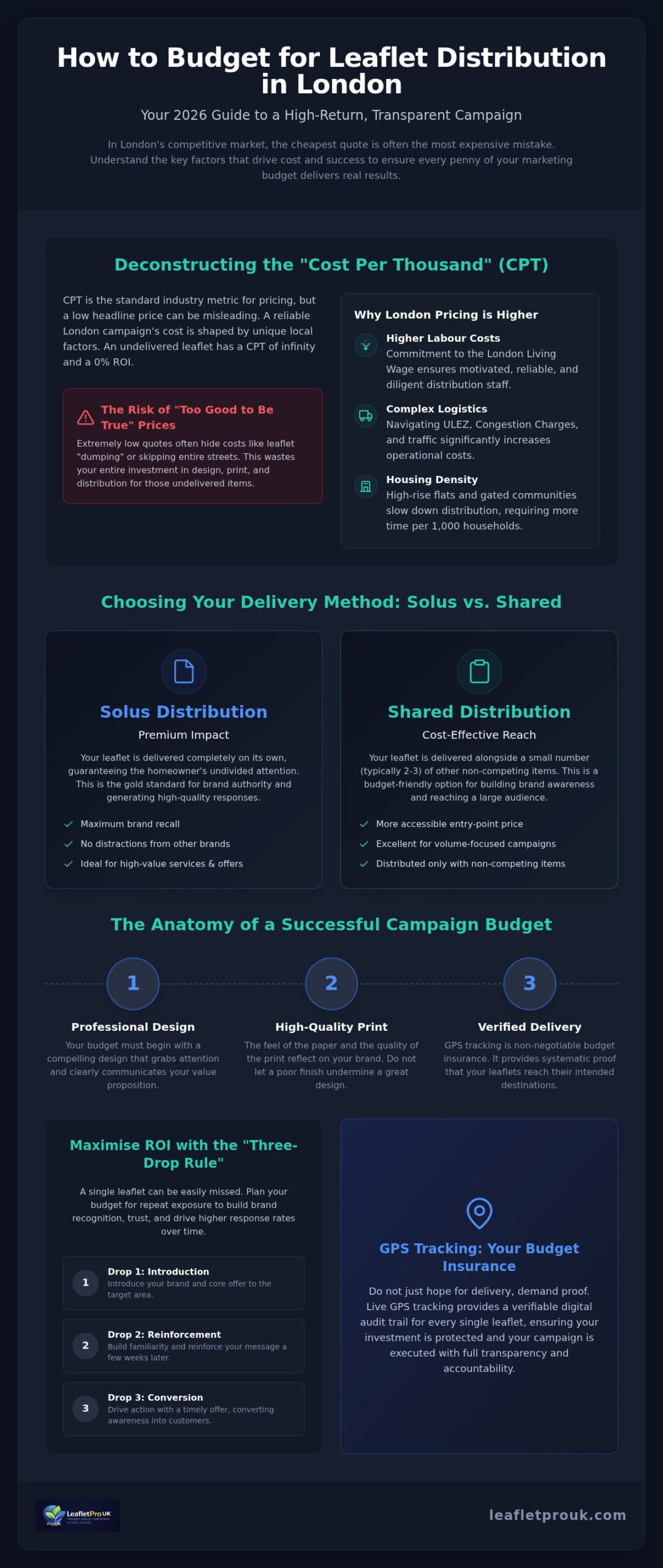
    Understanding how to budget for leaflet distribution London starts with mastering the industry’s primary unit of measurement: Cost per Thousand (CPT). Whilst the broader history of what is direct mail shows various ways to reach consumers, CPT remains the most reliable metric for physical distribution. It allows businesses to compare quotes on a like-for-like basis. However, you must distinguish between the headline price on a quote and the effective price of your campaign. If a provider offers a low headline rate but fails to deliver 30% of your materials, your effective price per successful doormat hit actually increases significantly.

    In the context of 2026 London logistics, CPT represents the total investment required to physically transport one thousand marketing assets from a storage facility directly into the letterboxes of a specific geographic demographic. To better understand this concept and how it fits into a wider strategy, watch this helpful video:

    Why London Pricing Differs from the Rest of the UK

    London presents a unique set of logistical challenges that naturally inflate the CPT compared to regional towns. Reputable distribution teams prioritise the London Living Wage to ensure staff are motivated and diligent, which is a fundamental cost that “budget” firms often bypass. Additionally, logistics providers must account for the daily costs of the Ultra Low Emission Zone (ULEZ) and the Congestion Charge when moving stock between boroughs. Even housing density plays a role; whilst Inner London has more households per square mile, the prevalence of high-rise flats and complex security codes means distributors often cover only 150 to 200 letterboxes per hour, making the process more labour-intensive than suburban rounds.

    The Risks of “Too Good to Be True” Pricing

    When you are researching how to budget for leaflet distribution London, you will inevitably encounter prices that seem unusually low. These providers often maintain their margins by “dumping” leaflets or skipping difficult-to-access streets, which results in a 0% ROI for those discarded items. A failed campaign isn’t just a loss of the distribution fee; it’s the wasted cost of design, paper, and printing. We view GPS verification as a non-negotiable budget insurance policy. By using GPS tracked leaflet distribution, you gain systematic proof that every flyer reached its intended destination, ensuring your budget is spent on genuine engagement rather than empty promises.

    Choosing Your Delivery Method: Shared vs Solus Budgeting

    Selecting the most appropriate delivery method is a pivotal decision when determining how to budget for leaflet distribution London. Your choice dictates the level of exclusivity your brand enjoys at the letterbox and directly influences your overall campaign cost. Whilst shared distribution offers a more accessible entry point for businesses focused on volume, solus delivery provides a premium platform where your message is the only one encountered by the resident. Following the DMA Code of Practice ensures that regardless of the method, your campaign maintains professional standards and ethical engagement with the public.

    Solus Distribution: Premium Impact for London Brands

    Solus distribution is the gold standard for businesses offering high-value services, such as estate agents, luxury home improvements, or private clinics. By ensuring your flyer is delivered entirely on its own, you eliminate the risk of being overshadowed by other marketing materials. This method typically results in the highest brand recall because it captures the recipient’s undivided attention the moment they pick up their post. When you plan your 2026 budget, view solus drops as a strategic investment in brand authority. We integrate GPS tracking as a non-negotiable layer for these campaigns, providing a digital audit trail that confirms every single doormat hit with absolute precision.

    Shared Distribution: Cost-Effective Volume

    If your primary objective is to achieve maximum reach across diverse London postcodes whilst managing a tighter budget, shared distribution is a sensible alternative. In this model, your leaflet is delivered alongside a small number of non-competing items. The logical trade-off is a higher level of competition for the resident’s attention. To maintain effectiveness, you should budget for higher print volumes to offset potentially lower response rates. This volume-led strategy works particularly well for local restaurants, retail promotions, or community events where broad awareness is more important than total exclusivity. It allows you to spread your message across a wider geographic area without an exponential increase in your distribution spend.

    Regardless of the delivery model you select, GPS tracking serves as the primary safeguard for your marketing capital. It transforms a vague promise into a verified logistical event, ensuring that your flyers are actually reaching households rather than being discarded. This level of accountability is why sophisticated brands prioritise transparency and proof over the lowest possible headline price. If you want to ensure your investment translates into genuine engagement, you might organise GPS tracked leaflet distribution to secure the peace of mind that comes with a well-executed, visible process.

    Factoring in London-Specific Logistics and Access Challenges

    London’s unique urban geography means that a campaign in the capital requires more nuanced planning than in any other UK city. When you are learning how to budget for leaflet distribution London, you must account for the physical architecture of your target postcodes. A distributor moving through a street of terraced houses in Croydon will achieve a much higher delivery rate per hour than someone navigating the secure apartment blocks of Canary Wharf. Understanding these variations is essential for setting realistic expectations and ensuring your campaign remains compliant with UK direct marketing regulations regarding access and resident privacy.

    The speed of distribution is the primary driver of labour costs. In suburban areas, a professional can often reach the higher end of the 150 to 200 letterboxes per hour industry average. However, in dense urban centres, this rate can drop significantly due to security gates, intercom systems, and concierge desks. This “Access Factor” is why certain postcodes carry a higher CPT. If you ignore these logistical realities, you risk underfunding your campaign, which often leads to distributors cutting corners to meet impossible targets. Precision in your budget allows for the diligence required to navigate these challenges properly.

    Inner vs Outer London: Budgeting for Density

    Targeting Inner London boroughs like SE1 or E14 offers incredible household density, which can reduce travel time between drops. However, this density is often accompanied by “letterbox fatigue,” where residents in high-traffic areas receive a higher volume of marketing mail. To cut through this noise, your budget may need to prioritise solus delivery over shared drops. Conversely, Zone 6 suburbs require more travel time but often yield higher engagement rates because residents receive fewer flyers. Balancing these factors ensures your investment is allocated where it will generate the most significant response for your specific industry.

    The “Gated” Premium: Access and Accountability

    In affluent areas like Chelsea or parts of the Docklands, “100% coverage” is often a logistical myth. Many high-end developments are gated or managed by concierges who may refuse entry to unaddressed mail. Professional teams handle this by using “Selected Street” drops, focusing on accessible high-value properties rather than wasting budget on unreachable units. We recommend budgeting for a slightly higher volume than your absolute target to compensate for these “no-access” zones. This strategic padding ensures your campaign hits its required reach without overspending on impossible doormats. For a deeper look at how we plan these complex routes, you can read our guide to GPS Tracked Leaflet Distribution, which explains the technology we use to verify every successful delivery.
    Budgeting for London Leaflet Distribution: 2026 Guide

    Integrated Budgeting: Design, Print, and GPS-Tracked Delivery

    A successful marketing campaign is a cohesive system rather than a series of isolated purchases. When you evaluate how to budget for leaflet distribution London, you must look at the integrated costs of design, high-quality printing, and the distribution itself. Choosing an end-to-end service provider ensures budget transparency and eliminates the hidden costs of managing multiple vendors. If you invest in premium distribution but use a poorly designed flyer, you are essentially paying to put a missed opportunity through someone’s door. A unified approach prevents budget creep and ensures that every pound spent on paper and ink works as hard as the pound spent on GPS-tracked delivery.

    Leaflet Design: Investing in the “First Impression”

    Professional design support is a strategic one-time cost that yields long-term ROI. In the competitive London market, your flyer has roughly two seconds to capture interest before a resident moves it from the doormat. Essential elements like a clear headline, a compelling offer, and a direct call-to-action are vital for success. For layout advice that maximises your physical space, you can review these Direct Response Leaflet Design Tips. Avoiding common leaflet marketing mistakes, such as cluttered visuals or missing contact details, protects your distribution investment from being ignored by your target audience.

    Printing Costs and Paper Quality

    Printing costs are heavily influenced by volume and material choice. Often, printing 10,000 units offers significantly better value than 5,000 due to the initial setup costs involved in professional lithographic printing. The physical format also dictates your spend; whilst A6 is compact, A5 remains the industry standard for providing enough space for a persuasive message without feeling intrusive. Paper weight, measured in gsm (grams per square metre), affects the perceived quality of your brand. A 130gsm or 170gsm flyer feels substantial and survives the journey through a letterbox better than thinner alternatives. In 2026, many brands are also budgeting for recycled paper options to align with the sustainability values of London residents. Choosing a matt or gloss finish can further protect the ink from damp weather, ensuring your message arrives in pristine condition.

    Calculating how to budget for leaflet distribution London accurately means accounting for these physical production variables from the outset. By consolidating these services, you maintain better control over the final outcome and ensure that the “credibility” of your print matches the precision of your delivery.

    Calculating Your Potential ROI and Finalising Your Campaign Spend

    Finalising your investment requires a shift in perspective from mere expenditure to projected return. To determine how to budget for leaflet distribution London effectively, you should first establish a “break-even” response rate. This is calculated by dividing your total campaign cost by the average profit generated per new customer. If your campaign requires a specific number of conversions to cover its costs, knowing this figure allows you to set realistic benchmarks for success. It transforms your marketing from a speculative cost into a controlled business process where every doormat hit has a measurable value.

    In the high-density London market, brand awareness often requires multiple exposures to convert a lead. We recommend the “Three-Drop Rule,” which involves delivering to the same postcode three times over a three-month period. This repetition builds the trust and familiarity necessary for residents to engage with your brand amongst the daily noise of the capital. Following these initial drops, you can use GPS data to refine your future budgets. By identifying specific streets or zones with higher engagement, you can reallocate funds towards these high-response areas whilst scaling back on less productive postcodes. For a comprehensive tracking setup, you can refer to our ROI Framework.

    The Value of Postcode-Targeted Precision

    Targeting the right demographics is a far more efficient use of capital than blanket coverage. By using London census data, you can align your budget with the specific housing types, income levels, or family structures that match your ideal customer profile. It is a logistical fact that 5,000 targeted flyers delivered to the correct audience will consistently outperform 20,000 untargeted ones. This precision reduces your total spend whilst increasing the likelihood of a high response rate, ensuring your marketing materials reach the hands of those most likely to value your services. It is about the quality of the reach, not just the quantity of the paper.

    Next Steps: Requesting a Transparent Quote

    To receive an accurate and transparent quote for your London campaign, you should provide details on your target postcodes, the desired delivery method, and the total volume of leaflets. We integrate GPS verification into every campaign budget to provide systematic proof of delivery, giving you the security that your investment is being handled with professional care. This accountability is the foundation of a successful marketing partnership. If you are ready to move from planning to execution, you can contact LeafletPro UK for a bespoke London campaign plan that prioritises precision and tangible results.

    Securing Your Brand’s Future in the Capital

    Mastering the nuances of the capital’s landscape ensures that every marketing pound is spent with purpose. By prioritising GPS-tracked accountability and focusing on postcode-targeted precision, you move away from the uncertainty of blanket coverage. Integrated services that combine expert design, high-quality print, and reliable delivery provide the transparency needed to maintain a predictable budget whilst maximising doormat impact. It’s clear that success in 2026 depends on verified data and a methodical approach to local engagement rather than vague promises.

    Understanding how to budget for leaflet distribution London is the first step toward building a sustainable and high-ROI campaign. Our specialist London postcode knowledge ensures your message reaches the most relevant demographics with absolute precision. By combining these logistical insights with our commitment to 100% accountability, we help you transform your physical marketing into a dependable growth engine for your business.

    Your next successful campaign starts with a plan rooted in data and logistical integrity. We look forward to helping you grow your brand across the capital with confidence and the peace of mind that comes from a well-executed process.

    Frequently Asked Questions

    How much does leaflet distribution cost per 1,000 in London?

    Industry rates for a London campaign depend on the delivery model and the specific borough’s density. Whilst some providers offer low headline figures, these often exclude essential verification or the London Living Wage for staff. When you research how to budget for leaflet distribution London, consider that inner boroughs typically command a higher rate due to congestion and access complexities. A reliable quote should reflect the actual labour time required for successful doormat delivery.

    Is it cheaper to use Royal Mail or a private London distribution company?

    Royal Mail often provides a lower entry price for unaddressed mail, yet they lack the geographic precision and accountability of a specialist private firm. Private companies offer GPS tracking and the ability to target specific postcodes rather than entire sectors. This targeted approach ensures your budget isn’t wasted on unsuitable demographics. For businesses seeking a high ROI, the transparency and verification provided by a private partner often outweigh the initial cost savings.

    Does the price of leaflet distribution include the cost of printing?

    Most distribution quotes are separate from production costs, although integrated providers offer combined packages for better budget visibility. Choosing an all-in-one service for design, print, and delivery simplifies your logistics and ensures the paper quality meets distribution standards. This approach prevents unexpected costs and ensures that the physical marketing assets are ready for the specific challenges of London letterboxes, such as weather resistance and an appropriate, professional paper weight.

    What is the minimum volume for a GPS-tracked leaflet drop in London?

    To generate statistically significant response data, most professional campaigns require a minimum volume of 5,000 leaflets. This threshold ensures that the GPS tracking data provides a comprehensive overview of the delivery route and household engagement. Smaller volumes often lead to a higher cost per thousand because the logistical setup and travel time remain constant. Budgeting for a larger initial drop is generally more cost-effective for businesses looking to establish a presence.

    How can I verify that my leaflets were actually delivered in London?

    Verification is achieved through detailed GPS logs that track the distributor’s exact path in real-time. This technology provides systematic proof that every leaflet reached the intended doormat, offering 100% accountability for your marketing spend. Unlike unverified services, GPS-tracked drops allow you to view digital maps of the covered streets. This level of visibility addresses the common fear of flyers being discarded and ensures your investment is handled with total professional integrity.

    Why is Solus distribution more expensive than Shared distribution?

    Solus distribution carries a higher price because your leaflet is the only item being delivered to the household. The distributor’s labour costs are covered entirely by your campaign, rather than being shared amongst multiple clients. This exclusivity ensures your brand has the resident’s undivided attention, which typically leads to higher response rates. Whilst shared delivery is a budget-friendly alternative, solus is the preferred choice for premium brands requiring maximum visibility and impact.

    Should I budget for more than one leaflet drop to the same London area?

    Yes, budgeting for multiple drops is a core component of how to budget for leaflet distribution London effectively. The “Three-Drop Rule” suggests that residents need to see your message at least three times to build trust and brand recognition. A single flyer can easily be overlooked, but repeated exposure over several months significantly increases the likelihood of conversion. Consistent presence in a postcode helps your business become a familiar, reliable local option.

    Are there extra costs for delivering flyers to London apartment blocks?

    Delivering to high-rise apartment blocks and gated communities often requires more time and labour, which can affect the overall campaign cost. These access challenges mean a distributor covers fewer households per hour compared to a street of traditional terraced houses. Whilst there isn’t always a specific surcharge, a transparent quote will account for the increased labour required to navigate security systems. Accurate budgeting must reflect these physical logistical realities to ensure full coverage.
  • Direct Response Leaflet Design Tips: Engineering Your London Campaign for ROI in 2026

    Direct Response Leaflet Design Tips: Engineering Your London Campaign for ROI in 2026

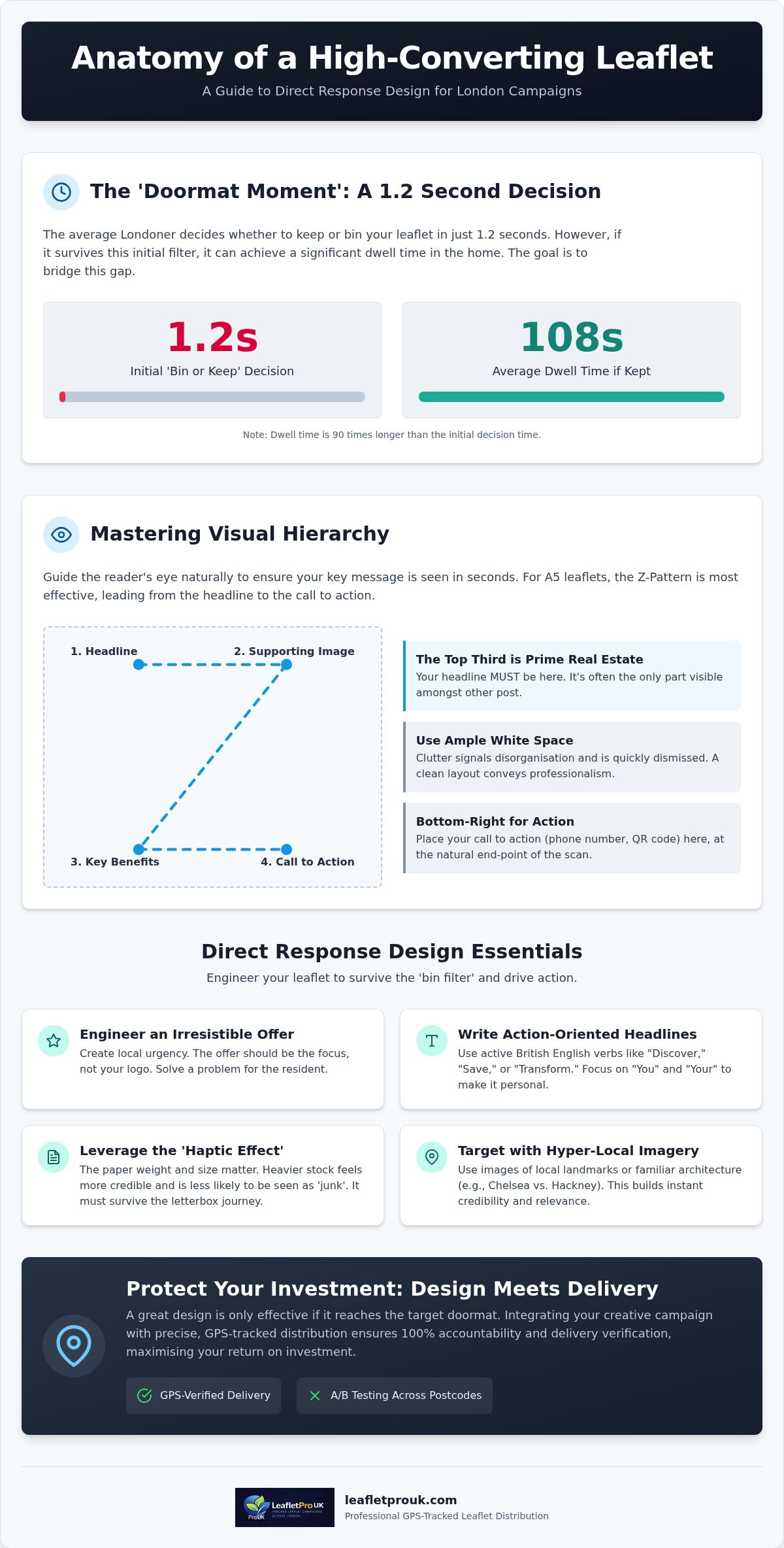
    Did you know that 89% of people remember receiving a flyer, yet the average Londoner spends just 1.2 seconds deciding whether to keep it or bin it? Whilst the average marketing email is forgotten in seconds, a physical leaflet enjoys a dwell time of 108 seconds if it survives that initial “doormat moment.” You’ve likely felt the frustration of seeing a significant investment in print yield unclear results, or perhaps you’re worried about the high “bin rate” of previous campaigns. It’s a common anxiety for businesses that value the tangibility of mail but require the accountability of modern logistics.

    In this article, you’ll discover essential direct response leaflet design tips to help you transform a simple flyer into a high-converting asset. We’ll show you how to apply direct response psychology to capture attention and drive measurable action in the 2026 regulatory environment. We’ll also preview how pairing professional design with GPS-verified distribution ensures your investment is handled with precision. By following this structured approach, you’ll learn to engineer a London campaign that prioritises ROI and delivers a steady, reliable flow of new leads.

    Key Takeaways

    • Master the visual hierarchy of your flyer by using Z-pattern layouts that prioritise your headline in the most valuable real estate of the top third.
    • Apply professional direct response leaflet design tips to engineer irresistible offers that utilise local urgency to drive immediate customer engagement.
    • Leverage the “haptic effect” by selecting the correct paper weight and size to ensure your brand feels credible and survives the physical letterbox journey.
    • Ensure your creative investment is protected by integrating design with GPS-tracked distribution for 100% accountability and delivery verification.
    • Refine your campaign’s ROI by using A/B testing across neighbouring London postcodes to identify which messaging generates the highest response rates.

    Understanding the ‘Doormat Moment’: The Psychology of Direct Response

    The “doormat moment” is the precise second a resident picks up their post. In that fleeting window, your marketing asset is either categorised as a priority or dismissed as clutter. Direct response leaflet marketing differs from general brand awareness because it’s engineered with a single, trackable goal in mind. Whether you want a QR code scan or a phone call, every element must drive that specific action. For a foundational perspective, you can read this overview of advertising mail to see how physical media remains a staple of direct marketing. This design-led approach only yields results if the physical delivery is as precise as the creative, which is why we prioritise GPS-verified distribution to ensure your assets actually reach the doormat.

    Success depends on the 1.2-second rule. This is the time it takes for a recipient to subconsciously filter their mail. In London, this physical interaction varies by property type. A flyer pushed through a draught-excluded Victorian door in Dulwich might land face-down; one dropped into a communal mailroom in a Nine Elms high-rise might sit amongst dozens of others. You must design for these variables. Reducing cognitive load is essential. If a recipient has to work to understand your offer whilst sorting their bills, they’ll simply bin it. Less is always more when you’re competing with the daily post.

    The ‘Bin or Keep’ Filter

    To survive the initial sort, your design must avoid looking like “junk.” This means moving away from cluttered, neon-soaked templates. Professional direct response leaflet design tips often suggest that your brand logo should never be the most prominent element. The recipient cares about their own problem, not your branding. Instead, use colour psychology to create contrast. Since many London hallways feature neutral tones, grey carpets, or wooden floors, using a bold, sophisticated palette helps your asset stand out from the floorboards without appearing garish or unprofessional.

    Targeting Postcodes with Relevant Imagery

    London is a patchwork of micro-markets. A design that resonates in the polished streets of Chelsea won’t necessarily work in the vibrant, industrial-chic areas of Hackney. Effective direct response leaflet design tips include using imagery that reflects the local architecture or specific landmarks. Seeing a familiar park or a recognisable street scene builds instant credibility. It signals that you’re a local expert rather than a distant national corporation. Tailoring your visuals to specific postcode demographics ensures your message feels personal and relevant. Using hyper-local imagery significantly reduces the “bin rate” by transforming a generic flyer into a community-focused message.

    Mastering Visual Hierarchy: How to Guide a Londoner’s Eye

    Visual hierarchy acts as the strategic roadmap for your recipient’s attention. Whilst many designers focus solely on aesthetics, effective direct response leaflet design tips prioritise the natural scanning habits of the human eye. For a standard A5 flyer, the Z-pattern is usually the most effective layout. It guides the reader from the top-left corner across to the right, then diagonally down to the bottom-left before finishing at your call to action in the bottom-right. This flow ensures no critical information is missed during the quick sort at the front door, whereas the F-pattern is often too restrictive for the limited space of a physical leaflet.

    Your headline must occupy the top third of the page. This is the most valuable real estate because it’s often the only part visible if the leaflet is partially covered by other post on the mat. To maintain professional credibility, ensure your claims align with truthful advertising standards; transparency is the foundation of local trust. Complement this with ample white space. Clutter creates visual claustrophobia, which signals a lack of organisation. A clean, spacious layout suggests a business that is methodical, reliable, and respectful of the reader’s time.

    Headline Secrets for Quick Action

    Success starts with active verbs and British English power words that prompt immediate movement. Words like “Discover,” “Save,” or “Transform” create a sense of momentum. Shift the focus from your business to the resident by using “You” and “Your” throughout the copy. A Power Headline for a local London plumber might be: “Restore your home’s heating today with our 60-minute emergency repair service in Islington.” This headline identifies the problem, offers a specific solution, and establishes local relevance instantly.

    Image and Graphic Placement

    Hero images should anchor the reader’s attention by visualising the outcome of your service. Place your primary image where it naturally intersects with the Z-pattern flow, usually in the centre or top-right. Use directional cues, such as the eyeline of a person in the photo or subtle arrows, to point directly toward your contact details. Icons are also highly effective for breaking up dense service descriptions into digestible points. If you’re struggling to balance these layout principles, our experts offer leaflet design support that integrates these psychological triggers into every campaign.

    The Anatomy of a High-Converting Offer and Call to Action

    The offer serves as the engine of your marketing asset. Whilst many businesses assume a generic discount suffices, sophisticated direct response leaflet design tips focus on solving a specific resident problem. An “Irresistible Offer” might be a free structural survey for Victorian terrace owners in Fulham rather than a vague percentage off. This approach builds credibility and establishes you as a knowledgeable guide. To validate your strategy, you should be tracking leaflet distribution response rates London to see which hooks resonate most. Creating urgency through postcode-specific specials, such as “Exclusive to E1 Residents this Week,” encourages immediate engagement before the leaflet is forgotten.

    Trackable Response Mechanisms

    Accountability relies on precise measurement. QR codes have become a standard in 2026, but they must be large enough to scan in low-light hallways. Aim for a minimum size of 20mm by 20mm. Don’t simply direct people to your homepage; use dedicated landing pages that continue the conversation started on the doormat. Unique offer codes are another reliable method for tying a sale back to a specific London distribution zone. This level of visibility ensures you aren’t guessing which areas of the city are driving your growth.

    The ‘Golden Rule’ of Single-Action Design

    Asking for multiple actions kills your conversion rate. If you request a phone call, a website visit, and a social media follow, the recipient often chooses none. Focus on one frictionless path. Even on physical paper, you can use a “Big Button” design by placing your CTA in a high-contrast, rounded box that mimics a digital interface. This makes the next step obvious. Always include a “What Happens Next” promise to manage expectations. Stating that a customer will receive a “Fixed-price quote within 4 hours” removes the friction of uncertainty and reinforces your brand’s reputation for reliability.

    Direct Response Leaflet Design Tips: Engineering Your London Campaign for ROI in 2026

    Physical Specifications: Why Paper Weight and Size Impact Response

    The physical sensation of your marketing asset is often the first tangible interaction a Londoner has with your brand. This is known as the “haptic effect.” Research into consumer behaviour suggests that the weight and texture of a piece of mail directly influence the perceived value of the service offered. If your leaflet feels substantial, your business is perceived as established and reliable. Conversely, a flimsy sheet suggests a lack of permanence. Integrating these physical considerations into your direct response leaflet design tips ensures that your creative work isn’t undermined by poor production choices.

    Choosing between A5 and DL sizes depends on your specific campaign goals. A5 is the industry standard for London residential drops because it provides enough surface area for high-impact “hero” images whilst remaining easy to handle. DL (tri-fold) leaflets are better suited for service-heavy businesses, such as estate agents or renovation firms, who need to present detailed information without cluttering the layout. Regardless of size, your leaflet must be durable enough to survive the mechanical brushes of a letterbox and the occasional London rain. A silk finish is typically preferred for its professional, non-reflective surface that enhances readability under hallway lights.

    Choosing the Right GSM (Grams per Square Metre)

    Paper weight is measured in GSM, and finding the right balance is a logistical necessity. Whilst 150gsm is a cost-effective baseline that offers decent durability, moving to a 250gsm or 300gsm stock provides a premium, card-like feel that demands attention. Flimsy paper is the fastest route to the recycling bin. It lacks the structural integrity to stand out amongst other post. There is also a direct link between paper thickness and delivery accountability. Heavier stock is less likely to crumple or tear during the distribution process, ensuring that our GPS-tracked teams can deliver your message in pristine condition.

    Folded vs. Single Sheet

    A single-sheet A5 flyer is ideal for bold, time-sensitive offers where the goal is a quick QR code scan. However, if your business requires a more methodical explanation of complex services, a folded DL leaflet provides a structured journey for the reader. This format allows you to categorise information across six distinct panels, guiding the resident through your value proposition with logical transitions. By applying these direct response leaflet design tips to your physical specifications, you create a more professional and persuasive asset. If you’re unsure which format best suits your postcode-targeted campaign, our team provides expert Professional Leaflet Design London to align your specifications with your ROI goals.

    Integrating Design with GPS-Tracked Distribution for Maximum Accountability

    Even the most scientifically engineered creative fails if it never reaches the intended letterbox. To avoid common leaflet marketing mistakes in London, you must view design and distribution as two halves of a single system. GPS-tracked delivery provides the empirical evidence required to trust that your investment is actually performing. Without this verification, you can’t distinguish between a design that didn’t resonate and a distribution that didn’t happen. Professional direct response leaflet design tips only provide value when the physical asset is delivered with systematic precision.

    Using GPS data allows for sophisticated A/B testing across neighbouring London postcodes. You can distribute one design variation in SW6 and a second in SW10, then monitor which call to action generates more traffic. This systematic approach identifies “Goldmine Areas,” which are specific clusters of streets where your messaging resonates most strongly. By cross-referencing GPS reports with your response data, you gain a high level of visibility into the habits of your target audience. It allows you to move away from guesswork and towards a model based on tangible results and verified coverage.

    The Power of GPS Proof

    Transparent reporting transforms vague promises into tangible proof. When you review a GPS distribution map, you’re looking at a granular record of every street traversed by the delivery team. This level of scrutiny ensures 100% accountability for your campaign. Matching response spikes to specific delivery times allows you to understand the lag between the “doormat moment” and the customer’s action. This process builds long-term trust, as you can see precisely how your budget is being utilised across the city’s complex logistics network. It’s about ensuring your direct response leaflet design tips are backed by a reliable delivery mechanism.

    Refining Your Strategy for the Next Drop

    Data-driven refinement is the key to sustained ROI. The “Iterative Loop” involves four distinct stages: design, deliver, track, and improve. After your first drop, use the response data to tweak your next design iteration. Perhaps a specific headline worked better in Hackney than in Islington, or a certain paper weight saw higher engagement in residential areas. By constantly analysing these variables, you turn every campaign into a learning opportunity that sharpens your competitive edge. When you’re ready to scale your results, book your GPS-tracked London campaign today to ensure your next distribution is handled with professional precision.

    Transforming Your London Marketing into a High-Converting Asset

    Mastering the “doormat moment” requires a methodical blend of psychological triggers and physical quality. By applying these direct response leaflet design tips, you ensure your message survives the initial sort and prompts immediate engagement through a frictionless call to action. Success isn’t just about aesthetics; it’s about the connection between a well-engineered offer and the integrity of the delivery process. We provide a complete design, print, and distribution solution that simplifies complex local logistics for your business.

    Our expert London postcode targeting ensures your message reaches the right households, whilst our GPS-verified delivery for every household provides the transparency you need to measure ROI accurately. This systematic approach allows you to iterate and improve your results with every drop. You can now move forward with the confidence that your marketing investment is being managed with professional precision and care.

    We look forward to helping you build a reliable and scalable lead generation engine in the heart of the capital.

    Frequently Asked Questions

    What is the best size for a direct response leaflet in London?

    A5 is the most effective size for standard London residential drops because it provides the ideal surface area for bold visual hierarchy without being cumbersome. It fits easily through the diverse range of letterbox types found in Victorian houses and modern apartments. Whilst DL is useful for service-heavy businesses needing six panels of information, A5 remains the standard for high-impact offers that require immediate attention during the initial sort.

    How many words should be on a high-converting flyer?

    Aim for 50 to 100 words to ensure your message is digestible within the 1.2-second decision window. High-converting flyers prioritise clarity over volume. You should focus on a “Power Headline,” three key bulleted benefits, and a single, clear call to action. Overloading the page with text increases cognitive load, which often leads to the recipient discarding the asset before they have even understood your core value proposition.

    Do QR codes actually work on physical leaflets?

    QR codes are highly effective in 2026 for bridging the gap between physical media and digital analytics. To ensure they work, place them in a high-contrast area and maintain a minimum size of 20mm by 20mm. Using a QR code allows you to direct residents to a dedicated landing page, making it much easier to track the specific ROI of your postcode-targeted campaign compared to general website traffic.

    What paper weight (GSM) should I use for a professional look?

    Use 250gsm to 300gsm paper stock if you want to project a premium and established brand image. This weight provides a card-like feel that survives the letterbox journey in pristine condition. Whilst 150gsm is a functional baseline for mass distribution, heavier stock leverages the “haptic effect,” where the physical weight of the paper increases the recipient’s perceived value of your service and builds instant credibility during the first interaction.

    How do I track the ROI of my leaflet distribution campaign?

    Tracking ROI requires the integration of specific response mechanisms into your design. You can use unique offer codes, dedicated landing page URLs, or tracked phone numbers to tie every lead back to a specific distribution zone. By following professional direct response leaflet design tips, you ensure that these tracking elements are prominent. Cross-referencing this data with our GPS distribution reports allows you to calculate the exact cost per lead for each London postcode.

    Should I use a professional designer or a template?

    Professional designers are recommended for campaigns where ROI is the primary objective. Whilst templates are cost-effective, they often lack the psychological engineering required to overcome the “bin or keep” filter. A designer who understands direct response principles can customise your visual hierarchy and imagery to suit specific London demographics. This bespoke approach ensures your asset looks like valuable information rather than generic junk mail, which significantly reduces your campaign’s bin rate.

    How does GPS tracking prove my leaflets were delivered?

    GPS tracking provides a digital footprint of the distribution team’s exact route through your target London postcodes. Every household reached is logged, creating a transparent map that verifies 100% coverage. This system eliminates the industry anxiety regarding “dumping” and provides empirical proof that your investment reached the doormat. It allows you to match response spikes to specific delivery times, ensuring complete accountability for your marketing spend across the city.

    What is the average response rate for a London leaflet drop?

    Typical response rates for a cold acquisition door drop in the UK range from 0.5% to 2% according to 2026 industry benchmarks. However, these figures vary based on the relevance of your offer and the precision of your targeting. Campaigns sent to a “warm” house file of existing customers often see much higher rates. Using direct response leaflet design tips to refine your messaging helps you stay at the higher end of these averages.

  • Residential Leaflet Drops London: The 2026 Professional Buying Guide

    Residential Leaflet Drops London: The 2026 Professional Buying Guide

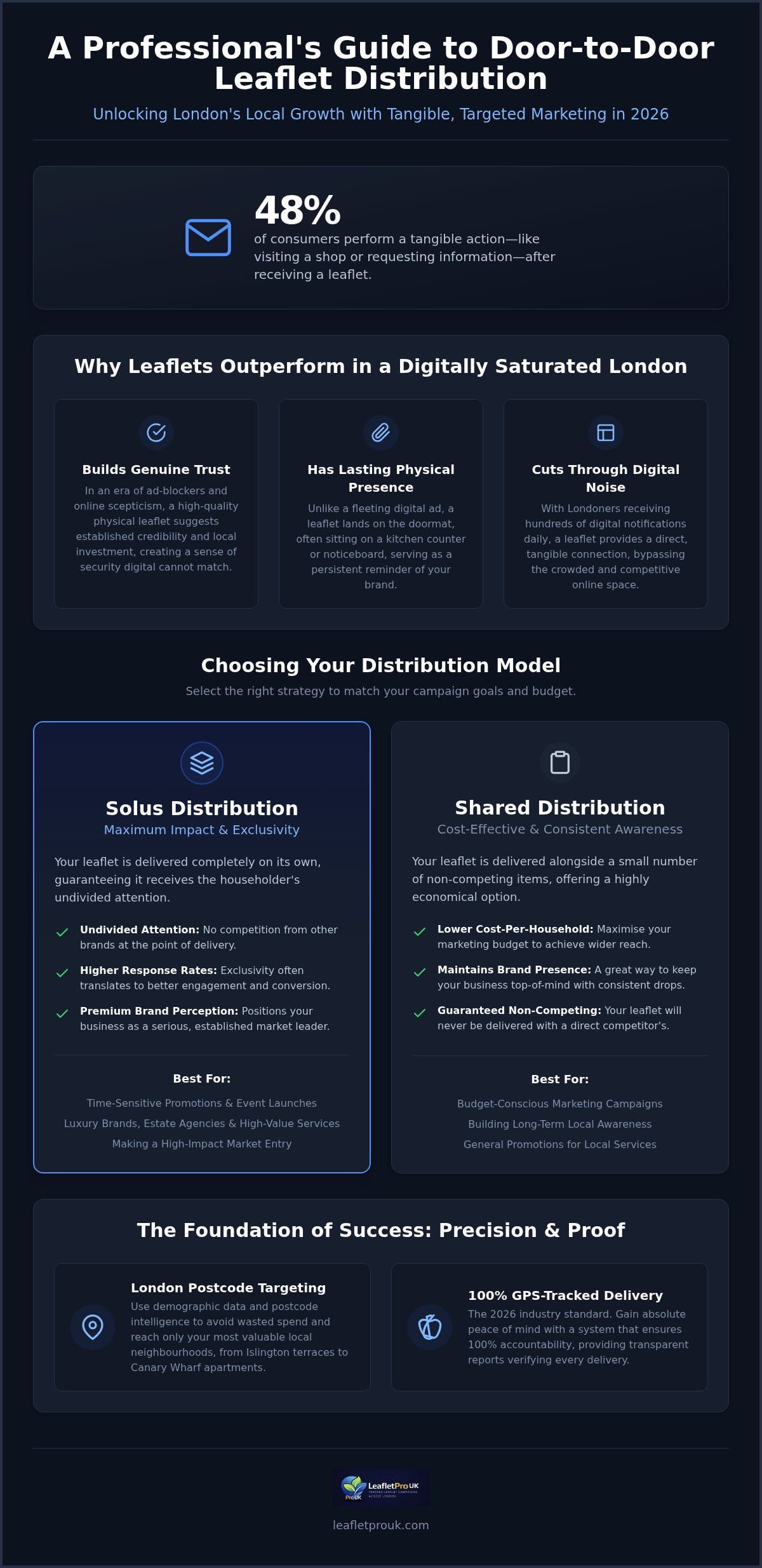
    Did you know that 48% of consumers take a tangible action, such as visiting a shop or requesting information, after receiving a leaflet through their door? Despite this significant potential for growth, many London business owners remain rightfully cautious about the integrity of their physical marketing campaigns. You likely share the common fear that your carefully designed flyers might end up in a recycling bin rather than reaching the letterboxes of your target audience. It is frustrating to invest in a marketing channel where the results often feel invisible or unverified.

    This 2026 guide is designed to replace that uncertainty with professional, data-led confidence. By mastering door-to-door leaflet distribution London, you can secure a reliable stream of local enquiries through precise postcode targeting and absolute transparency. We will show you how to plan a campaign that reaches the right doorsteps every time, backed by the rigorous proof of GPS tracking. You will learn how to navigate London’s unique housing landscape, choose between solus and shared delivery models, and implement a verification system that protects your budget whilst guaranteeing results.

    Key Takeaways

    • Learn why physical mail is outperforming digital channels in London’s 2026 landscape and how to capitalise on this trend for your business.
    • Master the nuances of door-to-door leaflet distribution London by selecting the right solus or shared model to suit your specific growth objectives.
    • Identify how to use demographic data and postcode intelligence to avoid wasted spend and reach only your most lucrative local neighbourhoods.
    • Discover the systematic process of GPS-tracked delivery that ensures 100% accountability and provides absolute peace of mind for your investment.
    • Gain a professional framework for planning your campaign, from high-quality design standards to end-to-end managed distribution.

    Why Residential Leaflet Drops Remain London’s Most Trusted Marketing Channel

    In 2026, the average Londoner is bombarded by hundreds of digital notifications daily. This digital saturation has led to a significant shift in consumer behaviour; whilst social media ads are swiped away in milliseconds, a physical leaflet held in the hand commands attention. Defining residential leaflet drops is simple: it is the process of door-to-door leaflet distribution London businesses use to reach private households directly, bypassing the noise of the digital inbox. This method ensures your message is the first thing a resident sees when they return home, providing a level of engagement that digital channels cannot replicate.

    London’s unique urban density creates a high-volume opportunity for brands. In postcodes such as SW or N, thousands of affluent households are clustered within walking distance, allowing for rapid, high-impact campaigns. Because these leaflets land on a doormat, they possess a staying power that digital ads lack. A well-designed flyer often sits on a kitchen counter or is pinned to a noticeboard, serving as a persistent physical reminder of your local authority. To better understand how this physical presence translates into brand awareness, watch this helpful video:

    The Trust Crisis in Digital Marketing

    With the rise of sophisticated ad-blockers and stringent privacy updates, reaching a London audience online has become increasingly difficult. Consumers have developed a natural scepticism towards digital content, whereas a high-quality, tangible leaflet suggests a level of established credibility and local investment. The psychological impact of receiving a professionally printed item in a domestic setting creates a sense of security that a digital scroll cannot match. Accountable Distribution is the 2026 industry standard for London brands, representing a commitment to 100% verified delivery through GPS tracking and transparent reporting.

    London’s Residential Landscape: A High-Density Opportunity

    London is a patchwork of architectural styles, from narrow Victorian terraces in Islington to sprawling modern apartment complexes in Canary Wharf and suburban semi-detached homes in Bromley. Successfully executing door-to-door leaflet distribution London requires a specialist who understands these geographical nuances. A local expert knows which blocks require specific access codes and which streets yield the highest response rates for specific sectors. For a deeper look at how to navigate these complexities, read our Household Targeted Leaflet Distribution in London: The 2026 Strategic Guide.

    Choosing Your Distribution Model: Solus vs Shared Residential Drops

    Selecting the delivery model for your door-to-door leaflet distribution London campaign is a strategic decision that directly impacts your response rates and overall return on investment. In the diverse London market, your choice usually depends on whether you require immediate, high-impact exclusivity or a cost-effective method to maintain consistent local awareness. Both models have their place in a 2026 marketing budget, provided they are executed with a commitment to transparency and verified delivery. If you’re unsure which model fits your current objectives, you can explore our tailored options for leaflet distribution London to find the perfect balance.

    When to Invest in Solus Distribution

    Solus distribution represents the gold standard of residential marketing. In this model, your leaflet is the only item delivered to the household, ensuring it receives the recipient’s undivided attention the moment they pick it up from the doormat. Exclusivity drives results. This approach is particularly effective for estate agency launches, luxury home services, or time-sensitive promotional offers where you cannot afford to be overshadowed by other brands. You gain absolute control over the timing of your drop, allowing you to align your physical marketing with specific events or seasonal peaks in the London property market.

    Maximising ROI with Shared Distribution

    Shared distribution offers a sophisticated, budget-friendly alternative for businesses looking to reach a high volume of households. This method involves pairing your leaflet with two or three other non-competing items, such as a local restaurant menu or a gym promotion. At LeafletPro UK, we adhere to a strict cleanliness rule. This ensures your flyer is never buried amongst a thick stack of junk mail; instead, it remains part of a curated, professional bundle. Shared drops are ideal for sectors like home improvements or local hospitality, where building long-term brand recognition across specific postcodes is more important than immediate exclusivity. It allows you to stretch your 2026 marketing budget further whilst maintaining a regular presence in your target neighbourhoods.

    Regardless of the path you choose, GPS tracking remains a non-negotiable standard. In a city as complex as London, you need more than just a promise of delivery; you require systematic proof. Every distributor should provide a digital audit trail showing exactly which streets were covered and when. This level of accountability eliminates the traditional anxieties of the industry, transforming a simple flyer drop into a reliable, evidence-based growth engine for your business. Whether you opt for the premium impact of solus or the strategic value of shared drops, the focus must always be on precision and verified reach.

    The London Postcode Goldmine: Precision Targeting for Better Results

    London’s marketing landscape is too varied for blanket drops to be effective. If you’re a high-end landscaper, delivering to a high-rise block in Canary Wharf is a waste of your budget. Precision is the key to ROI. By focusing on specific postcode sectors, you ensure your message reaches the doormats of residents who actually need your services. This strategic approach transforms door-to-door leaflet distribution London from a volume game into a targeted surgical strike. To understand the latest shifts in local populations, consult our London Postcode Demographics: 2026 Marketing Guide.

    Identifying Your Ideal London Demographic

    Success begins with matching your offering to the local population’s lifestyle. For luxury brands or high-end estate agents, targeting affluent ABC1 households in areas like Chelsea (SW3) or Hampstead (NW3) provides the highest probability of conversion. Conversely, if you’re promoting a new fitness app or a trendy coffee shop, the young professional hubs of Hackney (E8) or Clapham (SW4) are far more lucrative. We use deep local knowledge to filter out dead zones. This means we skip industrial estates, commercial-only streets, and non-residential blocks where your leaflets would simply be discarded.

    The Power of Postcode-Level Precision

    London’s geography is famously granular. A single postcode sector, such as W1U 1 in Marylebone, can have a completely different demographic profile than the street just two minutes away. This is why we don’t just target broad boroughs. We look at housing types to refine our delivery routes. If your business sells premium garden furniture, we’ll prioritise the leafy suburbs of Richmond or Dulwich over high-density apartment zones. Targeting garden owners directly is far more efficient than hoping a flat-dweller might one day move house.

    LeafletPro UK uses advanced mapping data to refine every residential delivery route. This ensures your campaign avoids the blind distribution that plagues less organised competitors. By focusing on letterboxes with the highest potential, you maximise your response rate whilst minimising waste. For a step-by-step guide on setting up your own targeted campaign, see our How to Target Postcodes for Leaflet Distribution London: The 2026 Checklist. Our methodical approach ensures that every flyer is delivered with purpose, providing the systematic reliability your business deserves.

    Residential Leaflet Drops London: The 2026 Professional Buying Guide

    Planning Your Campaign: From Design to GPS-Tracked Delivery

    A successful door-to-door leaflet distribution London campaign relies on a methodical, five-step planning process. Initially, you must define a clear objective for your drop. Whether your goal is to generate immediate enquiries, increase local footfall, or establish long-term brand awareness, every subsequent decision should support this aim. Once the objective is set, you can move through the logistical stages of design, print, and distribution with precision.

    • Step 1: Define your objective. Align your message with a singular goal to ensure clarity for the recipient.
    • Step 2: Professional design. Avoid a ‘DIY’ appearance; in London’s discerning market, visual credibility is non-negotiable.
    • Step 3: High-quality printing. Select paper weights that feel premium to the touch, reinforcing the perceived value of your brand.
    • Step 4: GPS-tracked distribution. Demand systematic verification to ensure every flyer reaches the correct letterbox.
    • Step 5: Reporting and analysis. Use the delivery data to identify high-performing postcodes and refine your future strategy.

    Design and Print: The Silent Salesmen

    Your leaflet acts as a silent representative for your business. To be effective, it requires a bold headline that addresses a specific local need, professional imagery, and a singular, compelling call-to-action. The physical quality of the paper is equally important. A higher GSM (Grams per Square Metre) ensures your leaflet doesn’t feel flimsy or insubstantial when picked up from a doormat. We offer dedicated design support and high-quality printing to ensure your marketing materials reflect the professional standards of your business.

    Verification: Understanding GPS Tracking Reports

    Accountability is built into every campaign through our 1-second GPS tracking technology. This system creates a detailed audit trail, providing a digital record of every street and household covered by our distributors. We don’t just provide a service; we provide a verifiable audit trail that offers total visibility over how your budget is being utilised. These reports are delivered as standard, allowing you to cross-reference delivery areas with the resulting enquiries or sales.

    GPS-verified data effectively eliminates the ‘dumping’ anxiety that often concerns business owners when investing in physical distribution. By providing a transparent and evidence-based reporting system, we ensure your investment is handled with the highest level of professional integrity. This systematic approach transforms residential drops into a reliable, verifiable channel for growth across London’s most lucrative neighbourhoods.

    Why LeafletPro UK is London’s Premier Residential Distribution Partner

    Choosing a partner for door-to-door leaflet distribution London requires more than just logistical capacity; it demands a deep, street-level understanding of the city’s unique geography. Unlike national providers who often rely on fragmented data or external contractors, we focus exclusively on the London market. This specialisation allows us to provide a level of precision and accountability that broader agencies simply cannot match. We act as your diligent partner, ensuring every campaign is executed with the systematic care your brand deserves.

    London-Only Expertise

    Managing London’s residential landscape involves overcoming complex access requirements, from high-security gated communities to concierge desks in modern apartment blocks. Our teams are intimately familiar with these local nuances, which ensures your leaflets actually reach the letterbox rather than being left in communal areas. This local accuracy is vital for service providers who need to build trust within specific neighbourhoods. For example, tradesmen looking to expand their local footprint can find tailored strategies in our London Tradesmen Leaflet Distribution: 2026 Growth Guide.

    Our commitment to transparency is reflected in our end-to-end service model. We manage the entire process, including design support, high-quality printing, and GPS-verified delivery, so you don’t have to coordinate multiple suppliers. This integrated approach ensures that the professional standard established during the design phase is maintained right through to the final doormat. We’ve successfully partnered with estate agents, local retailers, and tradesmen across every London borough, providing the tangible evidence of delivery that builds long-term confidence.

    Launching Your 2026 Campaign

    Starting your next campaign is a straightforward, methodical process designed to respect your time and budget. We begin by understanding your specific objectives and target postcodes, then provide a bespoke quote that reflects your requirements. There aren’t any hidden costs or vague promises; every step of the integrated customer journey is documented and verified. By combining local expertise with 1-second GPS tracking data, we provide the peace of mind that your investment is being handled with absolute professional integrity.

    Securing Your Local Growth in 2026

    Success in the capital’s competitive landscape requires a shift from speculative marketing to accountable precision. By combining hyper-local postcode intelligence with high-quality design, you ensure your message resonates with the right households. We’ve explored how systematic GPS tracking and a specialist focus on London’s unique geography eliminate the traditional risks associated with physical drops. Establishing a consistent presence through door-to-door leaflet distribution London allows your business to build genuine local authority directly on the doormat.

    As London postcode specialists, we provide an end-to-end solution where design and print are included as standard. Every delivery is GPS tracked to provide you with absolute transparency and peace of mind. You can now plan your residential campaigns with the confidence that every flyer is being handled with professional integrity and care.

    You don’t have to navigate the city’s complex logistics alone. With a diligent partner and verified delivery data, your next campaign can be the catalyst for sustainable and measurable business growth.

    Frequently Asked Questions

    How much does a residential leaflet drop in London cost in 2026?

    Campaign investment depends on your chosen distribution model and the total volume of households targeted. Solus distribution, where your flyer is delivered alone, carries a higher premium due to exclusivity and timing control. Shared distribution offers a more economical alternative by pairing your message with non-competing brands. We provide bespoke quotes based on your specific 2026 marketing objectives; this ensures you only pay for the precision targeting your business requires.

    How do I know my leaflets were actually delivered to the houses?

    Verification is handled through our 1-second GPS tracking system, which creates a precise digital audit trail of every delivery route. This data is provided to you in a comprehensive report, offering tangible proof of delivery to every doorstep in your target area. By using this systematic approach, we eliminate the anxiety of leaflets being discarded. You can cross-reference these reports with your own enquiry data to measure the success of your campaign accurately.

    What is the difference between solus and shared leaflet distribution?

    Solus distribution ensures your leaflet is the only item posted through the letterbox, providing maximum visibility and zero competition on the doormat. Shared distribution involves delivering your flyer alongside two or three non-competing items, which significantly reduces the cost per thousand. While solus is ideal for time-sensitive or high-end promotions, shared drops are an excellent way to maintain a consistent presence across door-to-door leaflet distribution London routes whilst managing a strict budget.

    Which London postcodes have the highest response rates for residential drops?

    There is no single “best” postcode; success is determined by how well your offering matches the local demographic profile. Affluent sectors in SW (South West) or W (West) London typically yield high response rates for premium home improvements and estate agency services. Conversely, high-density areas in East London often respond better to local hospitality or fitness promotions. We use demographic data to help you identify the specific neighbourhoods where your message will resonate most effectively.

    Can you help with the design and printing of my leaflets?

    We provide a complete end-to-end service that includes professional design support and high-quality printing alongside our distribution expertise. Our design team ensures your leaflet features a compelling headline and clear call-to-action that appeals to a London audience. We also offer various paper weights to ensure your marketing material feels premium when handled. This integrated approach saves you the logistical stress of managing multiple suppliers whilst guaranteeing a professional standard for your brand.

    How long does it take to complete a residential leaflet drop across a London postcode?

    The duration of a drop depends on the scale of your target area and whether you’ve chosen a solus or shared model. A typical campaign targeting a specific postcode sector can be completed within five to ten working days. Solus drops offer more flexibility for precise timing, whereas shared drops are scheduled to align with other non-competing items. We provide clear timelines at the start of your project so you can prepare for the resulting enquiries.

    Is GPS tracking included as standard with all LeafletPro UK campaigns?

    Yes, GPS tracking is an essential standard for every campaign we execute across the capital. Transparency is a core value of our service; we don’t believe in “blind” distribution that leaves business owners guessing. By including GPS tracking as standard, we provide the systematic proof required to verify that your door-to-door leaflet distribution London investment has reached every intended household. This level of accountability is what distinguishes our professional service from less organised competitors.

    Do you deliver to apartment blocks and gated communities in London?

    Our teams are specifically trained to handle London’s complex residential landscape, including gated communities and modern apartment blocks with concierge desks. Navigating these high-density developments requires local expertise and a professional approach to gain access to internal letterboxes. Because we focus exclusively on the London market, we have the experience necessary to ensure your leaflets are delivered correctly in areas that national providers might find difficult to access or navigate effectively.