Tag: flyer marketing

  • London Tradesmen Leaflet Distribution: 2026 Growth Guide

    London Tradesmen Leaflet Distribution: 2026 Growth Guide

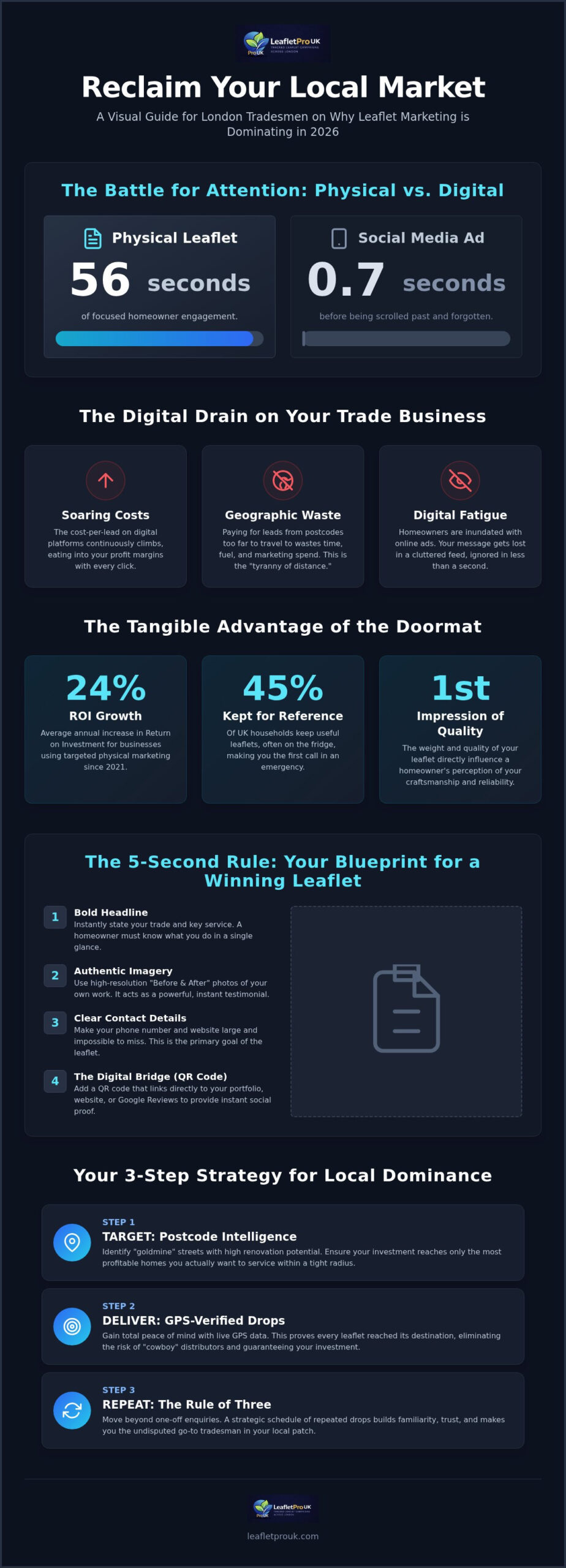
    Did you know that the average physical leaflet receives 56 seconds of engagement, whilst a social media ad is lucky to get just 0.7 seconds? For a London tradesman, that extra minute of focused attention is often the difference between securing a high-value contract and being scrolled past in a crowded digital feed. You’ve likely felt the frustration of digital platforms where the cost-per-lead keeps climbing, often delivering enquiries from postcodes that are simply too far to travel to. It’s also common to feel sceptical about traditional flyer drops after hearing stories of unreliable distributors who provide no proof of work. This guide explains how to reclaim your local market through professional leaflet distribution for tradesmen London.

    We’ll show you how to secure a steady stream of local enquiries using GPS-verified residential drops that offer total transparency and accountability. You’ll learn how to dominate high-value neighbourhoods and ensure your marketing materials actually reach the letterbox, giving you the peace of mind to focus on your tools whilst we handle the logistics of your 2026 growth strategy. By shifting your focus to verified physical outreach, you can establish a dominant presence in your most profitable local postcodes.

    Key Takeaways

    • Learn why London tradesmen are pivoting back to physical marketing to bypass high digital lead costs and reach homeowners directly in their own living rooms.
    • Master the “5-second rule” for design to ensure your trade services and contact details are immediately recognisable to busy residents.
    • Use postcode intelligence to identify “goldmine” streets, ensuring your leaflet distribution for tradesmen London targets properties with the highest renovation potential.
    • Gain peace of mind with GPS-verified delivery data that eliminates the risk of “cowboy” distribution and proves every flyer reached a doormat.
    • Implement a strategic “Rule of Three” schedule to move beyond one-off enquiries and build a dominant, trusted presence in your local patch.

    Why London Tradesmen are Returning to Leaflet Marketing in 2026

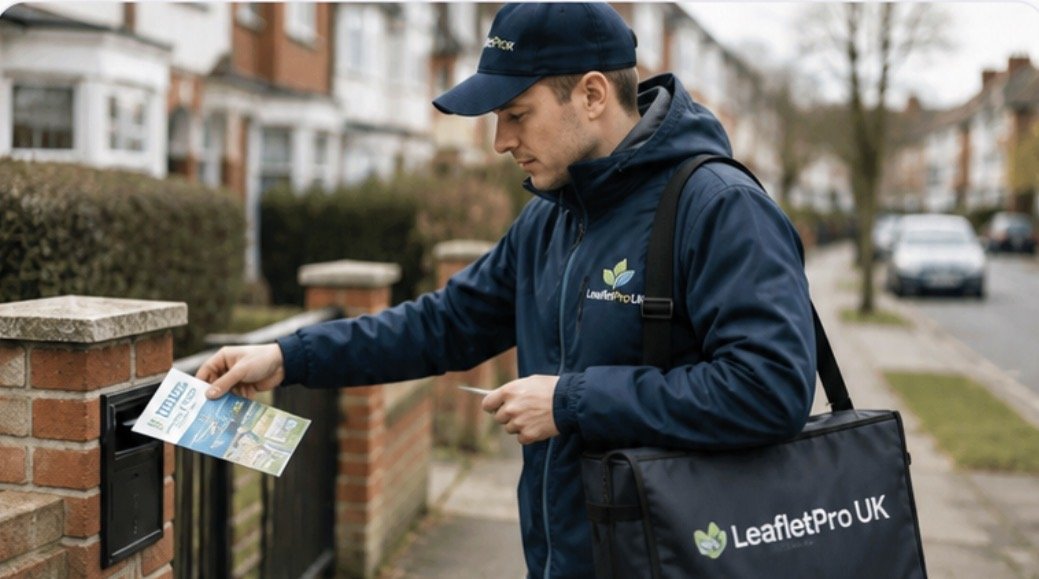
    In 2026, the marketing landscape for London tradesmen has shifted back to the physical doormat. After years of escalating digital costs, savvy professionals are rediscovering the power of a targeted strike on local streets. Many are finding that leaflet distribution for tradesmen London is the most reliable way to cut through the noise. This approach isn’t about mass-mailing the entire city; it’s about building “neighbourhood fame” so your van is recognised on every corner of your primary patch. By focusing on a tight 3-mile radius, you significantly reduce fuel costs and travel time, turning your business into a hyper-local authority.

    Digital fatigue is a real hurdle for modern homeowners. Whilst social media feeds are cluttered with ads that are ignored in less than a second, physical mail demands attention. For those seeking a neutral overview of advertising mail, its longevity in the home remains its greatest asset. It’s a strategic move that helps you dominate a specific borough rather than being a small fish in a massive digital pond.

    To better understand this concept, watch this helpful video:

    The Problem with Digital Lead Generation for Trades

    Platforms like Google Ads and Checkatrade have become increasingly expensive, often leading to a “tyranny of distance.” It’s frustrating to pay for a lead in North London when your base is in Wandsworth. This geographic waste eats into your margins and wastes your day in traffic. Utilising household targeted leaflet distribution London solves this by ensuring your message only reaches homes you actually want to service. It’s a precise method of leaflet distribution for tradesmen London that prioritises profitable proximity over broad, useless reach. The ROI for businesses using physical marketing has seen an average annual increase of 24% since 2021, proving that traditional methods are thriving when applied with local intelligence.

    The Psychology of the Doormat for Homeowners

    A physical flyer offers a tactile advantage that a screen cannot replicate. Research indicates that the average leaflet receives 56 seconds of engagement. This is a massive leap compared to the fleeting 0.7 seconds typical of social media ads. 45% of UK households keep leaflets for future reference, often pinning them to the fridge for “emergency” plumbing or electrical needs. The weight and quality of the paper directly influence a homeowner’s perception of your craft. A flimsy flyer suggests a budget service, whereas a high-quality print establishes immediate credibility and trust. This physical presence creates a sense of reliability that digital pixels simply cannot match. When a boiler breaks or a fuse blows, your details are already within reach, ensuring you are the first professional they call.

    Designing Trade Leaflets that Convert: A 2026 Blueprint

    Your flyer has roughly five seconds to convince a homeowner it isn’t junk. If they can’t identify your trade and contact details in that window, it’s headed for the recycling bin. Successful leaflet distribution for tradesmen London relies on this “5-Second Rule.” Use bold headings and high-quality photography of your actual work rather than generic stock images. For builders and landscapers, high-resolution “Before and After” imagery acts as a visual testimonial that words cannot match. In 2026, integrating a QR code is essential. It allows residents to scan and immediately view your portfolio or Google reviews, bridging the gap between physical mail and digital proof. When planning your campaign, it’s vital to stay compliant with UK direct marketing laws to protect your brand’s reputation.

    Designing a flyer that converts requires a methodical approach. It isn’t just about aesthetics; it’s about clarity and credibility. Your primary trade should be the largest text on the page. If you’re a gas engineer, the word “HEATING” or “BOILERS” should be unmistakable from across the room. Combine this with trust symbols like trade association logos and clear contact information. This structured layout ensures your leaflet distribution for tradesmen London delivers a professional first impression every time.

    Professional Design and Print Standards

    A flimsy, poorly designed flyer undermines your professionalism. To avoid the “junk mail” look, professional design support is non-negotiable. For affluent London neighbourhoods, a silk finish often feels more sophisticated and credible than a high-gloss coat. Even small details matter; an established landline number often projects more stability than a mobile number alone. These trust signals reassure homeowners that you’re a legitimate business, not a fly-by-night operation. If you want your materials to reflect the quality of your craft, investing in professional leaflet design London is a sensible first step.

    Direct Response Strategies for Trades

    Give people a reason to call now. A limited-time local offer, such as a “Free Boiler Health Check in SW19” for the first ten callers, creates genuine urgency. This doesn’t need to look desperate; it should feel like an exclusive neighbourhood benefit. Creating urgency without looking “salesy” is a fine balance that professional designers understand well. By using leaflet design support, you can ensure your offer stands out amongst generic flyers whilst maintaining a premium feel. If you’re looking for a partner to handle your next campaign, our team offers professional printing and design services to ensure your brand looks its best.

    Postcode Intelligence: Targeting the Most Profitable London Streets

    Effective leaflet distribution for tradesmen London isn’t about covering the most ground; it’s about covering the right ground. Success in a city as diverse as London requires surgical precision to ensure your flyers reach homeowners who actually need your specific skills. Identifying “Goldmine” postcodes involves looking at property age and renovation potential rather than just population density. For maintenance and restoration trades, targeting Victorian and Edwardian terraces in areas like Islington or Clapham is far more productive than a blanket drop across modern apartment complexes. By filtering out social housing or large council blocks where residents aren’t responsible for repairs, you ensure every penny of your marketing budget is spent on reachable prospects.

    To achieve this level of accuracy, you need a methodical approach to selection. Following a structured guide on how to target postcodes for leaflet distribution London allows you to map your services to the streets most likely to convert. This data-driven strategy prevents the waste associated with traditional “spray and pray” methods, ensuring your materials land in the hands of private homeowners with the capital and the need for trade services.

    Mapping London Demographics to Your Trade

    Different trades require different territories. Landscapers should look toward outer London boroughs like Bromley or Richmond, where larger private gardens provide ample opportunity for major projects. Roofers, however, find more value in areas with ageing housing stock where original slate roofs are reaching the end of their lifespan. Electricians can see high returns by focusing on affluent residential zones like Wandsworth or Dulwich, where residents are increasingly investing in smart home technology and EV charger installations. Matching your expertise to the specific needs of a neighbourhood’s property profile is the most efficient way to scale your enquiry levels.

    The Power of Postcode Sectors

    Broad postcode districts are often too varied for a precise campaign. Targeting SW19 is far too vague because it covers a massive range of property types and wealth brackets. Instead, a precision strike on SW19 4 allows you to focus on the specific streets that match your ideal client profile. Using local market data helps you identify where home improvements are currently trending, allowing you to adjust your message for “Prime Central London” vs emerging residential zones. This granular level of detail ensures your leaflet distribution for tradesmen London remains relevant to the person opening the door, significantly increasing your chances of securing a local contract.
    London Tradesmen Leaflet Distribution: 2026 Growth Guide

    GPS Tracking: Ensuring Your Investment Reaches the Doormat

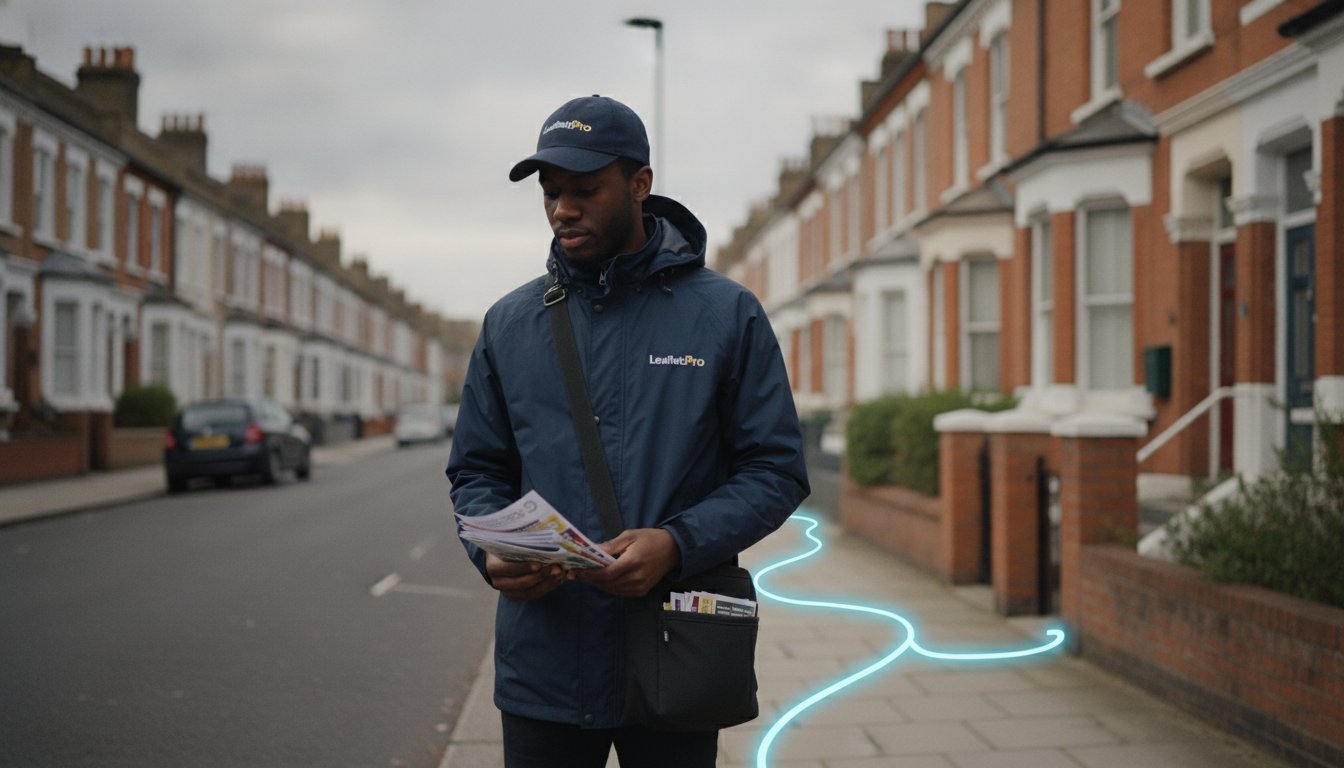
    The “dumped in the bin” era is finally over. GPS tracking has revolutionised the industry by replacing vague promises with hard data. For anyone investing in leaflet distribution for tradesmen London, this technology is the ultimate safeguard against marketing waste. Each distributor carries a tracking device that transmits “pings” to a central system at set intervals. These pings create a precise digital breadcrumb trail, or “pathing,” that shows exactly which streets were covered and when. To understand the full scope of this technology, you can read our GPS tracked leaflet distribution guide. By reviewing these time-stamped delivery confirmations, you can correlate incoming enquiries with the specific timing of a drop, allowing you to measure the direct impact of leaflet distribution for tradesmen London on your daily call volume.

    The Technology of Accountability

    Reading a GPS report is straightforward when you know what to look for. A professional report displays street-level coverage, making it easy to identify any missed houses or skipped blocks. Live supervision further enhances this process, as managers can monitor delivery teams across London in real-time to ensure they adhere to the planned route. This level of scrutiny maintains high standards and provides you with audited proof of delivery. This documentation is essential for your marketing tax records; it provides clear evidence of business expenditure that HMRC can verify if necessary.

    Peace of Mind for Busy Tradesmen

    Most tradesmen spend their days on-site, focused on their clients’ projects. Receiving digital proof of delivery via email or a portal means you can stay informed whilst you are working. You don’t have to wonder if your flyers are being delivered; you can see the progress on your phone during a tea break. This data is also invaluable for planning your next “follow-up” drop. If a specific street generates three new boiler installs, you’ll know exactly where to target your next campaign for maximum effect. Working with a partner that values transparency as much as you value your reputation builds a foundation of trust that is rare in the marketing world.

    Scaling Your Trade Business with Managed Leaflet Drops

    Building a sustainable business requires more than just a single burst of marketing. Whilst a one-off drop might generate immediate calls, long-term growth is achieved through a consistent monthly marketing programme. This is where the “Rule of Three” becomes essential. In the competitive London market, the first leaflet is often viewed as an introduction, the second builds familiarity, and the third is what usually secures the contract. By maintaining a regular presence on the doormats of your target postcodes, you transition from being another flyer in the pile to being the recognised local expert for your trade.

    For premium trades, solus distribution is the gold standard. This service ensures your flyer is delivered alone, without any competing materials, giving your brand the undivided attention of the homeowner. It’s a high-impact method of leaflet distribution for tradesmen London that projects authority and professional standards. Managing this process becomes significantly simpler when you utilise a “one-stop-shop” service. Having a single partner handle design, high-quality printing, and GPS-verified delivery ensures consistency across your campaign and saves you the logistical headache of coordinating multiple suppliers.

    From Sole Trader to Local Authority

    As your team of apprentices or subcontractors grows, your marketing needs to scale in tandem. Managed campaigns allow you to expand into multi-borough outreach without losing the granular focus that makes local marketing effective. You can organise campaigns that target specific streets in Wandsworth whilst simultaneously testing new territories in Richmond. Professional account management plays a vital role here, as it helps you refine your targeting over time based on the delivery data and enquiry patterns you’ve observed. This methodical approach ensures that as your business gets larger, your marketing becomes more efficient rather than more complicated.

    Getting Started with LeafletPro UK

    Launching your first campaign is a structured and transparent process. The first step is to request a postcode-specific quote tailored to your primary London trade patch. This allows you to plan your budget with precision and understand the exact reach of your investment. Before the design phase begins, it’s helpful to prepare a portfolio of your best work, as high-quality imagery is a key driver of conversion. Once you have your materials ready, you can visit LeafletPro UK to launch your first GPS-tracked campaign. This partnership provides the accountability and visibility you need to grow your trade business with confidence, ensuring every flyer is a purposeful step toward your next high-value contract.

    Securing Your Local Trade Dominance in 2026

    Dominating your local London patch in 2026 requires a strategic shift from broad digital reach to a targeted physical presence. You’ve seen how precision postcode targeting and professional design can turn a simple flyer into a powerful lead-generation tool. By focusing on renovation-heavy neighbourhoods and period properties, you ensure your message reaches homeowners who actually need your expertise. Peace of mind comes from knowing your investment is working exactly as planned, with every flyer reaching a verified doormat.

    With GPS-verified tracking, the era of discarded flyers is over. You can now correlate every enquiry with specific route data, allowing you to scale your business with total transparency. Choosing a partner that provides specialist demographic targeting and high-quality print ensures your brand remains the first choice for local residents. Implementing a consistent strategy for leaflet distribution for tradesmen London is the most reliable way to build long-term neighbourhood fame and secure high-value contracts. It’s time to stop chasing distant leads and start owning your local streets with confidence.

    Frequently Asked Questions

    What is the best type of leaflet for a London tradesman?

    High-quality A5 leaflets on 170gsm silk paper are the most effective choice for tradesmen. This size is easy to handle and fits through every standard London letterbox without folding. It offers sufficient space for your professional photography, trade certifications, and a bold call to action. Using a heavier paper weight signals that you’re an established professional who takes pride in every aspect of your work.

    How much does leaflet distribution for tradesmen cost in London?

    The cost of leaflet distribution for tradesmen London depends on your choice between shared or solus delivery and the total quantity required. Shared drops, where your flyer is delivered alongside other non-competing brands, offer a cost-effective entry point. Solus drops provide a premium service where your material is delivered alone. You should also factor in design and printing costs to ensure your campaign looks professional from the start.

    How do I know my flyers aren’t being thrown away by the distributor?

    We use GPS tracking to provide absolute transparency and eliminate any concerns about discarded materials. Every distributor carries a device that records their exact route, providing you with a time-stamped report of their progress. This data allows you to see every street covered and every “ping” at a property. It’s a systematic approach to verification that ensures your marketing investment actually reaches the homeowner’s doormat.

    Which London postcodes have the highest demand for trades right now?

    Postcodes with older housing stock, such as Victorian terraces in Islington or Edwardian homes in Clapham, currently show high demand for maintenance and restoration. Wealthier residential zones like Richmond or Wandsworth are excellent for high-value renovations and smart home installations. Identifying these “goldmine” areas based on property age and demographic data ensures your trade services are offered to residents who actually need them.

    Should I choose solus or shared distribution for my plumbing business?

    Solus distribution is the ideal choice for a plumbing business seeking high-value emergency or installation contracts. By delivering your flyer alone, you ensure that your message isn’t diluted by competing services. This “premium strike” approach increases the likelihood of your leaflet being kept in a drawer for future boiler repairs. Shared distribution is a budget-friendly alternative if you’re looking for broader brand awareness across a wider area.

    How many leaflets do I need to see a return on my investment?

    For most trades, a campaign of at least 5,000 to 10,000 leaflets is necessary to generate a consistent stream of enquiries. Research shows that 9.2% of delivered leaflets lead to some form of action, so higher volumes naturally produce more leads. Repeating the drop every few months within the same postcode sector helps build “neighbourhood fame,” making you the first professional residents think of when a problem arises.

    Can I target specific streets in London rather than whole postcodes?

    You can certainly target specific sectors to achieve surgical precision in your leaflet distribution for tradesmen London. Rather than dropping across an entire postcode district, you can focus on specific sectors that match your target property type. This allows you to bypass large apartment blocks or social housing that might not fit your trade profile, ensuring your flyers only land in the hands of private homeowners.

    How long does a typical London residential drop take to complete?

    A standard residential drop in London usually takes between three and five working days to complete. The exact duration depends on the density of the houses in your chosen postcode sector. High-density urban streets are finished more quickly, whilst leafier outer London boroughs take longer due to the distance between doormats. We provide regular updates so you know exactly when your materials are landing in your target area.
  • GPS Reports for Leaflet Distribution: Myth-Busting Guide

    GPS Reports for Leaflet Distribution: Myth-Busting Guide

    What if the colourful GPS map you just received is actually hiding more than it reveals? You’ve likely felt that nagging doubt when staring at a flurry of digital tracks, wondering if your flyers are truly hitting doormats or simply being driven around a London postcode. It’s a common anxiety for business owners who have been let down by a lack of transparency in the past. You deserve more than a vague promise that your marketing investment reached its destination. This guide provides the clarity you need for interpreting GPS tracking reports for leaflet distribution with absolute confidence. We’ll show you how to look past the surface of a map to find the authentic evidence of a job well done. You will learn to decode complex data sets, spot the subtle red flags of “flyer dumping,” and understand why a perfectly straight line is often a sign of trouble rather than success. By the end of this article, you’ll have the expertise to audit any delivery report and provide your stakeholders with undeniable proof of household penetration.

    Key Takeaways

    • Understand why continuous “snail trail” lines are far more reliable than static dots for verifying genuine door-to-door penetration.
    • Master the skill of interpreting GPS tracking reports for leaflet distribution by distinguishing between natural human walking patterns and deceptive vehicle-tracked data.
    • Learn to identify “GPS drift” caused by London’s high-rise buildings so you don’t mistake technical signal interference for poor staff performance.
    • Utilise a methodical five-point audit to ensure your campaign has achieved full saturation across your targeted London postcodes without leaving “white spaces.”
    • Discover how to transform raw delivery data into a strategic tool for identifying high-performing streets and improving future response rates.

    Decoding the Digital Snail Trail: What GPS Reports Actually Tell You

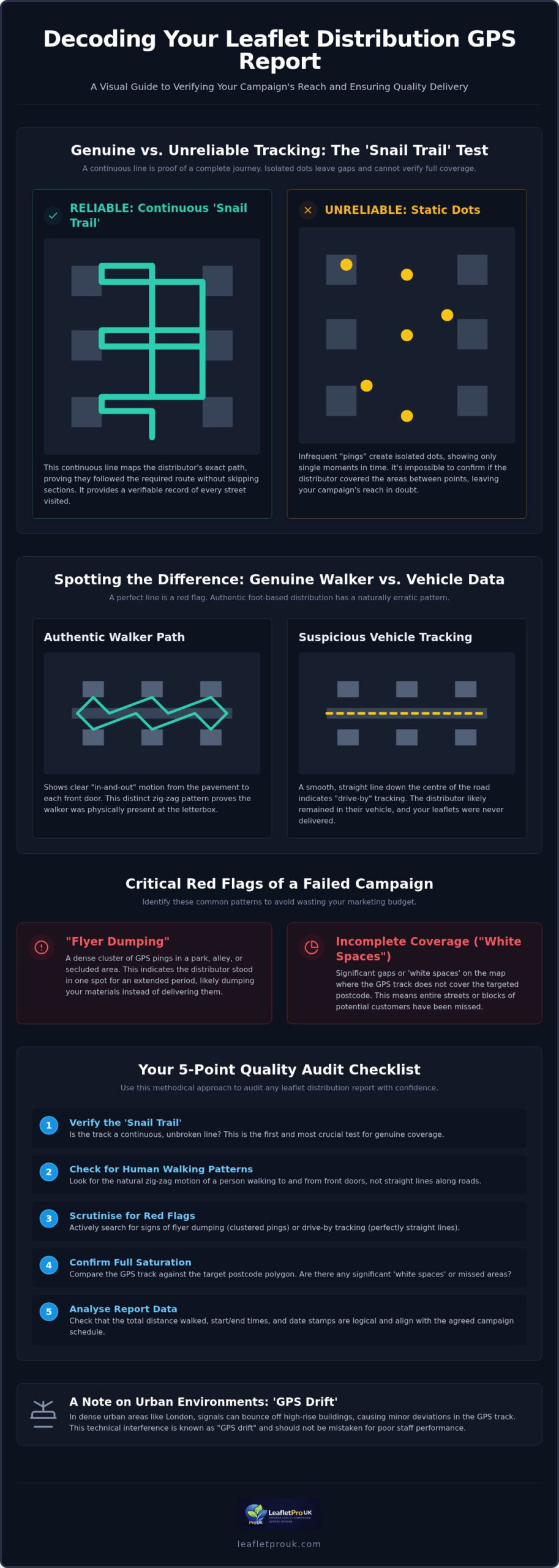
    A GPS tracking report is a digital audit of a distributor’s physical journey through a specific area. It functions as a transparent ledger for London businesses, providing a verifiable record of every street visited. The most critical element to look for is the “snail trail.” This is a continuous line that maps the distributor’s exact path. Unlike isolated dots, which only show where a person was at a single moment, a continuous line proves the walker followed the required route without skipping sections.

    It’s vital to address a common misconception. A GPS report does not technically prove a leaflet went through a letterbox. Instead, it proves the distributor reached the door. It provides the accountability required to ensure your flyers aren’t left in a pile or dumped in a recycling bin. For companies like LeafletPro UK, these reports are the foundation of a trust-based partnership, turning an invisible service into a tangible, audited asset.

    Understanding Pings, Paths, and Polygons

    The precision of your report depends on the “ping” frequency. This is the interval at which the data logger records its location. A report with 30-second pings provides a granular view of movement, showing every turn and driveway. In contrast, 5-minute intervals leave massive gaps, making it impossible to tell if a street was truly covered. When interpreting GPS tracking reports for leaflet distribution, you’ll also see “polygons.” These are the digital boundaries of your targeted London postcodes. Whilst these maps are highly accurate, technical factors like signal interference or atmospheric conditions are common sources of GPS error that can cause slight deviations. A professional distributor understands these nuances and uses high-resolution data to provide a cleaner audit trail.

    The Difference Between Live Tracking and Post-Drop Reports

    Live tracking dashboards offer real-time peace of mind, allowing you to see your campaign in motion. This is helpful for immediate verification, but it can be a distraction for busy business owners. Post-campaign PDF reports remain the gold standard for formal auditing. These documents provide a static, unalterable record that is easy to share with stakeholders. When interpreting GPS tracking reports for leaflet distribution, always check the date and time stamps. These ensure the work was completed during professional hours and within the agreed timeframe. A comprehensive report should include:

    • Visual overlays of the targeted postcode versus the actual path taken.
    • Total distance walked to confirm the physical effort involved.
    • Start and end times for each specific sector to verify consistency.

    This level of visibility ensures that every penny of your marketing budget is accounted for, providing the security that your message has reached its intended audience.

    The “Perfect Line” Myth: Identifying Walker Data vs. Vehicle Tracking

    Many clients believe a perfectly straight line on a map indicates a precise delivery. In reality, a straight line often signals that the data has been faked or recorded from a vehicle. Humans don’t walk through walls or glide over fences in perfectly geometric paths. Interpreting GPS tracking reports for leaflet distribution requires looking for the “noise” that proves a person was physically present at the letterbox. Genuine walker data is slightly erratic because people navigate obstacles like garden gates, parked cars, and uneven pavements.

    If the report shows a smooth line following the centre of the road without any deviation toward properties, you are likely looking at “drive-by” tracking. This occurs when a distributor stays in a van whilst the leaflets remain in the back. Another critical red flag is “The Dump.” On a map, this appears as a single, dense cluster of GPS pings in a park, bush, or bin area. It shows that the distributor stood in one spot for an extended period rather than walking the intended route. Spotting these patterns is the first step in ensuring your London campaign actually reaches the doormat.

    The Signature of a Genuine Door-to-Door Walk

    A high-quality report displays a clear “in-and-out” motion. This is the visual record of a walker moving from the pavement to the front door and back again. In London’s dense residential sectors, this creates a distinct zig-zag pattern. By understanding how GPS technology works, it becomes clear why these small movements are essential for verification. This pattern is the hallmark of a high-saturation campaign. You can use tracking leaflet distribution as a verification framework to ensure your provider isn’t just skimming the main roads or skipping difficult-to-reach properties.

    Red Flags: When the Map Doesn’t Match the Mission

    Speed is the most obvious indicator of vehicle tracking. If a distributor appears to be moving at 20 or 30mph through a residential street, they aren’t walking. Genuine foot distribution usually averages between 2 and 4mph. You should also perform a “Gap Analysis.” This involves checking for skipped cul-de-sacs or entire blocks that remain “white space” on the map. Relying on leaflet distribution with GPS proof is the only way to avoid these pitfalls and protect your marketing budget. If your current reports lack this level of detail, it may be time to partner with a transparent distribution expert who welcomes your scrutiny and provides methodical, audited results.

    Urban Canyons and High-Rises: Interpreting GPS Data in London

    London’s skyline is iconic, but for a GPS logger, it’s a labyrinth of signal-blocking obstacles. Tall buildings in areas like Canary Wharf or the City create what is known as the “Urban Canyon” effect. This occurs when satellite signals bounce off glass and steel before reaching the distributor’s device. When interpreting GPS tracking reports for leaflet distribution in these postcodes, you might see the “snail trail” suddenly jump or drift several metres away from the actual pavement. It’s a common myth that a “messy” cluster of dots on a map automatically means a walker was loitering. In high-density environments, these clusters often represent the technical reality of signal interference rather than a lack of movement.

    A professional distributor understands these nuances. At LeafletPro UK, we account for these factors in postcodes like E14 or EC1, ensuring that signal drift is never mistaken for a missed delivery. Our team uses high-sensitivity loggers designed to maintain a lock even amongst the narrowest streets. This methodical approach ensures your campaign data remains credible, even in the most challenging architectural environments.

    GPS Drift vs. Delivery Negligence

    Distinguishing between a technical glitch and a skipped street is an essential skill for any campaign manager. A genuine signal “jump” usually appears as a straight, impossible line across buildings, whereas a skipped street shows a clear, deliberate path that bypasses a specific road. Narrow alleys and London’s famously overcast weather can also dampen signal precision. Because of these variables, verified flyer distribution London requires more than just raw data; it needs local geographic knowledge to interpret the map accurately. We look for the consistency of the path rather than perfect alignment with the digital road. If the walker’s overall route is logical and covers the area, the data is likely sound.

    High-Density Housing: The “Vertical” Challenge

    London’s estates and multi-storey apartment blocks present a unique “vertical” challenge. If a distributor delivers 500 leaflets into a single high-rise, the GPS report may only show a dense “blob” of data in one spot. This happens because the device cannot track altitude or movement between floors. To verify these drops, we rely on timestamps. A ten-minute stay at a single address proves the distributor was inside navigating the floors, rather than simply walking past. We also monitor entry into gated communities and secure developments, ensuring that the tracking data aligns with the expected dwell time for that specific property type. This level of scrutiny provides the peace of mind that every household in a complex development was reached, turning a potential “white space” on the map into a verified success.

    GPS Reports for Leaflet Distribution: Myth-Busting Guide

    Auditing Your Report: A 5-Point Quality Checklist

    Receiving a digital map is only the first step in verifying your campaign’s success. To gain total confidence in your marketing investment, you must apply a rigorous auditing process to the data provided. Interpreting GPS tracking reports for leaflet distribution is about looking for the logic behind the lines. If the report doesn’t hold up to basic scrutiny, the transparency is merely an illusion. A professional audit ensures that every household in your targeted London postcode was reached with precision and care.

    When you review your delivery data, use these five criteria to verify its authenticity:

    • Postcode Alignment: Confirm the tracking lines stay strictly within your chosen London sectors.
    • Saturation Levels: Identify any “white spaces” on the map where streets or cul-de-sacs were skipped.
    • Timestamp Accuracy: Match the start and end times of the walk to the quantity of flyers delivered.
    • Speed Verification: Ensure the pace reflects a brisk human walk rather than the high speeds of a vehicle.
    • Signal Continuity: Identify “dead zones” in tunnels or basements where manual supervisor spot checks might have been necessary to maintain the audit trail.

    Step 1: Postcode Boundary Integrity

    A precise campaign stays within its designated lines. You should examine the map to ensure the distribution didn’t “bleed” into neighbouring postcodes that aren’t part of your current strategy. This is especially important in London, where demographics and property types can change significantly from one street to the next. Comparing your GPS report against your original targeted leaflet drops London plan ensures you aren’t paying for reach in irrelevant areas. If the lines frequently stray outside your target boundaries, it suggests a lack of logistical control during the drop.

    Step 2: The Time-to-Volume Ratio

    Time is a reliable truth-teller in logistics. A standard London walker typically covers 150-250 households per hour depending on the density of the housing. If a report suggests a single person delivered 1,000 leaflets in sixty minutes, it’s a major red flag. This “instant” delivery usually implies either vehicle tracking or, worse, that the leaflets were dumped rather than delivered. Cross-referencing the duration of the walk against the total volume provides an undeniable audit of the physical work performed on the ground.

    Beyond the Map: Using Verification Data to Optimise Strategy

    GPS reports are often viewed as a simple receipt for services rendered. This is a common myth that limits your campaign’s potential. In reality, the data remains valuable long after the final flyer has been posted. By interpreting GPS tracking reports for leaflet distribution, you can transform raw geographical data into a roadmap for future growth. You’ll be able to identify “Goldmine” London streets where engagement was highest and troubleshoot areas with lower response rates. If a specific sector underperforms, your report tells you if the issue was household penetration or if the marketing message itself needs refinement.

    Mastering the art of interpreting GPS tracking reports for leaflet distribution allows you to integrate this data with your internal sales tracking for a complete picture of your return on investment. You can correlate the exact time and date of a drop with a spike in website traffic or phone enquiries from a specific postcode. When you align your incoming lead data with the precise delivery times found in your reports, you gain a granular understanding of consumer behaviour. Perhaps a specific estate in E17 responds better to weekend drops, whilst a high-street sector in SW1 requires a different creative approach. This data-driven insight turns a one-off distribution into a repeatable, optimised system for business growth.

    A/B Testing Streets with GPS Precision

    Verified delivery data allows you to conduct sophisticated A/B tests across different London neighbourhoods. You can compare response rates between two postcodes with high accuracy, knowing exactly which streets were covered. This helps you identify “easy-access” zones versus “hard-to-reach” areas, such as secure apartment blocks or gated communities. By consulting the GPS tracked leaflet distribution pillar, you can develop long-term plans that prioritise high-yield sectors. This strategic layering ensures your next campaign is even more efficient than the last, as you refine your targeting based on historical performance rather than guesswork.

    The Peace of Mind Factor: Building Brand Security

    Transparent reporting does more than just verify work; it protects your brand’s reputation in the local community. If a resident or business partner questions your distribution activity, you have the audited evidence to prove your professional standards. This “Proof of Activity” is essential for franchise owners who need to demonstrate local marketing efforts to their headquarters. It builds a sense of security and accountability that vague promises can never match. When you value evidence over assumptions, you create a foundation for a reliable and scalable marketing channel that delivers tangible results.

    Ready for total transparency? Organise your verified London leaflet campaign with LeafletPro UK

    Secure Your London Campaign with Data-Driven Confidence

    A successful leaflet drop requires more than just a stack of flyers and a postcode. It demands a level of transparency that only rigorous, audited data can provide. By mastering the art of interpreting GPS tracking reports for leaflet distribution, you move from hoping your message was delivered to knowing it with absolute certainty. You now have the tools to distinguish genuine foot-traffic from deceptive vehicle tracking and to account for the technical nuances of London’s high-rise architecture.

    We provide the peace of mind that comes from methodical execution and London-exclusive GPS tracking technology. Every campaign is backed by full postcode-targeted audit reports and our 100% door-to-door delivery guarantee. This systematic approach ensures your brand reputation is protected whilst your marketing budget is utilised with maximum efficiency. You don’t have to settle for vague promises when you can have verifiable proof of performance.

    Take control of your local marketing today and watch your response rates climb with a partner that welcomes your scrutiny.

    Frequently Asked Questions

    Can GPS tracking reports be faked by distributors?

    Yes, faking is possible but usually easy to spot with a trained eye. Common deceptive tactics include “drive-by” tracking, where the distributor stays in a car, or using software to generate artificial paths. Interpreting GPS tracking reports for leaflet distribution involves looking for the natural “zig-zag” patterns and human walking speeds that are impossible to replicate with a vehicle. A genuine report reflects the physical reality of navigating gates and driveways.

    What is a “snail trail” in a leaflet distribution report?

    A snail trail is the continuous line on a map that represents the distributor’s exact walking path. Unlike isolated dots, which only show location at specific intervals, a continuous line provides a comprehensive audit of every street and driveway visited. This visual record is the primary method for verifying that a distributor has actually approached each household letterbox rather than simply skimming the main roads or skipping difficult cul-de-sacs during your campaign.

    Why are there gaps in the GPS lines on my distribution map?

    Gaps usually occur due to temporary signal loss or “dead zones” where the device cannot connect to satellites. This is common in tunnels, basements, or areas with heavy foliage. Whilst a few small gaps are normal, large missing sections should be cross-referenced with timestamps. If the timing doesn’t add up, it may indicate that the distributor switched off the device or skipped the area entirely, requiring further investigation from your provider.

    Does GPS tracking prove that my flyer went through the letterbox?

    GPS tracking proves that the distributor reached the door, but it doesn’t physically confirm the flyer was posted. It serves as a strong deterrent against dumping and provides a transparent audit of the walker’s physical effort. To ensure the highest levels of accuracy, we combine this data with supervisor spot checks and methodical reporting. This multi-layered approach gives you the security that your marketing investment is being handled with professional care and integrity.

    How long should it take to distribute 1,000 leaflets in London?

    A professional walker typically covers between 150 and 250 households per hour in London, depending on housing density. Therefore, distributing 1,000 leaflets usually takes between four and seven hours of active walking. If a report suggests 1,000 flyers were delivered in just two hours, it’s a significant red flag. Such speed almost certainly indicates vehicle-based tracking or that the leaflets were not delivered to individual households as promised by the distributor.

    What should I do if my GPS report shows the walker missed a street?

    You should immediately contact your distribution partner to request an explanation. A professional company will investigate the discrepancy by checking supervisor notes and timestamp data. If a street was genuinely missed due to an oversight, a reputable provider will organise a redelivery to that specific area at no extra cost. This accountability is why interpreting GPS tracking reports for leaflet distribution is so vital for maintaining full campaign saturation across your targeted postcodes.

    Is live tracking better than a post-campaign PDF report?

    Live tracking offers immediate peace of mind, but a post-campaign PDF report is the superior tool for formal auditing. PDF reports provide a static, unalterable record that includes detailed overlays, total distances, and precise timestamps. These documents are easier to share with stakeholders and serve as permanent proof of activity. Whilst live dashboards are useful for quick checks, the audited report remains the industry gold standard for verifying the integrity of your London distribution.

    How does GPS tracking work in London areas with tall buildings?

    Tall buildings can cause “GPS drift” or the “Urban Canyon” effect, where signals bounce off glass and steel structures. This might make the walker’s path appear slightly offset from the actual pavement on your map. In areas like Canary Wharf, we use high-sensitivity loggers to mitigate this issue. We also rely on dwell times and timestamps to verify delivery, ensuring that technical signal interference isn’t mistaken for poor performance or skipped properties.

  • Tracking Leaflet Distribution: A Verification Guide

    Tracking Leaflet Distribution: A Verification Guide

    What if the greatest threat to your marketing budget isn’t a poor design or a weak offer, but the simple uncertainty of whether your leaflets ever reached their destination? For many London business owners, the “trust gap” in physical marketing is a significant hurdle, often fuelled by the fear that thousands of printed materials might be discarded before they ever see a letterbox. It’s difficult to justify a marketing spend when the results feel untraceable and the process lacks visibility.

    We believe that transparency is the foundation of a successful partnership, and you deserve to know exactly where every penny of your investment is going. Learning how to track flyer distribution effectively turns a leap of faith into a data-driven strategy. By utilising precise GPS verification and professional reporting, you can eliminate the anxiety of “binning” and ensure every postcode in your campaign is covered with absolute precision.

    This guide provides a clear roadmap for interpreting tracking data and verifying doormat-level accountability. You’ll learn how to read route density maps, understand the logistics of professional distribution teams, and gain the confidence to reinvest in leaflet marketing as a reliable, measurable pillar of your business growth.

    Key Takeaways

    • Understand why transparent verification is essential to protect your marketing budget and eliminate the uncertainty of unverified door-to-door campaigns.
    • Discover the technical mechanics of how to track flyer distribution using satellite-linked devices that record the precise path of every distributor in real-time.
    • Learn how to interpret professional distribution maps by identifying route density and recognising human-specific walking signatures that confirm genuine delivery.
    • Explore the importance of a multi-layered verification approach that combines GPS data with independent supervisor spot-checks for maximum accountability.
    • Gain the confidence to reinvest in London-wide marketing by receiving clear, postcode-specific reports that provide total visibility of your campaign’s progress.

    The Trust Gap: Why You Must Track Flyer Distribution

    For years, door-to-door marketing felt like a “black box” for many London business owners. You’d invest in high-quality printing, hire a distribution team, and then simply wait for the phone to ring. If the enquiries didn’t materialise, you were left with a frustrating dilemma. Did the creative fail to resonate, or did the leaflets never actually reach the intended doormats? This lack of transparency creates a significant trust gap, often leading businesses to abandon a highly effective marketing channel because they can’t verify the work was completed.

    Understanding how to track flyer distribution has moved from being a technical curiosity to an absolute business necessity. In a competitive urban landscape, unverified distribution leads to skewed ROI and wasted marketing spend that most SMEs cannot afford to ignore. GPS tracking has transitioned from a premium add-on to an industry security standard, providing the objective evidence needed to bridge the trust gap. It offers a level of visibility that turns a leap of faith into a professional, data-driven operation.

    The Real Cost of “Binned” Leaflets

    When a distributor discards materials instead of delivering them, the financial damage is multifaceted. You don’t just lose the initial cost of the print and the distribution fee; you lose the potential lifetime value of every customer who never saw your message. If a Flyer (or flier) is never delivered, your response rate is guaranteed to be zero. Beyond the immediate loss of leads, there’s a serious risk to your brand reputation. Residents who find bundles of your branded leaflets dumped in communal areas or local parks will associate your business with litter and unprofessionalism. Choosing “cheap,” unverified distribution is frequently the most expensive mistake a business can make.

    Establishing Accountability with Your Distribution Partner

    Accountability begins long before the first leaflet is dropped. A professional partnership is built on clear expectations and a shared commitment to campaign integrity. By insisting on transparent reporting from the outset, you establish a framework where results are measured by data rather than vague promises. This transition from a “trust me” model to a “here is the evidence” approach fosters a much stronger long-term relationship. When you have access to precise route data, you gain the peace of mind required to scale your marketing efforts. Reliable verification ensures that your investment is handled with the same level of care and precision that you apply to every other area of your business.

    The Mechanics of GPS Leaflet Tracking Technology

    At its core, GPS tracking for physical marketing is the systematic use of satellite-linked devices to record the precise movements of a distributor. This technology removes the ambiguity of manual reporting by capturing coordinates at regular intervals whilst a team is on the ground. Understanding how to track flyer distribution requires a basic grasp of how these data points are transformed into a transparent record of work. The process begins with hardware that communicates with a network of satellites to log time, location, and speed, creating a digital breadcrumb trail of the entire delivery route.

    The hardware used in the field generally falls into two categories: dedicated portable data loggers or mobile application tracking. Whilst smartphone apps are convenient, professional logistics firms often prefer dedicated GPS loggers. These devices are built for a single purpose, offering superior battery life and more robust signal reception in dense London urban environments where high-rise buildings can sometimes interfere with satellite links. Once a shift is completed, the raw data is uploaded to a central server and processed into a visual map that provides clear evidence of coverage.

    Data Loggers vs. Live Tracking

    There’s a significant difference between receiving a post-campaign report and monitoring a live feed. Live tracking allows for immediate oversight, but the true value lies in the “ping interval” of the device. A high-frequency ping, occurring every five to ten seconds, is essential for doormat-level accuracy. If a device only pings every few minutes, the resulting map will show straight lines cutting through buildings and parks, failing to prove that the distributor actually walked up every driveway. By selecting a partner that utilises high-resolution GPS tracked leaflet distribution, you ensure the data is granular enough to verify every single letterbox visit.

    Geo-fencing and Postcode Boundaries

    Geo-fencing is a digital tool that creates virtual boundaries to ensure postcode-targeted precision during a campaign. This software is vital for maintaining the integrity of a London-specific drop, as it alerts supervisors if a distributor wanders outside the pre-authorised zone. It prevents “over-spill” into irrelevant areas, ensuring your marketing budget is concentrated exactly where your target demographic lives. This systematic approach is the most reliable way to learn how to track flyer distribution with absolute certainty, as it combines satellite data with strict geographical constraints to guarantee that no leaflets are wasted in non-targeted postcodes.

    Interpreting Your Flyer Delivery Tracking Data

    Receiving a GPS report is a significant milestone in any campaign, yet the real value lies in your ability to analyse the data provided. A series of lines on a digital map might look impressive at first glance, but you must look closer to verify that every household was reached. Learning how to track flyer distribution effectively means looking beyond the simple presence of a path and scrutinising the specific behaviours recorded by the hardware. A genuine, house-by-house delivery will produce a distinct pattern that reflects the physical reality of navigating London’s residential streets.

    One of the most vital indicators is the “walking pace” signature. A distributor who is actually visiting doors will move at a steady pedestrian speed, usually between two and three miles per hour, with frequent pauses at every letterbox. If the report shows a speed that remains consistently high or a path that never deviates from the centre of the road, it is a clear sign that the delivery was not completed to a professional standard. Time-stamped data adds another layer of security; it allows you to cross-reference the duration of the drop with the expected time required to cover that specific number of households.

    Spotting the Red Flags in a Report

    When you review your tracking data, stay alert for “straight-line” pings. These occur when a device loses signal or is purposefully turned off and then back on, resulting in a straight line that cuts through buildings or parks. Whilst occasional signal loss is possible in dense urban areas, frequent straight lines suggest a lack of accountability. Similarly, “street-only” walking patterns are a major concern. If the GPS track follows the road perfectly without showing the zig-zag movement into driveways and up to porches, it is highly likely that the distributor simply walked the route without delivering your materials. Don’t hesitate to question your provider if a certain street appears neglected or if the data doesn’t align with the physical layout of the neighbourhood.

    Verifying Route Density

    Counterintuitively, a “messy” map is often the hallmark of a successful campaign. A map filled with dense, overlapping lines indicates that the distributor was thorough, crossing the street repeatedly to ensure no door was missed. You should compare these GPS tracks against your targeted postcode list and the known household counts for those areas. This level of scrutiny allows you to confirm 100% coverage of specific London residential blocks, especially in high-density areas where letterboxes are close together. Understanding how to track flyer distribution involves more than just seeing a line on a screen; it requires a critical eye for detail to ensure the density of the tracking dots matches the density of the housing.

    Tracking Leaflet Distribution: A Verification Guide

    Beyond GPS: Multi-Layered Verification Methods

    Whilst GPS tracking provides an objective record of movement, it remains the foundation rather than the final word in campaign integrity. In the dense and often complex residential layouts of London, satellite data alone cannot always confirm the quality of a delivery. High-rise estates or Victorian conversions with communal entrances require a more nuanced approach to ensure every leaflet is placed correctly. Learning how to track flyer distribution effectively involves combining technical satellite data with human oversight and digital response metrics to create a fail-safe verification system.

    Professional distribution models now incorporate multi-layered strategies to bridge any remaining gaps in visibility. This includes physical spot-checks and back-checking, where managers verify the presence of materials shortly after a drop. These methods provide a level of qualitative proof that a GPS map cannot offer on its own. By layering these techniques, you move from simply knowing where a distributor walked to knowing exactly how your brand is being presented to the local community.

    The Importance of Physical Supervision

    Random site visits by independent supervisors are a critical component of a secure distribution model. These managers conduct unannounced inspections whilst a team is on the route, ensuring that distributors are diligent and respectful of “no junk mail” signs. This “supervisor effect” significantly improves distributor behaviour and accuracy, as staff are aware that their work is subject to physical scrutiny at any moment. Combining human oversight with satellite precision creates a total security framework that protects your marketing investment. This approach is particularly effective in high-density London postcodes where letterbox access can be challenging and requires a professional touch.

    Digital Response Tracking

    Integrating digital response tools like QR codes or unique URLs allows you to validate physical distribution through real-world engagement. When a resident scans a code on your flyer, it creates a timestamped digital hit that can be cross-referenced with your GPS reports. If a specific street shows high GPS density and a corresponding spike in digital traffic, you have definitive proof of a successful drop. This data allows you to create a “heat map” of success, overlaying satellite routes with conversion statistics to identify your most profitable neighbourhoods. To ensure your next campaign meets these rigorous standards, consider a partner that provides postcode-targeted flyer distribution with full verification.

    The 2026 trend in physical marketing is moving towards this total transparency model. Beyond satellite logs, some providers now conduct follow-up checks by knocking on a small percentage of doors to confirm receipt. This scientific framework replaces anecdotal evidence with hard data, giving you the confidence to scale your local London outreach with absolute certainty.

    Organising a Verified Campaign with LeafletPro UK

    At LeafletPro UK, we’ve built our reputation on the principle that transparency shouldn’t be a luxury. Every London campaign we manage includes 100% GPS-tracked distribution as standard. This commitment ensures that the trust gap discussed earlier is completely bridged. By choosing a partner that understands the intricate layout of the capital, you gain access to a service that values evidence over promises. We provide clear, understandable reports that show exactly where your marketing materials have landed, giving you the business-like confidence to scale your outreach.

    Our postcode-targeted approach is designed for local brand growth. We don’t just walk the streets; we target the specific neighbourhoods that match your ideal customer profile. Understanding how to track flyer distribution becomes simple when you are presented with a clean, professional report that mirrors your initial strategy. To complement our distribution, we offer integrated design and print services. This end-to-end oversight ensures that your flyer is doormat-ready, featuring the right weight, finish, and call-to-action to maximise your response rate.

    Our Process: From Postcode Selection to Proof of Delivery

    Our methodical process begins with a detailed consultation to identify the most profitable London postcodes for your business. Once the targeting is finalised, our door-to-door teams execute the drop using high-resolution GPS loggers. These devices provide the granular data necessary to prove doormat-level delivery in even the most complex urban environments. After the campaign, we use this GPS data to help you refine your future marketing strategies. By analysing the coverage maps against your enquiry levels, we can identify high-performing zones for repeat drops. London businesses favour our no-nonsense reporting because it provides tangible proof of work, allowing for a level of accountability that traditional marketing often lacks.

    Start Your Tracked Campaign Today

    Securing a verified drop for your business is a straightforward and professional process. You can request a quote based on your specific target area and volume requirements, knowing that every single leaflet is backed by satellite verification. The peace of mind that comes with a LeafletPro UK verified drop allows you to focus on handling new enquiries while we manage the complex local logistics. We act as a diligent partner, ensuring your investment is handled with precision and care. Organise your verified London leaflet drop with LeafletPro UK to ensure your message reaches every intended doormat with absolute certainty.

    Securing Your Marketing Investment Through Transparency

    Transitioning from unverified drops to a data-driven strategy is the most effective way to protect your marketing budget. By mastering how to track flyer distribution, you move beyond guesswork and establish a framework of total accountability. You’ve seen that while GPS tracking provides the essential foundation, the highest levels of security come from combining satellite precision with professional supervision and digital response metrics. This multi-layered approach ensures your materials are never discarded and always reach their intended audience.

    At LeafletPro UK, we specialise exclusively in London residential postcodes to ensure your campaign benefits from deep local expertise. We include GPS tracking as standard on all campaigns and provide detailed delivery reports for every drop we complete. This methodical approach ensures that your message reaches the correct doormat, allowing you to scale your business with absolute peace of mind. Our transparent reporting turns your physical marketing into a measurable, reliable growth engine for your brand.

    Don’t leave your local outreach to chance. Book your GPS-tracked London leaflet distribution today and experience the confidence of a fully verified campaign. We’re ready to help you turn your next drop into a documented success.

    Frequently Asked Questions

    Can GPS tracking data for leaflet distribution be faked?

    While raw digital files can theoretically be manipulated, professional tracking systems use encrypted logs and high-frequency pings that are extremely difficult to replicate. Authentic reports display a distinct “human” walking signature, including subtle speed variations and pauses at every letterbox. We scrutinise these patterns to ensure the data represents genuine physical activity, providing you with a credible and transparent record of your London campaign’s progress.

    How often are GPS locations updated during a flyer delivery?

    Professional-grade GPS loggers typically record coordinates every five to ten seconds. This high-frequency “ping interval” is essential to prove that a distributor actually walked up to each individual letterbox rather than simply walking down the centre of the road. Lower frequencies result in straight lines that fail to provide the granular evidence needed for a fully verified distribution across complex residential streets.

    What should I do if a GPS report shows a street was missed?

    If a report indicates a coverage gap, you should contact your distribution partner immediately to investigate the discrepancy. Professional firms use these reports as a vital quality control tool and will typically arrange a “top-up” drop to ensure the targeted postcode is fully covered. This is the primary benefit of learning how to track flyer distribution; it allows for objective resolution based on hard data.

    Is GPS tracking necessary for small, local leaflet drops?

    Yes, satellite verification is vital regardless of the campaign size. Even for a small drop of 1,000 leaflets, the cost of the print and the potential value of lost leads are significant. Verification provides the security required to confirm your marketing is actually reaching your local neighbours, ensuring your budget isn’t wasted on unverified services that rely solely on a “trust me” model.

    How do I access my distribution reports after the campaign?

    Reports are typically delivered via email as a comprehensive PDF or accessible through a secure client portal once the data has been processed. These files include a visual map overlay and timestamped logs of the routes taken. We ensure our reporting is transparent and easy to interpret, providing you with a permanent, professional record of the delivery work completed across your targeted London areas.

    Does GPS tracking work in high-rise London flats and estates?

    GPS tracking remains highly effective in urban environments, though signal “drift” can occasionally occur near exceptionally tall buildings. Professional distributors manage this by using dedicated hardware loggers which are more robust than standard smartphone apps. While the signal confirms the distributor entered the estate, we often use multi-layered verification, such as supervisor spot-checks, to guarantee that internal delivery to individual flats was completed.

    What is the difference between solus and tracked shared distribution?

    Solus distribution means your flyer is the only one being delivered to a household, whereas shared distribution involves your leaflet being delivered alongside two or three non-competing brands. Both methods must include how to track flyer distribution data as standard. The difference lies in the exclusivity and cost of the drop, but the verification process remains identical to ensure every doormat is reached.

    How long does it take to receive the tracking data once the drop is finished?

    You can typically expect to receive your verified tracking reports within 24 to 48 hours of the campaign’s completion. This short window allows time for the raw satellite data to be uploaded, cross-referenced with supervisor logs, and formatted into a readable map. This methodical processing ensures the information you receive is accurate, professional, and ready for your internal marketing ROI analysis.