Tag: leaflet marketing

  • 45+ Leaflet Call to Action Examples for London Sales 2026

    45+ Leaflet Call to Action Examples for London Sales 2026

    Did you know that 45% of UK residents keep leaflets in their homes for future reference? Whilst it’s easy to assume that physical mail gets lost in the “junk” pile, the reality is that 9.7% of all mail prompted a website visit in late 2025, marking a five-year high for engagement. You likely understand the frustration of a campaign that fails to land, especially when you can’t be certain if your flyers even reached the doormat. We agree that a professional distribution strategy is worthless if your message doesn’t compel the reader to act immediately.

    In this guide, we promise to provide you with over 45 high-conversion leaflet call to action examples specifically tailored for the competitive London market in 2026. You’ll discover how to move beyond generic phrases and utilise hyper-local postcode prompts that resonate with residents in specific boroughs. We will preview the essential design principles that make your CTA pop and explain how GPS-tracked delivery ensures your investment translates into measurable results. From discount codes to digital-physical integrations, you’ll gain the exact tools needed to transform your next London drop into a high-performing sales channel.

    Key Takeaways

    • Understand why physical CTAs require a distinct psychological approach compared to digital buttons to effectively bridge the gap between the doormat and the checkout.
    • Access a curated list of over 45 leaflet call to action examples categorised by industry to inspire your next high-performing London campaign.
    • Learn how hyper-local postcode targeting builds immediate trust with residents by replacing generic greetings with specific London district prompts.
    • Master visual design techniques, including the Z-pattern and high-contrast colour theory, to ensure your call to action remains the focal point of your flyer.
    • Discover how GPS-tracked distribution provides the accountability required to turn a well-crafted CTA into a measurable marketing success.

    The Anatomy of a High-Conversion Leaflet Call to Action

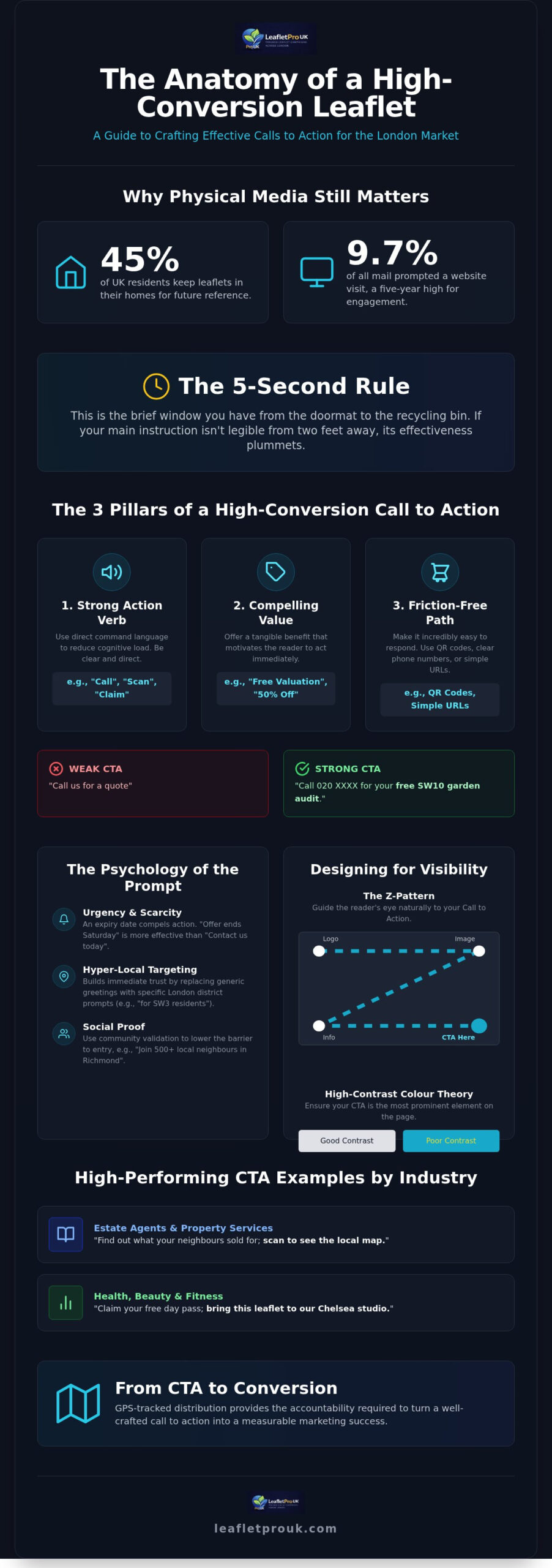
    A Call to action (CTA) serves as the vital bridge between your marketing message and the customer’s eventual purchase. Unlike a digital button that allows for instant clicking, a physical leaflet requires a more robust psychological nudge. You aren’t just asking for a click; you’re asking a London homeowner to pause their routine and engage with a physical object. To succeed, your leaflet call to action examples must balance three core pillars: a strong action verb, a compelling value proposition, and a friction-free method of contact. If any of these elements are missing, the bridge breaks. For instance, “Call us for a quote” is significantly weaker than “Call 020 XXXX for your free SW10 garden audit.”

    In the fast-paced London environment, your flyer faces the “5-second rule.” This is the brief window of time it takes for a resident to walk from their front door to the recycling bin. If the primary instruction isn’t legible from a distance of at least two feet, the campaign’s effectiveness drops. Clarity is the foundation of credibility. If a reader has to hunt for the phone number or website amongst the graphics, they will likely move on. We prioritise a layout where the CTA is the most prominent element on the page, ensuring the path to conversion is unmistakable.

    The Psychology of the Prompt

    Direct command language reduces cognitive load for the busy London homeowner. Clear instructions like “Bring this flyer to our Chelsea shop” or “Scan for your SW3 discount” perform better than passive suggestions. We recommend using urgency to drive immediate behaviour. Whilst research shows 45% of UK residents keep leaflets for future reference, an expiry date ensures that “future” becomes “today.” Phrases such as “Offer ends Saturday” create a necessary sense of scarcity that “Contact us today” simply lacks.

    Choosing Your Conversion Path

    Selecting the right path depends on your specific business goals and target borough. Direct response remains ideal for local tradespeople; a prominent phone number encourages immediate local trust. Digital bridges, such as QR codes, are now essential for linking physical media to London-specific landing pages. This allows for precise tracking of ROI. Finally, social proof prompts like “Join 500+ local neighbours in Richmond” use community validation to lower the barrier to entry. By combining professional leaflet design support with these leaflet call to action examples, you ensure your message isn’t just seen, but acted upon.

    45+ Leaflet Call to Action Examples Categorised by Industry

    Generic instructions often result in poor engagement because they fail to address the specific needs of a local audience. To achieve high response rates, your prompts must align with the effective flyer design and print London principles, ensuring the instruction is both visually clear and contextually relevant. Industry data highlights the effectiveness of direct mail when the message provides immediate, tangible value to the recipient. These leaflet call to action examples are designed to cut through the noise of a busy London household by offering clear, low-friction next steps.

    Estate Agents and Property Services

    Property marketing relies on establishing local authority and trust. Your CTA should offer expertise that a homeowner cannot find through a simple web search.

    • “Book your free SE1 property valuation today; call [Number].”
    • “Find out what your neighbours sold for; scan to see the local map.”
    • “Thinking of moving in 2026? Get our free local market report.”
    • “Register for off-market SW19 listings; text ‘HOME’ to [Number].”
    • “Claim your free landlord compliance checklist; visit [URL].”

    Health, Beauty, and Fitness

    For wellness businesses, the goal is to lower the barrier to entry. Using physical leaflets to offer “taster” experiences is a proven method for building a local client base.

    • “Claim your free day pass; bring this leaflet to our Chelsea studio.”
    • “First haircut half price; book online using code LONDON50.”
    • “Start your 6-week transformation; only 10 spots left for [Neighbourhood] residents.”
    • “Scan for a virtual tour of our new Islington spa.”
    • “Bring a friend for free this Friday; show this flyer at reception.”

    Restaurants, Cafes, and Local Shops

    Hospitality CTAs should focus on immediate gratification and community exclusivity. Postcode-specific offers make residents feel like “local insiders.”

    • “Dinner is on us; Buy one main, get one free this Tuesday.”
    • “Scan for our secret local menu; only for our [Postcode] neighbours.”
    • “Show this flyer at the till for a free coffee with any pastry.”
    • “Book your Sunday Roast table; call 020 XXXX to secure your spot.”
    • “Get 20% off your first takeaway order; use code LOCAL20.”

    These leaflet call to action examples work most effectively when they are delivered with precision. To ensure your message reaches the correct doormats, it is essential to partner with a professional leaflet distribution company that understands the nuances of London’s diverse boroughs. By combining a compelling offer with verified delivery, you can transform a simple flyer into a reliable lead-generation tool for your business.

    Hyper-Local CTAs: Using London Postcodes for Better Response

    In London’s dense urban market, generic greetings like “Dear Neighbour” often feel like mass-produced noise. Residents are more likely to engage when they feel a message is crafted specifically for their street or borough. By using hyper-local identifiers, you transform a standard marketing piece into a community-relevant notice. This approach taps into the psychology of effective calls to action, where familiarity breeds trust and reduces the mental friction of responding. When a resident sees their own postcode on a flyer, the perceived relevance of the offer increases immediately.

    The Postcode Power Play

    Mentioning a specific postcode district, such as “Attention SW19 Residents,” immediately anchors your service in the reader’s physical reality. This level of precision is most effective when paired with household targeted leaflet distribution London, ensuring your flyers reach high-density areas where your service is most needed. You don’t just want a broad reach; you want a relevant reach. Consider these leaflet call to action examples that leverage local geography:

    • “Exclusive N1 residents discount: 20% off your first booking.”
    • “Free lawn health checks for TW9 homeowners this week.”
    • “New boutique opening near Victoria Park; scan for your opening night invite.”

    Mentioning a local street or a well-known park increases the “keepability” of a leaflet. Residents are less likely to discard a flyer that mentions their specific micro-neighbourhood, as it feels like a bespoke service rather than a cold solicitation.

    Trust through Local Presence

    Trust is the currency of the London doormat. Proving you are a genuine local entity rather than a faceless national chain can significantly boost response rates. One effective method is referencing local landmarks or transit hubs to provide a mental map for the customer. A CTA like “Visit us on the High Street, just a 2-minute walk from Angel Station” makes the visit feel convenient and low-risk. It tells the reader exactly where you are without them needing to open a map app.

    Historical presence also matters in a city that is constantly changing. Using phrases like “Serving the Bromley community since 2010; see our local reviews” provides the credibility residents look for. Additionally, using a traditional 020 landline number rather than a mobile number reinforces a sense of permanence and professional standards. Whilst mobile numbers are common, the London landline suggests an established office or shopfront. These subtle leaflet call to action examples work because they provide the tangible proof Londoners require before picking up the phone.

    Finally, remember that London’s 33 boroughs have vastly different demographics. A CTA for a luxury service in Chelsea should focus on “Bespoke consultations for SW3 residents,” whereas a student-focused offer in Camden might use “Flash this flyer for a free drink.” Tailoring your language to the specific borough ensures your message resonates with the local culture and economic profile of the area.
    45+ Leaflet Call to Action Examples for London Sales 2026

    Designing Your CTA for Maximum Visibility

    A well-crafted message only works if the reader’s eye is physically led to it. Most London residents scan a piece of mail in less than five seconds before deciding its fate. To capture this brief window of attention, you must utilise established reading patterns. The Z-pattern is particularly effective for flyers with minimal text, guiding the eye from the headline across the page and down to the bottom-right corner. This is where your primary leaflet call to action examples should be positioned for maximum impact. If your design is more information-heavy, an F-pattern layout ensures the reader encounters your instruction whilst scanning the left-hand margin.

    Colour theory plays a vital role in making your instruction stand out against the background. We recommend using high-contrast colour pairings that separate the CTA from the rest of the design. For example, a bright orange action button on a deep blue background creates a visual vibration that is difficult to ignore. Typography should follow a similar logic of clarity. Bold, sans-serif fonts are the standard for action words because they remain legible even in low light or from a distance. Clutter is the ultimate enemy of conversion; using “white space” around your CTA ensures the message isn’t swallowed by secondary graphics or lengthy paragraphs.

    QR Codes: The Modern CTA

    QR codes have become the standard for linking physical media to digital results. To ensure your QR code is doormat-friendly, place it at least 2cm away from the edge of the flyer to prevent it from being clipped during the high-quality printing process. Always include a clear “Scan Me” instruction alongside the code to remove any ambiguity. For a sophisticated London campaign, we suggest creating unique landing pages for different postcodes. This allows you to track exactly which boroughs are generating the most engagement, providing the data needed to refine your future distribution strategy.

    Visual Cues and Directional Elements

    Directional elements act as silent guides for the reader. Using arrows that point toward your phone number or website can increase response rates by physically directing the eye to the next step. If your leaflet includes photography of people, ensure their eyeline is directed toward the CTA text rather than looking off-page. For limited-time offers, a “burst” or “sticker” effect can highlight a discount whilst creating a sense of urgency. Visual hierarchy is the strategic arrangement of design elements to lead the reader’s eye toward the conversion point, serving as the hidden engine behind physical marketing ROI.

    Measuring Success: From CTA to GPS-Tracked Conversion

    A persuasive message is only a theoretical success until it physically reaches the doormat. We prioritise transparency because we understand that even the best leaflet call to action examples fail if the distribution process lacks integrity. To accurately calculate your response rates, you need a verified “denominator”, which is the exact number of homes that received your flyer. This is why GPS tracked leaflet distribution serves as the essential baseline for measuring marketing effectiveness. Without tracked proof, you cannot distinguish between a flawed creative strategy and a failure in the logistical delivery chain.

    Measuring response requires a systematic approach to data collection. You should utilise unique tracking mechanisms for every campaign, such as dedicated phone numbers or borough-specific promo codes. Dedicated URLs or QR codes that lead to hidden landing pages are particularly effective for London businesses looking to segment their results. These tools allow you to attribute every lead to a specific drop, providing the evidence needed to justify your marketing spend. If a low response rate occurs despite 100% verified delivery, you’ll know it’s time to adjust the offer or the design rather than the distribution partner. This systematic verification ensures that every marketing decision is based on tangible results rather than vague assumptions.

    The Accountability Standard

    Our commitment to visibility ensures you never have to guess about the status of your campaign. By using GPS reports to verify that every letterbox in your targeted London postcodes was reached, you gain the peace of mind that your investment was handled with precision. You can cross-reference these delivery timestamps with spikes in your website traffic or incoming enquiries to see the immediate impact of your drop. This data-driven approach helps you avoid common leaflet marketing mistakes London companies face when they rely on unverified “blind” drops. Accountability is not just a feature; it is the baseline for professional marketing standards.

    A/B Testing Your CTAs

    The diversity amongst London’s boroughs provides a unique opportunity to refine your leaflet call to action examples through A/B testing. You might test a “20% off” offer in Wandsworth whilst running a “Buy One Get One Free” promotion in a demographically similar area of Battersea. GPS data ensures these test zones are truly comparable in terms of housing density and economic profile. By analysing the results from these two distinct areas, you can identify which psychological trigger resonates most with your target audience. Scaling your success becomes a logical, methodical process once you have identified the highest-performing prompt through rigorous local testing.

    Optimising Your London Marketing Strategy for 2026

    A successful campaign requires more than just a creative headline; it demands a systematic integration of clear visual hierarchy, hyper-local messaging, and verifiable delivery. By applying these leaflet call to action examples, you can effectively bridge the gap between a resident’s doormat and your business’s bottom line. We’ve established that trust in the London market is built through accountability and professional standards. Specialist London postcode targeting ensures your message reaches the intended demographic, whilst dedicated design support ensures your instruction remains the focal point of every flyer.

    Physical marketing in 2026 is no longer a matter of guesswork. With GPS-tracked delivery data provided for every campaign, you can move forward with the confidence that your investment is being handled with absolute integrity. It’s time to transform your flyers into reliable sales tools that drive measurable results across the capital.

    Frequently Asked Questions

    What is the best call to action for a local business leaflet?

    The most effective call to action for a local business is one that combines a clear command with a tangible local benefit. For instance, “Book your free Richmond boiler service” is superior to a generic “Call us.” We recommend focusing on a low-friction entry point that addresses a specific need within your London borough. This approach reduces the mental effort required for the resident to take the next step towards your business.

    How many CTAs should I include on a single flyer?

    You should generally stick to one primary call to action to avoid confusing the reader. Whilst it’s tempting to offer multiple contact methods, a single dominant instruction typically yields higher response rates. If you must include a secondary option, ensure it doesn’t compete for visual attention. A clear hierarchy allows the London homeowner to understand exactly what they need to do within the first few seconds of engagement.

    Does a QR code work better than a phone number on a leaflet?

    QR codes and phone numbers serve different demographic preferences, so the best choice depends on your target London audience. Younger residents often prefer the speed of a QR code that links to a mobile-optimised landing page. Conversely, older homeowners or those seeking urgent local services may prefer a traditional 020 landline number. We suggest including both to ensure you don’t exclude potential customers based on their preferred communication method.

    How can I track how many people responded to my leaflet campaign?

    Tracking response rates is best achieved through unique identifiers like borough-specific promo codes or dedicated landing page URLs. By assigning a different code to each London postcode drop, you can precisely measure which areas generate the most leads. You can also use dedicated tracking phone numbers. These methods provide the hard data needed to refine your leaflet call to action examples for future campaigns and calculate your exact ROI.

    What words should I avoid in a leaflet call to action?

    Avoid passive or vague language like “Click here” or “Contact us for more details.” These phrases lack a value proposition and fail to motivate immediate action. You should also steer clear of overly aggressive sales jargon that can appear untrustworthy to London residents. Instead, use active verbs that promise a benefit, such as “Claim,” “Discover,” or “Receive,” which feel more like an invitation than a hard sales pitch.

    How do I make my CTA stand out on a crowded leaflet design?

    Making your instruction stand out requires the strategic use of high-contrast colours and generous white space. If your design is crowded, the eye won’t know where to land, which often leads to the flyer being discarded. Use a bold, sans-serif font for your primary action word and ensure it’s at least 20% larger than the surrounding body text. Our design support team focuses on creating this visual hierarchy to ensure your message pops.

    Is it better to put the CTA on the front or the back of the leaflet?

    You must place your primary call to action on the front of the leaflet to ensure it’s seen immediately upon delivery. Since many flyers are scanned whilst walking from the doormat to the bin, you cannot rely on the reader turning the page over. However, repeating a secondary version of the CTA on the back can reinforce the message for those who take the time to read the full content of your leaflet call to action examples.

    How do I know if my leaflets were actually delivered in London?

    The only reliable way to verify delivery is through GPS-tracked distribution reports that show the exact route taken by the distributor. At LeafletPro UK, we provide this transparent data for every campaign we handle across London. This reporting allows you to see exactly which streets were reached and at what time. It eliminates the industry anxiety regarding “blind” drops and provides the accountability you need for your marketing investment.

  • Common Leaflet Marketing Mistakes in London: A 2026 Strategy Guide

    Common Leaflet Marketing Mistakes in London: A 2026 Strategy Guide

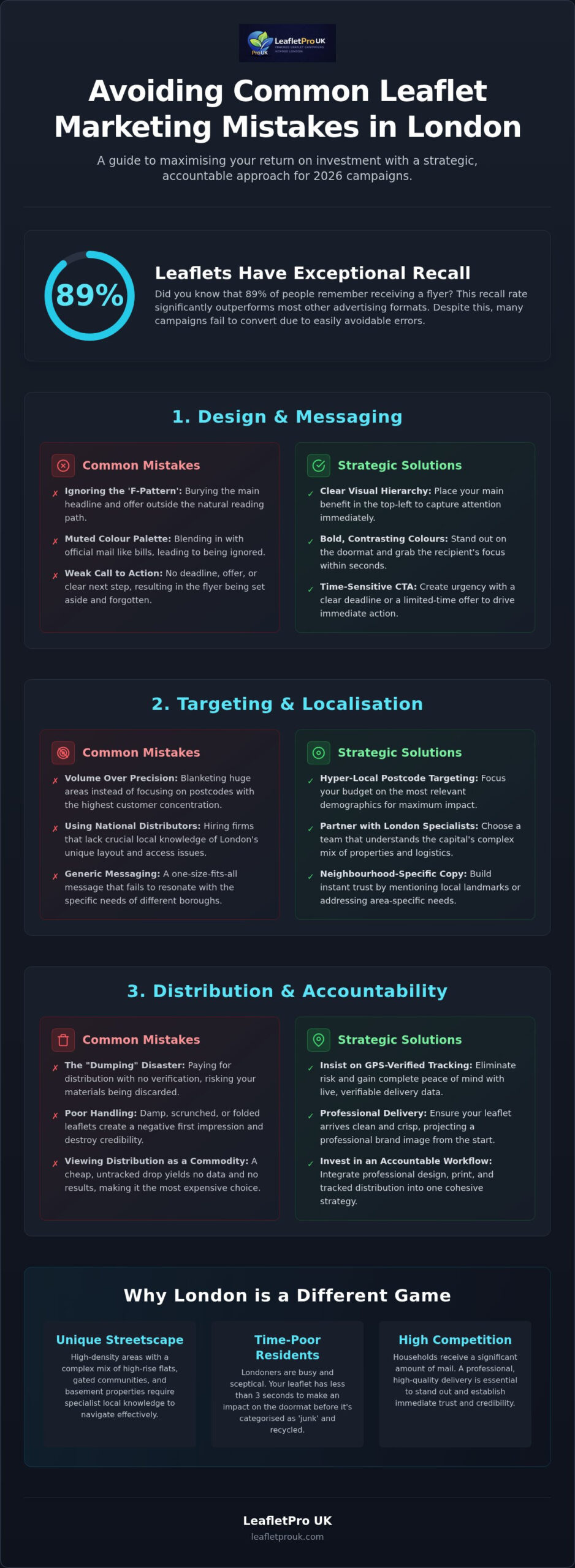
    Did you know that 89% of people remember receiving a flyer, a recall rate that significantly outperforms almost every other advertising format in 2026? Despite this high engagement, many business owners still find themselves frustrated by low conversion rates and a lack of transparency from their distributors. It’s a common anxiety; you invest in professional design and print, yet you’re left wondering if your materials actually reached the intended letterboxes or were simply discarded. Understanding the common leaflet marketing mistakes London companies frequently encounter is the first step toward securing your budget and your brand’s reputation.

    We recognise that you need more than just vague promises of delivery to feel confident in your local marketing. You deserve a distribution strategy rooted in accountability and precision. In this guide, you’ll discover how to avoid the pitfalls that waste your budget and learn the secrets to a high-ROI London leaflet campaign. We will examine the importance of GPS-verified tracking, the role of hyper-local postcode targeting, and how a systematic approach to distribution can turn a simple flyer into a powerful driver of local growth.

    Key Takeaways

    • Learn how to capture immediate attention on the doorstep by applying a clear visual hierarchy and the “F-pattern” reading layout to your flyer designs.
    • Understand why prioritising postcode precision over sheer volume ensures your message reaches the most relevant London demographics for your specific service.
    • Discover how to avoid common leaflet marketing mistakes London businesses often make by utilising GPS-verified delivery to eliminate the risk of discarded materials.
    • Master the process of integrating professional design, high-quality printing, and tracked distribution into one cohesive and accountable workflow.
    • Identify the specific performance benchmarks and response rates you should expect from a professionally executed local campaign in 2026.

    The High Stakes of Leaflet Marketing in London

    A successful 2026 leaflet campaign isn’t just about printing a high volume of flyers; it’s about physical cut-through in a world saturated by digital notifications. London households receive a significant amount of mail weekly, meaning your brand has a narrow window to make an impression. If your campaign is poorly planned, you aren’t just losing the cost of the paper. You’re losing the potential lifetime value of a customer and damaging your brand’s credibility. One of the common leaflet marketing mistakes London firms fall into is viewing distribution as a commodity rather than a strategic investment. A poorly executed drop is ultimately more expensive than a premium, tracked one because it yields no data and no results.

    To better understand the power of physical marketing, watch this helpful video:

    London vs. The Rest of the UK: A Different Game

    Distributing in London requires a level of local intelligence that national providers often lack. The capital’s streetscape is uniquely dense, featuring a complex mix of high-rise multi-occupancy buildings and strictly managed gated communities. Whilst a suburban drop in the Midlands might be straightforward, navigating the logistics of London’s 33 boroughs is a specialist task. Many businesses fail because they hire national distributors who don’t understand the physical barriers to entry in the City. Effective direct mail marketing in the capital relies on understanding micro-demographics. For instance, the messaging for a Victorian terrace in SW19 must differ from a modern apartment complex in E17 to be truly effective.

    The Psychology of the London Doormat

    Londoners are notoriously time-poor and sceptical. Most recipients categorise their post within the first three seconds of picking it up from the doormat. If your flyer arrives scrunched, damp, or buried amongst low-quality mail, it’s headed straight for the recycling bin. A professional, clean delivery is essential for establishing immediate trust in a high-competition environment. By ensuring your leaflets are handled with precision by a specialist like LeafletPro UK, you avoid the common leaflet marketing mistakes London businesses typically encounter. This professional image on the doorstep is the foundation of a high-ROI campaign, turning a simple piece of paper into a credible invitation to engage with your brand.

    Design and Messaging: Where Most Flyers Lose the Doorstep Battle

    One of the most common leaflet marketing mistakes London businesses make is overcomplicating the visual layout. When a recipient picks up a stack of mail, they scan for relevance using a predictable “F-pattern.” They start at the top left, move across, and then scan down the left side. If your primary headline isn’t positioned within this natural eye path, your message is discarded before it’s even processed. Your visual hierarchy must be ruthless; the main benefit should be the largest element on the page, followed by a supporting image and a clear instruction on what to do next.

    Consider the backdrop of a typical London doormat. Most official correspondence, such as council tax statements or utility bills, arrives in white or pale blue envelopes. If your flyer uses a similar muted palette, it risks blending into the “admin pile” that residents often ignore. Using bold, contrasting colours ensures your brand captures attention immediately. However, this visual impact must lead directly to a time-sensitive Call to Action. Failing to include a deadline or a specific reason to act now is a fatal error that results in your flyer being kept for later but eventually forgotten.

    Copywriting for the Busy Londoner

    Effective copywriting for the capital’s busy residents focuses entirely on the recipient’s needs. Instead of leaden introductions about your company’s history, lead with the immediate problem you solve. Mentioning specific London neighbourhoods, such as “Serving residents in Clapham” or “Trusted by homeowners in Islington,” provides instant local social proof that resonates far more than generic claims. To succeed, you must adhere to the One-Second Rule: a leaflet headline must communicate its primary value proposition and brand identity within one second of visual contact to avoid being discarded.

    Print Quality and Physicality

    The physical feel of your flyer speaks volumes about your professional standards. Flimsy, low-grade paper stock often suggests a flimsy service to a discerning audience. Choosing a premium finish or a heavier weight helps your message survive the letterbox without being scrunched and feels substantial in the hand. Avoiding the common leaflet marketing mistakes London firms encounter means treating every design choice as a tool for building credibility. Investing in professional leaflet design ensures that every element, from the paper weight to the visual layout, works together to prevent your campaign from being ignored. If you’re looking to elevate your brand’s presence, our team can help you organise a high-impact design that stands out on any London doormat.

    Targeting Blunders: Why Postcode Precision Trumps Volume

    One of the most common leaflet marketing mistakes London businesses commit is the “Spray and Pray” approach. They prioritise sheer volume, believing that distributing 50,000 leaflets randomly is more effective than a targeted drop of 5,000. This is rarely true. In a city as diverse as London, a mass-market strategy often leads to your message landing on the wrong doormat. It’s far more productive to reach a smaller, high-intent audience than to waste your budget on households that have no use for your service.

    London’s demographics change house by house. The messaging required to resonate with a homeowner in the leafy streets of SW19 is fundamentally different from what works for a young professional in an E17 creative hub. Failing to account for these nuances is a significant oversight. You must also use data to exclude irrelevant areas, such as industrial zones or large-scale social housing developments if you’re promoting a luxury brand. Precise targeting ensures your brand image remains professional and your ROI stays high.

    Postcode vs. Radius Marketing

    A common error is using a simple 1-mile radius for targeting. In London, a single mile can span several different council tax bands and demographic profiles. Relying on a radius often means crossing boundaries into areas where your service isn’t a fit. Instead, the most successful campaigns utilise household targeted leaflet distribution in London by focusing on specific postcode sectors. By mapping your “goldmine” areas based on where your current customers live, you can replicate that success in similar neighbourhoods with surgical precision.

    Seasonal and Timing Errors

    Timing is as critical as targeting. Dropping leaflets during holiday “blackout” periods, such as the peak of the summer holidays or the chaotic week before Christmas, often leads to lower engagement. People are either away or overwhelmed by high volumes of post. You should also consider the synergy between your drops and local events. Hitting a postcode near a local festival or during London Fashion Week can provide a relevant hook for your message. Finally, remember the “Rule of Three.” It’s often better to hit the same postcode three times to build brand recognition than to spread your resources too thin across the capital once. Avoiding these common leaflet marketing mistakes London businesses often make will ensure your campaign is both memorable and effective.

    Common Leaflet Marketing Mistakes in London: A 2026 Strategy Guide

    The Accountability Gap: Avoiding the “Dumping” Disaster

    The industry’s most uncomfortable secret is the reality of “dumping,” where unverified leaflets are discarded in recycling bins rather than delivered to doormats. This usually happens when businesses prioritise the lowest possible price over service integrity. Choosing a distributor based solely on a rock-bottom price per thousand is one of the most common leaflet marketing mistakes London entrepreneurs make. When the cost of distribution seems too good to be true, it’s often because the distributor isn’t paying their walkers a fair wage or investing in the technology required to verify their work.

    Spotting a “cowboy” distributor requires looking for specific red flags before they waste your marketing budget. Reliable partners will always be transparent about their processes and won’t shy away from difficult questions regarding their workforce. A professional agency operates with the understanding that their reputation is tied to your success. By insisting on evidence-based delivery, you transition from a hopeful “drop” to a reliable, long-term marketing programme that builds genuine brand equity across the capital.

    How to Audit Your Distribution

    A professional GPS tracking report should provide a granular view of the walker’s path, showing exactly which streets were covered and when. It isn’t enough to see a general area highlighted; you need to see the precise movement data that confirms every letterbox was reached. Beyond digital logs, the “back-checking” process remains a vital tool for verification. This involves conducting spot-checks with householders to confirm they received the material. You can learn how to track flyer distribution to ensure 100% coverage and protect your investment from being part of another “dumping” statistic.

    The Peace of Mind Factor

    Transparency acts as the foundation of a successful partnership between you and your London flyer agency. When you have access to verifiable data, you can move beyond the anxiety of missing leaflets and focus on strategy. GPS data provides more than just proof; it allows you to identify “dead zones” where response rates are low, helping you optimise future campaigns for better performance. This level of accountability is directly linked to your final ROI calculations. Without verified delivery, you’re unable to determine if a low response rate was due to your message or simply because the leaflets never reached the doorstep. Avoiding these common leaflet marketing mistakes London businesses often face ensures every pound spent is an active contribution to your growth.

    Scaling Success: Organising a Flawless London Campaign

    Organising a successful marketing drive in the capital requires more than just high-quality flyers; it demands a synchronised approach to the entire campaign lifecycle. One of the common leaflet marketing mistakes London businesses make is treating design, print, and distribution as three disconnected tasks. When these elements are handled by different providers, the risk of logistical friction increases. A design that looks perfect on a screen might use a paper weight that causes issues during high-speed sorting, or a printer might fail to understand the specific bundling requirements needed for a targeted postcode drop. By integrating these stages into a single, cohesive workflow, you ensure that your professional brand image is maintained from the initial concept to the final delivery on the doormat.

    Building long-term momentum is equally vital. Many companies fall into the trap of the “one and done” campaign, where they expect a single drop to generate a permanent shift in sales. In reality, physical marketing thrives on consistency. According to JICMAIL data from 2025, 13.9% of door drops generate a commercial action, but this figure often increases when a brand establishes a recurring local presence. Hitting the same postcode sector three times over a set period builds much higher brand recall than a solitary, unfocused effort. Before your materials leave the warehouse, ensure you’ve verified these five critical points:

    • Postcode Accuracy: Confirm the distribution map aligns exactly with your high-value target sectors.
    • Print Consistency: Verify the physical stock matches the weight and finish of your approved proof.
    • Tracking Readiness: Ensure GPS logging devices are synchronised with the specific walkers assigned to your route.
    • CTA Functionality: Test all QR codes or unique landing page URLs to confirm they track conversions correctly.
    • Quantity Audit: Cross-reference the total print volume against the household counts in your chosen London boroughs.

    The End-to-End Solution

    Using a single partner for both design and delivery significantly reduces the margin for error. At LeafletPro UK, we streamline this process by providing an integrated service that considers the logistical realities of London’s streetscape from the very first sketch. We ensure that your print finishes are durable enough to survive the letterbox whilst maintaining a premium feel that appeals to discerning residents. This systematic approach eliminates the “missing link” between a creative idea and a successfully delivered leaflet.

    Measuring Your ROI

    In 2026, a “good” response rate is defined by its contribution to your bottom line, not just the number of flyers delivered. Utilising unique “London-only” discount codes or postcode-specific QR codes allows you to track exactly where your leads are coming from. This data is essential for calculating the Lifetime Value (LTV) of customers acquired through physical mail. When you understand which streets yield the highest conversion, you can refine your strategy and scale your success with total confidence. Ready to launch? Get a GPS-tracked London distribution quote today.

    Securing Your Brand’s Future in the Capital

    Mastering the nuances of the London market requires a transition from guesswork to verified execution. By prioritising GPS accountability and hyper-local postcode targeting, you eliminate the anxieties of unverified delivery and wasted budget. Avoiding the common leaflet marketing mistakes London businesses often face allows you to focus on what truly matters; building a credible, professional presence on the doorsteps of your ideal customers. Success in 2026 isn’t built on a single drop but on a methodical, data-driven approach that integrates professional design with specialist local knowledge.

    Our end-to-end service combines professional in-house design and print with 100% GPS tracked delivery proof. This systematic approach, backed by specialist London postcode knowledge, ensures your investment is handled with the scrutiny it deserves. We provide the transparency you need to scale your local campaigns with total peace of mind.

    Your next campaign is an opportunity to outpace the competition through precision and reliability. We’re here to ensure every flyer works as hard as you do to grow your business and establish a lasting local reputation.

    Frequently Asked Questions

    How do I know if my leaflets were actually delivered in London?

    GPS tracking reports are the industry standard for verification. These reports provide a digital map showing the exact route taken by the distributor, confirming that every street and letterbox in your target area was reached. We also recommend back-checking, which involves contacting residents in the drop zone to confirm receipt. This dual-layer approach provides the transparency needed to avoid common leaflet marketing mistakes London businesses often encounter with unverified or poorly managed distribution services.

    What is the most common design mistake on London flyers?

    Overcrowding the layout with too much text is the most frequent error. Londoners are typically time-poor and will only engage with a flyer for a few seconds. If your primary value proposition and call to action aren’t immediately obvious, the material is likely to be discarded. Successful designs use high-contrast colours to stand out against white utility envelopes and follow a clear visual hierarchy that guides the eye towards the most important information.

    Which London postcodes have the highest response rates?

    Response rates vary significantly based on your specific industry and the relevance of your offer to local demographics. For instance, home improvement services often see higher engagement in leafy residential areas like SW19 or N6, whilst tech startups might find more success in creative hubs like E1 or N1. High response rates are achieved by matching your message to the specific postcode profile rather than relying on a generic, city-wide drop that ignores local nuances.

    Is GPS tracking really necessary for a small local drop?

    Yes, GPS tracking is essential regardless of the campaign size because it provides accountability and peace of mind. Even for a small drop of 5,000 leaflets, you need proof that your marketing budget wasn’t wasted on materials that ended up in a recycling bin. Tracking data allows you to verify that the distribution was completed as planned, ensuring that every pound spent has a genuine chance of generating a meaningful return for your business.

    How many leaflets should I print for a first-time London campaign?

    A first-time campaign typically requires between 5,000 and 10,000 leaflets to gather meaningful data. This volume allows you to test specific postcode sectors and measure response rates accurately without overextending your initial budget. Printing fewer than 5,000 often results in a sample size too small to determine if your messaging is effective. We suggest focusing this volume on a tightly defined area to build local brand recognition and establish a professional presence.

    Can I target specific types of houses, like terraced or detached, in London?

    You can target specific property types by utilising postcode-targeted flyer distribution. London’s diverse architecture means that certain sectors are dominated by Victorian terraces, whilst others feature modern apartment blocks or detached suburban homes. By selecting postcodes that align with your ideal customer’s housing profile, you ensure your message reaches the right environment. This precision helps you avoid the common leaflet marketing mistakes London firms make when using unfocused radius targeting that crosses demographic boundaries.

    What happens if a distributor is caught dumping leaflets?

    Dumping leaflets is a breach of contract and damages your brand’s reputation. Professional agencies have strict disciplinary procedures for such behaviour and use GPS monitoring to prevent it from occurring. If a distributor is caught, they are typically removed from the workforce immediately. Your agency should then offer a full re-delivery or a refund for the affected area. This is why choosing a transparent partner with a proven track record is vital for your peace of mind.

    How long does a typical London leaflet distribution campaign take to complete?

    A standard campaign of 10,000 leaflets usually takes between five and seven working days to complete. This timeline allows for a methodical and accurate delivery process that ensures every letterbox is reached without rushing the walkers. Larger campaigns or those involving complex multi-occupancy buildings may require additional time. We provide a clear schedule at the start of every project so you can coordinate your internal sales team or local events with the physical drop.