Tag: local marketing

  • Leaflet Distribution for Professional Services London: The 2026 Strategy

    Leaflet Distribution for Professional Services London: The 2026 Strategy

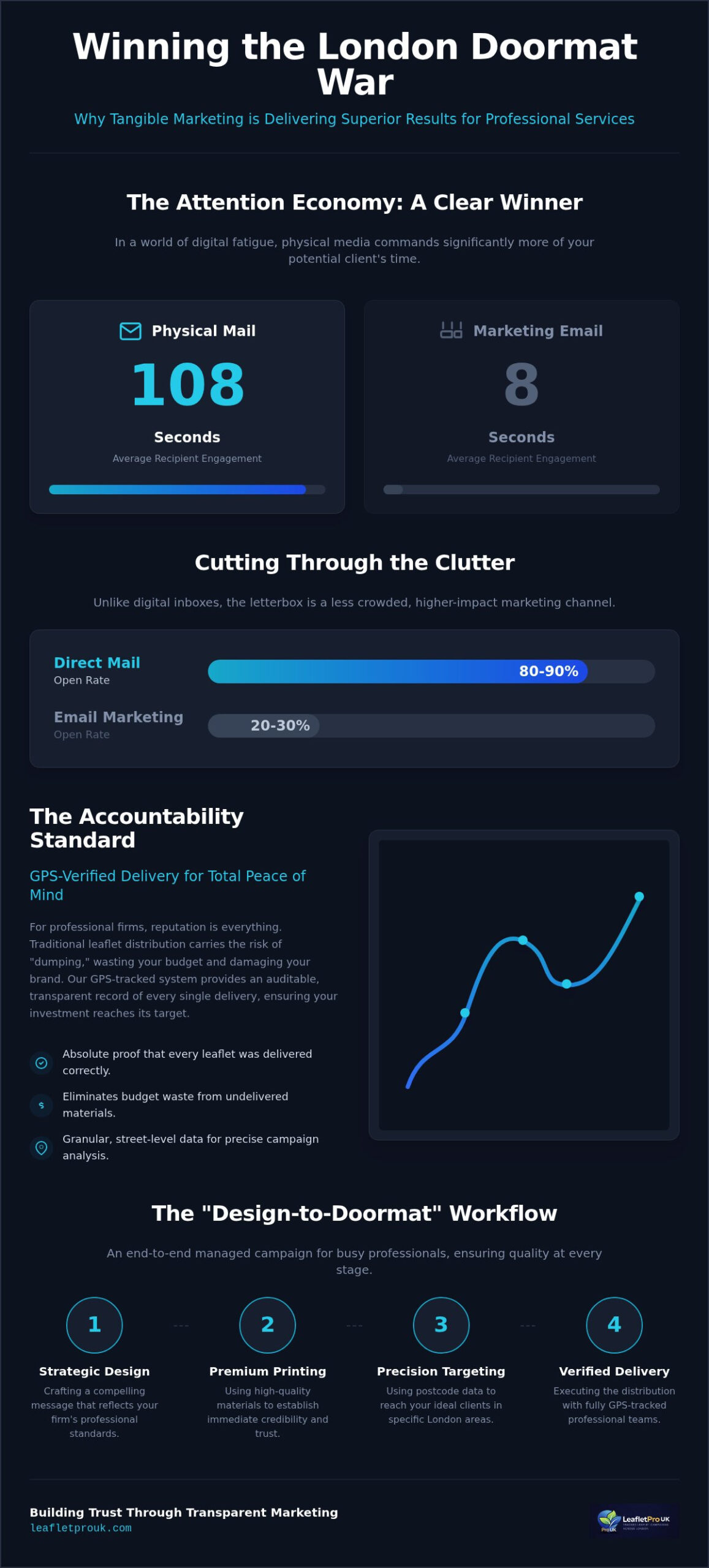
    Did you know that the average recipient spends 108 seconds engaging with physical mail, compared to a mere eight seconds for a marketing email? In a city where digital ad auctions are increasingly crowded and expensive, professional firms are finding it harder to cut through the noise. You’ve likely felt the frustration of watching your marketing budget vanish into “black hole” digital campaigns or, worse, worrying that your physical flyers ended up in a bin rather than a letterbox. Successfully executing leaflet distribution for professional services London requires more than just printing paper; it demands a level of transparency that traditional methods often lack.

    We understand that for a London business, reaching affluent households in gated blocks or high-density postcodes is a logistical challenge that requires precision. This guide will show you how to bypass digital fatigue and secure high-quality local enquiries using GPS-verified targeting. We’ll explore the 2026 strategy for building brand trust through accountable, data-driven distribution that proves every penny of your investment reached its destination.

    Key Takeaways

    • Understand why physical marketing is outperforming digital channels for London professional firms in 2026 by securing significantly higher engagement and local trust.
    • Discover how GPS-tracked delivery provides absolute verification for your campaign, eliminating the risk of undelivered flyers and ensuring your budget is fully utilised.
    • Learn to navigate London’s unique residential landscape by using precise postcode targeting to reach your ideal clients in high-density or gated areas.
    • Master a strategic approach to leaflet distribution for professional services London that combines expert design with high-quality printing to establish an authoritative brand presence.
    • Explore the efficiency of a “Design-to-Doormat” workflow, allowing busy business owners to manage end-to-end campaigns with professional precision and minimal operational friction.

    Beyond Digital: Why Flyer Distribution for Services Wins in 2026

    Leaflet distribution for professional services London operates as a high-trust acquisition channel that connects established firms with local residents. In an era where digital noise has reached a breaking point, the physical presence of a well-crafted document offers a level of authority that screens cannot match. For London-based solicitors, accountants, and estate agents, the doormat represents a direct line to the household decision-makers. By 2026, the phenomenon of “digital fatigue” has led many Londoners to subconsciously filter out online advertisements, making the tactile nature of a Flyer (pamphlet) a refreshing and more memorable alternative.

    Physicality provides a distinct advantage in terms of longevity. Whilst a digital ad disappears as soon as the user scrolls, a high-quality leaflet often resides in the home for several days. Research indicates that direct mail has an open rate of 80 to 90 per cent, which dwarfs the 20 to 30 per cent typically seen in email marketing. This extended “shelf life” ensures that your professional brand remains visible during the exact moments when a family or business owner is ready to discuss their service needs.

    Cutting Through the London Digital Noise

    London’s digital ad auctions are amongst the most competitive in the world, with Cost-Per-Click (CPC) rates for professional keywords often reaching unsustainable levels. Physical distribution offers a stable alternative with predictable costs that bypass ad-blockers and overflowing email inboxes. The psychology of the “kitchen table” is central here; this is the space where London households make significant financial and legal decisions. When your flyer lands on that table, it isn’t just an advert. It’s a tangible invitation to a professional partnership that arrives in a clutter-free environment.

    The Tangible Advantage for Professional Brands

    For service providers, the quality of the paper and the precision of the print are direct reflections of their work standards. Using premium finishes and professional layouts helps establish immediate credibility before the recipient even reads the first sentence. It’s about projecting a sense of local legitimacy and permanence. To ensure your campaign meets these high expectations, it’s vital to utilise professional leaflet design and distribution London experts who understand the nuances of the local market. This integrated approach ensures that every drop reinforces your reputation for excellence and meticulous attention to detail.

    The Accountability Standard: GPS Tracking and Professional Integrity

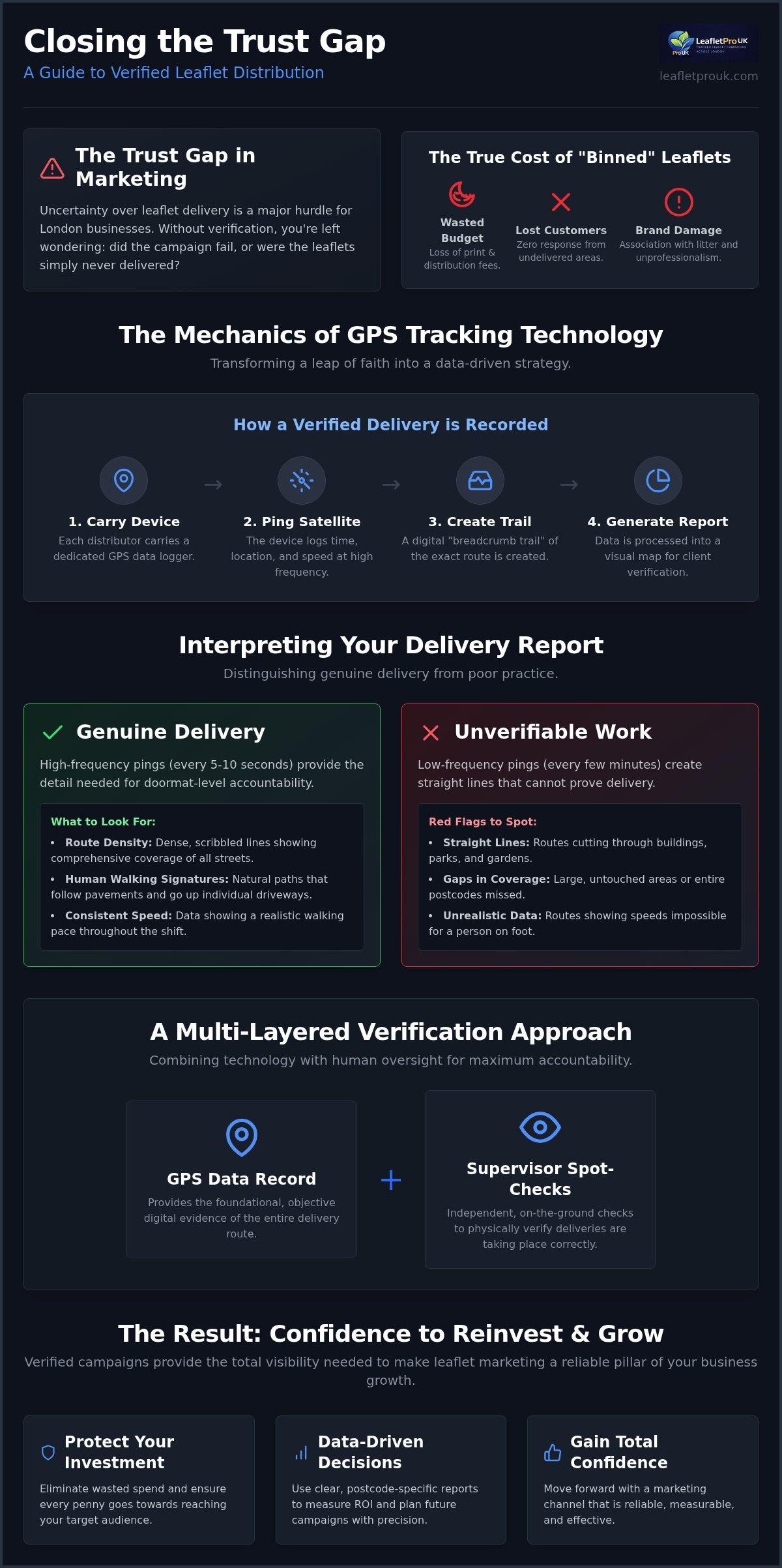
    The most persistent anxiety for any business owner investing in physical marketing is the “dumping” factor. You’ve likely heard stories of thousands of flyers ending up in a recycling bin rather than reaching their intended audience. For high-value sectors, this isn’t just a waste of budget; it’s a risk to your brand’s reputation. This is why GPS-tracked leaflet distribution for professional services London has evolved from a premium feature into an essential security standard. It provides the empirical evidence required to prove that every single piece of collateral was delivered to the correct doorstep.

    Professional integrity relies on transparency. By utilising live tracking, we transform a logistical process into a visible, auditable service. This level of scrutiny ensures that distributors remain diligent, adhering to the official UK government guidance regarding responsible distribution. It establishes a foundation of trust where you no longer have to guess about the reach of your campaign. GPS proof acts as a mandatory safeguard, ensuring your professional message is handled with the same care you apply to your own client work.

    How GPS Verification Works in Practice

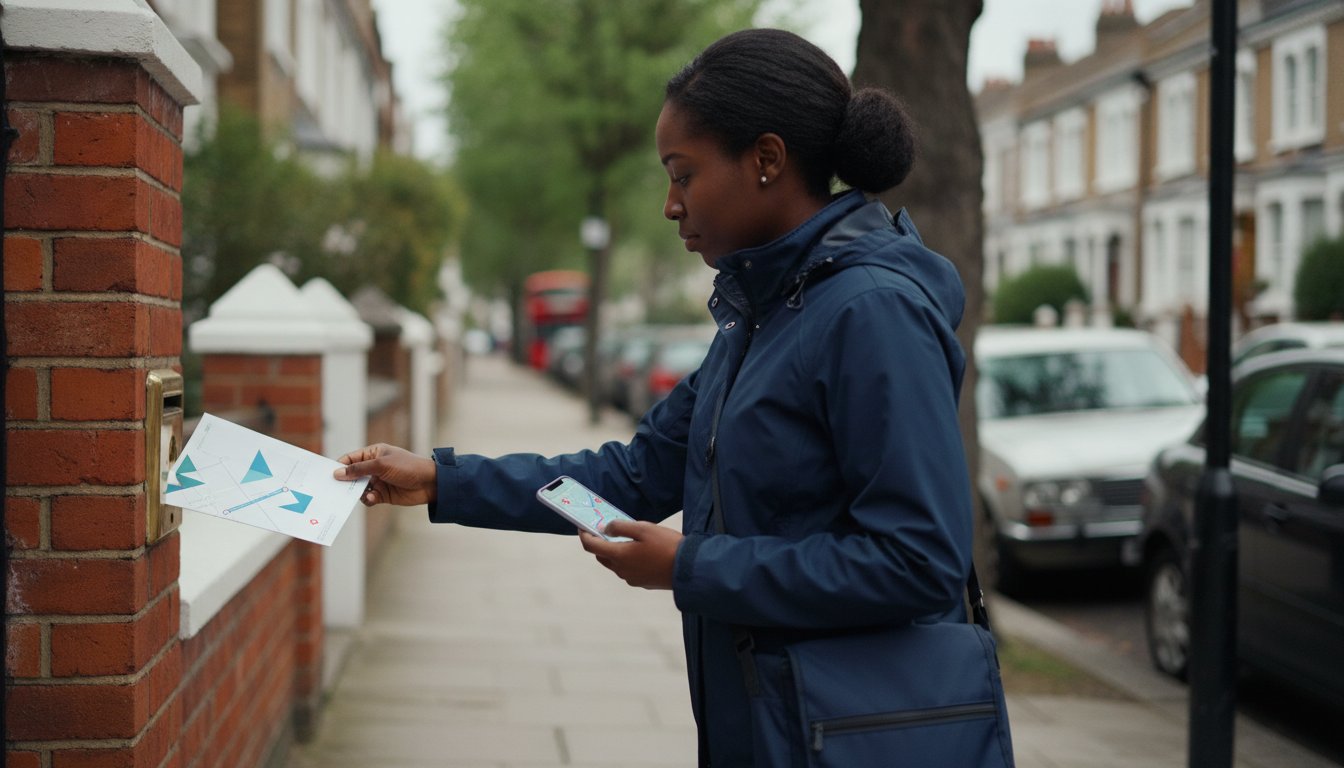
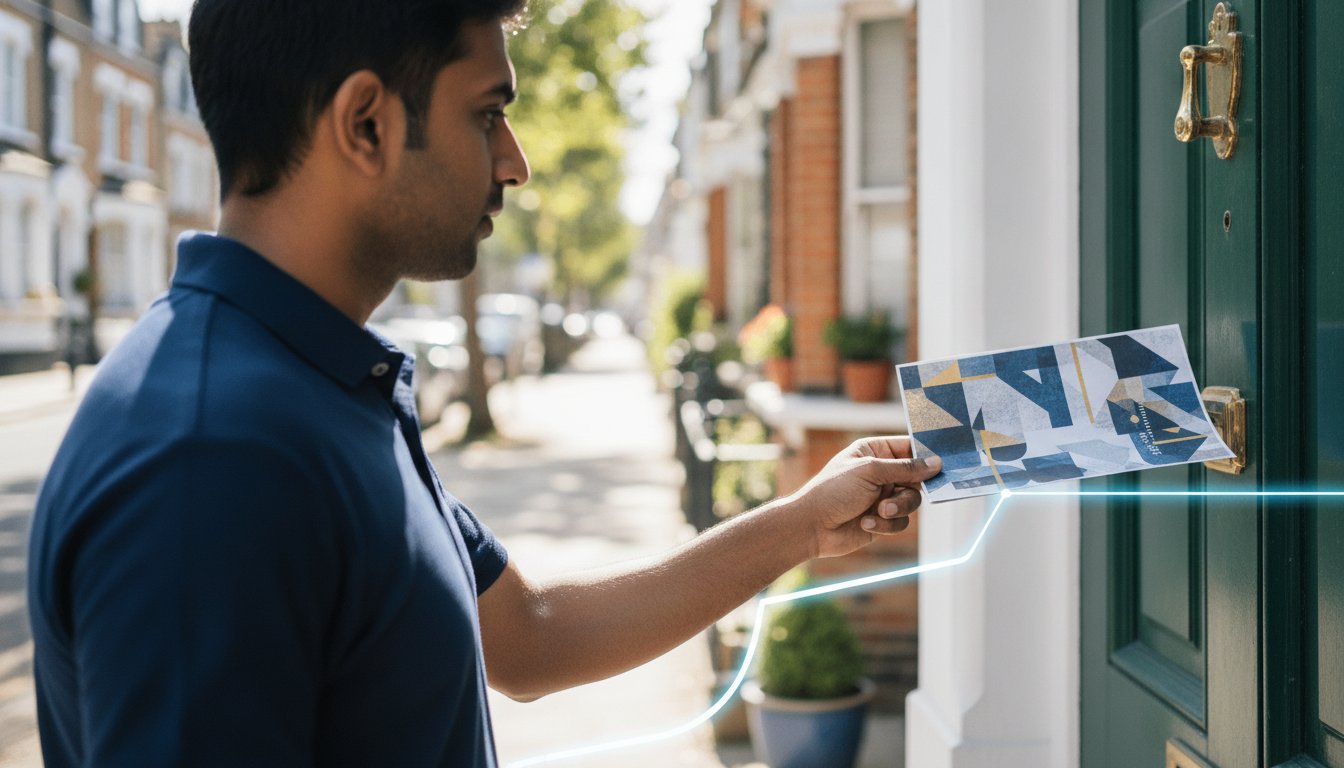
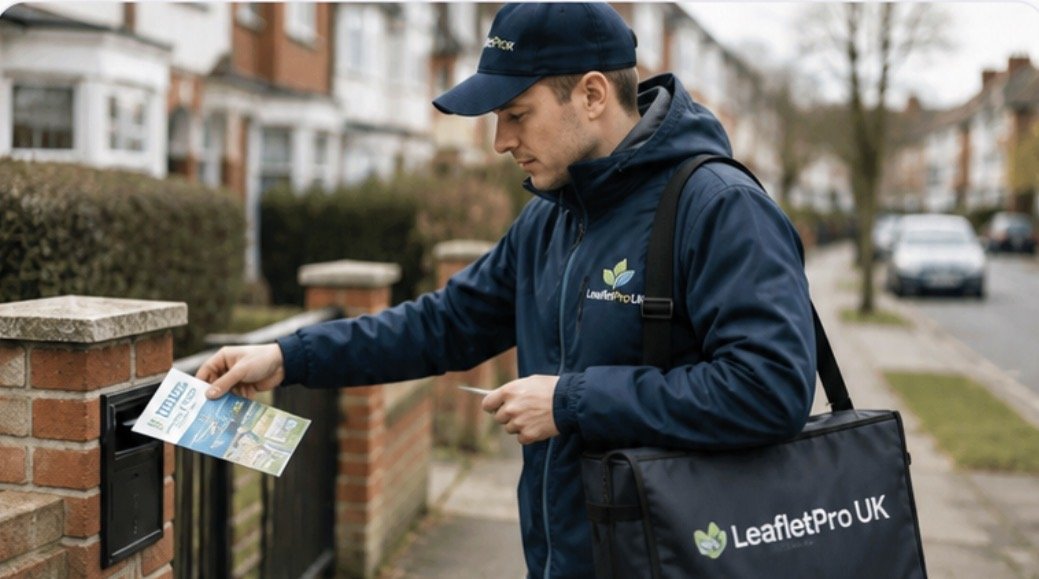
    Distributors carry specialised GPS devices that record their exact movements in real-time. Unlike basic area tracking, which only shows a general presence in a postcode, granular street-level data captures the specific path taken to every letterbox. This ensures “cleanliness of work,” a term we use to describe the professional standard of delivery. It means flyers are pushed fully through the door rather than being left hanging or discarded in communal areas. You can verify our distribution standards to see how this precision protects your professional image.

    Auditing Your London Campaign Results

    Once a drop is complete, you receive a comprehensive report featuring the raw GPS data. This allows you to cross-reference the delivery path against your target postcodes. By knowing exactly where your flyers landed, you can correlate incoming enquiries with specific streets, allowing for a far more accurate calculation of ROI. This data-led approach is explored further in our GPS Tracked Leaflet Distribution Guide. Having access to this level of detail empowers you to refine future campaigns, focusing your budget on the areas that generate the highest volume of qualified leads for your firm.

    Strategic Roundup: Tailoring Campaigns for London Service Sectors

    A “one-size-fits-all” template rarely succeeds in the capital’s nuanced market. When planning leaflet distribution for professional services London, your strategy must align with the specific expectations of your target demographic. High-value sectors like wealth management or legal firms often benefit from “Solus” distribution. This exclusive approach ensures your brand isn’t diluted by being bundled with unrelated flyers. Meanwhile, shared drops offer a balanced way for local businesses to maintain a steady presence amongst residents. A well-timed drop can be the difference between a forgotten ad and a confirmed appointment. Ensuring your campaign follows UK government guidelines on leaflet distribution is a fundamental step in maintaining professional standards.

    Estate Agents and Property Professionals

    London property professionals require collateral that feels as substantial as the investments they manage. High-gloss, premium cardstock is essential for projecting a high-end image. Strategy involves targeting high-value postcodes for valuations or “Just Sold” notices to create local momentum. By including a QR code, you can offer residents an instant digital property valuation, turning a static flyer into a dynamic lead-generation tool. This integrated approach is a hallmark of a professional leaflet distribution company service.

    Healthcare, Dental, and Wellness Clinics

    For dental, healthcare, and wellness clinics, the primary goal is building local familiarity. Drops should be concentrated within a 10-15 minute walking radius of the facility to capture the most relevant footfall. Trust is the currency of health. Highlighting professional qualifications, CQC ratings, and “First Consultation Free” offers lowers the barrier for new patients. It’s about presenting your clinic as a safe, credible choice for the local community.

    Home Improvements and Professional Trades

    Home improvement services find success by matching their message to seasonal demands. Promoting boiler servicing in autumn or roofing repairs before winter sets in is a proven tactic. Authority is built through evidence. Including Trustpilot logos alongside a mention of a recent project on a nearby street provides the social proof Londoners look for. A clear, time-sensitive CTA like “Book by October 1st” provides the necessary nudge to move from interest to enquiry.
    Leaflet Distribution for Professional Services London: The 2026 Strategy

    Precision Targeting: Using London Postcodes to Reach Your Ideal Customer

    London is a unique landscape composed of thousands of distinct postcode micro-markets. For a professional firm, a blanket approach is rarely cost-effective and often leads to significant budget wastage. Success hinges on precise postcode-targeted delivery. This method ensures your message reaches specific demographics, such as affluent homeowners or growing families, rather than being scattered across irrelevant areas. Identifying these high-potential streets requires a data-driven approach that looks beyond simple geography to understand the socio-economic profile of each neighbourhood. By focusing on specific sectors within a borough, you can optimise your spend and increase the likelihood of generating high-quality enquiries from residents who actually need your services.

    Identifying Your London ‘Goldmine’ Areas

    Postcode maps are the foundation of any strategic campaign. There’s a stark difference between the established, high-net-worth households of SW postcodes like Chelsea or Wimbledon and the rapidly emerging professional markets in East London. Mapping these areas allows you to align your service offering with the local resident profile. For instance, a private dental clinic might target different postcodes than a high-end estate agency. To explore this further, consult our Household Targeted Leaflet Distribution London Guide, which outlines how to refine your reach using 2026 demographic data.

    Maximising Coverage in High-Density London

    London presents unique logistical hurdles, particularly gated communities and high-rise blocks with restricted access. Many national distributors struggle with these complexities, leading to missed opportunities and wasted stock that never reaches a doormat. Maximising coverage requires a distributor with hyper-local London knowledge and the patience to navigate complex residential layouts. We understand the specific access protocols for different boroughs, ensuring your leaflets reach the doormats of residents in even the most exclusive developments. This niche expertise is what separates a professional leaflet distribution for professional services London campaign from a generic, unreliable drop. Using a London-exclusive partner means your campaign is executed by specialists who navigate these streets daily, ensuring no letterbox is overlooked due to a lack of local familiarity or access insight.

    From Concept to Doormat: Organising a Full-Service Campaign

    For a busy London business owner, marketing should be a seamless extension of their professional standards rather than a logistical burden. Transitioning from a marketing concept to a physical doormat presence requires a coordinated “Design-to-Doormat” approach. This ensures that the high-trust reputation you’ve built isn’t compromised by poor execution or a lack of oversight. By integrating design, printing, and distribution into a single, verified workflow, you eliminate the friction of managing multiple vendors. This systematic reliability is essential when executing leaflet distribution for professional services London, where every household interaction is a reflection of your firm’s credibility.

    The physical “hand-feel” of your marketing material communicates your brand’s value before a single word is read. Using thin or low-quality flyers can inadvertently signal a lack of permanence, which is particularly damaging for premium service providers like law firms or private clinics. A heavier paper weight combined with a silk or gloss finish provides the tactile authority required to stand out amongst household post. It’s about projecting a sense of established authority through every detail of the process.

    Professional Design and Print Standards

    Expert design support ensures your message isn’t just aesthetically pleasing but also structured for conversion. Unlike automated templates that lack local nuance, bespoke design allows for a clear hierarchy of information and a professional layout that builds immediate trust. Choosing the right finish is equally vital for professional credibility. Silk finishes often project a sophisticated, understated elegance that suits legal or financial services, whilst gloss can make high-resolution property photography or vibrant wellness branding pop. These choices are fundamental to establishing a professional brand that local residents feel comfortable inviting into their homes.

    The LeafletPro UK Distribution Process

    Our methodology is built on transparency and precision, guiding you through a structured three-step journey. First, we provide a consultation to select the most relevant postcodes based on your specific service niche, ensuring you don’t waste stock on uninterested demographics. Second, we assist in designing a high-converting flyer that features a clear, local Call to Action (CTA) tailored to your London audience. Finally, our team carries out GPS-tracked delivery, providing you with the full accountability reporting required to verify your investment. This end-to-end service allows you to focus on your clients whilst we handle the complex logistics of local market engagement.

    Securing Your Local Market Presence in 2026

    Building a sustainable pipeline of local enquiries in 2026 requires a return to tangible, high-trust marketing. We’ve explored how a physical presence on the doormat bypasses the exhaustion of digital ad auctions, provided every drop is backed by empirical evidence. By implementing GPS-tracked leaflet distribution for professional services London, your firm moves from guesswork to a verified acquisition model that respects your budget and protects your reputation. Our specialised London-only logistics expertise ensures your collateral reaches the right households, even within the city’s most complex residential blocks.

    Success depends on the integrity of the process. By utilising a full end-to-end service that covers design, print, and delivery, you ensure a consistent standard of quality that builds immediate credibility with local residents. With GPS-tracked route reports provided for every drop, you gain the visibility needed to calculate accurate ROI and refine your local outreach with confidence.

    It’s time to reclaim your local market and establish a lasting connection with the residents who matter most to your business. We’re ready to help you deliver results with precision and care.

    Frequently Asked Questions

    Is leaflet distribution still effective for professional services in London?

    Physical marketing remains highly effective because it bypasses the “digital noise” that often overwhelms London residents. Unlike a fleeting social media ad, a physical flyer stays in the home for several days, offering a tactile reminder of your brand. For leaflet distribution for professional services London, this translates to higher engagement levels. Direct mail has a significantly higher open rate than email, providing a reliable way to build local trust and authority.

    How does GPS tracking prove my leaflets were actually delivered?

    GPS tracking provides empirical proof of delivery by logging the exact path taken by our distributors. Every letterbox interaction is recorded using live devices, which generate a granular route report for your review. This “Accountability-as-a-Service” model eliminates the industry fear of “dumping” and ensures your investment is fully utilised. You’ll receive transparent data showing exactly which streets were covered, providing the peace of mind that your message reached its destination.

    Can I target specific affluent postcodes in London for my campaign?

    You can absolutely target specific affluent postcodes to ensure your campaign reaches your ideal household profile. London’s micro-markets vary significantly, so we use demographic data to identify high-potential areas such as established SW postcodes or emerging professional hubs. This postcode-targeted delivery prevents budget wastage on irrelevant areas. By focusing on specific streets rather than blanket drops, you increase the likelihood of securing enquiries from qualified local leads.

    What is the difference between solus and shared distribution for services?

    Solus distribution is an exclusive service where your flyer is delivered on its own, ensuring the recipient’s undivided attention. This is often preferred by premium professional brands to maintain high-end positioning. Shared distribution involves delivering your leaflet alongside a few non-competing flyers, making it a more cost-effective option for consistent local presence. Both methods utilise our GPS-tracked standards, allowing you to choose the approach that best fits your brand strategy.

    Do you provide professional design and high-quality printing services?

    LeafletPro UK provides a complete end-to-end solution that includes professional design support and high-quality printing. We understand that the “hand-feel” of your flyer is a direct reflection of your service standards. Our team helps you create high-converting layouts with clear calls to action, which are then produced using premium finishes. Managing the entire journey from concept to doormat ensures a consistent, professional brand image that builds immediate credibility with Londoners.

    How long does a typical London leaflet distribution campaign take?

    The duration of a campaign typically depends on the volume of leaflets and the specific postcodes targeted. Once your design and printing are finalised, most distribution phases are completed within one to two weeks. We prioritise a methodical pace to ensure every letterbox is reached with the required “cleanliness of work.” We’ll provide a clear timeline during your initial consultation so you can coordinate your internal resources to handle the resulting enquiries.

    What is the best time of year for a service business to distribute flyers?

    The optimal timing for a campaign often depends on your specific service sector and seasonal demand. For example, home improvement trades often see higher conversion in autumn, whilst property professionals may target the busy spring market. However, repetition is key to building lasting brand recognition in London’s competitive landscape. Success often involves at least three drops to the same area to build the familiarity and trust needed to drive a meaningful response.

    How do I measure the ROI of my flyer distribution campaign?

    Measuring ROI is straightforward when you integrate trackable elements into your flyer design. We recommend using unique QR codes, dedicated phone numbers, or specific landing pages to monitor which enquiries originate from your leaflet distribution for professional services London campaign. By cross-referencing these leads with our GPS delivery reports, you can identify which postcodes are generating the highest returns. This data-led approach allows you to refine future drops for even greater efficiency.
  • 45+ Leaflet Call to Action Examples for London Sales 2026

    45+ Leaflet Call to Action Examples for London Sales 2026

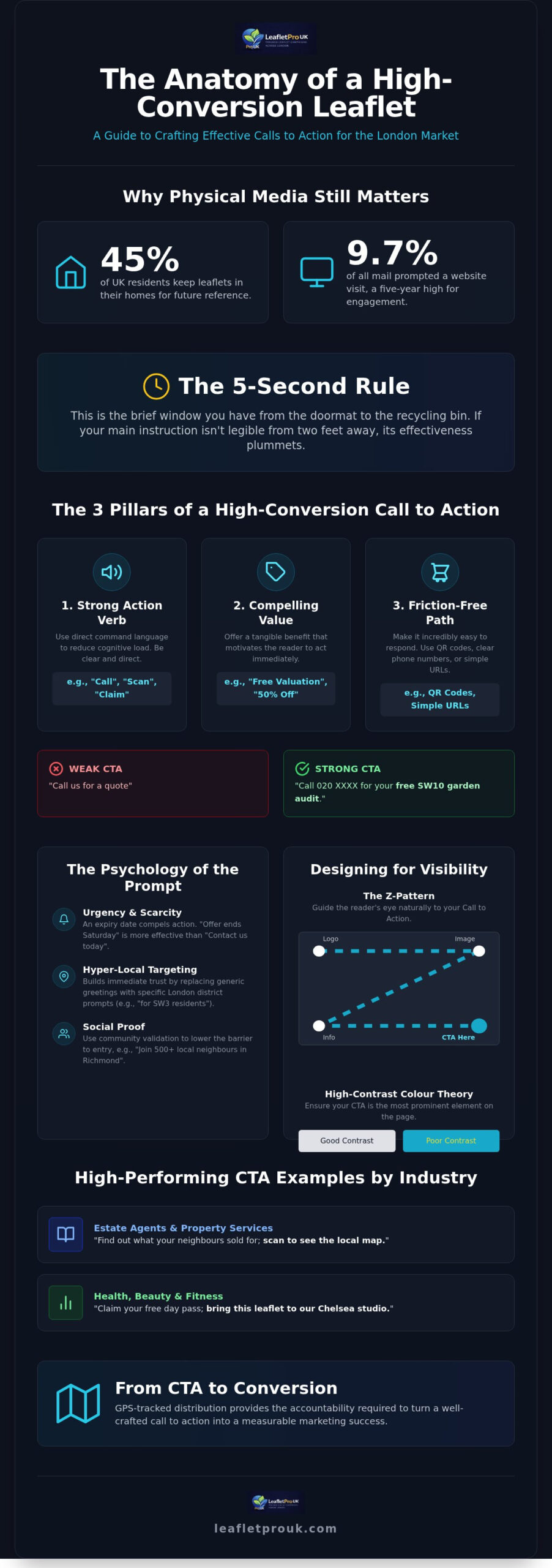
    Did you know that 45% of UK residents keep leaflets in their homes for future reference? Whilst it’s easy to assume that physical mail gets lost in the “junk” pile, the reality is that 9.7% of all mail prompted a website visit in late 2025, marking a five-year high for engagement. You likely understand the frustration of a campaign that fails to land, especially when you can’t be certain if your flyers even reached the doormat. We agree that a professional distribution strategy is worthless if your message doesn’t compel the reader to act immediately.

    In this guide, we promise to provide you with over 45 high-conversion leaflet call to action examples specifically tailored for the competitive London market in 2026. You’ll discover how to move beyond generic phrases and utilise hyper-local postcode prompts that resonate with residents in specific boroughs. We will preview the essential design principles that make your CTA pop and explain how GPS-tracked delivery ensures your investment translates into measurable results. From discount codes to digital-physical integrations, you’ll gain the exact tools needed to transform your next London drop into a high-performing sales channel.

    Key Takeaways

    • Understand why physical CTAs require a distinct psychological approach compared to digital buttons to effectively bridge the gap between the doormat and the checkout.
    • Access a curated list of over 45 leaflet call to action examples categorised by industry to inspire your next high-performing London campaign.
    • Learn how hyper-local postcode targeting builds immediate trust with residents by replacing generic greetings with specific London district prompts.
    • Master visual design techniques, including the Z-pattern and high-contrast colour theory, to ensure your call to action remains the focal point of your flyer.
    • Discover how GPS-tracked distribution provides the accountability required to turn a well-crafted CTA into a measurable marketing success.

    The Anatomy of a High-Conversion Leaflet Call to Action

    A Call to action (CTA) serves as the vital bridge between your marketing message and the customer’s eventual purchase. Unlike a digital button that allows for instant clicking, a physical leaflet requires a more robust psychological nudge. You aren’t just asking for a click; you’re asking a London homeowner to pause their routine and engage with a physical object. To succeed, your leaflet call to action examples must balance three core pillars: a strong action verb, a compelling value proposition, and a friction-free method of contact. If any of these elements are missing, the bridge breaks. For instance, “Call us for a quote” is significantly weaker than “Call 020 XXXX for your free SW10 garden audit.”

    In the fast-paced London environment, your flyer faces the “5-second rule.” This is the brief window of time it takes for a resident to walk from their front door to the recycling bin. If the primary instruction isn’t legible from a distance of at least two feet, the campaign’s effectiveness drops. Clarity is the foundation of credibility. If a reader has to hunt for the phone number or website amongst the graphics, they will likely move on. We prioritise a layout where the CTA is the most prominent element on the page, ensuring the path to conversion is unmistakable.

    The Psychology of the Prompt

    Direct command language reduces cognitive load for the busy London homeowner. Clear instructions like “Bring this flyer to our Chelsea shop” or “Scan for your SW3 discount” perform better than passive suggestions. We recommend using urgency to drive immediate behaviour. Whilst research shows 45% of UK residents keep leaflets for future reference, an expiry date ensures that “future” becomes “today.” Phrases such as “Offer ends Saturday” create a necessary sense of scarcity that “Contact us today” simply lacks.

    Choosing Your Conversion Path

    Selecting the right path depends on your specific business goals and target borough. Direct response remains ideal for local tradespeople; a prominent phone number encourages immediate local trust. Digital bridges, such as QR codes, are now essential for linking physical media to London-specific landing pages. This allows for precise tracking of ROI. Finally, social proof prompts like “Join 500+ local neighbours in Richmond” use community validation to lower the barrier to entry. By combining professional leaflet design support with these leaflet call to action examples, you ensure your message isn’t just seen, but acted upon.

    45+ Leaflet Call to Action Examples Categorised by Industry

    Generic instructions often result in poor engagement because they fail to address the specific needs of a local audience. To achieve high response rates, your prompts must align with the effective flyer design and print London principles, ensuring the instruction is both visually clear and contextually relevant. Industry data highlights the effectiveness of direct mail when the message provides immediate, tangible value to the recipient. These leaflet call to action examples are designed to cut through the noise of a busy London household by offering clear, low-friction next steps.

    Estate Agents and Property Services

    Property marketing relies on establishing local authority and trust. Your CTA should offer expertise that a homeowner cannot find through a simple web search.

    • “Book your free SE1 property valuation today; call [Number].”
    • “Find out what your neighbours sold for; scan to see the local map.”
    • “Thinking of moving in 2026? Get our free local market report.”
    • “Register for off-market SW19 listings; text ‘HOME’ to [Number].”
    • “Claim your free landlord compliance checklist; visit [URL].”

    Health, Beauty, and Fitness

    For wellness businesses, the goal is to lower the barrier to entry. Using physical leaflets to offer “taster” experiences is a proven method for building a local client base.

    • “Claim your free day pass; bring this leaflet to our Chelsea studio.”
    • “First haircut half price; book online using code LONDON50.”
    • “Start your 6-week transformation; only 10 spots left for [Neighbourhood] residents.”
    • “Scan for a virtual tour of our new Islington spa.”
    • “Bring a friend for free this Friday; show this flyer at reception.”

    Restaurants, Cafes, and Local Shops

    Hospitality CTAs should focus on immediate gratification and community exclusivity. Postcode-specific offers make residents feel like “local insiders.”

    • “Dinner is on us; Buy one main, get one free this Tuesday.”
    • “Scan for our secret local menu; only for our [Postcode] neighbours.”
    • “Show this flyer at the till for a free coffee with any pastry.”
    • “Book your Sunday Roast table; call 020 XXXX to secure your spot.”
    • “Get 20% off your first takeaway order; use code LOCAL20.”

    These leaflet call to action examples work most effectively when they are delivered with precision. To ensure your message reaches the correct doormats, it is essential to partner with a professional leaflet distribution company that understands the nuances of London’s diverse boroughs. By combining a compelling offer with verified delivery, you can transform a simple flyer into a reliable lead-generation tool for your business.

    Hyper-Local CTAs: Using London Postcodes for Better Response

    In London’s dense urban market, generic greetings like “Dear Neighbour” often feel like mass-produced noise. Residents are more likely to engage when they feel a message is crafted specifically for their street or borough. By using hyper-local identifiers, you transform a standard marketing piece into a community-relevant notice. This approach taps into the psychology of effective calls to action, where familiarity breeds trust and reduces the mental friction of responding. When a resident sees their own postcode on a flyer, the perceived relevance of the offer increases immediately.

    The Postcode Power Play

    Mentioning a specific postcode district, such as “Attention SW19 Residents,” immediately anchors your service in the reader’s physical reality. This level of precision is most effective when paired with household targeted leaflet distribution London, ensuring your flyers reach high-density areas where your service is most needed. You don’t just want a broad reach; you want a relevant reach. Consider these leaflet call to action examples that leverage local geography:

    • “Exclusive N1 residents discount: 20% off your first booking.”
    • “Free lawn health checks for TW9 homeowners this week.”
    • “New boutique opening near Victoria Park; scan for your opening night invite.”

    Mentioning a local street or a well-known park increases the “keepability” of a leaflet. Residents are less likely to discard a flyer that mentions their specific micro-neighbourhood, as it feels like a bespoke service rather than a cold solicitation.

    Trust through Local Presence

    Trust is the currency of the London doormat. Proving you are a genuine local entity rather than a faceless national chain can significantly boost response rates. One effective method is referencing local landmarks or transit hubs to provide a mental map for the customer. A CTA like “Visit us on the High Street, just a 2-minute walk from Angel Station” makes the visit feel convenient and low-risk. It tells the reader exactly where you are without them needing to open a map app.

    Historical presence also matters in a city that is constantly changing. Using phrases like “Serving the Bromley community since 2010; see our local reviews” provides the credibility residents look for. Additionally, using a traditional 020 landline number rather than a mobile number reinforces a sense of permanence and professional standards. Whilst mobile numbers are common, the London landline suggests an established office or shopfront. These subtle leaflet call to action examples work because they provide the tangible proof Londoners require before picking up the phone.

    Finally, remember that London’s 33 boroughs have vastly different demographics. A CTA for a luxury service in Chelsea should focus on “Bespoke consultations for SW3 residents,” whereas a student-focused offer in Camden might use “Flash this flyer for a free drink.” Tailoring your language to the specific borough ensures your message resonates with the local culture and economic profile of the area.

    45+ Leaflet Call to Action Examples for London Sales 2026

    Designing Your CTA for Maximum Visibility

    A well-crafted message only works if the reader’s eye is physically led to it. Most London residents scan a piece of mail in less than five seconds before deciding its fate. To capture this brief window of attention, you must utilise established reading patterns. The Z-pattern is particularly effective for flyers with minimal text, guiding the eye from the headline across the page and down to the bottom-right corner. This is where your primary leaflet call to action examples should be positioned for maximum impact. If your design is more information-heavy, an F-pattern layout ensures the reader encounters your instruction whilst scanning the left-hand margin.

    Colour theory plays a vital role in making your instruction stand out against the background. We recommend using high-contrast colour pairings that separate the CTA from the rest of the design. For example, a bright orange action button on a deep blue background creates a visual vibration that is difficult to ignore. Typography should follow a similar logic of clarity. Bold, sans-serif fonts are the standard for action words because they remain legible even in low light or from a distance. Clutter is the ultimate enemy of conversion; using “white space” around your CTA ensures the message isn’t swallowed by secondary graphics or lengthy paragraphs.

    QR Codes: The Modern CTA

    QR codes have become the standard for linking physical media to digital results. To ensure your QR code is doormat-friendly, place it at least 2cm away from the edge of the flyer to prevent it from being clipped during the high-quality printing process. Always include a clear “Scan Me” instruction alongside the code to remove any ambiguity. For a sophisticated London campaign, we suggest creating unique landing pages for different postcodes. This allows you to track exactly which boroughs are generating the most engagement, providing the data needed to refine your future distribution strategy.

    Visual Cues and Directional Elements

    Directional elements act as silent guides for the reader. Using arrows that point toward your phone number or website can increase response rates by physically directing the eye to the next step. If your leaflet includes photography of people, ensure their eyeline is directed toward the CTA text rather than looking off-page. For limited-time offers, a “burst” or “sticker” effect can highlight a discount whilst creating a sense of urgency. Visual hierarchy is the strategic arrangement of design elements to lead the reader’s eye toward the conversion point, serving as the hidden engine behind physical marketing ROI.

    Measuring Success: From CTA to GPS-Tracked Conversion

    A persuasive message is only a theoretical success until it physically reaches the doormat. We prioritise transparency because we understand that even the best leaflet call to action examples fail if the distribution process lacks integrity. To accurately calculate your response rates, you need a verified “denominator”, which is the exact number of homes that received your flyer. This is why GPS tracked leaflet distribution serves as the essential baseline for measuring marketing effectiveness. Without tracked proof, you cannot distinguish between a flawed creative strategy and a failure in the logistical delivery chain.

    Measuring response requires a systematic approach to data collection. You should utilise unique tracking mechanisms for every campaign, such as dedicated phone numbers or borough-specific promo codes. Dedicated URLs or QR codes that lead to hidden landing pages are particularly effective for London businesses looking to segment their results. These tools allow you to attribute every lead to a specific drop, providing the evidence needed to justify your marketing spend. If a low response rate occurs despite 100% verified delivery, you’ll know it’s time to adjust the offer or the design rather than the distribution partner. This systematic verification ensures that every marketing decision is based on tangible results rather than vague assumptions.

    The Accountability Standard

    Our commitment to visibility ensures you never have to guess about the status of your campaign. By using GPS reports to verify that every letterbox in your targeted London postcodes was reached, you gain the peace of mind that your investment was handled with precision. You can cross-reference these delivery timestamps with spikes in your website traffic or incoming enquiries to see the immediate impact of your drop. This data-driven approach helps you avoid common leaflet marketing mistakes London companies face when they rely on unverified “blind” drops. Accountability is not just a feature; it is the baseline for professional marketing standards.

    A/B Testing Your CTAs

    The diversity amongst London’s boroughs provides a unique opportunity to refine your leaflet call to action examples through A/B testing. You might test a “20% off” offer in Wandsworth whilst running a “Buy One Get One Free” promotion in a demographically similar area of Battersea. GPS data ensures these test zones are truly comparable in terms of housing density and economic profile. By analysing the results from these two distinct areas, you can identify which psychological trigger resonates most with your target audience. Scaling your success becomes a logical, methodical process once you have identified the highest-performing prompt through rigorous local testing.

    Optimising Your London Marketing Strategy for 2026

    A successful campaign requires more than just a creative headline; it demands a systematic integration of clear visual hierarchy, hyper-local messaging, and verifiable delivery. By applying these leaflet call to action examples, you can effectively bridge the gap between a resident’s doormat and your business’s bottom line. We’ve established that trust in the London market is built through accountability and professional standards. Specialist London postcode targeting ensures your message reaches the intended demographic, whilst dedicated design support ensures your instruction remains the focal point of every flyer.

    Physical marketing in 2026 is no longer a matter of guesswork. With GPS-tracked delivery data provided for every campaign, you can move forward with the confidence that your investment is being handled with absolute integrity. It’s time to transform your flyers into reliable sales tools that drive measurable results across the capital.

    Frequently Asked Questions

    What is the best call to action for a local business leaflet?

    The most effective call to action for a local business is one that combines a clear command with a tangible local benefit. For instance, “Book your free Richmond boiler service” is superior to a generic “Call us.” We recommend focusing on a low-friction entry point that addresses a specific need within your London borough. This approach reduces the mental effort required for the resident to take the next step towards your business.

    How many CTAs should I include on a single flyer?

    You should generally stick to one primary call to action to avoid confusing the reader. Whilst it’s tempting to offer multiple contact methods, a single dominant instruction typically yields higher response rates. If you must include a secondary option, ensure it doesn’t compete for visual attention. A clear hierarchy allows the London homeowner to understand exactly what they need to do within the first few seconds of engagement.

    Does a QR code work better than a phone number on a leaflet?

    QR codes and phone numbers serve different demographic preferences, so the best choice depends on your target London audience. Younger residents often prefer the speed of a QR code that links to a mobile-optimised landing page. Conversely, older homeowners or those seeking urgent local services may prefer a traditional 020 landline number. We suggest including both to ensure you don’t exclude potential customers based on their preferred communication method.

    How can I track how many people responded to my leaflet campaign?

    Tracking response rates is best achieved through unique identifiers like borough-specific promo codes or dedicated landing page URLs. By assigning a different code to each London postcode drop, you can precisely measure which areas generate the most leads. You can also use dedicated tracking phone numbers. These methods provide the hard data needed to refine your leaflet call to action examples for future campaigns and calculate your exact ROI.

    What words should I avoid in a leaflet call to action?

    Avoid passive or vague language like “Click here” or “Contact us for more details.” These phrases lack a value proposition and fail to motivate immediate action. You should also steer clear of overly aggressive sales jargon that can appear untrustworthy to London residents. Instead, use active verbs that promise a benefit, such as “Claim,” “Discover,” or “Receive,” which feel more like an invitation than a hard sales pitch.

    How do I make my CTA stand out on a crowded leaflet design?

    Making your instruction stand out requires the strategic use of high-contrast colours and generous white space. If your design is crowded, the eye won’t know where to land, which often leads to the flyer being discarded. Use a bold, sans-serif font for your primary action word and ensure it’s at least 20% larger than the surrounding body text. Our design support team focuses on creating this visual hierarchy to ensure your message pops.

    Is it better to put the CTA on the front or the back of the leaflet?

    You must place your primary call to action on the front of the leaflet to ensure it’s seen immediately upon delivery. Since many flyers are scanned whilst walking from the doormat to the bin, you cannot rely on the reader turning the page over. However, repeating a secondary version of the CTA on the back can reinforce the message for those who take the time to read the full content of your leaflet call to action examples.

    How do I know if my leaflets were actually delivered in London?

    The only reliable way to verify delivery is through GPS-tracked distribution reports that show the exact route taken by the distributor. At LeafletPro UK, we provide this transparent data for every campaign we handle across London. This reporting allows you to see exactly which streets were reached and at what time. It eliminates the industry anxiety regarding “blind” drops and provides the accountability you need for your marketing investment.

  • Guaranteed Flyer Delivery London: A Guide to Accountable Postcode Marketing

    Guaranteed Flyer Delivery London: A Guide to Accountable Postcode Marketing

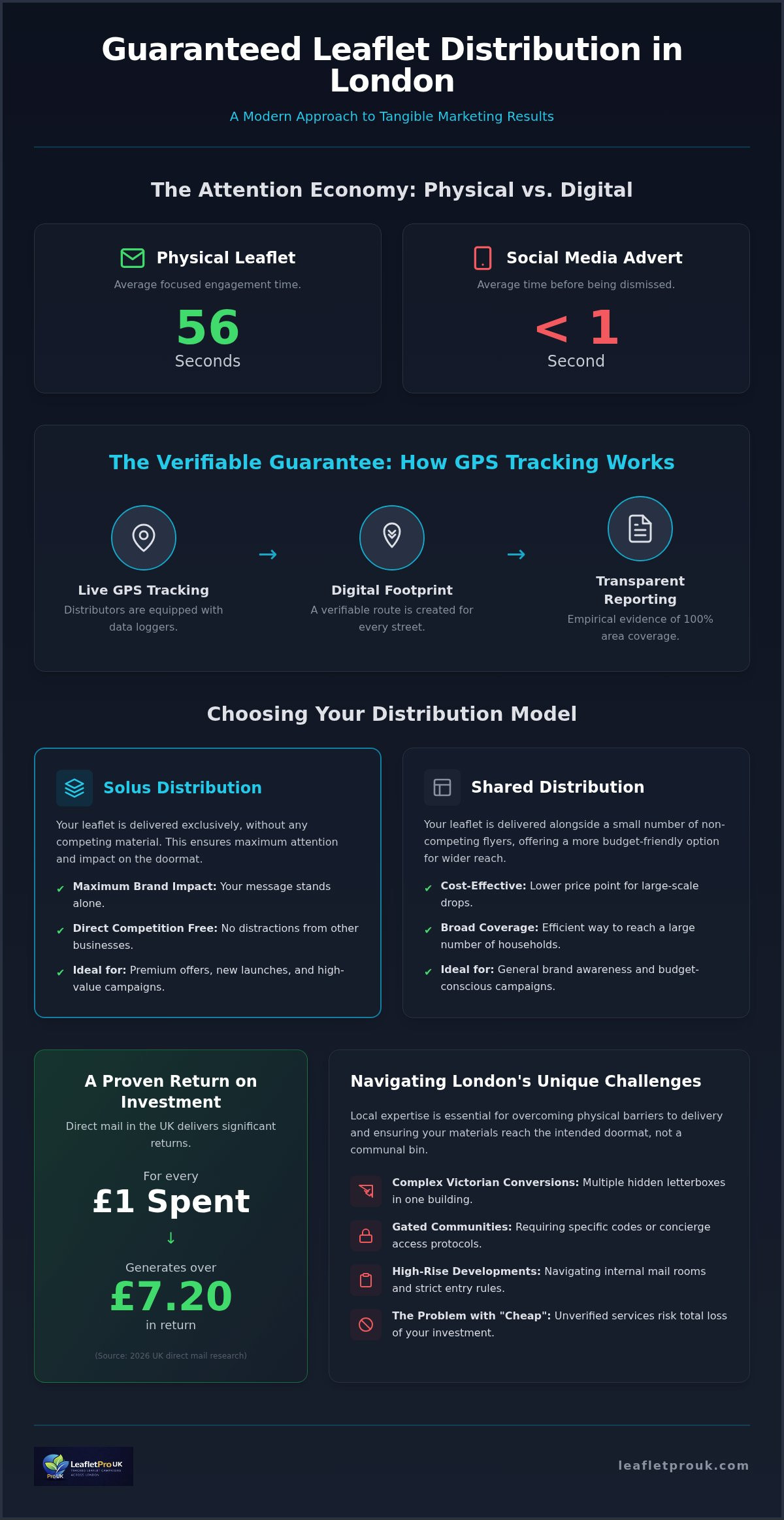
    Did you know that the average physical leaflet receives 56 seconds of focused engagement, whilst a social media advert is often dismissed in less than a second? This data from 2025 highlights the enduring power of physical mail, yet many businesses remain wary of the risks involved. If you’ve ever felt that your marketing budget was being wasted on undelivered flyers, you aren’t alone. Finding a reliable menu distribution service London can feel like a gamble when there’s a perceived lack of transparency from distribution staff or difficulty targeting specific affluent postcodes.

    We understand that peace of mind is just as important as the delivery itself. You need to know that your materials are reaching households across specific London postcodes with absolute precision. This guide will show you how to eliminate the uncertainty of door-to-door marketing by using verifiable, GPS-tracked delivery. We’ll explain how to achieve 100% coverage of your targeted area and how transparent reporting provides the evidence you need to show stakeholders that your campaign is driving a tangible increase in local enquiries.

    Key Takeaways

    • Understand how GPS-tracked delivery provides a verifiable digital footprint for every street in your target postcode, eliminating the risk of undelivered materials.
    • Learn to distinguish between Solus and Shared distribution models to select the most effective menu distribution service London for your specific campaign goals.
    • Discover why a London-exclusive focus is essential for navigating the unique logistical challenges of the city’s high-density housing and gated complexes.
    • Gain insights into identifying high-value postcodes and designing leaflets that capture immediate attention before they’re even picked up from the mat.
    • Explore the benefits of an integrated design, print, and distribution model for maintaining total accountability and professional standards throughout the process.

    The Challenge of Reliable Flyer Delivery in London’s Competitive Market

    London presents a unique logistical landscape that can be incredibly difficult to navigate without specific local expertise. London isn’t like other cities. For any business investing in a menu distribution service London, the city’s architecture often creates significant barriers to entry. High-density housing, complex Victorian conversions, and modern gated complexes in areas like Chelsea or Southwark require distributors to have a deep understanding of local street layouts. Without this knowledge, marketing materials often end up in “the black hole”—a term used to describe flyers that are dumped in communal recycling bins or left in piles at security entrances rather than reaching the resident’s doormat.

    The emotional and financial cost of a failed campaign is high. Every discarded flyer represents more than just a few pence of wasted paper; it’s a missed opportunity for a local enquiry and a potential blow to your brand’s reputation amongst neighbours. Research from 2026 indicates that direct mail in the UK has an average return on investment of over £7.20 for every £1 spent, meaning the stakes for successful delivery are significant. Historically, flyer distribution methods have relied on trust alone, but modern marketers require more. True “guaranteed delivery” is no longer about a simple promise. It’s about the systematic verification of the process, ensuring every single item is accounted for through rigorous oversight.

    To better understand the logistical precision required for the capital, watch this helpful video:

    Navigating London Postcodes: Why Local Expertise Matters

    The difference between delivering in NW3 (Hampstead) and the high-rise developments of E14 (Canary Wharf) is vast. In Hampstead, distributors must navigate long residential drives and hidden garden flat entrances. Local knowledge prevents waste by accounting for specific obstacles:

    • Victorian conversions with hidden basement flat letterboxes.
    • Gated communities requiring specific security codes or concierge access.
    • High-rise developments where internal mail rooms are the only point of entry.

    Whilst Canary Wharf requires knowledge of which buildings allow access to internal letterboxes, other areas require specific timing for deliveries. By understanding London-specific letterbox behaviours, a professional team ensures your message actually lands where it belongs.

    The Problem with “Cheap” Distribution Services

    Unrealistic pricing often signals a lack of professional oversight. When a service is priced significantly below market rates, it typically means they’ve cut corners on staff wages or GPS tracking technology. This leads to the “hidden costs” of cheap flyers: the total loss of your printing investment and the missed revenue from potential customers. Choosing a reputable menu distribution service London means opting for transparency over low-cost gambles. Professional London brands are shifting toward audited, premium delivery models. They understand that paying for accountability is an investment in the campaign’s integrity, ensuring that every postcode targeted is actually covered with precision and care.

    How GPS Tracked Leaflet Distribution Creates a Verifiable Guarantee

    GPS tracked leaflet distribution isn’t just a modern convenience; it’s a technical safeguard for businesses that value transparency. By equipping distributors with sophisticated data loggers, we create a chronological record of their movement through specific London streets. This digital footprint provides the “ping” data required to prove that every letterbox was visited. For any brand investing in a menu distribution service London, this data replaces vague promises with empirical evidence. Data doesn’t lie.

    The mechanism of proof relies on recording the distributor’s location every few seconds. These points are then plotted onto a map to create a detailed route line that mirrors the distributor’s actual path. If a client ever suspects a street was overlooked, the GPS map provides immediate clarity. This eliminates the “he-said-she-said” conflict that has plagued the industry for decades. Supervisors monitor these data feeds whilst the distribution is in progress, allowing for real-time oversight and ensuring the work maintains our professional standards.

    Interpreting Your GPS Tracking Report

    A professional report should be easy to read but rich in specific detail. You should look for continuous route lines that follow the pavement, indicating the distributor actually walked the path rather than simply driving past. Time stamps are equally vital. They show the duration spent in each area, which prevents “speed-walking” where flyers might be delivered haphazardly. Seeing your campaign move through the capital in real-time provides a level of peace of mind that traditional, unmonitored methods cannot match. If you’re ready to see this level of detail for yourself, you can explore our tracked distribution options.

    Accountability Beyond the Tech

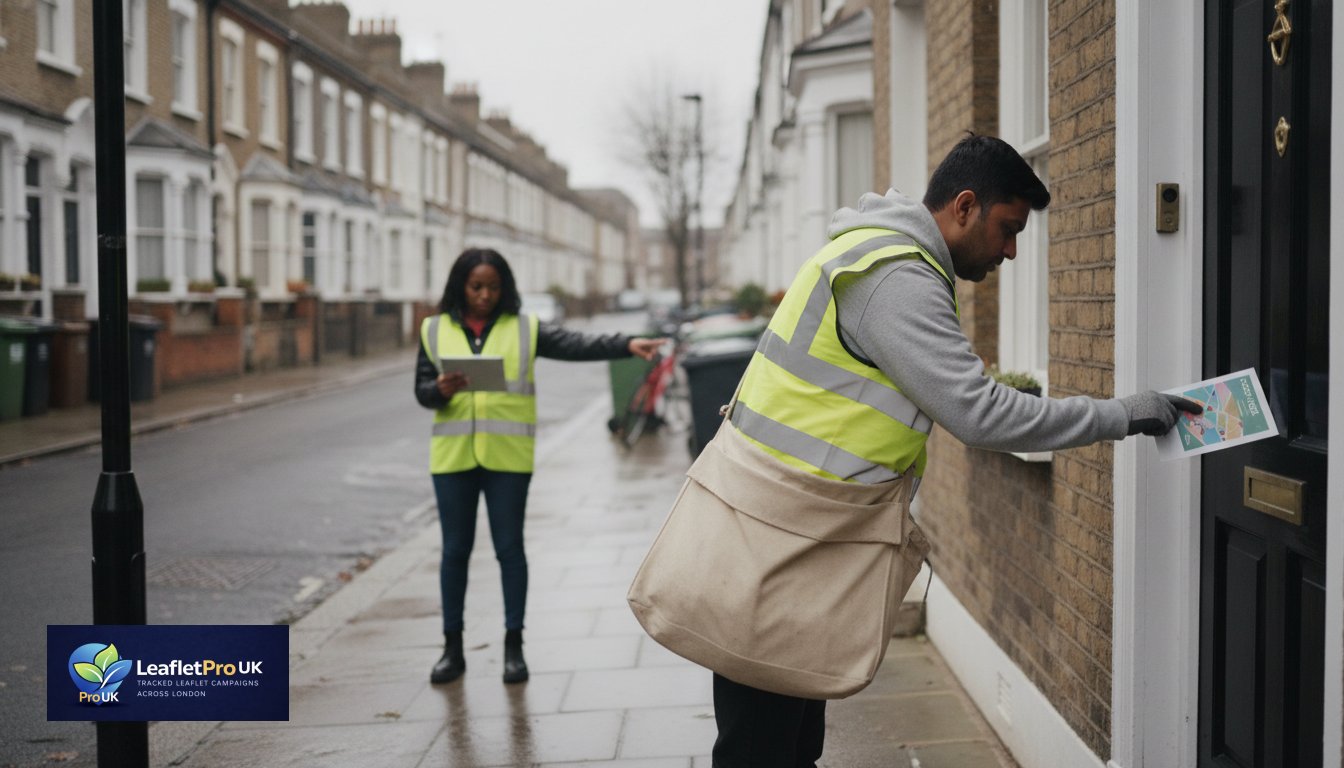
    Whilst technology is a powerful tool, it’s only one link in the integrity chain. GPS shows where a person walked, but back-checking and physical spot-checks confirm the actual quality of the drop. We ensure our staff are trained in the specific etiquette required for London residential properties, such as ensuring flyers are pushed fully through the letterbox. We also ensure our operations adhere to UK direct marketing regulations as a core part of our framework. We believe there’s a direct link between fair wages and reliability. By paying our distributors properly, we foster a culture of diligence that technology alone cannot replace. This combined approach ensures your menu distribution service London delivers the tangible results your business deserves.

    Comparing Distribution Models: Solus vs. Shared for Maximum Accountability

    Choosing the right delivery model is a strategic decision that directly affects your campaign’s visibility and conversion rate. Solus distribution ensures your flyer is the only item posted through the letterbox, granting your brand undivided attention from the resident. In contrast, shared distribution involves your message being delivered alongside two or three other non-competing brands. Whilst shared drops offer a lower entry cost, premium brands often prefer solus delivery to secure a “guaranteed” impact. When you select a menu distribution service London, understanding this trade-off between sheer volume and focused precision is essential for a high-performing campaign.

    Why Solus Delivery Wins in London

    The psychological effect on the recipient shouldn’t be underestimated. A single, high-quality flyer feels like a personal communication or a local service announcement. Conversely, a handful of mixed materials often triggers a “junk mail” response, leading to items being discarded before they’re even read. By choosing solus, you eliminate the clutter factor on the doormat, which significantly increases engagement. This model also provides superior flexibility. Since you aren’t waiting for other brands to fill a distribution slot, you can target specific London postcodes at the exact time your business needs the boost, whether that’s for a weekend launch or a seasonal promotion.

    When to Choose Shared Distribution

    Shared distribution remains a viable path for startups or local shops in high-traffic areas where budget efficiency is the primary concern. To maintain professional integrity and prevent brand dilution, it’s vital to ensure that your flyers are never paired with direct competitors. We adhere strictly to UK advertising codes to ensure all campaigns are handled responsibly, ethically, and in a way that respects the consumer. Adhering to these standards builds trust amongst your local audience and protects your long-term reputation.

    Even in a shared model, accountability shouldn’t be sacrificed for a lower price point. At LeafletPro UK, we maintain the same GPS tracking standards for shared drops as we do for solus. This ensures that every participant receives a transparent report of the delivery route, proving that the menu distribution service London was executed exactly as promised across the targeted postcodes. Precision matters, regardless of the delivery model you choose.

    Guaranteed Flyer Delivery London: A Guide to Accountable Postcode Marketing

    Planning Your London Campaign: From Postcode Selection to Final Report

    Successful physical marketing in the capital requires a strategic roadmap rather than a scattergun approach. For businesses seeking a menu distribution service London, the process begins long before the first flyer hits the mat. We follow a methodical five-step framework to ensure every campaign delivers a return on investment. First, we identify high-value London postcodes based on your specific target demographic. Second, we focus on a design that captures attention in the 2.5 seconds before it’s picked up. Third, we select a print finish that signals quality to London homeowners. Fourth, we execute the drop with GPS-tracked precision. Finally, we provide an audited report to help you calculate your tangible results.

    Targeting the Right London Doors

    Granular postcode data is essential to distinguish between residential houses and commercial-only zones. London’s street-level complexity means that broad-brush targeting often leads to significant waste. Using precise data prevents your stock from being lost in industrial estates or unoccupied developments. Avoiding “dead drops” in areas with high vacancy rates or restricted access ensures your budget is spent where it has the most impact. When you Organise your targeted leaflet drops in London, you’re investing in a strategy that respects your budget and your brand. Precision is key in a city this dense.

    The Importance of Design and Print Quality

    A “guaranteed” delivery is entirely wasted on a poorly designed flyer. If your design is cluttered or your message is unclear, the recipient won’t engage. Professional London brands often move toward premium materials because heavy-weight paper prevents flyers from crumpling in the letterbox. A crumpled flyer is junk. A crisp flyer is an invitation. Integrating QR codes is an excellent way to track digital conversions from physical drops, allowing you to see exactly how your menu distribution service London is performing online. This bridges the gap between your letterbox marketing and your digital presence seamlessly.

    Planning a campaign shouldn’t be a stressful endeavour. By focusing on the quality of the design and the precision of the targeting, you can turn a simple flyer into a powerful lead-generation tool that builds long-term trust with your local audience.

    Why LeafletPro UK is the Gold Standard for Guaranteed London Drops

    LeafletPro UK operates with a London-exclusive focus that national providers simply cannot replicate. We know the specific nuances of every street from the townhouse basements of Chelsea to the modern developments in Clapham. This local expertise allows us to navigate the “difficult” drops that others often skip, such as high-density flats with complex security access or gated communities. When you choose our menu distribution service London, you’re partnering with a team that views the city’s logistical hurdles as a routine part of a professional day’s work.

    Our integrated model sets us apart by keeping design support, high-quality printing, and distribution under one roof. This creates a single point of accountability. You won’t find yourself caught between a printer blaming a distributor or a designer who doesn’t understand letterbox dimensions. By managing the entire process, we ensure that the quality of the physical flyer matches the precision of the delivery. Our transparent GPS reporting provides pure data without the smoke and mirrors, giving you a clear view of exactly where your investment has gone. Precision is our standard.

    A Partner, Not Just a Provider

    We believe in a no-nonsense approach to local logistics. This means maintaining constant communication with our clients to provide true peace of mind. We don’t just drop flyers; we manage campaigns with the diligence of a partner who cares about your local reputation. To understand more about the technical side of our verification process, you can Read our guide to GPS tracked leaflet distribution. Our commitment to professional standards ensures that your brand is represented with the cleanliness and credibility it deserves amongst your target audience.

    Start Your Guaranteed Campaign Today

    Beginning your journey toward a more accountable marketing strategy is straightforward. Our onboarding process is designed to be methodical and thorough. It starts with your initial enquiry, followed by a consultation to identify your specific London postcode targets. We then provide a quote tailored to your volume and demographic needs. Once the strategy is agreed, we move swiftly from design and print to the first letterbox drop. If you’re ready to secure a reliable menu distribution service London, the next step is simple.

    Elevate Your Local Marketing with Verifiable Results

    Eliminating the uncertainty of door-to-door campaigns is the first step toward a higher return on investment. By prioritising transparency and systematic verification, you ensure that every flyer reaches its intended destination. We’ve explored how GPS tracking replaces vague promises with hard data and why choosing a specialist with exclusive London knowledge is vital for navigating the city’s complex street layouts. Whether you’re launching a new venture or scaling an established brand, a professional menu distribution service London provides the accountability you need to grow with confidence.

    LeafletPro UK remains committed to delivering peace of mind through our standard GPS reports and end-to-end design, print, and delivery solutions. We handle the logistical heavy lifting so you can focus on managing the increased enquiries your campaign generates. It’s time to move away from unverified drops and embrace a model built on integrity and visible proof.

    We look forward to helping you reach every doormat in your target postcode with absolute precision.

    Frequently Asked Questions

    How do I know my flyers were actually delivered?

    You receive a comprehensive GPS-tracked report as standard, which provides a digital footprint of every street covered. This data shows the chronological movement of the distributor through your target postcodes. By reviewing these route maps, you can verify that every letterbox was visited. We also conduct physical back-checking and spot-checks to ensure the quality of the drop meets our professional standards for transparency and accountability.

    What happens if a distributor skips a street in my target postcode?

    Any skipped streets identified through our real-time GPS monitoring are rectified immediately whilst the distribution is still in progress. Supervisors oversee the live data feeds to ensure 100% coverage of your designated area. If an omission is discovered after the fact, we investigate the cause and organise a remedial drop to ensure your campaign achieves the total visibility you’ve paid for. Integrity is central to our service model.

    Is GPS tracking 100% accurate in high-rise London areas?

    Modern GPS loggers are highly accurate, though signal drift can occasionally occur amongst high-rise buildings in areas like Canary Wharf. To maintain precision, we use high-sensitivity equipment that records pings every few seconds. Our supervisors are trained to interpret these reports, distinguishing between signal fluctuations and actual missed streets. This technical oversight ensures that even in dense urban environments, the integrity of your delivery remains verifiable and clear.

    How much does a guaranteed flyer distribution service cost in London?

    Costs for a professional menu distribution service London depend on whether you choose a solus or shared model and the specific postcodes you wish to target. Pricing is influenced by housing density and the weight of your materials. Whilst budget services might seem attractive, they often lack the GPS tracking and supervisory oversight required for a guaranteed result. We provide tailored quotes that reflect the systematic reliability of our network.

    Can you target specific demographics like “young professionals” or “families”?

    Yes, we use granular postcode data to help you target specific demographics across London. By selecting postcodes that align with your ideal customer profile, you can focus your marketing spend on the areas most likely to generate enquiries. This targeted approach prevents waste in non-residential zones and ensures your message reaches households that match your business goals, whether you are looking for affluent families or urban professionals.

    Do you provide a report at the end of the campaign?

    You will receive a detailed audited report upon the completion of your distribution campaign. This professional document includes the full GPS route maps, time stamps, and a summary of the postcodes covered. This report serves as your evidence of delivery, allowing you to present tangible proof to stakeholders. It is an essential tool for calculating your return on investment and planning future marketing strategies with confidence and peace of mind.

    How long does it take to distribute 5,000 leaflets across London?

    Distributing 5,000 leaflets typically takes between five and seven working days, depending on the density of the target postcodes and the delivery model selected. Solus campaigns often move faster as they aren’t dependent on other brands. We prioritise a methodical pace to ensure every flyer is pushed fully through the letterbox, maintaining the high standards expected of a premium menu distribution service London whilst ensuring 100% coverage.

    Can you handle the design and printing of my flyers as well?

    We provide an end-to-end solution that includes specialist design support and high-quality printing alongside our distribution services. By managing the entire process, we ensure your flyers are produced to the correct specifications for London letterboxes. This integrated model provides a single point of accountability, ensuring that the quality of the print finish and the effectiveness of the design align perfectly with your strategic door-to-door distribution goals.

  • Avoiding Leaflet Distribution Scams in London: A Reliable Buyer’s Guide

    Avoiding Leaflet Distribution Scams in London: A Reliable Buyer’s Guide

    Imagine investing a significant portion of your marketing budget into a bespoke campaign, only to discover your carefully designed flyers have been dumped in a skip rather than delivered to your target postcodes. For many business owners in the capital, this isn’t just a fear; it’s a frustrating reality caused by rogue distributors who prioritise speed over service. You’re likely here because you’ve felt the anxiety of non-delivery or have been burnt by a lack of transparency in the past. It’s completely understandable to feel cautious when your return on investment depends entirely on the integrity of a third party.

    This guide focuses on avoiding leaflet distribution scams London businesses often face, providing you with the exact tools needed to identify cowboy agencies and verify every single delivery. You’ll learn how to interpret granular GPS data reports, why local London expertise beats national outsourcing, and how to secure a reliable partner that ensures 100% household coverage. By the end of this article, you’ll have a clear framework for protecting your budget and ensuring your message actually reaches the doormats of your future customers with absolute precision.

    Key Takeaways

    • Learn to identify red flags of “Ghost Agencies,” such as the absence of a registered London office or a verifiable landline number.
    • Discover the critical role of GPS tracking in providing transparent evidence that your marketing materials have reached their intended destinations.
    • Master the specific techniques for avoiding leaflet distribution scams London businesses face, including the common “flyer dumping” tactic used by rogue operators.
    • Understand why choosing a London-only specialist ensures higher accountability and more precise postcode targeting than using nationwide outsourcers.
    • Implement a systematic buyer’s checklist to verify distributor credentials and secure a reliable partner for long-term marketing growth.

    The Reality of Leaflet Distribution Scams in London

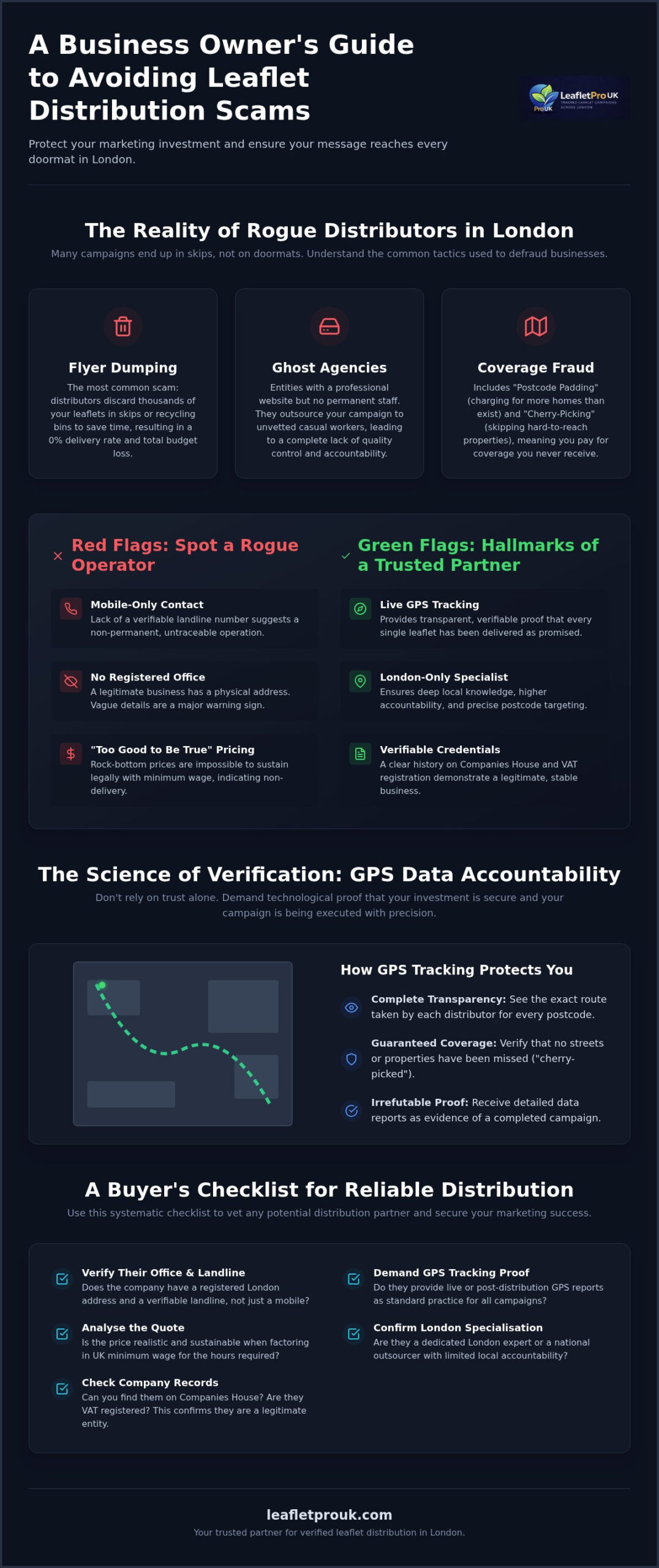
    Leaflet marketing has been a vital part of the history of leaflet marketing for centuries, but the modern industry in the capital faces a persistent threat from rogue operators. London’s high-density housing and complex street layouts provide the perfect cover for the “flyer dumping” phenomenon. This occurs when unscrupulous distributors simply discard thousands of flyers in communal recycling bins or skips rather than delivering them to doormats. The financial loss is obvious, but the reputational damage to a brand found amongst a pile of discarded paper can be irreparable.

    Many businesses fall victim to the “Ghost Agency” model. These companies present a professional digital front with polished websites, yet they possess no permanent distribution staff. Instead, they operate as middlemen, outsourcing your campaign to unvetted casual workers or “man with a van” outfits who lack accountability. This lack of oversight is why avoiding leaflet distribution scams London wide is essential for any serious marketing strategy. London’s complex geography, with its gated estates and high-rise blocks, requires a level of diligence that these ghost agencies simply don’t provide.

    To better understand this concept, watch this helpful video:

    Common Scams: From Flyer Dumping to Under-Counting

    Rogue distributors often employ “Postcode Padding,” a tactic where they charge for a higher number of households than actually exist in a specific London area. By claiming a postcode contains 10,000 homes when the reality is closer to 7,000, they pocket the difference in both distribution fees and the surplus print. Another frequent issue is “cherry-picking.” In this scenario, distributors skip difficult-to-reach properties, such as those with long driveways or steep hills, whilst still charging you the full rate for total coverage. These shortcuts directly undermine your campaign’s reach and effectiveness.

    The “Too Good to Be True” Price Trap

    Pricing is often the clearest indicator of a potential scam. If a quote for a solus drop seems remarkably low, it’s likely because the maths doesn’t work. When you factor in the UK’s minimum wage and the time it takes to cover 1,000 London homes properly, certain rock-bottom prices are impossible to sustain legally. Scammers bridge this gap by either not delivering the items or paying staff “under the table” rates that encourage dumping. Professional agencies, such as LeafletPro UK, must charge a sustainable rate to ensure every distributor is fairly paid and every leaflet is tracked. Understanding these economic realities is the first step in avoiding leaflet distribution scams London providers might use to lure in unsuspecting buyers.

    Red Flags: How to Spot a Rogue Distributor Before You Pay

    Identifying a rogue operator often begins with a simple check of their contact details. A professional distributor will always maintain a registered business address and a landline telephone number. If an agency only provides a mobile number or a vague contact form, it suggests a lack of permanent infrastructure. This mobile-only setup is a significant warning sign when avoiding leaflet distribution scams London businesses frequently encounter. It makes it far too easy for a company to disappear once they’ve pocketed your payment without completing the drop.

    Legitimate operations should also be easily verifiable through official channels. If a company claims to handle large-scale campaigns but lacks VAT registration or a clear history on Companies House, proceed with extreme caution. Whilst letterbox delivery doesn’t typically require specific local authority permits, it’s still vital to ensure your partner understands the official UK government guidelines regarding the distribution of printed matter. A lack of regulatory awareness often precedes a lack of operational accountability.

    Vetting the Agency’s Infrastructure

    A transparent expert will be happy to explain how they recruit and supervise their walking teams. Ask specific questions about their London presence. Do they have a local depot? How do they ensure their staff actually walk the routes? If they cannot provide recent London-based case studies or references from local brands, they likely lack the experience required for the capital’s unique logistics. Verifying credentials like a valid Company Number, for example, Company No. 17330538, protects your investment from the Ghost Agency model discussed previously.

    Analysing the Proposal and Terms

    Reliable partners provide clear, written contracts that detail the scope of work. You should always clarify whether your campaign is Solus, where your flyer is delivered alone, or Shared. Rogue distributors often charge solus prices whilst delivering your material alongside several others. Most importantly, never accept a vague promise of “we track our staff.” Demand to see a sample GPS report from a previous campaign to verify the level of detail you’ll receive. If you’re looking for a partner that prioritises this level of visibility, you can view our transparent reporting standards to see how we maintain such high levels of accuracy. This proactive approach is the most effective way of avoiding leaflet distribution scams London has to offer.

    The Science of Verification: GPS Tracking and Data Accountability

    GPS tracking has transformed the industry from a game of blind trust into a measurable logistical operation. It is currently the most effective tool for avoiding leaflet distribution scams London businesses encounter. Whilst the Advertising Standards Authority (ASA) regulates the honesty of the content on your flyers, GPS data regulates the honesty of the delivery itself. Without this digital footprint, you have no objective way to confirm that your marketing budget hasn’t been wasted. Reliable agencies use this technology to provide an audit trail that is both visible and verifiable.

    Understanding the difference between live tracking and post-campaign reporting is vital for campaign security. Live tracking allows for real-time monitoring, but the comprehensive post-campaign report provides the granular evidence needed for a final audit. When you examine a GPS map, look for organic walking paths that follow pavements and letterbox approaches. If the lines are perfectly straight and cut through the centre of buildings, it’s a clear sign of faked data or “GPS spoofing.” Genuine tracks show dwell times at each property, proving the distributor actually stopped to complete the drop rather than simply driving past the street.

    What a Reliable GPS Report Must Include

    A professional report shouldn’t just show a general area; it needs to provide specific, high-resolution data. To ensure your campaign has been executed with precision, look for the following elements in your verification documents:

    • Granular pings: Data points captured every 5 to 10 seconds to show the exact path to every door, not just a ping every few streets.
    • Time-stamped routes: Clear chronological data that matches the agreed delivery window and proves the distributor’s pace was realistic.
    • Postcode-specific overlays: A visual map that overlays the GPS tracks onto your target London postcodes to prove 100% saturation.

    Understanding GPS Reports

    Explaining how GPS tracked flyer delivery London ensures accountability is at the heart of a transparent service model. LeafletPro UK uses this transparent route data to build long-term partnerships based on evidence rather than vague promises. We supplement this digital verification with physical “back-checking,” where supervisors visit randomly selected roads post-delivery to confirm the presence of your flyers. This dual-layered approach ensures that digital data is always backed by physical reality, providing the peace of mind that your investment has reached the right doormats.

    Avoiding Leaflet Distribution Scams in London: A Reliable Buyer’s Guide

    A Buyer’s Checklist for Reliable Leaflet Distribution in London

    Securing a successful campaign in the capital requires more than just a signature on a quote; it demands a systematic vetting process. When avoiding leaflet distribution scams London businesses must first verify an agency’s operational focus. Nationwide outsourcers frequently subcontract work to unvetted local providers, which dilutes accountability and increases the risk of non-delivery. A London-only specialist maintains direct control over their walking teams, ensuring that the staff representing your brand are held to professional standards.

    Your checklist should involve a request for a granular postcode breakdown before any flyers are printed. Vague promises of “blanket coverage” in a borough are a significant red flag. You need to see the exact household counts for your target sectors to ensure you aren’t paying for “ghost” addresses. Once the numbers are confirmed, get the distribution method in writing. Rogue operators often charge for solus drops whilst delivering your material amongst a thick bundle of competitors. Finally, audit the agency’s print quality; an organisation that cuts corners on paper and ink is likely to cut corners on the doormat too.

    Navigating London Postcodes and Demographics

    London’s residential landscape is uniquely challenging, featuring a mix of sprawling estates, high-rise blocks, and gated communities. Using postcode targeted flyer delivery is far more effective than an unconsidered blanket drop, as it allows you to bypass industrial areas and focus on high-response neighbourhoods. Reliable distributors understand the logistics of accessing secure blocks and won’t simply leave a pile of flyers in a communal lobby. They have established protocols for handling concierges and secure entry systems, ensuring your message actually reaches the individual letterbox.

    Final Questions to Ask Your Distributor

    Before the first flyer hits a doormat, establish a clear reporting schedule. A transparent partner will proactively answer the following questions to prove their integrity:

    • “Can I see the GPS data for my specific campaign?” Accept nothing less than the granular pings discussed in previous sections.
    • “How do you handle undeliverable addresses or access issues?” Professional teams document these hurdles rather than ignoring the properties.
    • “What is your process for managing and supervising the walking teams?” Ask about the ratio of supervisors to distributors and how they conduct physical back-checks.

    By following this framework, you move beyond “trust” and into a relationship based on verifiable evidence. This is the only certain way of avoiding leaflet distribution scams London rogue operators use to exploit marketing budgets.

    Why LeafletPro UK is the Trusted Choice for London Brands

    LeafletPro UK is built on the principle that local marketing requires local accountability. Unlike nationwide agencies that often fall into the “Nationwide Outsourcing” trap, we focus exclusively on the London market. This specialisation ensures we never subcontract your campaign to unvetted casual staff in other regions. By maintaining a permanent presence in the capital, we provide a level of oversight that national providers simply cannot match. Every campaign we manage is an opportunity to prove our commitment to avoiding leaflet distribution scams London businesses have suffered from for too long.

    Our promise of 100% GPS-tracked accountability isn’t just a marketing slogan; it’s the foundation of our operational model. We understand that your marketing budget is an investment, not a gamble. Therefore, we provide transparent route data for every single drop, allowing you to see exactly where your leaflets have landed. This end-to-end service includes professional design support and high-quality printing, ensuring your brand is presented with the credibility it deserves from the first moment a resident picks it up.

    Our Systematic Approach to Reliability

    We organise our walking teams with a focus on systematic execution. Every route is planned with logistical precision, and our supervisors conduct regular physical checks to supplement our digital GPS verification. By integrating design and print production within our workflow, we maintain total consistency across your entire campaign. This integrated approach eliminates the risk of “lost in translation” errors that occur when multiple third-party vendors are involved. We prioritise visibility and verification over raw volume, ensuring that every house on your target list receives your message.

    Ready to Launch a Secure London Campaign?

    Choosing trusted leaflet distributors is the most significant factor in determining your campaign’s ROI. A well-executed, postcode-targeted drop can generate a response rate of 0.5% to 2% for cold mailings, but these results are only possible if the leaflets actually reach the door. Implementing a secure marketing strategy is the only way of avoiding leaflet distribution scams London operators might attempt. We provide the data, the local knowledge, and the professional standards required to help your business grow within the capital’s competitive landscape.

    Secure Your Next London Campaign with Data-Driven Confidence

    The definitive framework for avoiding leaflet distribution scams London businesses can rely on is built upon three essential pillars: transparency, local specialisation, and verifiable data. By prioritising agencies that offer full GPS route transparency, you eliminate the guesswork and ensure your marketing materials reach their intended destinations. Choosing a partner with exclusively London-focused logistics prevents the common pitfalls of nationwide outsourcing and unvetted subcontracting that often lead to wasted budgets.

    Real peace of mind comes from knowing that every stage of your campaign is handled with professional precision. From in-house design and high-quality print production to the final door-to-door drop, every step must be visible and accountable. When evidence replaces vague promises, your marketing budget becomes a powerful tool for sustainable growth within the capital’s competitive market. We’re ready to help you reach your audience with the integrity and care your brand deserves.

    Frequently Asked Questions

    How can I tell if a leaflet distribution company is a scam?

    Look for red flags such as a lack of a registered physical office, mobile-only contact details, or prices that don’t cover the minimum wage for the staff. Rogue agencies often refuse to provide detailed GPS reports or written contracts. Verifying a company’s registration on Companies House and checking for recent, authentic London-based references are essential steps in avoiding leaflet distribution scams London businesses often encounter.

    What is a fair price for leaflet distribution in London in 2026?

    A fair price must account for the London Living Wage and the time required to navigate complex urban routes. Whilst prices vary based on volume and delivery method, quotes that seem exceptionally low are usually a sign that staff are being underpaid or the delivery is not being completed. You should expect to pay a rate that supports a sustainable, professional operation with full GPS accountability and ethical employment practices.

    Is GPS tracking 100% proof that my leaflets were delivered?

    GPS tracking provides the strongest digital evidence, but it’s most effective when paired with physical back-checking. High-quality reports show granular “pings” that trace a distributor’s path to every individual doormat rather than just a general street view. Whilst no system is entirely infallible, a detailed GPS route map combined with supervisory oversight offers the highest level of security and transparency available in the modern industry.

    What should I do if I suspect my leaflets have been dumped?

    You should immediately contact the agency and request the specific GPS data for the area in question. If they can’t provide granular, time-stamped reports, it’s a significant cause for concern. Legitimate companies will investigate the matter through their supervisory teams and provide evidence of delivery. If dumping is confirmed, a professional partner will offer a resolution, such as a re-run or a credit for the affected area.

    Why is London distribution more expensive than in other UK cities?

    London’s unique geography and higher operational costs naturally influence pricing. The capital contains a high density of multi-occupancy buildings, gated estates, and secure blocks that require more time to navigate than standard suburban streets. Additionally, the London Living Wage is higher than the national average. Professional agencies must reflect these fair pay standards to ensure a reliable and diligent workforce for your campaign.

    Can I track my leaflet delivery in real-time?

    Some advanced agencies offer live tracking, but the most important document is the comprehensive post-campaign report. This report allows for a detailed audit of the entire route once the data has been processed and verified. Real-time monitoring can be helpful for peace of mind, but the granular, time-stamped data provided after the drop is what ensures the long-term accountability of your marketing investment.

    What is the difference between solus and shared distribution in terms of reliability?

    Solus distribution offers the highest level of impact and is often easier to track with precision because your flyer is delivered alone. Shared distribution involves your material being delivered alongside other non-competing flyers. Both methods are reliable when managed by a professional agency, but solus campaigns typically see higher response rates because your message doesn’t have to compete for the homeowner’s attention on the doormat.

    How do professional distributors handle blocks of flats in London?

    Professional teams use established protocols to navigate London’s many apartment blocks and secure estates. This involves communicating with concierges or using legitimate access methods to ensure flyers reach individual letterboxes rather than being left in communal lobbies. This level of detail is vital for avoiding leaflet distribution scams London providers might use by simply dumping materials at the entrance of high-rise buildings.

  • Tracking Leaflet Distribution: A Verification Guide

    Tracking Leaflet Distribution: A Verification Guide

    What if the greatest threat to your marketing budget isn’t a poor design or a weak offer, but the simple uncertainty of whether your leaflets ever reached their destination? For many London business owners, the “trust gap” in physical marketing is a significant hurdle, often fuelled by the fear that thousands of printed materials might be discarded before they ever see a letterbox. It’s difficult to justify a marketing spend when the results feel untraceable and the process lacks visibility.

    We believe that transparency is the foundation of a successful partnership, and you deserve to know exactly where every penny of your investment is going. Learning how to track flyer distribution effectively turns a leap of faith into a data-driven strategy. By utilising precise GPS verification and professional reporting, you can eliminate the anxiety of “binning” and ensure every postcode in your campaign is covered with absolute precision.

    This guide provides a clear roadmap for interpreting tracking data and verifying doormat-level accountability. You’ll learn how to read route density maps, understand the logistics of professional distribution teams, and gain the confidence to reinvest in leaflet marketing as a reliable, measurable pillar of your business growth.

    Key Takeaways

    • Understand why transparent verification is essential to protect your marketing budget and eliminate the uncertainty of unverified door-to-door campaigns.
    • Discover the technical mechanics of how to track flyer distribution using satellite-linked devices that record the precise path of every distributor in real-time.
    • Learn how to interpret professional distribution maps by identifying route density and recognising human-specific walking signatures that confirm genuine delivery.
    • Explore the importance of a multi-layered verification approach that combines GPS data with independent supervisor spot-checks for maximum accountability.
    • Gain the confidence to reinvest in London-wide marketing by receiving clear, postcode-specific reports that provide total visibility of your campaign’s progress.

    The Trust Gap: Why You Must Track Flyer Distribution

    For years, door-to-door marketing felt like a “black box” for many London business owners. You’d invest in high-quality printing, hire a distribution team, and then simply wait for the phone to ring. If the enquiries didn’t materialise, you were left with a frustrating dilemma. Did the creative fail to resonate, or did the leaflets never actually reach the intended doormats? This lack of transparency creates a significant trust gap, often leading businesses to abandon a highly effective marketing channel because they can’t verify the work was completed.

    Understanding how to track flyer distribution has moved from being a technical curiosity to an absolute business necessity. In a competitive urban landscape, unverified distribution leads to skewed ROI and wasted marketing spend that most SMEs cannot afford to ignore. GPS tracking has transitioned from a premium add-on to an industry security standard, providing the objective evidence needed to bridge the trust gap. It offers a level of visibility that turns a leap of faith into a professional, data-driven operation.

    The Real Cost of “Binned” Leaflets

    When a distributor discards materials instead of delivering them, the financial damage is multifaceted. You don’t just lose the initial cost of the print and the distribution fee; you lose the potential lifetime value of every customer who never saw your message. If a Flyer (or flier) is never delivered, your response rate is guaranteed to be zero. Beyond the immediate loss of leads, there’s a serious risk to your brand reputation. Residents who find bundles of your branded leaflets dumped in communal areas or local parks will associate your business with litter and unprofessionalism. Choosing “cheap,” unverified distribution is frequently the most expensive mistake a business can make.

    Establishing Accountability with Your Distribution Partner

    Accountability begins long before the first leaflet is dropped. A professional partnership is built on clear expectations and a shared commitment to campaign integrity. By insisting on transparent reporting from the outset, you establish a framework where results are measured by data rather than vague promises. This transition from a “trust me” model to a “here is the evidence” approach fosters a much stronger long-term relationship. When you have access to precise route data, you gain the peace of mind required to scale your marketing efforts. Reliable verification ensures that your investment is handled with the same level of care and precision that you apply to every other area of your business.

    The Mechanics of GPS Leaflet Tracking Technology

    At its core, GPS tracking for physical marketing is the systematic use of satellite-linked devices to record the precise movements of a distributor. This technology removes the ambiguity of manual reporting by capturing coordinates at regular intervals whilst a team is on the ground. Understanding how to track flyer distribution requires a basic grasp of how these data points are transformed into a transparent record of work. The process begins with hardware that communicates with a network of satellites to log time, location, and speed, creating a digital breadcrumb trail of the entire delivery route.

    The hardware used in the field generally falls into two categories: dedicated portable data loggers or mobile application tracking. Whilst smartphone apps are convenient, professional logistics firms often prefer dedicated GPS loggers. These devices are built for a single purpose, offering superior battery life and more robust signal reception in dense London urban environments where high-rise buildings can sometimes interfere with satellite links. Once a shift is completed, the raw data is uploaded to a central server and processed into a visual map that provides clear evidence of coverage.

    Data Loggers vs. Live Tracking

    There’s a significant difference between receiving a post-campaign report and monitoring a live feed. Live tracking allows for immediate oversight, but the true value lies in the “ping interval” of the device. A high-frequency ping, occurring every five to ten seconds, is essential for doormat-level accuracy. If a device only pings every few minutes, the resulting map will show straight lines cutting through buildings and parks, failing to prove that the distributor actually walked up every driveway. By selecting a partner that utilises high-resolution GPS tracked leaflet distribution, you ensure the data is granular enough to verify every single letterbox visit.

    Geo-fencing and Postcode Boundaries

    Geo-fencing is a digital tool that creates virtual boundaries to ensure postcode-targeted precision during a campaign. This software is vital for maintaining the integrity of a London-specific drop, as it alerts supervisors if a distributor wanders outside the pre-authorised zone. It prevents “over-spill” into irrelevant areas, ensuring your marketing budget is concentrated exactly where your target demographic lives. This systematic approach is the most reliable way to learn how to track flyer distribution with absolute certainty, as it combines satellite data with strict geographical constraints to guarantee that no leaflets are wasted in non-targeted postcodes.

    Interpreting Your Flyer Delivery Tracking Data

    Receiving a GPS report is a significant milestone in any campaign, yet the real value lies in your ability to analyse the data provided. A series of lines on a digital map might look impressive at first glance, but you must look closer to verify that every household was reached. Learning how to track flyer distribution effectively means looking beyond the simple presence of a path and scrutinising the specific behaviours recorded by the hardware. A genuine, house-by-house delivery will produce a distinct pattern that reflects the physical reality of navigating London’s residential streets.

    One of the most vital indicators is the “walking pace” signature. A distributor who is actually visiting doors will move at a steady pedestrian speed, usually between two and three miles per hour, with frequent pauses at every letterbox. If the report shows a speed that remains consistently high or a path that never deviates from the centre of the road, it is a clear sign that the delivery was not completed to a professional standard. Time-stamped data adds another layer of security; it allows you to cross-reference the duration of the drop with the expected time required to cover that specific number of households.

    Spotting the Red Flags in a Report

    When you review your tracking data, stay alert for “straight-line” pings. These occur when a device loses signal or is purposefully turned off and then back on, resulting in a straight line that cuts through buildings or parks. Whilst occasional signal loss is possible in dense urban areas, frequent straight lines suggest a lack of accountability. Similarly, “street-only” walking patterns are a major concern. If the GPS track follows the road perfectly without showing the zig-zag movement into driveways and up to porches, it is highly likely that the distributor simply walked the route without delivering your materials. Don’t hesitate to question your provider if a certain street appears neglected or if the data doesn’t align with the physical layout of the neighbourhood.

    Verifying Route Density

    Counterintuitively, a “messy” map is often the hallmark of a successful campaign. A map filled with dense, overlapping lines indicates that the distributor was thorough, crossing the street repeatedly to ensure no door was missed. You should compare these GPS tracks against your targeted postcode list and the known household counts for those areas. This level of scrutiny allows you to confirm 100% coverage of specific London residential blocks, especially in high-density areas where letterboxes are close together. Understanding how to track flyer distribution involves more than just seeing a line on a screen; it requires a critical eye for detail to ensure the density of the tracking dots matches the density of the housing.

    Tracking Leaflet Distribution: A Verification Guide

    Beyond GPS: Multi-Layered Verification Methods

    Whilst GPS tracking provides an objective record of movement, it remains the foundation rather than the final word in campaign integrity. In the dense and often complex residential layouts of London, satellite data alone cannot always confirm the quality of a delivery. High-rise estates or Victorian conversions with communal entrances require a more nuanced approach to ensure every leaflet is placed correctly. Learning how to track flyer distribution effectively involves combining technical satellite data with human oversight and digital response metrics to create a fail-safe verification system.

    Professional distribution models now incorporate multi-layered strategies to bridge any remaining gaps in visibility. This includes physical spot-checks and back-checking, where managers verify the presence of materials shortly after a drop. These methods provide a level of qualitative proof that a GPS map cannot offer on its own. By layering these techniques, you move from simply knowing where a distributor walked to knowing exactly how your brand is being presented to the local community.

    The Importance of Physical Supervision

    Random site visits by independent supervisors are a critical component of a secure distribution model. These managers conduct unannounced inspections whilst a team is on the route, ensuring that distributors are diligent and respectful of “no junk mail” signs. This “supervisor effect” significantly improves distributor behaviour and accuracy, as staff are aware that their work is subject to physical scrutiny at any moment. Combining human oversight with satellite precision creates a total security framework that protects your marketing investment. This approach is particularly effective in high-density London postcodes where letterbox access can be challenging and requires a professional touch.

    Digital Response Tracking

    Integrating digital response tools like QR codes or unique URLs allows you to validate physical distribution through real-world engagement. When a resident scans a code on your flyer, it creates a timestamped digital hit that can be cross-referenced with your GPS reports. If a specific street shows high GPS density and a corresponding spike in digital traffic, you have definitive proof of a successful drop. This data allows you to create a “heat map” of success, overlaying satellite routes with conversion statistics to identify your most profitable neighbourhoods. To ensure your next campaign meets these rigorous standards, consider a partner that provides postcode-targeted flyer distribution with full verification.

    The 2026 trend in physical marketing is moving towards this total transparency model. Beyond satellite logs, some providers now conduct follow-up checks by knocking on a small percentage of doors to confirm receipt. This scientific framework replaces anecdotal evidence with hard data, giving you the confidence to scale your local London outreach with absolute certainty.

    Organising a Verified Campaign with LeafletPro UK

    At LeafletPro UK, we’ve built our reputation on the principle that transparency shouldn’t be a luxury. Every London campaign we manage includes 100% GPS-tracked distribution as standard. This commitment ensures that the trust gap discussed earlier is completely bridged. By choosing a partner that understands the intricate layout of the capital, you gain access to a service that values evidence over promises. We provide clear, understandable reports that show exactly where your marketing materials have landed, giving you the business-like confidence to scale your outreach.

    Our postcode-targeted approach is designed for local brand growth. We don’t just walk the streets; we target the specific neighbourhoods that match your ideal customer profile. Understanding how to track flyer distribution becomes simple when you are presented with a clean, professional report that mirrors your initial strategy. To complement our distribution, we offer integrated design and print services. This end-to-end oversight ensures that your flyer is doormat-ready, featuring the right weight, finish, and call-to-action to maximise your response rate.

    Our Process: From Postcode Selection to Proof of Delivery

    Our methodical process begins with a detailed consultation to identify the most profitable London postcodes for your business. Once the targeting is finalised, our door-to-door teams execute the drop using high-resolution GPS loggers. These devices provide the granular data necessary to prove doormat-level delivery in even the most complex urban environments. After the campaign, we use this GPS data to help you refine your future marketing strategies. By analysing the coverage maps against your enquiry levels, we can identify high-performing zones for repeat drops. London businesses favour our no-nonsense reporting because it provides tangible proof of work, allowing for a level of accountability that traditional marketing often lacks.

    Start Your Tracked Campaign Today

    Securing a verified drop for your business is a straightforward and professional process. You can request a quote based on your specific target area and volume requirements, knowing that every single leaflet is backed by satellite verification. The peace of mind that comes with a LeafletPro UK verified drop allows you to focus on handling new enquiries while we manage the complex local logistics. We act as a diligent partner, ensuring your investment is handled with precision and care. Organise your verified London leaflet drop with LeafletPro UK to ensure your message reaches every intended doormat with absolute certainty.

    Securing Your Marketing Investment Through Transparency

    Transitioning from unverified drops to a data-driven strategy is the most effective way to protect your marketing budget. By mastering how to track flyer distribution, you move beyond guesswork and establish a framework of total accountability. You’ve seen that while GPS tracking provides the essential foundation, the highest levels of security come from combining satellite precision with professional supervision and digital response metrics. This multi-layered approach ensures your materials are never discarded and always reach their intended audience.

    At LeafletPro UK, we specialise exclusively in London residential postcodes to ensure your campaign benefits from deep local expertise. We include GPS tracking as standard on all campaigns and provide detailed delivery reports for every drop we complete. This methodical approach ensures that your message reaches the correct doormat, allowing you to scale your business with absolute peace of mind. Our transparent reporting turns your physical marketing into a measurable, reliable growth engine for your brand.

    Don’t leave your local outreach to chance. Book your GPS-tracked London leaflet distribution today and experience the confidence of a fully verified campaign. We’re ready to help you turn your next drop into a documented success.

    Frequently Asked Questions

    Can GPS tracking data for leaflet distribution be faked?

    While raw digital files can theoretically be manipulated, professional tracking systems use encrypted logs and high-frequency pings that are extremely difficult to replicate. Authentic reports display a distinct “human” walking signature, including subtle speed variations and pauses at every letterbox. We scrutinise these patterns to ensure the data represents genuine physical activity, providing you with a credible and transparent record of your London campaign’s progress.

    How often are GPS locations updated during a flyer delivery?

    Professional-grade GPS loggers typically record coordinates every five to ten seconds. This high-frequency “ping interval” is essential to prove that a distributor actually walked up to each individual letterbox rather than simply walking down the centre of the road. Lower frequencies result in straight lines that fail to provide the granular evidence needed for a fully verified distribution across complex residential streets.

    What should I do if a GPS report shows a street was missed?

    If a report indicates a coverage gap, you should contact your distribution partner immediately to investigate the discrepancy. Professional firms use these reports as a vital quality control tool and will typically arrange a “top-up” drop to ensure the targeted postcode is fully covered. This is the primary benefit of learning how to track flyer distribution; it allows for objective resolution based on hard data.

    Is GPS tracking necessary for small, local leaflet drops?

    Yes, satellite verification is vital regardless of the campaign size. Even for a small drop of 1,000 leaflets, the cost of the print and the potential value of lost leads are significant. Verification provides the security required to confirm your marketing is actually reaching your local neighbours, ensuring your budget isn’t wasted on unverified services that rely solely on a “trust me” model.

    How do I access my distribution reports after the campaign?

    Reports are typically delivered via email as a comprehensive PDF or accessible through a secure client portal once the data has been processed. These files include a visual map overlay and timestamped logs of the routes taken. We ensure our reporting is transparent and easy to interpret, providing you with a permanent, professional record of the delivery work completed across your targeted London areas.

    Does GPS tracking work in high-rise London flats and estates?

    GPS tracking remains highly effective in urban environments, though signal “drift” can occasionally occur near exceptionally tall buildings. Professional distributors manage this by using dedicated hardware loggers which are more robust than standard smartphone apps. While the signal confirms the distributor entered the estate, we often use multi-layered verification, such as supervisor spot-checks, to guarantee that internal delivery to individual flats was completed.

    What is the difference between solus and tracked shared distribution?

    Solus distribution means your flyer is the only one being delivered to a household, whereas shared distribution involves your leaflet being delivered alongside two or three non-competing brands. Both methods must include how to track flyer distribution data as standard. The difference lies in the exclusivity and cost of the drop, but the verification process remains identical to ensure every doormat is reached.

    How long does it take to receive the tracking data once the drop is finished?

    You can typically expect to receive your verified tracking reports within 24 to 48 hours of the campaign’s completion. This short window allows time for the raw satellite data to be uploaded, cross-referenced with supervisor logs, and formatted into a readable map. This methodical processing ensures the information you receive is accurate, professional, and ready for your internal marketing ROI analysis.