In the competitive London market, the cheapest quote for leaflet distribution is often the most expensive mistake a business can make. Understanding how to budget for leaflet distribution London requires looking beyond the initial price per thousand to focus on verified doormat delivery and demographic precision. You likely recognise that physical marketing is a powerful tool for connecting with local residents, yet the logistical hurdles of the capital often lead to concerns about wasted spend or flyers being discarded by unreliable distributors.
We believe that peace of mind comes from knowing your investment is handled with total transparency and care. This 2026 guide will help you master the complexities of London pricing to build a high-ROI campaign whilst avoiding common pitfalls. We will explore how to navigate the differences between inner and outer borough logistics, the necessity of GPS tracking for accountability, and the ways postcode-targeted precision can significantly boost your response rates. By the end, you will have a clear framework for a predictable, effective marketing budget that delivers tangible results for your business.
Key Takeaways
- Understand the “Cost per 1,000” (CPT) metric and why London’s specific labour and congestion factors necessitate a higher baseline for reliable delivery.
- Evaluate the financial merits of shared versus solus distribution to determine which model best balances your brand’s visibility requirements with your available capital.
- Account for London’s unique housing geography, including gated communities and high-density flats, to ensure your budget reflects the actual time required for successful letterbox access.
- Learn how to budget for leaflet distribution London by integrating professional design, high-quality printing, and mandatory GPS tracking into a single, transparent investment plan.
- Apply the “Three-Drop Rule” to your financial planning to move beyond one-off flyers and establish a consistent, high-ROI presence amongst your target demographics.
Breaking Down the Cost per 1,000 for London Letterbox Drops
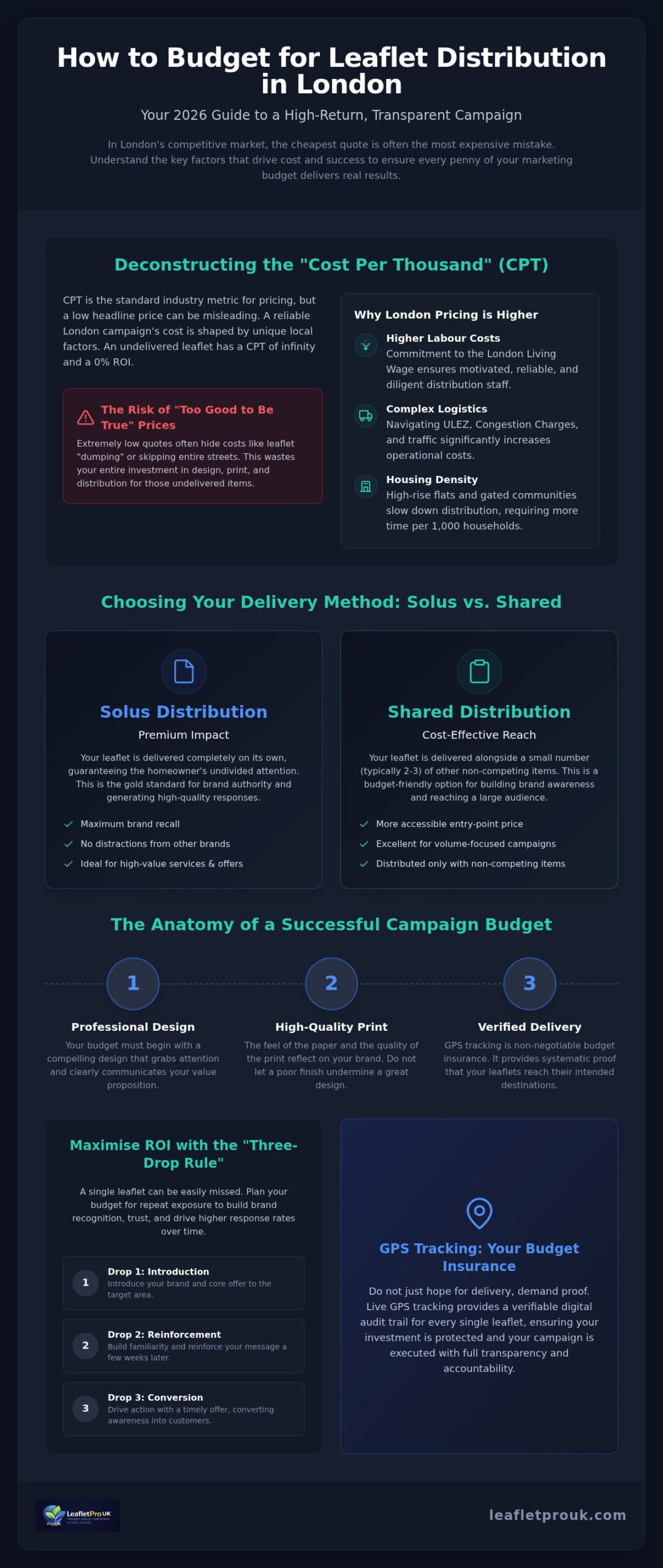
Understanding how to budget for leaflet distribution London starts with mastering the industry’s primary unit of measurement: Cost per Thousand (CPT). Whilst the broader history of what is direct mail shows various ways to reach consumers, CPT remains the most reliable metric for physical distribution. It allows businesses to compare quotes on a like-for-like basis. However, you must distinguish between the headline price on a quote and the effective price of your campaign. If a provider offers a low headline rate but fails to deliver 30% of your materials, your effective price per successful doormat hit actually increases significantly.
In the context of 2026 London logistics, CPT represents the total investment required to physically transport one thousand marketing assets from a storage facility directly into the letterboxes of a specific geographic demographic. To better understand this concept and how it fits into a wider strategy, watch this helpful video:
Why London Pricing Differs from the Rest of the UK
London presents a unique set of logistical challenges that naturally inflate the CPT compared to regional towns. Reputable distribution teams prioritise the London Living Wage to ensure staff are motivated and diligent, which is a fundamental cost that “budget” firms often bypass. Additionally, logistics providers must account for the daily costs of the Ultra Low Emission Zone (ULEZ) and the Congestion Charge when moving stock between boroughs. Even housing density plays a role; whilst Inner London has more households per square mile, the prevalence of high-rise flats and complex security codes means distributors often cover only 150 to 200 letterboxes per hour, making the process more labour-intensive than suburban rounds.
The Risks of “Too Good to Be True” Pricing
When you are researching how to budget for leaflet distribution London, you will inevitably encounter prices that seem unusually low. These providers often maintain their margins by “dumping” leaflets or skipping difficult-to-access streets, which results in a 0% ROI for those discarded items. A failed campaign isn’t just a loss of the distribution fee; it’s the wasted cost of design, paper, and printing. We view GPS verification as a non-negotiable budget insurance policy. By using GPS tracked leaflet distribution, you gain systematic proof that every flyer reached its intended destination, ensuring your budget is spent on genuine engagement rather than empty promises.
Choosing Your Delivery Method: Shared vs Solus Budgeting
Selecting the most appropriate delivery method is a pivotal decision when determining how to budget for leaflet distribution London. Your choice dictates the level of exclusivity your brand enjoys at the letterbox and directly influences your overall campaign cost. Whilst shared distribution offers a more accessible entry point for businesses focused on volume, solus delivery provides a premium platform where your message is the only one encountered by the resident. Following the DMA Code of Practice ensures that regardless of the method, your campaign maintains professional standards and ethical engagement with the public.
Solus Distribution: Premium Impact for London Brands
Solus distribution is the gold standard for businesses offering high-value services, such as estate agents, luxury home improvements, or private clinics. By ensuring your flyer is delivered entirely on its own, you eliminate the risk of being overshadowed by other marketing materials. This method typically results in the highest brand recall because it captures the recipient’s undivided attention the moment they pick up their post. When you plan your 2026 budget, view solus drops as a strategic investment in brand authority. We integrate GPS tracking as a non-negotiable layer for these campaigns, providing a digital audit trail that confirms every single doormat hit with absolute precision.
Shared Distribution: Cost-Effective Volume
If your primary objective is to achieve maximum reach across diverse London postcodes whilst managing a tighter budget, shared distribution is a sensible alternative. In this model, your leaflet is delivered alongside a small number of non-competing items. The logical trade-off is a higher level of competition for the resident’s attention. To maintain effectiveness, you should budget for higher print volumes to offset potentially lower response rates. This volume-led strategy works particularly well for local restaurants, retail promotions, or community events where broad awareness is more important than total exclusivity. It allows you to spread your message across a wider geographic area without an exponential increase in your distribution spend.
Regardless of the delivery model you select, GPS tracking serves as the primary safeguard for your marketing capital. It transforms a vague promise into a verified logistical event, ensuring that your flyers are actually reaching households rather than being discarded. This level of accountability is why sophisticated brands prioritise transparency and proof over the lowest possible headline price. If you want to ensure your investment translates into genuine engagement, you might organise GPS tracked leaflet distribution to secure the peace of mind that comes with a well-executed, visible process.
Factoring in London-Specific Logistics and Access Challenges
London’s unique urban geography means that a campaign in the capital requires more nuanced planning than in any other UK city. When you are learning how to budget for leaflet distribution London, you must account for the physical architecture of your target postcodes. A distributor moving through a street of terraced houses in Croydon will achieve a much higher delivery rate per hour than someone navigating the secure apartment blocks of Canary Wharf. Understanding these variations is essential for setting realistic expectations and ensuring your campaign remains compliant with UK direct marketing regulations regarding access and resident privacy.
The speed of distribution is the primary driver of labour costs. In suburban areas, a professional can often reach the higher end of the 150 to 200 letterboxes per hour industry average. However, in dense urban centres, this rate can drop significantly due to security gates, intercom systems, and concierge desks. This “Access Factor” is why certain postcodes carry a higher CPT. If you ignore these logistical realities, you risk underfunding your campaign, which often leads to distributors cutting corners to meet impossible targets. Precision in your budget allows for the diligence required to navigate these challenges properly.
Inner vs Outer London: Budgeting for Density
Targeting Inner London boroughs like SE1 or E14 offers incredible household density, which can reduce travel time between drops. However, this density is often accompanied by “letterbox fatigue,” where residents in high-traffic areas receive a higher volume of marketing mail. To cut through this noise, your budget may need to prioritise solus delivery over shared drops. Conversely, Zone 6 suburbs require more travel time but often yield higher engagement rates because residents receive fewer flyers. Balancing these factors ensures your investment is allocated where it will generate the most significant response for your specific industry.
The “Gated” Premium: Access and Accountability
In affluent areas like Chelsea or parts of the Docklands, “100% coverage” is often a logistical myth. Many high-end developments are gated or managed by concierges who may refuse entry to unaddressed mail. Professional teams handle this by using “Selected Street” drops, focusing on accessible high-value properties rather than wasting budget on unreachable units. We recommend budgeting for a slightly higher volume than your absolute target to compensate for these “no-access” zones. This strategic padding ensures your campaign hits its required reach without overspending on impossible doormats. For a deeper look at how we plan these complex routes, you can read our guide to GPS Tracked Leaflet Distribution, which explains the technology we use to verify every successful delivery.
Integrated Budgeting: Design, Print, and GPS-Tracked Delivery
A successful marketing campaign is a cohesive system rather than a series of isolated purchases. When you evaluate how to budget for leaflet distribution London, you must look at the integrated costs of design, high-quality printing, and the distribution itself. Choosing an end-to-end service provider ensures budget transparency and eliminates the hidden costs of managing multiple vendors. If you invest in premium distribution but use a poorly designed flyer, you are essentially paying to put a missed opportunity through someone’s door. A unified approach prevents budget creep and ensures that every pound spent on paper and ink works as hard as the pound spent on GPS-tracked delivery.
Leaflet Design: Investing in the “First Impression”
Professional design support is a strategic one-time cost that yields long-term ROI. In the competitive London market, your flyer has roughly two seconds to capture interest before a resident moves it from the doormat. Essential elements like a clear headline, a compelling offer, and a direct call-to-action are vital for success. For layout advice that maximises your physical space, you can review these Direct Response Leaflet Design Tips. Avoiding common leaflet marketing mistakes, such as cluttered visuals or missing contact details, protects your distribution investment from being ignored by your target audience.
Printing Costs and Paper Quality
Printing costs are heavily influenced by volume and material choice. Often, printing 10,000 units offers significantly better value than 5,000 due to the initial setup costs involved in professional lithographic printing. The physical format also dictates your spend; whilst A6 is compact, A5 remains the industry standard for providing enough space for a persuasive message without feeling intrusive. Paper weight, measured in gsm (grams per square metre), affects the perceived quality of your brand. A 130gsm or 170gsm flyer feels substantial and survives the journey through a letterbox better than thinner alternatives. In 2026, many brands are also budgeting for recycled paper options to align with the sustainability values of London residents. Choosing a matt or gloss finish can further protect the ink from damp weather, ensuring your message arrives in pristine condition.
Calculating how to budget for leaflet distribution London accurately means accounting for these physical production variables from the outset. By consolidating these services, you maintain better control over the final outcome and ensure that the “credibility” of your print matches the precision of your delivery.
Calculating Your Potential ROI and Finalising Your Campaign Spend
Finalising your investment requires a shift in perspective from mere expenditure to projected return. To determine how to budget for leaflet distribution London effectively, you should first establish a “break-even” response rate. This is calculated by dividing your total campaign cost by the average profit generated per new customer. If your campaign requires a specific number of conversions to cover its costs, knowing this figure allows you to set realistic benchmarks for success. It transforms your marketing from a speculative cost into a controlled business process where every doormat hit has a measurable value.
In the high-density London market, brand awareness often requires multiple exposures to convert a lead. We recommend the “Three-Drop Rule,” which involves delivering to the same postcode three times over a three-month period. This repetition builds the trust and familiarity necessary for residents to engage with your brand amongst the daily noise of the capital. Following these initial drops, you can use GPS data to refine your future budgets. By identifying specific streets or zones with higher engagement, you can reallocate funds towards these high-response areas whilst scaling back on less productive postcodes. For a comprehensive tracking setup, you can refer to our ROI Framework.
The Value of Postcode-Targeted Precision
Targeting the right demographics is a far more efficient use of capital than blanket coverage. By using London census data, you can align your budget with the specific housing types, income levels, or family structures that match your ideal customer profile. It is a logistical fact that 5,000 targeted flyers delivered to the correct audience will consistently outperform 20,000 untargeted ones. This precision reduces your total spend whilst increasing the likelihood of a high response rate, ensuring your marketing materials reach the hands of those most likely to value your services. It is about the quality of the reach, not just the quantity of the paper.
Next Steps: Requesting a Transparent Quote
To receive an accurate and transparent quote for your London campaign, you should provide details on your target postcodes, the desired delivery method, and the total volume of leaflets. We integrate GPS verification into every campaign budget to provide systematic proof of delivery, giving you the security that your investment is being handled with professional care. This accountability is the foundation of a successful marketing partnership. If you are ready to move from planning to execution, you can contact LeafletPro UK for a bespoke London campaign plan that prioritises precision and tangible results.
Securing Your Brand’s Future in the Capital
Mastering the nuances of the capital’s landscape ensures that every marketing pound is spent with purpose. By prioritising GPS-tracked accountability and focusing on postcode-targeted precision, you move away from the uncertainty of blanket coverage. Integrated services that combine expert design, high-quality print, and reliable delivery provide the transparency needed to maintain a predictable budget whilst maximising doormat impact. It’s clear that success in 2026 depends on verified data and a methodical approach to local engagement rather than vague promises.
Understanding how to budget for leaflet distribution London is the first step toward building a sustainable and high-ROI campaign. Our specialist London postcode knowledge ensures your message reaches the most relevant demographics with absolute precision. By combining these logistical insights with our commitment to 100% accountability, we help you transform your physical marketing into a dependable growth engine for your business.
Your next successful campaign starts with a plan rooted in data and logistical integrity. We look forward to helping you grow your brand across the capital with confidence and the peace of mind that comes from a well-executed process.
Frequently Asked Questions
How much does leaflet distribution cost per 1,000 in London?
Industry rates for a London campaign depend on the delivery model and the specific borough’s density. Whilst some providers offer low headline figures, these often exclude essential verification or the London Living Wage for staff. When you research how to budget for leaflet distribution London, consider that inner boroughs typically command a higher rate due to congestion and access complexities. A reliable quote should reflect the actual labour time required for successful doormat delivery.
Is it cheaper to use Royal Mail or a private London distribution company?
Royal Mail often provides a lower entry price for unaddressed mail, yet they lack the geographic precision and accountability of a specialist private firm. Private companies offer GPS tracking and the ability to target specific postcodes rather than entire sectors. This targeted approach ensures your budget isn’t wasted on unsuitable demographics. For businesses seeking a high ROI, the transparency and verification provided by a private partner often outweigh the initial cost savings.
Does the price of leaflet distribution include the cost of printing?
Most distribution quotes are separate from production costs, although integrated providers offer combined packages for better budget visibility. Choosing an all-in-one service for design, print, and delivery simplifies your logistics and ensures the paper quality meets distribution standards. This approach prevents unexpected costs and ensures that the physical marketing assets are ready for the specific challenges of London letterboxes, such as weather resistance and an appropriate, professional paper weight.
What is the minimum volume for a GPS-tracked leaflet drop in London?
To generate statistically significant response data, most professional campaigns require a minimum volume of 5,000 leaflets. This threshold ensures that the GPS tracking data provides a comprehensive overview of the delivery route and household engagement. Smaller volumes often lead to a higher cost per thousand because the logistical setup and travel time remain constant. Budgeting for a larger initial drop is generally more cost-effective for businesses looking to establish a presence.
How can I verify that my leaflets were actually delivered in London?
Verification is achieved through detailed GPS logs that track the distributor’s exact path in real-time. This technology provides systematic proof that every leaflet reached the intended doormat, offering 100% accountability for your marketing spend. Unlike unverified services, GPS-tracked drops allow you to view digital maps of the covered streets. This level of visibility addresses the common fear of flyers being discarded and ensures your investment is handled with total professional integrity.
Why is Solus distribution more expensive than Shared distribution?
Solus distribution carries a higher price because your leaflet is the only item being delivered to the household. The distributor’s labour costs are covered entirely by your campaign, rather than being shared amongst multiple clients. This exclusivity ensures your brand has the resident’s undivided attention, which typically leads to higher response rates. Whilst shared delivery is a budget-friendly alternative, solus is the preferred choice for premium brands requiring maximum visibility and impact.
Should I budget for more than one leaflet drop to the same London area?
Yes, budgeting for multiple drops is a core component of how to budget for leaflet distribution London effectively. The “Three-Drop Rule” suggests that residents need to see your message at least three times to build trust and brand recognition. A single flyer can easily be overlooked, but repeated exposure over several months significantly increases the likelihood of conversion. Consistent presence in a postcode helps your business become a familiar, reliable local option.
Are there extra costs for delivering flyers to London apartment blocks?
Delivering to high-rise apartment blocks and gated communities often requires more time and labour, which can affect the overall campaign cost. These access challenges mean a distributor covers fewer households per hour compared to a street of traditional terraced houses. Whilst there isn’t always a specific surcharge, a transparent quote will account for the increased labour required to navigate security systems. Accurate budgeting must reflect these physical logistical realities to ensure full coverage.