Tag: small business marketing

  • Leaflet Design Best Practices: A 2026 Guide to London Campaign Success

    Leaflet Design Best Practices: A 2026 Guide to London Campaign Success

    A leaflet that lands on a London doormat has exactly two seconds to justify its existence before it meets the recycling bin. You’ve likely felt the frustration of investing in a campaign only to see your hard-earned budget produce silence instead of sales. In a city as fast-paced as ours, generic flyers often fail because they lack the visual authority needed to capture attention. Understanding leaflet design best practices is no longer just about aesthetics; it’s about survival in a competitive physical marketplace where every millimetre of paper must work for your brand.

    This guide provides the technical clarity and creative strategies required to turn your marketing materials into high-conversion sales channels. We’ll demystify complex print terms like bleed and CMYK whilst showing you how to maintain brand consistency across every London postcode. You’ll learn how to bridge the gap between professional design and seamless distribution, ensuring your next campaign delivers the measurable response rates your business deserves. From doormat-ready layouts to GPS-tracked delivery standards, we’re outlining the roadmap for your 2026 campaign success.

    Key Takeaways

    • Learn how the three-second rule dictates campaign success by capturing attention on competitive London doormats before the recipient reaches the recycling bin.
    • Master leaflet design best practices including visual hierarchy and colour psychology to guide potential customers from the initial hook to the final action.
    • Avoid expensive production errors by understanding the technical requirements of print, from CMYK colour profiles to essential bleed and quiet zones.
    • Discover how to integrate QR codes and high-value offers that turn a physical flyer into a trackable digital conversion tool.
    • Understand the benefits of an integrated workflow where design decisions are informed by local London postcode data and GPS-tracked delivery insights.

    Why Professional Leaflet Design Support is Essential for London Campaigns

    London letterboxes are battlegrounds for attention. Every day, households in boroughs like Kensington or Fulham receive a high volume of marketing material. Your headline must win the battle of the doormat instantly; you have roughly three seconds before a recipient decides whether to read on or recycle. This narrow window is why generic flyers fail. Adhering to leaflet design best practices ensures your message survives this initial sorting process by presenting a clear, authoritative value proposition that resonates with a busy urban audience.

    Professional design builds immediate trust through the psychology of tangibility. The history and uses of flyers show that physical marketing’s strength lies in its ability to create a lasting impression in a way digital ads cannot. A well-constructed leaflet feels substantial and credible. If a flyer looks cheap, cluttered, or poorly aligned, the recipient subconsciously transfers that lack of quality to your business. High standards in your creative assets signal that you’re an established and dependable brand.

    Design shouldn’t exist in a vacuum. It must be informed by the eventual GPS-tracked distribution area to be truly effective. At LeafletPro UK, we believe leaflet design support should be a collaborative process that considers the specific streets your flyers will land on. When your design is synchronised with your logistical strategy, you create a seamless journey from the doormat to the sale.

    The Risk of DIY Templates

    Generic online templates often ignore the nuances of the London market. These “off-the-shelf” designs frequently fail to resonate with local audiences because they lack a specific aesthetic hook tailored to the city’s diverse boroughs. Beyond the visuals, DIY tools often overlook critical technical requirements like print bleed and quiet zones. If your design is cut incorrectly during the printing process, your contact details or call to action might be lost. Using a template might seem cost-effective initially, but the hidden cost of a failed campaign far outweighs the savings. A flyer that doesn’t fit the letterbox or looks disjointed from your website damages your professional standing and breaks brand consistency.

    London-Specific Audience Targeting

    Effective campaigns tailor their visual language to specific demographics. A flyer designed for a young professional in Shoreditch should look and feel different from one targeting a family in Richmond. Professional designers use local insights to choose imagery and typography that converts within these distinct micro-markets. Localised design is the alignment of creative assets with specific postcode demographics. By matching your creative approach to the household’s expectations, you increase the likelihood of a positive response. This targeted approach ensures your budget isn’t wasted on generic messaging that fails to connect with the people most likely to use your services.

    Core Visual Principles: Hierarchy, Colour, and White Space

    Applying leaflet design best practices ensures your message is not only seen but processed in the few seconds before a recipient reaches their kitchen table. A professional layout functions as a silent guide, directing the reader’s eye through a logical sequence of information. This starts with a dominant “Hook” to grab attention, followed by a concise “Offer” to build interest, and concludes with a clear “Action”. Without this structured hierarchy, even the most compelling discount becomes lost in a sea of competing text.

    Strategic use of colour and white space is what separates a premium brand from junk mail. Whilst it’s tempting to fill every millimetre of paper to maximise value, a cluttered flyer suggests a disorganised business. White space, or negative space, provides the visual “breathing room” required for the brain to focus on your primary message. Similarly, your colour palette should evoke specific emotional responses whilst adhering to your brand guidelines. For example, deep blues often project reliability and security, which is essential for service-based businesses operating in London’s competitive residential markets.

    Typography also plays a critical role in conversion, particularly in the unique environment of London housing. Many recipients will first view your leaflet in dimly lit communal hallways or porches. Choosing clean, sans-serif fonts ensures legibility at a glance. Avoid overly decorative scripts that sacrifice clarity for style. If you’re struggling to balance these creative elements with your marketing goals, our leaflet design support provides the expertise needed to create a layout that commands professional respect.

    Creating a “Focal Point” that Works

    Your leaflet needs a singular hero image to anchor the design. Using a collage of small, low-resolution photos creates confusion and dilutes your impact. Position your primary offer near this focal point so it’s impossible to miss. We recommend using a “Z-Pattern” layout, which follows the natural way Londoners scan physical documents: starting at the top-left, moving across to the top-right, and then sweeping down to the bottom-right for the final call to action. This methodical approach ensures the most important details are positioned exactly where the eye naturally lands.

    Branding and Credibility

    Trust is a primary driver for response rates in London’s boroughs. To build this, your logo and contact details must be prominent but integrated into the design rather than appearing as an afterthought. You can enhance credibility by including trust signals, such as professional associations or even subtle imagery of local London landmarks relevant to your target postcode. This creates an immediate sense of local presence. Maintaining a clean, organised aesthetic reflects a reliable business, giving the homeowner peace of mind that they are dealing with an established professional rather than a fly-by-night operation.

    Technical Best Practices: Preparation for High-Quality Printing

    Adhering to leaflet design best practices requires a transition from creative vision to technical precision. Even the most striking layout will fail if the file isn’t prepared correctly for the physical printing process. One of the most common errors involves colour profiles. Digital screens display images in RGB (Red, Green, Blue), whilst professional printers use CMYK (Cyan, Magenta, Yellow, Key/Black). If you don’t convert your design to CMYK before sending it to print, the final colours may appear dull or distorted compared to what you see on your monitor.

    Protection against cutting errors is equally vital. “Bleed” refers to the extra 3mm of background design that extends beyond the final trim line, ensuring no white edges appear if the cutting blade shifts slightly. Similarly, “quiet zones” are the margins inside the trim line where no critical text or logos should be placed. By maintaining these zones, you ensure your contact details remain intact and legible once the leaflets are finished and ready for distribution across London.

    Image quality is a non-negotiable standard. For professional London marketing, 300dpi (dots per inch) is the minimum resolution required to avoid pixelation. Low-resolution images suggest a lack of care, which can damage your brand’s credibility before the recipient has read a single word. To ensure the highest fidelity, we require print-ready PDFs as the industry standard. This format embeds all fonts and high-resolution assets, providing a stable file that translates perfectly from the designer’s desk to our high-quality printing presses.

    Choosing the Right Paper Stock (GSM)

    The weight of your paper, measured in Grams per Square Metre (GSM), significantly influences the “hand-feel” and perceived value of your brand. A 130gsm stock is the reliable choice for high-volume distributions, providing a professional look whilst remaining cost-effective. However, for premium London boroughs, upgrading to 250gsm or higher creates a sense of luxury and durability. You can explore our full range of options in our guide to Leaflet Printing Finishes London.

    Finishes that Demand Attention

    Selecting the right finish depends on your industry and brand identity. Gloss finishes offer vibrant colours and a high-shine look, whilst matte or silk options provide a more understated, sophisticated feel. Beyond aesthetics, specialised coatings play a functional role by protecting your leaflets from scuffing or moisture during the door-to-door delivery process. As we move through 2026, many London residents also expect a commitment to the environment. Choosing sustainable, FSC-certified paper and vegetable-based inks demonstrates that your business is both professional and eco-conscious.

    Leaflet Design Best Practices: A 2026 Guide to London Campaign Success

    Designing for Response: CTAs and Tracking Integration

    A visually stunning leaflet is only successful if it triggers a measurable response. In the competitive London market, leaflet design best practices must bridge the gap between creative aesthetics and distribution logistics. Many businesses treat design and distribution as separate silos, but a high-conversion campaign requires these elements to work in tandem. By integrating specific tracking mechanisms directly into your layout, you transform a physical flyer into a data-rich marketing channel that justifies every penny of your investment.

    Tracking ROI is essential for verifying the effectiveness of your campaign. You can achieve this by using unique phone numbers or dedicated landing pages for different London postcodes. Alternatively, unique discount codes allow you to attribute every sale to a specific distribution wave. These leaflet design best practices ensure your marketing remains accountable and transparent. To prevent your leaflet from sitting indefinitely on a sideboard, employ the scarcity principle. Including a clear expiry date creates a sense of urgency, prompting the recipient to act whilst your brand is still fresh in their mind. This methodical approach to data collection provides the evidence needed to refine future campaigns.

    Optimising QR Codes for Conversion

    QR codes are the most efficient way to link physical leaflets to your London-specific landing pages. However, their placement must be strategic. The code should be large enough to scan easily but shouldn’t dominate the visual hierarchy. Most importantly, you must provide a compelling reason to scan. A prompt such as “Scan for 20% off your first London order” provides immediate value and encourages engagement. For more inspiration on how to phrase these prompts, see our 45+ Leaflet Call to Action Examples.

    The Offer-Centric Layout

    The “What’s in it for me?” factor must be the most prominent text on your page. If a recipient cannot identify the benefit within two seconds, they’ll likely discard the flyer. Use bold subheadings to break up copy and highlight secondary benefits, ensuring the main offer remains the focal point. Direct Response Design is a layout focused on a single, measurable user action. This approach removes friction and guides the reader toward a specific outcome, whether that’s a phone call, a website visit, or an in-store redemption. By simplifying the decision-making process, you increase the likelihood of a conversion.

    Maximising ROI with LeafletPro UK’s Integrated Design Service

    Choosing an integrated partner ensures your campaign moves flawlessly from the initial concept to the final letterbox. Whilst many agencies treat creative work and logistics as separate entities, LeafletPro UK operates an end-to-end solution that keeps design, print, and distribution under one roof. This unified approach eliminates the risk of technical translation errors and ensures that every element of your flyer adheres to leaflet design best practices from the very first draft. By managing the entire lifecycle of your marketing material, we provide a level of accountability that fragmented services cannot match.

    Our creative decisions are uniquely informed by the logistical data we gather daily across London postcodes. We use insights from previous GPS-tracked campaigns to suggest the best creative approach for your specific target area. If a particular borough responds better to certain imagery or specific paper finishes, our designers incorporate these findings into your layout. This data-led strategy ensures your design isn’t just attractive; it’s technically optimised for the specific demographics you intend to reach, providing the peace of mind that your investment is grounded in evidence.

    Quality control remains a priority throughout the process. We ensure your leaflets are printed to the exact standards required for our distribution teams, avoiding common issues like thin paper that jams in letterboxes or finishes that smudge in transit. From the first pixel of your design to the final doormat in London, we provide the visibility and systematic reliability necessary for a successful campaign. This integrated workflow saves time and reduces the confusion often associated with managing multiple vendors.

    Working with LeafletPro UK Designers

    Our collaborative process is designed to turn your business goals into professional creative assets. We work closely with you to ensure your campaign is “distribution-ready”, meaning every file meets our rigorous technical standards for print and delivery. This proactive approach prevents the delays and errors often associated with generic DIY templates. For a deeper look at how we synchronise these elements, read our Professional Leaflet Design and Distribution London guide.

    The Final Step: GPS-Tracked Delivery

    A high-quality design deserves a delivery method that is equally sophisticated. Once your design is finalised and printed, our GPS-tracked teams take over, providing the ultimate proof that your material reached its target. These reports offer a level of transparency that gives you total confidence in your marketing spend. By closing the loop between design and delivery, we ensure your brand message lands exactly where it’s needed, supported by a diligent partner who values results over vague promises.

    Future-Proofing Your London Leaflet Campaigns

    Success in the capital’s competitive market requires more than just high-quality paper. It demands a strategic alignment of visual hierarchy, technical precision, and measurable response mechanisms. By implementing leaflet design best practices, you ensure your brand survives the initial doormat sort and drives tangible engagement through trackable calls to action. Moving beyond generic templates allows your business to project the authority and credibility that London residents expect.

    Our integrated approach provides the peace of mind that your campaign is handled with professional scrutiny from the first pixel to the final delivery. With an expert London-based design team and GPS-tracked delivery data for 100% transparency, we manage the entire lifecycle of your marketing material. This end-to-end management ensures your creative vision is never compromised by technical errors or unreliable distribution.

    Transforming your marketing into a high-conversion sales channel starts with a commitment to professional standards. We’re ready to help you turn every London letterbox into a new opportunity for growth.

    Frequently Asked Questions

    What is the best size for a business leaflet in London?

    A5 is widely considered the most effective size for London-based campaigns. This format provides enough space for a clear visual hierarchy whilst remaining compact enough to fit through standard residential letterboxes without being damaged. Whilst A4 or A6 options are available, A5 strikes the perfect balance between printing costs and impact. It’s a versatile choice that allows for bold headlines and clear calls to action, ensuring your brand message remains professional and legible.

    How much does professional leaflet design support cost?

    The cost of professional design support depends on the specific requirements of your campaign and the complexity of the creative brief. Investing in expert design is a strategic move that helps you avoid the common pitfalls of DIY templates which often fail to convert. At LeafletPro UK, we focus on creating assets that are “fit for the doormat”, ensuring your budget isn’t wasted on materials that lack the visual authority needed to capture attention.

    Can I provide my own design for printing and distribution?

    You are welcome to provide your own artwork for our printing and distribution services. To maintain our high standards of quality control, your files must meet specific technical requirements, such as including a 3mm bleed and using the CMYK colour profile. We recommend reviewing leaflet design best practices before submission to ensure your layout is optimised for our GPS-tracked delivery teams. Our experts can perform a basic check to confirm your files are distribution-ready.

    What file format should I use for my leaflet design?

    A high-resolution, print-ready PDF is the industry standard and our preferred format for all leaflet campaigns. This file type ensures that your fonts, images, and layout remain stable during the transition from design to print. It’s essential that all images within the PDF are at least 300dpi to prevent pixelation. Using a PDF format allows us to maintain the integrity of your brand’s colours and sharp details, providing a professional finish that reflects your business quality.

    How do I ensure my leaflet design is print-ready?

    Ensuring your design is print-ready involves checking several technical benchmarks. You must confirm that your document uses the CMYK colour space rather than RGB to ensure colour accuracy on paper. Additionally, include a 3mm bleed around all edges and keep critical text within a “quiet zone” away from the trim line. Verification of image resolution is also vital; every graphic should meet the 300dpi standard. These steps prevent production delays and ensure a clean, professional final product.

    What is the difference between a flyer and a leaflet in design terms?

    In design terms, the words “flyer” and “leaflet” are often used interchangeably, though subtle differences exist. A flyer is typically a single-sheet, flat document used for high-volume distribution. A leaflet may involve more complex designs, such as folds or premium paper stocks, and is often used for more detailed service descriptions. Regardless of the terminology, the core leaflet design best practices remain the same: you need a strong hook, a clear offer, and a compelling call to action.

    How many words should be on a standard A5 leaflet?

    For a standard A5 leaflet, we recommend keeping your copy concise to avoid a cluttered look. Aim for a maximum of 150 to 200 words. This allows for a dominant headline, a few punchy bullet points highlighting your primary benefits, and a clear call to action. Space is a premium commodity on a physical flyer; using too much text can overwhelm the reader and lead to your message being ignored. Clear, brief messaging always performs better.

    Can you help with the copy and headlines for my leaflet?

    Yes, our professional design support includes guidance on crafting effective headlines and persuasive copy. We understand that the right words are just as important as the visual layout for driving conversions. Our team uses local insights from across London postcodes to help you phrase offers that resonate with your specific target audience. We focus on creating a “What’s in it for me?” factor that grabs attention instantly and encourages the recipient to take the next step.
  • Effective Flyer Design and Print London: The 2026 Conversion Guide

    Effective Flyer Design and Print London: The 2026 Conversion Guide

    How many thousands of pounds are currently sitting at the bottom of recycling bins across Greater London because a marketing campaign lacked accountability? It’s a common frustration for many business owners who feel that physical marketing is a black hole where budgets disappear without a trace. You likely understand that whilst a well-crafted message is vital, the logistical gap between a printer and a potential customer’s doormat often feels impossible to bridge with any real certainty. Managing separate designers, printers, and distributors only adds to the complexity and risk of your investment.

    This guide will show you how to master effective flyer design for distribution London by integrating professional aesthetics with rigorous, GPS-verified delivery systems. You’ll learn how to stop guessing and start seeing tangible response rates from your most valuable local postcodes. We will explore the critical design elements that prevent your materials from being discarded and explain how transparent tracking ensures every penny of your marketing spend is accounted for. By the end of this article, you’ll have a clear roadmap for creating physical marketing that commands attention and delivers verified results in the competitive 2026 market.

    Key Takeaways

    • Understand why integrating design, print, and distribution into a single workflow prevents campaign failure and ensures brand consistency from concept to doormat.
    • Master the “Seven-Second Rule” and information hierarchy to create effective flyer design for distribution London that captures attention before it reaches the recycling bin.
    • Learn how to select the optimal paper weight and format, such as A5 or DL, to balance a premium feel with cost-effective delivery across London postcodes.
    • Discover how GPS-tracked distribution provides complete transparency, allowing you to verify that every flyer has reached its intended destination with absolute precision.
    • See how an end-to-end management approach saves time and reduces the logistical hassle of coordinating multiple vendors for your local marketing campaigns.

    The London Doormat Challenge: Why Design and Print Integration Matters

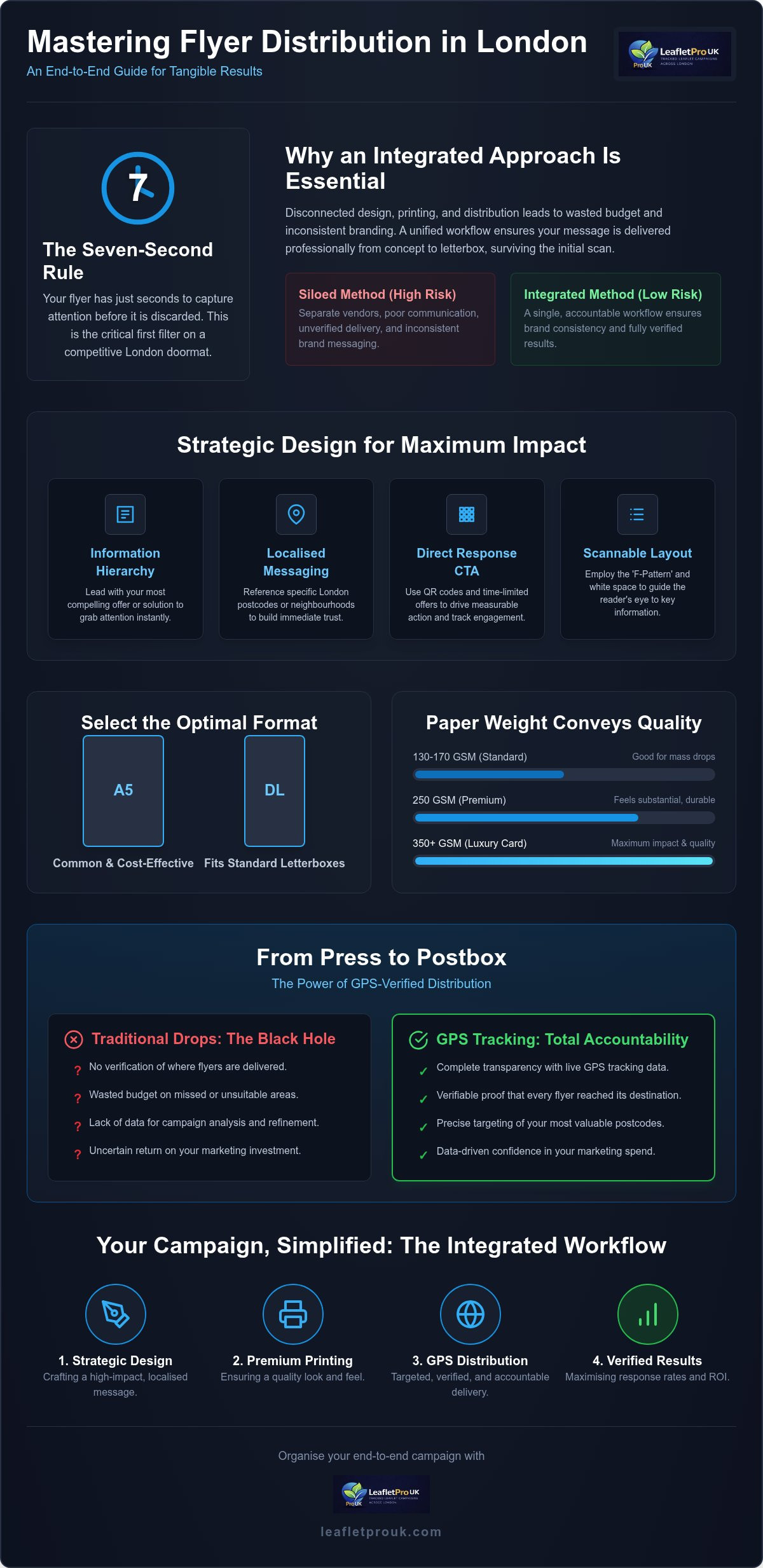
    The competition on a London doormat is exceptionally high. On any given day, a resident in Fulham or Islington might find several pieces of mail waiting for them. This environment has birthed the “Seven-Second Rule”, a critical window where a recipient decides to either keep your flyer or move it directly to the recycling bin. Achieving effective flyer design for distribution London isn’t just about aesthetics; it’s about surviving this initial filter through immediate visual impact and physical quality.

    Many campaigns fail because they treat design, print, and distribution as separate silos. When these elements aren’t aligned, the results are often disappointing. A designer might create a beautiful layout that doesn’t account for the physical “grip” required by a distributor, or a printer might use ink that smudges in the damp London air. When these phases don’t communicate, you risk a final product that looks unprofessional by the time it reaches the customer. An integrated approach ensures that the visual strategy matches the logistical reality of the city’s letterboxes.

    London Household Behaviour in 2026

    Londoners’ decision-making processes have become increasingly refined. In high-density areas like Hackney or Wandsworth, communal entrances and shared hallway tables create a “bin-adjacent” sorting culture. If your flyer feels flimsy or looks like a generic national advertisement, it’s unlikely to make it past the front door. High-quality paper weights and London-centric messaging are essential for building trust. Referencing specific local postcodes or neighbourhood landmarks signals that your business is part of the community, which significantly outperforms one-size-fits-all marketing templates.

    The Synergy of Professional Design and GPS Delivery

    The physical condition of your marketing material speaks volumes about your brand’s standards. A crisp, uncreased flyer delivered through a letterbox suggests a professional and diligent business. However, visual quality is only half the battle. Without GPS verification, you’re essentially operating in the dark. Integrating effective flyer design for distribution London with GPS-tracked delivery from a specialist provider like LeafletPro UK provides the accountability that London businesses need. It moves the campaign away from unverified mass drops and toward targeted precision, where every delivery is logged and verified. This systematic approach ensures that your investment is protected and your reach is proven by data rather than vague promises.

    Strategic Flyer Design for Maximum Response Rates

    Creating effective flyer design for distribution London requires a strategic hierarchy that respects the recipient’s limited time. Your primary message must be visible within the first second of contact. This means your headline shouldn’t be your company name; it should be your most compelling offer or solution. If you provide a service in a specific borough, mentioning that location prominently creates an instant connection and increases the likelihood of the flyer being kept. Londoners respond best to messaging that feels tailored to their specific neighbourhood rather than a generic city-wide blast.

    A “Direct Response” call-to-action (CTA) is the engine of your campaign. In a local context, this might be a time-limited discount or a specific invitation to a local event. To bridge the gap between physical and digital, QR codes are indispensable. They provide a frictionless path to your website whilst allowing you to track exactly which postcodes are driving traffic. This data-led approach ensures you can refine your strategy for future drops. Colour choice also plays a role in standing out amongst the morning post. High-contrast schemes often work better than muted tones, provided they align with your brand’s professional identity and don’t feel visually aggressive.

    Layout Essentials for Quick Scanning

    The “F-Pattern” is a proven layout strategy for A5 and A6 leaflets. Readers typically scan across the top, then down the left side, and across the middle. Placing your most vital information along these paths ensures it’s seen. White space is equally important. In a cluttered London environment, a clean design suggests a well-organised business. Using bold typography to highlight specific boroughs, such as “Serving Greenwich since 2010”, immediately signals local relevance and authority. It’s about making the information as easy to digest as possible during that short walk from the front door to the kitchen table.

    Trust Signals and Credibility

    Londoners are naturally discerning and often skeptical of unsolicited mail. Including trust signals like customer reviews or local industry certifications can mitigate this. A physical London address on the design provides a sense of permanence and accountability that a mobile number alone cannot offer. You can also include a “GPS Verified” badge on your artwork. This signals to the recipient that your business values transparency and systematic execution, which sets you apart from less organised competitors. Incorporating these elements is a fundamental part of effective flyer design for distribution London, as it moves the conversation from a vague promise to a credible offer. If you’re unsure how to balance these elements, seeking professional design support can help ensure your flyer communicates reliability from the moment it’s picked up.

    Selecting Premium Print Specifications for London Campaigns

    A well-executed layout is only as strong as the substrate it is printed on. When your marketing material arrives on a London doormat, the recipient’s first impression is tactile rather than visual. Choosing the right paper stock is a logistical decision that directly impacts the success of your effective flyer design for distribution London. If the paper feels flimsy or cheap, the brand perception follows suit. Conversely, a substantial, high-quality flyer suggests a business that is established and dependable.

    The Perceived Value of Paper Stocks

    For most professional London distributions, 150gsm (grams per square metre) is considered the industry sweet spot. It provides enough rigidity to survive the journey through a letterbox without creasing, yet it remains cost-effective for high-volume campaigns. If you are operating in premium sectors such as luxury real estate or high-end home renovations, moving to a 250gsm or 300gsm card stock can significantly elevate your brand’s authority. These heavier weights feel more like an invitation than an advertisement, which often leads to higher retention rates in affluent postcodes.

    The choice of finish also dictates how your message is received. Silk finish is frequently the preferred choice for London businesses because it reduces glare and resists fingerprints, ensuring the text remains legible under various lighting conditions. Whilst gloss finishes can make colours appear more vibrant, they can sometimes feel overly commercial or “loud.” A silk or matt finish often projects a more sophisticated, modern aesthetic that aligns with contemporary London design trends. Selecting the right “feel” ensures your flyer is not just seen, but respected as a professional piece of communication.

    Sustainability in 2026 Print

    Environmental responsibility is no longer a niche concern; it’s a core expectation for many Londoners. Utilising FSC-certified paper stocks is a transparent way to demonstrate your brand’s commitment to ethical sourcing. In 2026, the quality of recycled paper has reached a point where it is virtually indistinguishable from virgin stock in terms of vibrancy and durability. You can even turn these “green” credentials into a design feature by including a small sustainability mark on your artwork. This builds immediate rapport with eco-conscious residents and positions your business as a forward-thinking entity. By combining high-quality printing with sustainable practices, you create a marketing tool that is both effective and ethically sound.

    Effective Flyer Design and Print London: The 2026 Conversion Guide

    From Press to Postbox: Integrating Print with GPS-Tracked Distribution

    Many London businesses invest heavily in high-end production only to falter at the final hurdle: delivery. Even the most effective flyer design for distribution London loses its value if it never reaches the intended doormat. This is where GPS tracking becomes a non-negotiable standard for any high-volume campaign. It provides a level of transparency that replaces vague assurances with hard data. By integrating your print process with a verified distribution network, you ensure that your marketing spend is protected by a systematic audit trail.

    A GPS distribution report shouldn’t be a confusing map of lines; it’s a tool for business owners to verify coverage and identify gaps. You should look for consistent track logs that mirror the street layout of your targeted London postcodes. This data also allows for sophisticated A/B testing. You might distribute a design featuring luxury imagery to affluent SW postcodes whilst using a more value-driven layout in emerging areas. By linking specific designs to tracked routes, you can accurately measure which creative approach generates the highest response. This logistical precision is what separates a professional campaign from a generic mail drop.

    Understanding Postcode Targeting

    London’s geography is unique, with residential streets often sitting directly adjacent to strictly commercial zones. Effective distribution requires excluding industrial estates or office blocks where flyers are likely to be discarded by receptionists. This precision ensures your print quantities are optimised for households, reducing wastage and increasing the density of your reach. To refine your strategy further, you can learn more about targeted leaflet drops in London and how they maximise local engagement.

    Accountability in Distribution

    The “GPS Proof” standard is the antidote to industry-standard “blind” delivery. At LeafletPro UK, we provide comprehensive tracking as a standard feature, ensuring 100% doormat coverage across your chosen areas. This level of accountability has saved numerous London businesses from wasted budgets. For example, a local restaurant recently used our GPS data to identify that a specific neighbourhood was under-performing despite high delivery rates. This allowed them to pivot their effective flyer design for distribution London to a different demographic, ultimately doubling their redemption rate. Whether you choose a “Solus” drop for maximum impact or a “Shared” drop for cost-efficiency, verification remains the core of our process.

    Organising Your End-to-End Campaign with LeafletPro UK

    Managing separate designers, printers, and distributors often creates unnecessary friction and increases the risk of campaign failure. LeafletPro UK provides a streamlined solution by acting as your single point of contact for the entire process. This integrated model ensures that the strategic goals established during the design phase are carried through to the physical print and final delivery. By maintaining oversight from concept to doormat, we eliminate the communication gaps that often lead to delays or quality issues. You gain a partner who is responsible for the entire workflow, allowing you to focus on managing the resulting enquiries.

    Our methodology is built on a foundation of local expertise. National agencies often apply a generic template to every city, but we focus exclusively on the London market. We understand the specific demographic profiles of different boroughs and how these should influence your effective flyer design for distribution London. Our process begins with detailed postcode mapping to identify your ideal audience and ends with a comprehensive GPS report that verifies every delivery. This systematic approach provides the accountability that modern businesses require, moving beyond vague promises to evidence-based results.

    Professional Design Support

    Working with our in-house team allows you to refine your layout for maximum engagement. We ensure your brand voice remains consistent whilst optimising the visual elements for the London letterbox. This design phase is directly integrated with our GPS tracked distribution service, ensuring that the final product is built for the specific logistical path it will take. By considering the physical journey during the design stage, we help you avoid common pitfalls like illegible text or poor colour contrast in low-light hallways. This synergy between creative and logistical planning is essential for achieving a high return on investment.

    Peace of Mind Delivery

    The LeafletPro UK guarantee is rooted in transparency and reliability. We focus exclusively on London residential doormats, avoiding the wastage associated with commercial drops or unverified distribution methods. This specialisation allows us to provide a service that is both targeted and reliable. Every campaign is backed by GPS evidence, giving you absolute certainty that your materials have reached their destination. To begin briefing your first 2026 campaign, you can reach out to our team to discuss your specific goals. We will guide you through the mapping process and provide a custom quote for an integrated design, print, and distribution package tailored to your postcode requirements.

    Securing Your Competitive Edge in the London Market

    Mastering the transition from a digital concept to a physical doormat requires a blend of creative strategy and logistical precision. You’ve seen how integrating high-quality print specifications with rigorous delivery standards eliminates the typical “blind spots” of traditional marketing. By focusing on effective flyer design for distribution London, you ensure your message doesn’t just reach the letterbox but commands the attention of your specific target demographic. This level of coordination is what defines a professional presence in the capital.

    Accountability is the foundation of every successful campaign in 2026. Utilising GPS-tracked delivery reports for every drop provides the transparency you need to verify your return on investment with absolute certainty. Our comprehensive design-to-doormat service is built on years of London postcode targeting expertise, ensuring your brand stands out in the capital’s most competitive neighbourhoods. It’s time to move away from unverified mass drops and embrace a systematic approach that delivers tangible, verified results. You deserve a marketing partner that values evidence over empty promises.

    We look forward to helping you transform your local engagement with a campaign that is as reliable as it is impactful.

    Frequently Asked Questions

    How much does flyer design and print in London typically cost?

    Costs depend on several variables, including your choice of paper weight, the total volume required, and the level of design support needed. Whilst it’s tempting to seek the lowest price, a poorly printed flyer often results in lower response rates. We focus on providing a transparent, integrated service where the cost reflects the professional standards and systematic verification required for a successful London campaign. Requesting a custom quote ensures the pricing aligns with your specific postcode targets.

    What is the best flyer size for door-to-door distribution in London?

    A5 remains the most popular and effective choice for residential drops because it provides enough surface area for a clear information hierarchy and a compelling call-to-action. DL formats are also highly effective for premium service sectors, as they often stand out amongst standard post. Your choice should depend on your brand’s aesthetic and the amount of detail required to communicate your offer clearly to London households without appearing cluttered or unprofessional.

    How long does a full design, print, and distribution campaign take to launch?

    A comprehensive campaign generally takes between one and two weeks to move from the initial briefing to the first doormat. This timeline allows for a professional design phase, followed by high-quality printing and logistical scheduling. We prioritise a methodical approach to ensure that every aspect of the campaign, from postcode mapping to GPS setup, is executed with the precision necessary for a high-impact launch across your chosen London neighbourhoods.

    Can I provide my own design for you to print and distribute?

    You are welcome to submit your own artwork, provided it meets our technical print specifications. Our team will conduct a professional review to ensure the layout is optimised for effective flyer design for distribution London. We look for elements like clear typography and a strong local message that will resonate with residents in your chosen boroughs. If adjustments are needed to improve conversion, we will provide guidance before proceeding to the printing stage.

    How do I know my flyers have actually been delivered in London?

    We eliminate the uncertainty of physical marketing by providing detailed GPS tracking reports as a standard feature of every campaign. These reports show the exact routes taken by our distributors, offering transparent proof that your materials have reached every intended doormat. This systematic verification process ensures complete accountability and gives you the confidence that your marketing budget is being utilised with maximum efficiency across your specifically targeted London areas and postcodes.

    What is the minimum quantity for a GPS-tracked London campaign?

    Minimum quantities are determined by the specific density of your chosen London postcodes and whether you select a Solus or Shared distribution model. We focus on providing targeted precision, so we work with you to establish a volume that ensures meaningful reach within a specific neighbourhood. This approach prevents wastage and ensures that your campaign maintains the high professional standards required for a successful local engagement strategy in the competitive London market.

    Should I choose gloss or matt finish for my London leaflets?

    Whilst gloss is vibrant, a silk or matt finish is often the more sophisticated choice for modern London campaigns. Silk finishes are particularly effective because they resist fingerprints and reduce glare, ensuring your message remains professional and legible even in dimly lit residential entrances. This tactile quality contributes to the perceived value of your brand and helps your flyer survive the transition from the letterbox to the recipient’s kitchen table.

    Do you offer hand-to-hand distribution in Central London?

    Our services are focused exclusively on door-to-door residential distribution within the London area. We don’t offer hand-to-hand or street-level distribution because residential drops offer a more tangible and lasting connection with the recipient. By delivering directly to the home, your marketing materials have a much higher chance of being kept and acted upon. This focus allows us to maintain the highest levels of GPS-tracked accountability and precision for every client.

  • Budgeting for London Leaflet Distribution: 2026 Guide

    Budgeting for London Leaflet Distribution: 2026 Guide

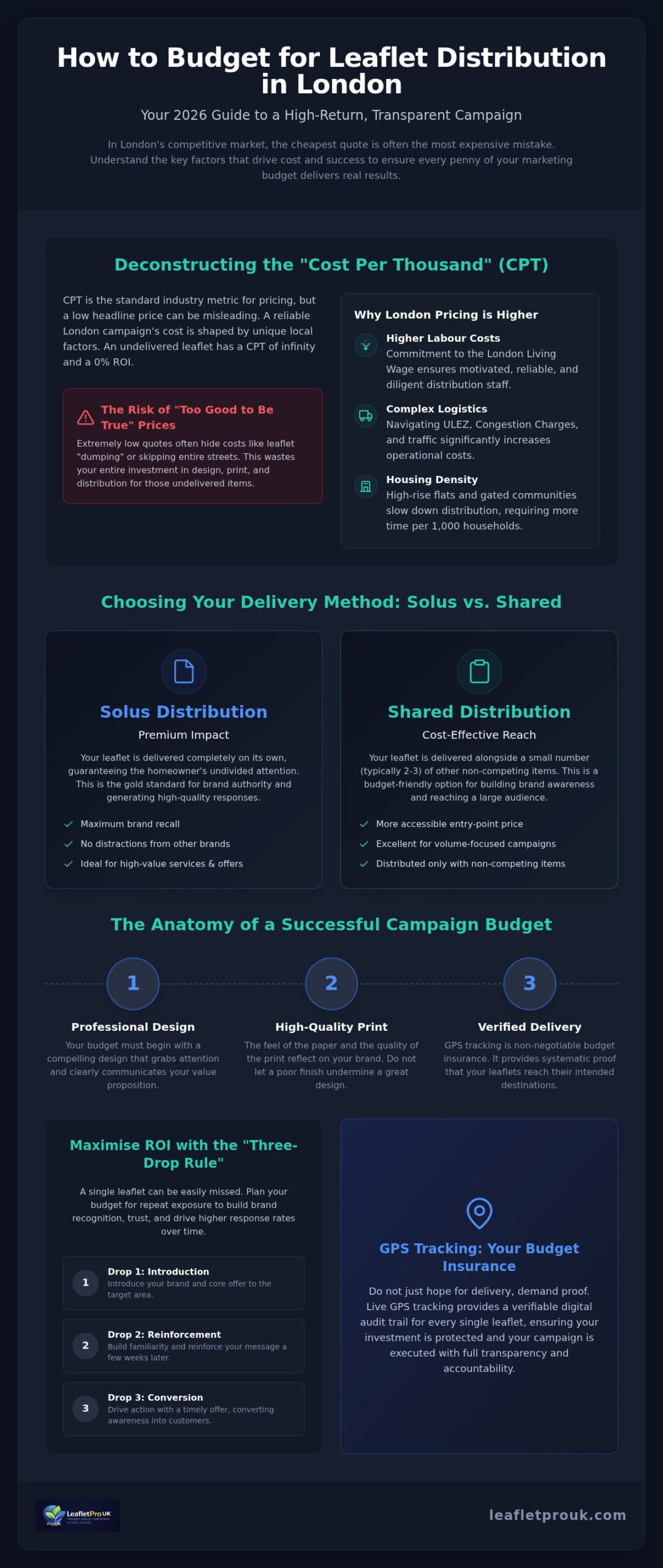
    In the competitive London market, the cheapest quote for leaflet distribution is often the most expensive mistake a business can make. Understanding how to budget for leaflet distribution London requires looking beyond the initial price per thousand to focus on verified doormat delivery and demographic precision. You likely recognise that physical marketing is a powerful tool for connecting with local residents, yet the logistical hurdles of the capital often lead to concerns about wasted spend or flyers being discarded by unreliable distributors.

    We believe that peace of mind comes from knowing your investment is handled with total transparency and care. This 2026 guide will help you master the complexities of London pricing to build a high-ROI campaign whilst avoiding common pitfalls. We will explore how to navigate the differences between inner and outer borough logistics, the necessity of GPS tracking for accountability, and the ways postcode-targeted precision can significantly boost your response rates. By the end, you will have a clear framework for a predictable, effective marketing budget that delivers tangible results for your business.

    Key Takeaways

    • Understand the “Cost per 1,000” (CPT) metric and why London’s specific labour and congestion factors necessitate a higher baseline for reliable delivery.
    • Evaluate the financial merits of shared versus solus distribution to determine which model best balances your brand’s visibility requirements with your available capital.
    • Account for London’s unique housing geography, including gated communities and high-density flats, to ensure your budget reflects the actual time required for successful letterbox access.
    • Learn how to budget for leaflet distribution London by integrating professional design, high-quality printing, and mandatory GPS tracking into a single, transparent investment plan.
    • Apply the “Three-Drop Rule” to your financial planning to move beyond one-off flyers and establish a consistent, high-ROI presence amongst your target demographics.

    Breaking Down the Cost per 1,000 for London Letterbox Drops

    Understanding how to budget for leaflet distribution London starts with mastering the industry’s primary unit of measurement: Cost per Thousand (CPT). Whilst the broader history of what is direct mail shows various ways to reach consumers, CPT remains the most reliable metric for physical distribution. It allows businesses to compare quotes on a like-for-like basis. However, you must distinguish between the headline price on a quote and the effective price of your campaign. If a provider offers a low headline rate but fails to deliver 30% of your materials, your effective price per successful doormat hit actually increases significantly.

    In the context of 2026 London logistics, CPT represents the total investment required to physically transport one thousand marketing assets from a storage facility directly into the letterboxes of a specific geographic demographic. To better understand this concept and how it fits into a wider strategy, watch this helpful video:

    Why London Pricing Differs from the Rest of the UK

    London presents a unique set of logistical challenges that naturally inflate the CPT compared to regional towns. Reputable distribution teams prioritise the London Living Wage to ensure staff are motivated and diligent, which is a fundamental cost that “budget” firms often bypass. Additionally, logistics providers must account for the daily costs of the Ultra Low Emission Zone (ULEZ) and the Congestion Charge when moving stock between boroughs. Even housing density plays a role; whilst Inner London has more households per square mile, the prevalence of high-rise flats and complex security codes means distributors often cover only 150 to 200 letterboxes per hour, making the process more labour-intensive than suburban rounds.

    The Risks of “Too Good to Be True” Pricing

    When you are researching how to budget for leaflet distribution London, you will inevitably encounter prices that seem unusually low. These providers often maintain their margins by “dumping” leaflets or skipping difficult-to-access streets, which results in a 0% ROI for those discarded items. A failed campaign isn’t just a loss of the distribution fee; it’s the wasted cost of design, paper, and printing. We view GPS verification as a non-negotiable budget insurance policy. By using GPS tracked leaflet distribution, you gain systematic proof that every flyer reached its intended destination, ensuring your budget is spent on genuine engagement rather than empty promises.

    Choosing Your Delivery Method: Shared vs Solus Budgeting

    Selecting the most appropriate delivery method is a pivotal decision when determining how to budget for leaflet distribution London. Your choice dictates the level of exclusivity your brand enjoys at the letterbox and directly influences your overall campaign cost. Whilst shared distribution offers a more accessible entry point for businesses focused on volume, solus delivery provides a premium platform where your message is the only one encountered by the resident. Following the DMA Code of Practice ensures that regardless of the method, your campaign maintains professional standards and ethical engagement with the public.

    Solus Distribution: Premium Impact for London Brands

    Solus distribution is the gold standard for businesses offering high-value services, such as estate agents, luxury home improvements, or private clinics. By ensuring your flyer is delivered entirely on its own, you eliminate the risk of being overshadowed by other marketing materials. This method typically results in the highest brand recall because it captures the recipient’s undivided attention the moment they pick up their post. When you plan your 2026 budget, view solus drops as a strategic investment in brand authority. We integrate GPS tracking as a non-negotiable layer for these campaigns, providing a digital audit trail that confirms every single doormat hit with absolute precision.

    Shared Distribution: Cost-Effective Volume

    If your primary objective is to achieve maximum reach across diverse London postcodes whilst managing a tighter budget, shared distribution is a sensible alternative. In this model, your leaflet is delivered alongside a small number of non-competing items. The logical trade-off is a higher level of competition for the resident’s attention. To maintain effectiveness, you should budget for higher print volumes to offset potentially lower response rates. This volume-led strategy works particularly well for local restaurants, retail promotions, or community events where broad awareness is more important than total exclusivity. It allows you to spread your message across a wider geographic area without an exponential increase in your distribution spend.

    Regardless of the delivery model you select, GPS tracking serves as the primary safeguard for your marketing capital. It transforms a vague promise into a verified logistical event, ensuring that your flyers are actually reaching households rather than being discarded. This level of accountability is why sophisticated brands prioritise transparency and proof over the lowest possible headline price. If you want to ensure your investment translates into genuine engagement, you might organise GPS tracked leaflet distribution to secure the peace of mind that comes with a well-executed, visible process.

    Factoring in London-Specific Logistics and Access Challenges

    London’s unique urban geography means that a campaign in the capital requires more nuanced planning than in any other UK city. When you are learning how to budget for leaflet distribution London, you must account for the physical architecture of your target postcodes. A distributor moving through a street of terraced houses in Croydon will achieve a much higher delivery rate per hour than someone navigating the secure apartment blocks of Canary Wharf. Understanding these variations is essential for setting realistic expectations and ensuring your campaign remains compliant with UK direct marketing regulations regarding access and resident privacy.

    The speed of distribution is the primary driver of labour costs. In suburban areas, a professional can often reach the higher end of the 150 to 200 letterboxes per hour industry average. However, in dense urban centres, this rate can drop significantly due to security gates, intercom systems, and concierge desks. This “Access Factor” is why certain postcodes carry a higher CPT. If you ignore these logistical realities, you risk underfunding your campaign, which often leads to distributors cutting corners to meet impossible targets. Precision in your budget allows for the diligence required to navigate these challenges properly.

    Inner vs Outer London: Budgeting for Density

    Targeting Inner London boroughs like SE1 or E14 offers incredible household density, which can reduce travel time between drops. However, this density is often accompanied by “letterbox fatigue,” where residents in high-traffic areas receive a higher volume of marketing mail. To cut through this noise, your budget may need to prioritise solus delivery over shared drops. Conversely, Zone 6 suburbs require more travel time but often yield higher engagement rates because residents receive fewer flyers. Balancing these factors ensures your investment is allocated where it will generate the most significant response for your specific industry.

    The “Gated” Premium: Access and Accountability

    In affluent areas like Chelsea or parts of the Docklands, “100% coverage” is often a logistical myth. Many high-end developments are gated or managed by concierges who may refuse entry to unaddressed mail. Professional teams handle this by using “Selected Street” drops, focusing on accessible high-value properties rather than wasting budget on unreachable units. We recommend budgeting for a slightly higher volume than your absolute target to compensate for these “no-access” zones. This strategic padding ensures your campaign hits its required reach without overspending on impossible doormats. For a deeper look at how we plan these complex routes, you can read our guide to GPS Tracked Leaflet Distribution, which explains the technology we use to verify every successful delivery.

    Budgeting for London Leaflet Distribution: 2026 Guide

    Integrated Budgeting: Design, Print, and GPS-Tracked Delivery

    A successful marketing campaign is a cohesive system rather than a series of isolated purchases. When you evaluate how to budget for leaflet distribution London, you must look at the integrated costs of design, high-quality printing, and the distribution itself. Choosing an end-to-end service provider ensures budget transparency and eliminates the hidden costs of managing multiple vendors. If you invest in premium distribution but use a poorly designed flyer, you are essentially paying to put a missed opportunity through someone’s door. A unified approach prevents budget creep and ensures that every pound spent on paper and ink works as hard as the pound spent on GPS-tracked delivery.

    Leaflet Design: Investing in the “First Impression”

    Professional design support is a strategic one-time cost that yields long-term ROI. In the competitive London market, your flyer has roughly two seconds to capture interest before a resident moves it from the doormat. Essential elements like a clear headline, a compelling offer, and a direct call-to-action are vital for success. For layout advice that maximises your physical space, you can review these Direct Response Leaflet Design Tips. Avoiding common leaflet marketing mistakes, such as cluttered visuals or missing contact details, protects your distribution investment from being ignored by your target audience.

    Printing Costs and Paper Quality

    Printing costs are heavily influenced by volume and material choice. Often, printing 10,000 units offers significantly better value than 5,000 due to the initial setup costs involved in professional lithographic printing. The physical format also dictates your spend; whilst A6 is compact, A5 remains the industry standard for providing enough space for a persuasive message without feeling intrusive. Paper weight, measured in gsm (grams per square metre), affects the perceived quality of your brand. A 130gsm or 170gsm flyer feels substantial and survives the journey through a letterbox better than thinner alternatives. In 2026, many brands are also budgeting for recycled paper options to align with the sustainability values of London residents. Choosing a matt or gloss finish can further protect the ink from damp weather, ensuring your message arrives in pristine condition.

    Calculating how to budget for leaflet distribution London accurately means accounting for these physical production variables from the outset. By consolidating these services, you maintain better control over the final outcome and ensure that the “credibility” of your print matches the precision of your delivery.

    Calculating Your Potential ROI and Finalising Your Campaign Spend

    Finalising your investment requires a shift in perspective from mere expenditure to projected return. To determine how to budget for leaflet distribution London effectively, you should first establish a “break-even” response rate. This is calculated by dividing your total campaign cost by the average profit generated per new customer. If your campaign requires a specific number of conversions to cover its costs, knowing this figure allows you to set realistic benchmarks for success. It transforms your marketing from a speculative cost into a controlled business process where every doormat hit has a measurable value.

    In the high-density London market, brand awareness often requires multiple exposures to convert a lead. We recommend the “Three-Drop Rule,” which involves delivering to the same postcode three times over a three-month period. This repetition builds the trust and familiarity necessary for residents to engage with your brand amongst the daily noise of the capital. Following these initial drops, you can use GPS data to refine your future budgets. By identifying specific streets or zones with higher engagement, you can reallocate funds towards these high-response areas whilst scaling back on less productive postcodes. For a comprehensive tracking setup, you can refer to our ROI Framework.

    The Value of Postcode-Targeted Precision

    Targeting the right demographics is a far more efficient use of capital than blanket coverage. By using London census data, you can align your budget with the specific housing types, income levels, or family structures that match your ideal customer profile. It is a logistical fact that 5,000 targeted flyers delivered to the correct audience will consistently outperform 20,000 untargeted ones. This precision reduces your total spend whilst increasing the likelihood of a high response rate, ensuring your marketing materials reach the hands of those most likely to value your services. It is about the quality of the reach, not just the quantity of the paper.

    Next Steps: Requesting a Transparent Quote

    To receive an accurate and transparent quote for your London campaign, you should provide details on your target postcodes, the desired delivery method, and the total volume of leaflets. We integrate GPS verification into every campaign budget to provide systematic proof of delivery, giving you the security that your investment is being handled with professional care. This accountability is the foundation of a successful marketing partnership. If you are ready to move from planning to execution, you can contact LeafletPro UK for a bespoke London campaign plan that prioritises precision and tangible results.

    Securing Your Brand’s Future in the Capital

    Mastering the nuances of the capital’s landscape ensures that every marketing pound is spent with purpose. By prioritising GPS-tracked accountability and focusing on postcode-targeted precision, you move away from the uncertainty of blanket coverage. Integrated services that combine expert design, high-quality print, and reliable delivery provide the transparency needed to maintain a predictable budget whilst maximising doormat impact. It’s clear that success in 2026 depends on verified data and a methodical approach to local engagement rather than vague promises.

    Understanding how to budget for leaflet distribution London is the first step toward building a sustainable and high-ROI campaign. Our specialist London postcode knowledge ensures your message reaches the most relevant demographics with absolute precision. By combining these logistical insights with our commitment to 100% accountability, we help you transform your physical marketing into a dependable growth engine for your business.

    Your next successful campaign starts with a plan rooted in data and logistical integrity. We look forward to helping you grow your brand across the capital with confidence and the peace of mind that comes from a well-executed process.

    Frequently Asked Questions

    How much does leaflet distribution cost per 1,000 in London?

    Industry rates for a London campaign depend on the delivery model and the specific borough’s density. Whilst some providers offer low headline figures, these often exclude essential verification or the London Living Wage for staff. When you research how to budget for leaflet distribution London, consider that inner boroughs typically command a higher rate due to congestion and access complexities. A reliable quote should reflect the actual labour time required for successful doormat delivery.

    Is it cheaper to use Royal Mail or a private London distribution company?

    Royal Mail often provides a lower entry price for unaddressed mail, yet they lack the geographic precision and accountability of a specialist private firm. Private companies offer GPS tracking and the ability to target specific postcodes rather than entire sectors. This targeted approach ensures your budget isn’t wasted on unsuitable demographics. For businesses seeking a high ROI, the transparency and verification provided by a private partner often outweigh the initial cost savings.

    Does the price of leaflet distribution include the cost of printing?

    Most distribution quotes are separate from production costs, although integrated providers offer combined packages for better budget visibility. Choosing an all-in-one service for design, print, and delivery simplifies your logistics and ensures the paper quality meets distribution standards. This approach prevents unexpected costs and ensures that the physical marketing assets are ready for the specific challenges of London letterboxes, such as weather resistance and an appropriate, professional paper weight.

    What is the minimum volume for a GPS-tracked leaflet drop in London?

    To generate statistically significant response data, most professional campaigns require a minimum volume of 5,000 leaflets. This threshold ensures that the GPS tracking data provides a comprehensive overview of the delivery route and household engagement. Smaller volumes often lead to a higher cost per thousand because the logistical setup and travel time remain constant. Budgeting for a larger initial drop is generally more cost-effective for businesses looking to establish a presence.

    How can I verify that my leaflets were actually delivered in London?

    Verification is achieved through detailed GPS logs that track the distributor’s exact path in real-time. This technology provides systematic proof that every leaflet reached the intended doormat, offering 100% accountability for your marketing spend. Unlike unverified services, GPS-tracked drops allow you to view digital maps of the covered streets. This level of visibility addresses the common fear of flyers being discarded and ensures your investment is handled with total professional integrity.

    Why is Solus distribution more expensive than Shared distribution?

    Solus distribution carries a higher price because your leaflet is the only item being delivered to the household. The distributor’s labour costs are covered entirely by your campaign, rather than being shared amongst multiple clients. This exclusivity ensures your brand has the resident’s undivided attention, which typically leads to higher response rates. Whilst shared delivery is a budget-friendly alternative, solus is the preferred choice for premium brands requiring maximum visibility and impact.

    Should I budget for more than one leaflet drop to the same London area?

    Yes, budgeting for multiple drops is a core component of how to budget for leaflet distribution London effectively. The “Three-Drop Rule” suggests that residents need to see your message at least three times to build trust and brand recognition. A single flyer can easily be overlooked, but repeated exposure over several months significantly increases the likelihood of conversion. Consistent presence in a postcode helps your business become a familiar, reliable local option.

    Are there extra costs for delivering flyers to London apartment blocks?

    Delivering to high-rise apartment blocks and gated communities often requires more time and labour, which can affect the overall campaign cost. These access challenges mean a distributor covers fewer households per hour compared to a street of traditional terraced houses. Whilst there isn’t always a specific surcharge, a transparent quote will account for the increased labour required to navigate security systems. Accurate budgeting must reflect these physical logistical realities to ensure full coverage.

  • Household Targeted Leaflet Distribution in London: The 2026 Strategic Guide

    Household Targeted Leaflet Distribution in London: The 2026 Strategic Guide

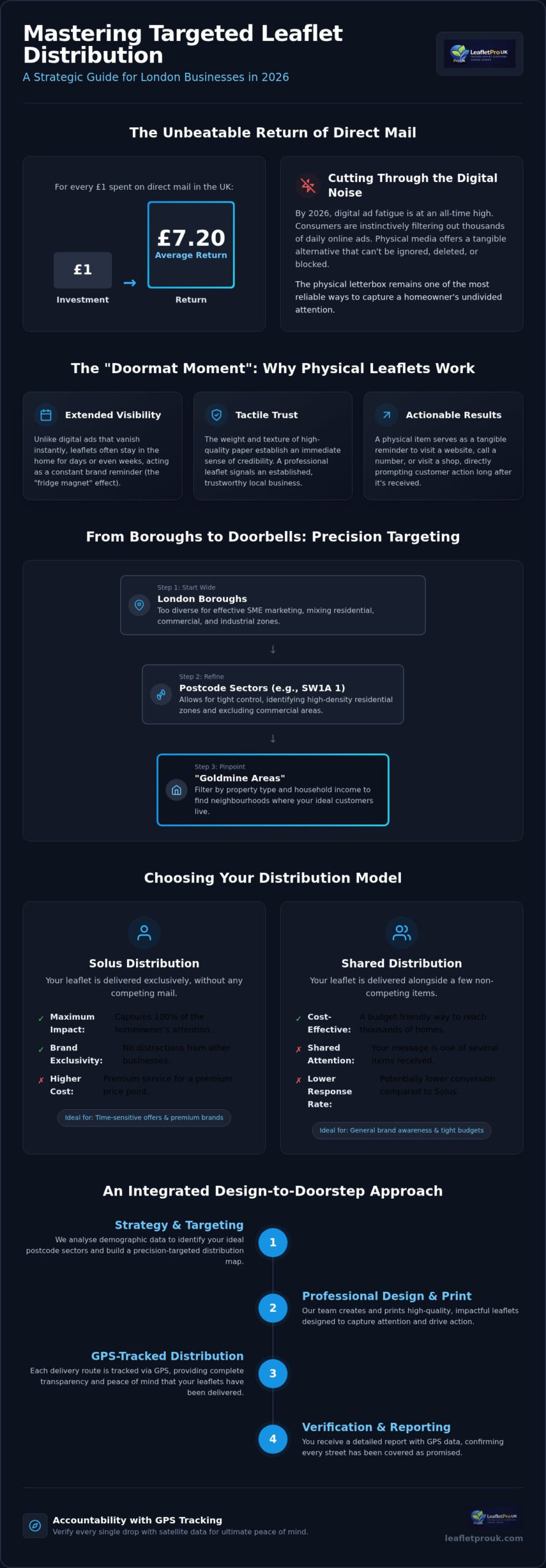
    Did you know that for every £1 spent on direct mail in the UK, businesses see an average return of over £7.20? In an era where digital ad fatigue is at an all-time high, the physical letterbox remains one of the most reliable ways to capture a homeowner’s undivided attention. You’ve likely felt the frustration of pouring a marketing budget into household targeted leaflet distribution London whilst worrying that your flyers ended up in a recycling bin before they were even seen. It’s a common anxiety for business owners who want to ensure their investment reaches the right doorstep with absolute certainty.

    This guide shows you how to master your local marketing through precision postcode mapping and GPS-verified delivery. You’ll learn how to optimise your budget and eliminate wasted spend by identifying your ideal demographics, verifying every drop with satellite data, and streamlining your campaign from the initial design to the final letterbox. We’ve built this 2026 strategic guide to provide the transparency and accountability your business deserves, ensuring every leaflet is handled with the professional care and diligence required to drive tangible results.

    Key Takeaways

    • Learn why physical media is the most effective way to cut through digital noise. It’s a proven method to capture the attention of London residents in a tactile way.
    • Master the use of granular postcode data for household targeted leaflet distribution London so you don’t waste your budget on non-target areas.
    • Determine whether solus or shared distribution is the right choice for your campaign by comparing brand visibility against cost-effectiveness.
    • Discover how GPS tracking provides the accountability and peace of mind needed to verify that your marketing materials are delivered as promised.
    • Understand how an integrated design-to-doorstep approach creates a seamless experience whilst ensuring your brand’s message remains consistent and professional.

    Why Household Targeted Leaflet Distribution in London is Essential in 2026

    In a city as fast-paced as London, the average resident is bombarded by thousands of digital impressions every day. From social media feeds to intrusive pop-ups, the noise is constant. By 2026, digital fatigue has reached a tipping point, leading many consumers to instinctively filter out online advertisements. This shift has revitalised the history of leaflet distribution, as physical media offers a tangible alternative that simply can’t be ignored or deleted with a single click. For local businesses, household targeted leaflet distribution London provides a rare opportunity to bypass the digital clutter and place a brand directly into the hands of a potential customer.

    The “Doormat Moment”: Consumer Behaviour in London

    Londoners interact with their physical post in a way that is fundamentally different from how they engage with digital notifications. Whilst an email is often swiped away in seconds, a physical flyer requires a deliberate action. This “doormat moment” creates a psychological connection; the weight and texture of high-quality paper establish an immediate sense of credibility. Key benefits of this physical interaction include:

    • Extended Visibility: Leaflets often stay in the home for days or weeks, unlike digital ads that disappear instantly.
    • Tactile Trust: High-quality print finishes signal professionalism and established authority.
    • Actionable Results: A physical item serves as a tangible reminder to visit a shop or book a service.

    By using professional leaflet design support, businesses can transform a simple flyer into a trusted community resource that residents actually want to keep. This “fridge magnet” effect ensures your message remains visible long after a social media post has vanished into a saturated feed.

    Beating Digital Ad Costs with Targeted Drops

    Digital marketing costs in the capital continue to climb, yet engagement rates often struggle to keep pace. Relying on cookie-based tracking has become increasingly difficult due to privacy regulations and the widespread use of ad-blockers. In contrast, postcode-targeted distribution offers a fixed-cost model that reaches every household in a specific area, including those who use premium ad-free services. It’s a methodical approach that prioritises local authority over broad, untargeted digital reach. Physical presence matters. When a resident sees a high-quality leaflet from a local business, it signals that the company is invested in the community. This physical footprint builds a level of trust that digital-only brands often struggle to replicate, providing a reliable foundation for long-term marketing ROI.

    The Mechanics of Targeted Leaflet Drops in London Postcodes

    Effective household targeted leaflet distribution London relies on a granular understanding of the city’s unique geography. It isn’t enough to simply pick a general area and hope for the best. Instead, professional distribution uses demographic data to select specific London postcode sectors for delivery. This methodical approach ensures your message reaches “Goldmine Areas”, which are neighbourhoods where the consumer profile perfectly matches your ideal customer. By moving beyond basic postcodes, we can identify street-level demographics that maximise your marketing impact. Data drives results.

    Mapping London: From Boroughs to Postcode Sectors

    Targeting an entire borough is often inefficient for local SMEs. These areas are too diverse, mixing high-street shops and industrial estates with residential streets. Postcode sectors, such as SW1A 1, allow for much tighter control. By using detailed postcode maps, you can identify high-density residential zones whilst excluding commercial addresses that don’t fit your campaign. This level of scrutiny ensures that every flyer is placed through a domestic letterbox. It reduces waste and increases the likelihood of a response.

    Demographic Filtering for Maximum Impact

    Success in the capital requires filtering by specific property types and household income data. If you’re a luxury estate agent, targeting areas dominated by studio apartments won’t yield results. Conversely, a local cleaning service might find their best returns in streets with large terraced houses or semi-detached properties. Aligning your campaign timing with local London events or seasonal trends further enhances engagement. It’s also vital to remain compliant with UK direct marketing regulations to maintain professional standards and consumer trust. Following these guidelines ensures your brand is perceived as a diligent partner in the community.

    Identifying these nuances is a complex task, but it’s the foundation of a reliable campaign. If you need assistance in identifying your most profitable zones, LeafletPro UK provides the data-driven expertise to map your target households with precision. Our focus on accountability ensures your investment is handled with care.

    Evaluating Distribution Models: Solus vs. Shared Household Drops

    Choosing the right delivery method is a pivotal decision for any campaign strategy. Your choice between solus and shared models depends on your specific business goals, the nature of your offer, and your available budget. Whilst both methods utilise the same high standards of household targeted leaflet distribution London, they cater to different marketing needs. The fundamental difference lies in the “share of doormat” your brand receives at the moment of delivery. Accountability is key to this process.

    Regardless of the model you select, transparency remains the most critical factor. At LeafletPro UK, we provide GPS-tracked delivery as standard for every campaign. This visibility acts as the antidote to industry “cowboys” who may fail to complete their routes or skip houses. Whether your flyer is delivered alone or amongst others, you deserve proof that your investment reached the correct letterboxes. Evidence-based results are the foundation of a successful partnership.

    When to Choose Solus Distribution

    Solus distribution involves your leaflet being delivered entirely on its own. This model is the preferred choice for high-value services, such as estate agents or premium home renovation firms, where an exclusive brand feel is essential. When a resident picks up a single, high-quality flyer from their doormat, your message has their undivided attention. It is also the only viable option for time-sensitive offers that cannot wait for a scheduled shared slot. If your conversion relies on being the only voice heard at that moment, solus is the superior investment.

    The Advantages of Shared Postcode Marketing

    Shared distribution is a highly cost-effective alternative for businesses looking to build broader brand awareness across London postcode sectors. In this model, your flyer is delivered alongside a maximum of two or three other non-competing brands. We meticulously vet every campaign to ensure a local service provider is never paired with a direct rival. This approach offers significant cost savings, allowing you to reach a larger volume of households for the same total spend.

    Beyond the financial benefits, shared drops are often seen as a more sustainable choice. By delivering multiple items in a single journey, we reduce the total miles travelled by our teams, lowering the overall environmental footprint of your campaign whilst maintaining rigorous delivery standards. It is an ideal entry point for businesses testing new territories or running consistent brand-building campaigns over several months.

    Household Targeted Leaflet Distribution in London: The 2026 Strategic Guide

    Planning Your Residential Leaflet Drops in London: A Step-by-Step Guide

    Executing a successful campaign requires a methodical sequence of actions. It isn’t just about printing flyers; it’s about a systematic process that ensures your brand reaches the right letterbox at the right time. By following a structured guide for household targeted leaflet distribution London, you can eliminate guesswork and build a reliable marketing engine. This approach prioritises accountability and ensures every penny of your budget is working toward a tangible result.

    The planning process follows five essential stages:

    • Step 1: Precision Targeting. Align your ideal customer profile with specific London postcode sectors using demographic data.
    • Step 2: Volume Analysis. Use current household density data to determine how many units are required to achieve statistical significance.
    • Step 3: Strategic Timing. Select a delivery window that matches consumer behaviour. For example, home improvement services often see higher engagement during weekend drops when residents are at home.
    • Step 4: Creative Strategy. Design a direct response leaflet with a single, clear call-to-action that is easy for the resident to follow.
    • Step 5: Verification. Review GPS reports to confirm every street was covered and use that data to calculate your final ROI.

    Calculating Quantities and Coverage

    Determining the correct volume for an SW or NW postcode drop is a delicate balance. If your sample size is too small, you risk the “dilution effect”, where your message doesn’t reach enough people to generate a measurable response. Industry standards suggest a minimum of 5,000 leaflets to gather meaningful data from a campaign. For long-term growth, we recommend planning for multi-wave drops. Delivering to the same households three times over a three-month period builds the brand recognition necessary for higher conversion rates.

    Navigating London-Specific Delivery Challenges

    London’s unique architecture presents logistical hurdles that national providers often overlook. Accessing high-rise apartments and gated residential complexes requires local knowledge and established protocols. We also account for “No Junk Mail” stickers, which are prevalent in certain affluent London areas, to maintain professional standards and respect resident privacy. Our teams are trained to identify and avoid non-residential “dead zones”, such as industrial parks or commercial centres. This level of scrutiny ensures your household targeted leaflet distribution London campaign remains efficient, professional, and focused on domestic letterboxes.

    Maximising ROI with LeafletPro UK: Integrated Design, Print, and GPS Tracking

    Managing a marketing campaign across multiple vendors often leads to fragmentation and lost ROI. We provide a “Clean Campaign” approach, where every stage from initial concept to the final letterbox is handled under one roof. This integrated model ensures that your household targeted leaflet distribution London remains consistent, professional, and fully accountable. By consolidating design, high-quality printing, and logistics, you gain a diligent partner focused on the integrity of the entire process. It eliminates the friction of managing separate suppliers and ensures your brand standards are maintained from start to finish.

    The Power of Professional Leaflet Design

    Generic templates often fail to resonate in competitive London neighbourhoods. Capturing attention in the city’s busy households requires a strategic layout that guides the eye toward the call-to-action within the “doorstep reading” window, which is typically only two seconds. Our leaflet design support focuses on high-impact visuals and clear messaging that captures attention immediately. We use premium paper stocks that feel substantial and trustworthy to the touch. Additionally, we integrate QR codes to bridge the gap between physical and digital media, allowing residents to scan and book services whilst you track response data in real time.

    Accountability through GPS Tracking Data

    Peace of mind comes from evidence. Every campaign we manage includes GPS tracked delivery as standard, providing a clear map of exactly where your flyers were placed. You’ll receive detailed reports that allow you to interpret delivery patterns and verify coverage across your selected postcode sectors. This systematic verification is the ultimate antidote to industry uncertainty. It ensures no street is missed and allows you to calculate your marketing ROI with precision, knowing exactly which areas drove the highest engagement. Transparency isn’t just a promise; it’s a core component of our delivery workflow.

    Local businesses across the capital have seen transformative results through this methodical model. For example, a boutique fitness studio in South West London recently achieved a significant boost in trial memberships by targeting specific residential streets with high-quality, GPS-verified drops. By focusing on precision rather than volume, they reduced wasted spend and established a firm presence in their local community. This evidence-based approach turns a simple flyer drop into a sophisticated, data-driven marketing strategy.

    Securing Your Local Market Presence with Precision

    Success in the capital’s competitive landscape requires a shift from broad advertising to methodical engagement. By implementing a strategy for household targeted leaflet distribution London, you move from speculative marketing to a data-driven approach that respects your budget. You now understand how granular postcode mapping ensures your flyers reach the right doorsteps, whilst GPS tracking provides the absolute transparency needed to verify every delivery. This systematic model eliminates industry uncertainty and focuses entirely on driving tangible local results.

    A professional campaign is built on the pillars of expert London postcode mapping, integrated design support, and high-quality printing. We provide GPS tracked delivery as standard to ensure your investment is handled with the highest level of scrutiny and care. It’s time to stop worrying about wasted flyers and start building a reliable marketing engine that connects your business with the households that matter most.

    We look forward to helping you grow your local authority through a well-executed and transparent distribution campaign.

    Frequently Asked Questions

    How many households can I target in a specific London postcode?

    You can target anywhere from a few hundred to several thousand households depending on the specific postcode sector. A typical London postcode sector contains approximately 2,500 to 3,000 residential addresses. We use granular density data to provide an exact count for your chosen area. This precision ensures you only pay for the households you actually want to reach, preventing budget waste on non-residential or commercial properties during your household targeted leaflet distribution London campaign.

    Is GPS tracking really accurate for door-to-door delivery?

    Yes, GPS tracking is highly accurate and provides a reliable record of every letterbox reached. Our distributors carry data loggers that record their exact coordinates throughout the day. This technology creates a digital trail for your household targeted leaflet distribution London project, offering peace of mind that the campaign was executed with integrity. It’s a systematic way to verify coverage and hold the delivery team accountable for every single flyer placed in a residential letterbox.

    How do I know which London postcodes are best for my business?

    Selecting the best postcodes involves aligning your target customer profile with local demographic data. We analyse factors like average household income, property types, and resident behaviour to identify “Goldmine Areas” for your brand. If you’re a high-end service, we’ll focus on affluent sectors with larger residential footprints. This data-driven approach ensures your flyers land in the hands of those most likely to convert, maximising your local marketing ROI through strategic and methodical postcode mapping.

    What is the difference between solus and shared distribution?

    Solus distribution means your leaflet is the only item delivered to a household, ensuring 100% share of doormat and maximum attention. Shared distribution involves delivering your flyer alongside a maximum of two or three non-competing items. Shared drops are more cost-effective for broad awareness, whilst solus is ideal for high-value or time-sensitive offers. Both models utilise the same GPS-verified delivery standards to ensure your marketing materials reach their intended domestic destination with absolute professional certainty.

    Can you help with the design of my leaflet as well as the delivery?

    We provide comprehensive design support to ensure your leaflet is optimised for immediate engagement. Our team understands the “two-second rule” of doorstep reading and creates layouts that lead the eye to a clear call-to-action. By managing the entire lifecycle from design and high-quality printing to final distribution, we maintain your brand’s integrity. This integrated approach simplifies your logistics and ensures that the final physical product is of the highest professional standard before delivery.

    How long does a typical household targeted campaign in London take to complete?

    A typical campaign of 5,000 to 10,000 leaflets usually takes between five and ten working days to complete. The exact duration depends on the housing density of your chosen postcode sectors and the distribution model selected. Solus drops are often completed faster, whilst shared drops are scheduled within specific delivery windows. We provide a clear timeline at the start of your project so you can coordinate your internal sales or service teams with professional confidence.

    What happens if a building has restricted access or is a block of flats?

    Our teams use deep local knowledge to navigate London’s varied architecture, including gated complexes and high-rise apartments. When a building has restricted access, we follow established protocols to gain entry through communal post rooms or concierge desks where permitted. If access is completely prohibited, we record this in our GPS reports to maintain transparency. This level of detail ensures you have a realistic view of your actual coverage and avoids wasted efforts in inaccessible zones.

    How do I track the return on investment for my leaflet drop?

    Tracking ROI is best achieved by including a unique call-to-action on your leaflet, such as a QR code, a dedicated phone number, or a specific discount code. These methods allow you to link every enquiry back to the physical drop. When you compare these conversions against the GPS delivery data provided, you gain a clear picture of which postcode sectors performed best. This evidence-based feedback is vital for refining and improving your future marketing strategies with precision.