Author: samuelkidane1000@gmail.com

  • GPS Reports for Leaflet Distribution: Myth-Busting Guide

    GPS Reports for Leaflet Distribution: Myth-Busting Guide

    What if the colourful GPS map you just received is actually hiding more than it reveals? You’ve likely felt that nagging doubt when staring at a flurry of digital tracks, wondering if your flyers are truly hitting doormats or simply being driven around a London postcode. It’s a common anxiety for business owners who have been let down by a lack of transparency in the past. You deserve more than a vague promise that your marketing investment reached its destination. This guide provides the clarity you need for interpreting GPS tracking reports for leaflet distribution with absolute confidence. We’ll show you how to look past the surface of a map to find the authentic evidence of a job well done. You will learn to decode complex data sets, spot the subtle red flags of “flyer dumping,” and understand why a perfectly straight line is often a sign of trouble rather than success. By the end of this article, you’ll have the expertise to audit any delivery report and provide your stakeholders with undeniable proof of household penetration.

    Key Takeaways

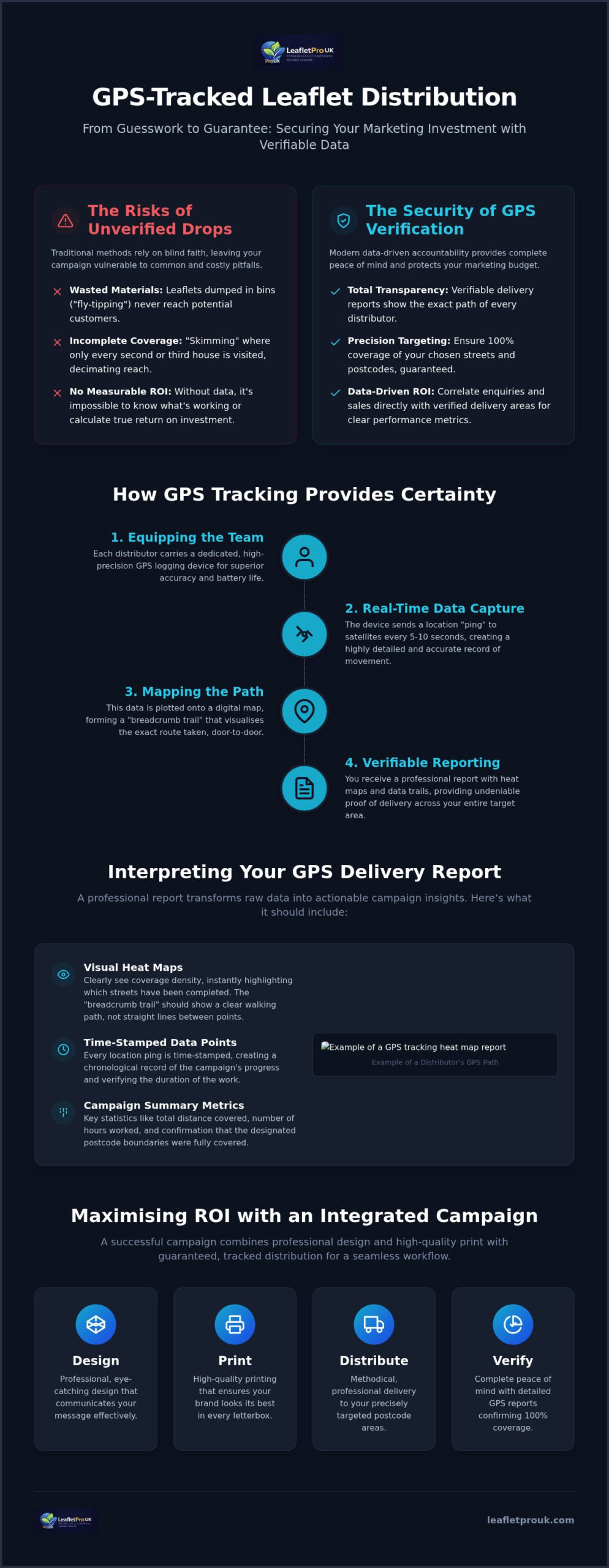
    • Understand why continuous “snail trail” lines are far more reliable than static dots for verifying genuine door-to-door penetration.
    • Master the skill of interpreting GPS tracking reports for leaflet distribution by distinguishing between natural human walking patterns and deceptive vehicle-tracked data.
    • Learn to identify “GPS drift” caused by London’s high-rise buildings so you don’t mistake technical signal interference for poor staff performance.
    • Utilise a methodical five-point audit to ensure your campaign has achieved full saturation across your targeted London postcodes without leaving “white spaces.”
    • Discover how to transform raw delivery data into a strategic tool for identifying high-performing streets and improving future response rates.

    Decoding the Digital Snail Trail: What GPS Reports Actually Tell You

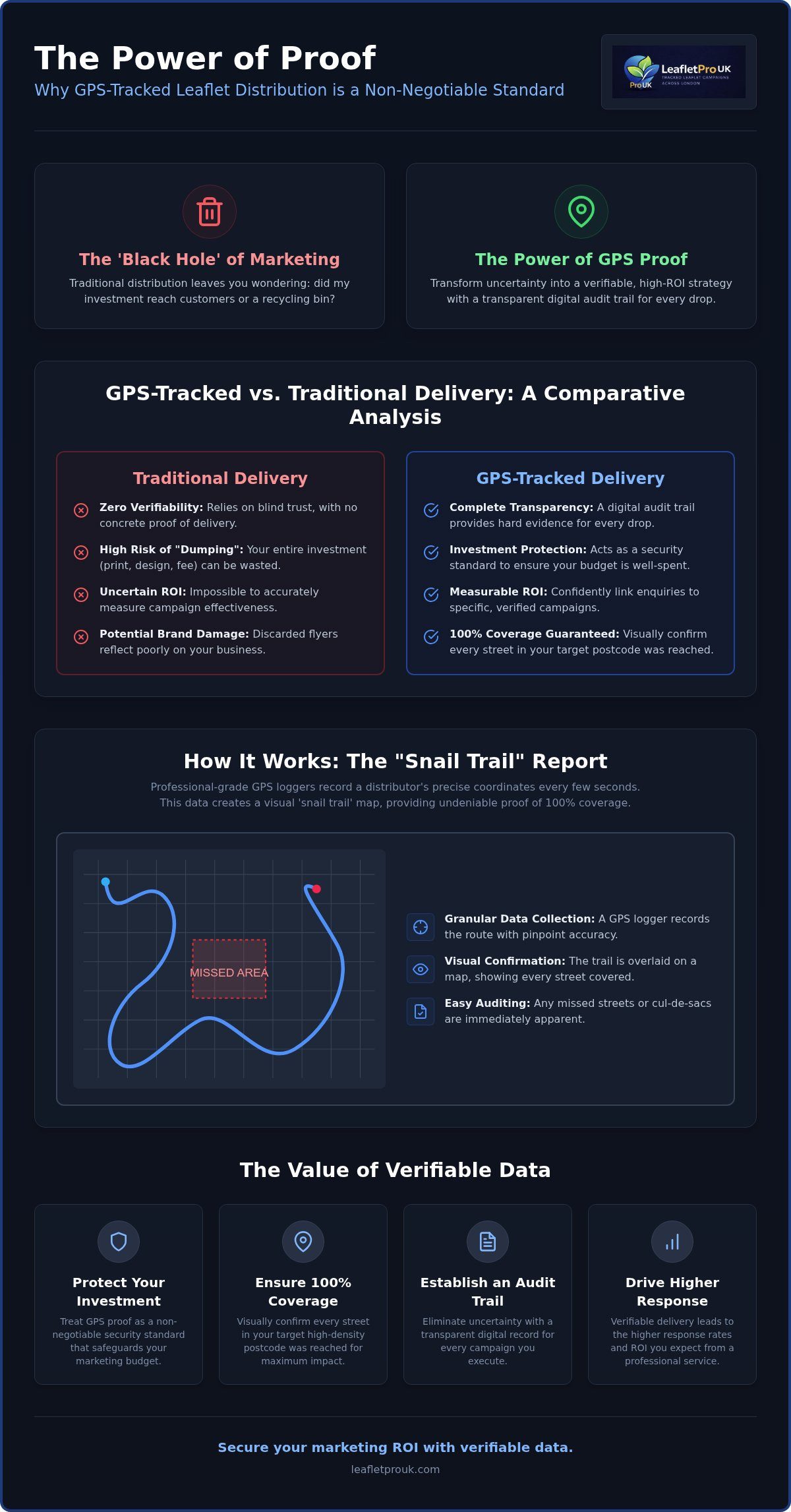
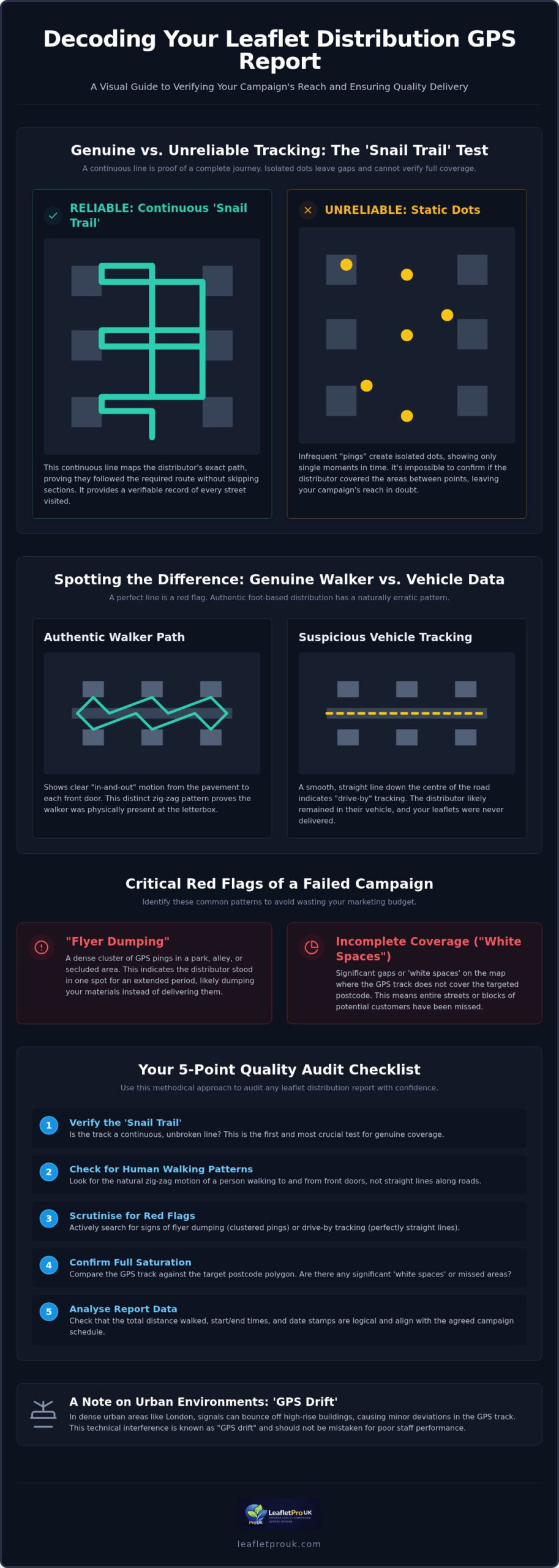
    A GPS tracking report is a digital audit of a distributor’s physical journey through a specific area. It functions as a transparent ledger for London businesses, providing a verifiable record of every street visited. The most critical element to look for is the “snail trail.” This is a continuous line that maps the distributor’s exact path. Unlike isolated dots, which only show where a person was at a single moment, a continuous line proves the walker followed the required route without skipping sections.

    It’s vital to address a common misconception. A GPS report does not technically prove a leaflet went through a letterbox. Instead, it proves the distributor reached the door. It provides the accountability required to ensure your flyers aren’t left in a pile or dumped in a recycling bin. For companies like LeafletPro UK, these reports are the foundation of a trust-based partnership, turning an invisible service into a tangible, audited asset.

    Understanding Pings, Paths, and Polygons

    The precision of your report depends on the “ping” frequency. This is the interval at which the data logger records its location. A report with 30-second pings provides a granular view of movement, showing every turn and driveway. In contrast, 5-minute intervals leave massive gaps, making it impossible to tell if a street was truly covered. When interpreting GPS tracking reports for leaflet distribution, you’ll also see “polygons.” These are the digital boundaries of your targeted London postcodes. Whilst these maps are highly accurate, technical factors like signal interference or atmospheric conditions are common sources of GPS error that can cause slight deviations. A professional distributor understands these nuances and uses high-resolution data to provide a cleaner audit trail.

    The Difference Between Live Tracking and Post-Drop Reports

    Live tracking dashboards offer real-time peace of mind, allowing you to see your campaign in motion. This is helpful for immediate verification, but it can be a distraction for busy business owners. Post-campaign PDF reports remain the gold standard for formal auditing. These documents provide a static, unalterable record that is easy to share with stakeholders. When interpreting GPS tracking reports for leaflet distribution, always check the date and time stamps. These ensure the work was completed during professional hours and within the agreed timeframe. A comprehensive report should include:

    • Visual overlays of the targeted postcode versus the actual path taken.
    • Total distance walked to confirm the physical effort involved.
    • Start and end times for each specific sector to verify consistency.

    This level of visibility ensures that every penny of your marketing budget is accounted for, providing the security that your message has reached its intended audience.

    The “Perfect Line” Myth: Identifying Walker Data vs. Vehicle Tracking

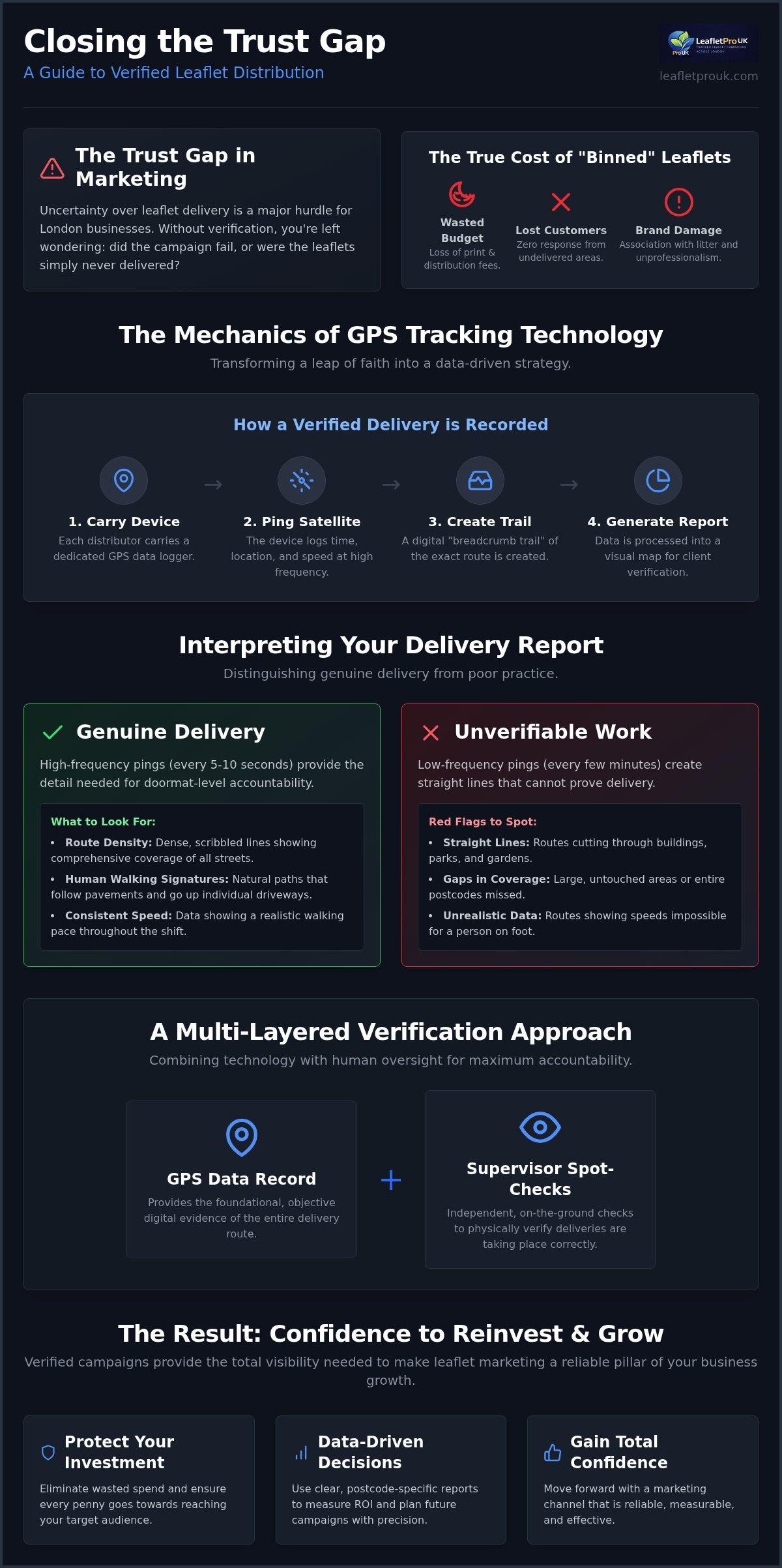
    Many clients believe a perfectly straight line on a map indicates a precise delivery. In reality, a straight line often signals that the data has been faked or recorded from a vehicle. Humans don’t walk through walls or glide over fences in perfectly geometric paths. Interpreting GPS tracking reports for leaflet distribution requires looking for the “noise” that proves a person was physically present at the letterbox. Genuine walker data is slightly erratic because people navigate obstacles like garden gates, parked cars, and uneven pavements.

    If the report shows a smooth line following the centre of the road without any deviation toward properties, you are likely looking at “drive-by” tracking. This occurs when a distributor stays in a van whilst the leaflets remain in the back. Another critical red flag is “The Dump.” On a map, this appears as a single, dense cluster of GPS pings in a park, bush, or bin area. It shows that the distributor stood in one spot for an extended period rather than walking the intended route. Spotting these patterns is the first step in ensuring your London campaign actually reaches the doormat.

    The Signature of a Genuine Door-to-Door Walk

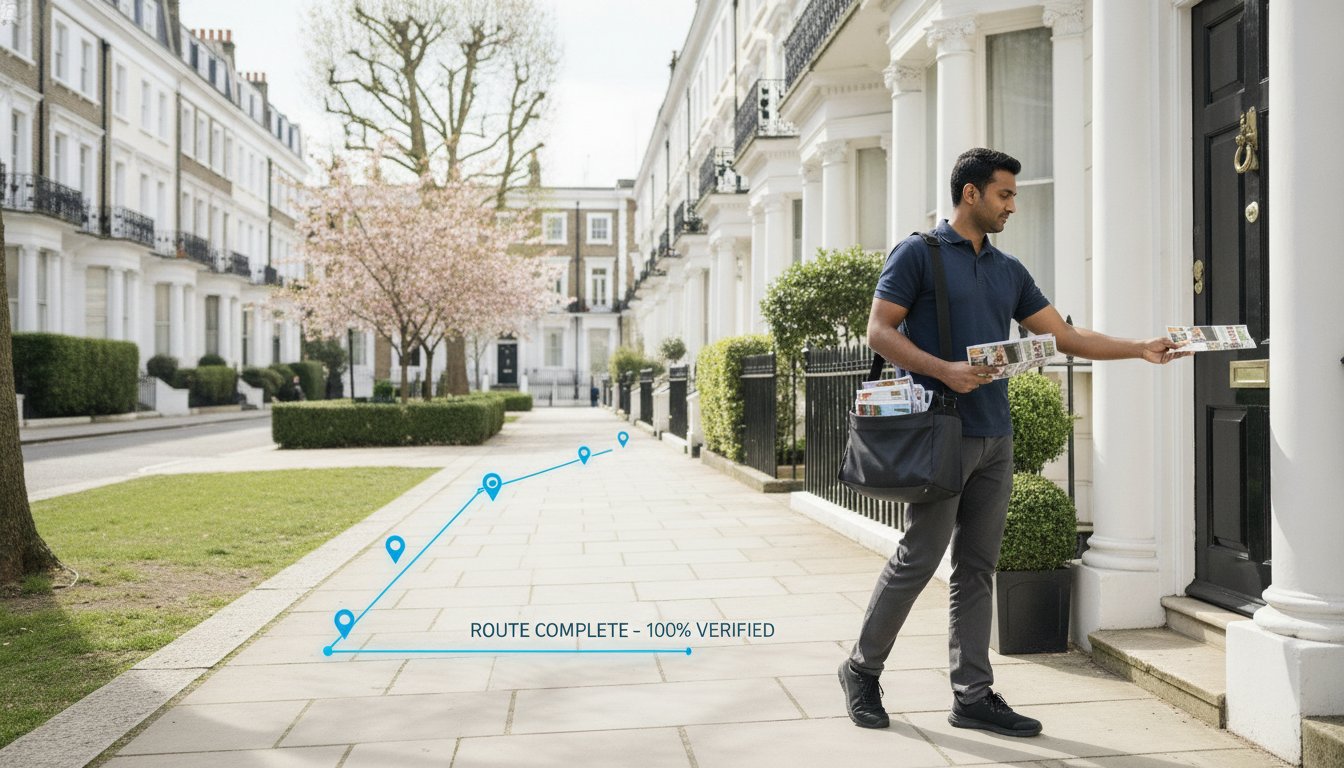
    A high-quality report displays a clear “in-and-out” motion. This is the visual record of a walker moving from the pavement to the front door and back again. In London’s dense residential sectors, this creates a distinct zig-zag pattern. By understanding how GPS technology works, it becomes clear why these small movements are essential for verification. This pattern is the hallmark of a high-saturation campaign. You can use tracking leaflet distribution as a verification framework to ensure your provider isn’t just skimming the main roads or skipping difficult-to-reach properties.

    Red Flags: When the Map Doesn’t Match the Mission

    Speed is the most obvious indicator of vehicle tracking. If a distributor appears to be moving at 20 or 30mph through a residential street, they aren’t walking. Genuine foot distribution usually averages between 2 and 4mph. You should also perform a “Gap Analysis.” This involves checking for skipped cul-de-sacs or entire blocks that remain “white space” on the map. Relying on leaflet distribution with GPS proof is the only way to avoid these pitfalls and protect your marketing budget. If your current reports lack this level of detail, it may be time to partner with a transparent distribution expert who welcomes your scrutiny and provides methodical, audited results.

    Urban Canyons and High-Rises: Interpreting GPS Data in London

    London’s skyline is iconic, but for a GPS logger, it’s a labyrinth of signal-blocking obstacles. Tall buildings in areas like Canary Wharf or the City create what is known as the “Urban Canyon” effect. This occurs when satellite signals bounce off glass and steel before reaching the distributor’s device. When interpreting GPS tracking reports for leaflet distribution in these postcodes, you might see the “snail trail” suddenly jump or drift several metres away from the actual pavement. It’s a common myth that a “messy” cluster of dots on a map automatically means a walker was loitering. In high-density environments, these clusters often represent the technical reality of signal interference rather than a lack of movement.

    A professional distributor understands these nuances. At LeafletPro UK, we account for these factors in postcodes like E14 or EC1, ensuring that signal drift is never mistaken for a missed delivery. Our team uses high-sensitivity loggers designed to maintain a lock even amongst the narrowest streets. This methodical approach ensures your campaign data remains credible, even in the most challenging architectural environments.

    GPS Drift vs. Delivery Negligence

    Distinguishing between a technical glitch and a skipped street is an essential skill for any campaign manager. A genuine signal “jump” usually appears as a straight, impossible line across buildings, whereas a skipped street shows a clear, deliberate path that bypasses a specific road. Narrow alleys and London’s famously overcast weather can also dampen signal precision. Because of these variables, verified flyer distribution London requires more than just raw data; it needs local geographic knowledge to interpret the map accurately. We look for the consistency of the path rather than perfect alignment with the digital road. If the walker’s overall route is logical and covers the area, the data is likely sound.

    High-Density Housing: The “Vertical” Challenge

    London’s estates and multi-storey apartment blocks present a unique “vertical” challenge. If a distributor delivers 500 leaflets into a single high-rise, the GPS report may only show a dense “blob” of data in one spot. This happens because the device cannot track altitude or movement between floors. To verify these drops, we rely on timestamps. A ten-minute stay at a single address proves the distributor was inside navigating the floors, rather than simply walking past. We also monitor entry into gated communities and secure developments, ensuring that the tracking data aligns with the expected dwell time for that specific property type. This level of scrutiny provides the peace of mind that every household in a complex development was reached, turning a potential “white space” on the map into a verified success.
    GPS Reports for Leaflet Distribution: Myth-Busting Guide

    Auditing Your Report: A 5-Point Quality Checklist

    Receiving a digital map is only the first step in verifying your campaign’s success. To gain total confidence in your marketing investment, you must apply a rigorous auditing process to the data provided. Interpreting GPS tracking reports for leaflet distribution is about looking for the logic behind the lines. If the report doesn’t hold up to basic scrutiny, the transparency is merely an illusion. A professional audit ensures that every household in your targeted London postcode was reached with precision and care.

    When you review your delivery data, use these five criteria to verify its authenticity:

    • Postcode Alignment: Confirm the tracking lines stay strictly within your chosen London sectors.
    • Saturation Levels: Identify any “white spaces” on the map where streets or cul-de-sacs were skipped.
    • Timestamp Accuracy: Match the start and end times of the walk to the quantity of flyers delivered.
    • Speed Verification: Ensure the pace reflects a brisk human walk rather than the high speeds of a vehicle.
    • Signal Continuity: Identify “dead zones” in tunnels or basements where manual supervisor spot checks might have been necessary to maintain the audit trail.

    Step 1: Postcode Boundary Integrity

    A precise campaign stays within its designated lines. You should examine the map to ensure the distribution didn’t “bleed” into neighbouring postcodes that aren’t part of your current strategy. This is especially important in London, where demographics and property types can change significantly from one street to the next. Comparing your GPS report against your original targeted leaflet drops London plan ensures you aren’t paying for reach in irrelevant areas. If the lines frequently stray outside your target boundaries, it suggests a lack of logistical control during the drop.

    Step 2: The Time-to-Volume Ratio

    Time is a reliable truth-teller in logistics. A standard London walker typically covers 150-250 households per hour depending on the density of the housing. If a report suggests a single person delivered 1,000 leaflets in sixty minutes, it’s a major red flag. This “instant” delivery usually implies either vehicle tracking or, worse, that the leaflets were dumped rather than delivered. Cross-referencing the duration of the walk against the total volume provides an undeniable audit of the physical work performed on the ground.

    Beyond the Map: Using Verification Data to Optimise Strategy

    GPS reports are often viewed as a simple receipt for services rendered. This is a common myth that limits your campaign’s potential. In reality, the data remains valuable long after the final flyer has been posted. By interpreting GPS tracking reports for leaflet distribution, you can transform raw geographical data into a roadmap for future growth. You’ll be able to identify “Goldmine” London streets where engagement was highest and troubleshoot areas with lower response rates. If a specific sector underperforms, your report tells you if the issue was household penetration or if the marketing message itself needs refinement.

    Mastering the art of interpreting GPS tracking reports for leaflet distribution allows you to integrate this data with your internal sales tracking for a complete picture of your return on investment. You can correlate the exact time and date of a drop with a spike in website traffic or phone enquiries from a specific postcode. When you align your incoming lead data with the precise delivery times found in your reports, you gain a granular understanding of consumer behaviour. Perhaps a specific estate in E17 responds better to weekend drops, whilst a high-street sector in SW1 requires a different creative approach. This data-driven insight turns a one-off distribution into a repeatable, optimised system for business growth.

    A/B Testing Streets with GPS Precision

    Verified delivery data allows you to conduct sophisticated A/B tests across different London neighbourhoods. You can compare response rates between two postcodes with high accuracy, knowing exactly which streets were covered. This helps you identify “easy-access” zones versus “hard-to-reach” areas, such as secure apartment blocks or gated communities. By consulting the GPS tracked leaflet distribution pillar, you can develop long-term plans that prioritise high-yield sectors. This strategic layering ensures your next campaign is even more efficient than the last, as you refine your targeting based on historical performance rather than guesswork.

    The Peace of Mind Factor: Building Brand Security

    Transparent reporting does more than just verify work; it protects your brand’s reputation in the local community. If a resident or business partner questions your distribution activity, you have the audited evidence to prove your professional standards. This “Proof of Activity” is essential for franchise owners who need to demonstrate local marketing efforts to their headquarters. It builds a sense of security and accountability that vague promises can never match. When you value evidence over assumptions, you create a foundation for a reliable and scalable marketing channel that delivers tangible results.

    Ready for total transparency? Organise your verified London leaflet campaign with LeafletPro UK

    Secure Your London Campaign with Data-Driven Confidence

    A successful leaflet drop requires more than just a stack of flyers and a postcode. It demands a level of transparency that only rigorous, audited data can provide. By mastering the art of interpreting GPS tracking reports for leaflet distribution, you move from hoping your message was delivered to knowing it with absolute certainty. You now have the tools to distinguish genuine foot-traffic from deceptive vehicle tracking and to account for the technical nuances of London’s high-rise architecture.

    We provide the peace of mind that comes from methodical execution and London-exclusive GPS tracking technology. Every campaign is backed by full postcode-targeted audit reports and our 100% door-to-door delivery guarantee. This systematic approach ensures your brand reputation is protected whilst your marketing budget is utilised with maximum efficiency. You don’t have to settle for vague promises when you can have verifiable proof of performance.

    Take control of your local marketing today and watch your response rates climb with a partner that welcomes your scrutiny.

    Frequently Asked Questions

    Can GPS tracking reports be faked by distributors?

    Yes, faking is possible but usually easy to spot with a trained eye. Common deceptive tactics include “drive-by” tracking, where the distributor stays in a car, or using software to generate artificial paths. Interpreting GPS tracking reports for leaflet distribution involves looking for the natural “zig-zag” patterns and human walking speeds that are impossible to replicate with a vehicle. A genuine report reflects the physical reality of navigating gates and driveways.

    What is a “snail trail” in a leaflet distribution report?

    A snail trail is the continuous line on a map that represents the distributor’s exact walking path. Unlike isolated dots, which only show location at specific intervals, a continuous line provides a comprehensive audit of every street and driveway visited. This visual record is the primary method for verifying that a distributor has actually approached each household letterbox rather than simply skimming the main roads or skipping difficult cul-de-sacs during your campaign.

    Why are there gaps in the GPS lines on my distribution map?

    Gaps usually occur due to temporary signal loss or “dead zones” where the device cannot connect to satellites. This is common in tunnels, basements, or areas with heavy foliage. Whilst a few small gaps are normal, large missing sections should be cross-referenced with timestamps. If the timing doesn’t add up, it may indicate that the distributor switched off the device or skipped the area entirely, requiring further investigation from your provider.

    Does GPS tracking prove that my flyer went through the letterbox?

    GPS tracking proves that the distributor reached the door, but it doesn’t physically confirm the flyer was posted. It serves as a strong deterrent against dumping and provides a transparent audit of the walker’s physical effort. To ensure the highest levels of accuracy, we combine this data with supervisor spot checks and methodical reporting. This multi-layered approach gives you the security that your marketing investment is being handled with professional care and integrity.

    How long should it take to distribute 1,000 leaflets in London?

    A professional walker typically covers between 150 and 250 households per hour in London, depending on housing density. Therefore, distributing 1,000 leaflets usually takes between four and seven hours of active walking. If a report suggests 1,000 flyers were delivered in just two hours, it’s a significant red flag. Such speed almost certainly indicates vehicle-based tracking or that the leaflets were not delivered to individual households as promised by the distributor.

    What should I do if my GPS report shows the walker missed a street?

    You should immediately contact your distribution partner to request an explanation. A professional company will investigate the discrepancy by checking supervisor notes and timestamp data. If a street was genuinely missed due to an oversight, a reputable provider will organise a redelivery to that specific area at no extra cost. This accountability is why interpreting GPS tracking reports for leaflet distribution is so vital for maintaining full campaign saturation across your targeted postcodes.

    Is live tracking better than a post-campaign PDF report?

    Live tracking offers immediate peace of mind, but a post-campaign PDF report is the superior tool for formal auditing. PDF reports provide a static, unalterable record that includes detailed overlays, total distances, and precise timestamps. These documents are easier to share with stakeholders and serve as permanent proof of activity. Whilst live dashboards are useful for quick checks, the audited report remains the industry gold standard for verifying the integrity of your London distribution.

    How does GPS tracking work in London areas with tall buildings?

    Tall buildings can cause “GPS drift” or the “Urban Canyon” effect, where signals bounce off glass and steel structures. This might make the walker’s path appear slightly offset from the actual pavement on your map. In areas like Canary Wharf, we use high-sensitivity loggers to mitigate this issue. We also rely on dwell times and timestamps to verify delivery, ensuring that technical signal interference isn’t mistaken for poor performance or skipped properties.


  • Avoiding Leaflet Distribution Scams in London: A Reliable Buyer’s Guide

    Avoiding Leaflet Distribution Scams in London: A Reliable Buyer’s Guide

    Imagine investing a significant portion of your marketing budget into a bespoke campaign, only to discover your carefully designed flyers have been dumped in a skip rather than delivered to your target postcodes. For many business owners in the capital, this isn’t just a fear; it’s a frustrating reality caused by rogue distributors who prioritise speed over service. You’re likely here because you’ve felt the anxiety of non-delivery or have been burnt by a lack of transparency in the past. It’s completely understandable to feel cautious when your return on investment depends entirely on the integrity of a third party.

    This guide focuses on avoiding leaflet distribution scams London businesses often face, providing you with the exact tools needed to identify cowboy agencies and verify every single delivery. You’ll learn how to interpret granular GPS data reports, why local London expertise beats national outsourcing, and how to secure a reliable partner that ensures 100% household coverage. By the end of this article, you’ll have a clear framework for protecting your budget and ensuring your message actually reaches the doormats of your future customers with absolute precision.

    Key Takeaways

    • Learn to identify red flags of “Ghost Agencies,” such as the absence of a registered London office or a verifiable landline number.
    • Discover the critical role of GPS tracking in providing transparent evidence that your marketing materials have reached their intended destinations.
    • Master the specific techniques for avoiding leaflet distribution scams London businesses face, including the common “flyer dumping” tactic used by rogue operators.
    • Understand why choosing a London-only specialist ensures higher accountability and more precise postcode targeting than using nationwide outsourcers.
    • Implement a systematic buyer’s checklist to verify distributor credentials and secure a reliable partner for long-term marketing growth.

    The Reality of Leaflet Distribution Scams in London

    Leaflet marketing has been a vital part of the history of leaflet marketing for centuries, but the modern industry in the capital faces a persistent threat from rogue operators. London’s high-density housing and complex street layouts provide the perfect cover for the “flyer dumping” phenomenon. This occurs when unscrupulous distributors simply discard thousands of flyers in communal recycling bins or skips rather than delivering them to doormats. The financial loss is obvious, but the reputational damage to a brand found amongst a pile of discarded paper can be irreparable.

    Many businesses fall victim to the “Ghost Agency” model. These companies present a professional digital front with polished websites, yet they possess no permanent distribution staff. Instead, they operate as middlemen, outsourcing your campaign to unvetted casual workers or “man with a van” outfits who lack accountability. This lack of oversight is why avoiding leaflet distribution scams London wide is essential for any serious marketing strategy. London’s complex geography, with its gated estates and high-rise blocks, requires a level of diligence that these ghost agencies simply don’t provide.

    To better understand this concept, watch this helpful video:

    Common Scams: From Flyer Dumping to Under-Counting

    Rogue distributors often employ “Postcode Padding,” a tactic where they charge for a higher number of households than actually exist in a specific London area. By claiming a postcode contains 10,000 homes when the reality is closer to 7,000, they pocket the difference in both distribution fees and the surplus print. Another frequent issue is “cherry-picking.” In this scenario, distributors skip difficult-to-reach properties, such as those with long driveways or steep hills, whilst still charging you the full rate for total coverage. These shortcuts directly undermine your campaign’s reach and effectiveness.

    The “Too Good to Be True” Price Trap

    Pricing is often the clearest indicator of a potential scam. If a quote for a solus drop seems remarkably low, it’s likely because the maths doesn’t work. When you factor in the UK’s minimum wage and the time it takes to cover 1,000 London homes properly, certain rock-bottom prices are impossible to sustain legally. Scammers bridge this gap by either not delivering the items or paying staff “under the table” rates that encourage dumping. Professional agencies, such as LeafletPro UK, must charge a sustainable rate to ensure every distributor is fairly paid and every leaflet is tracked. Understanding these economic realities is the first step in avoiding leaflet distribution scams London providers might use to lure in unsuspecting buyers.

    Red Flags: How to Spot a Rogue Distributor Before You Pay

    Identifying a rogue operator often begins with a simple check of their contact details. A professional distributor will always maintain a registered business address and a landline telephone number. If an agency only provides a mobile number or a vague contact form, it suggests a lack of permanent infrastructure. This mobile-only setup is a significant warning sign when avoiding leaflet distribution scams London businesses frequently encounter. It makes it far too easy for a company to disappear once they’ve pocketed your payment without completing the drop.

    Legitimate operations should also be easily verifiable through official channels. If a company claims to handle large-scale campaigns but lacks VAT registration or a clear history on Companies House, proceed with extreme caution. Whilst letterbox delivery doesn’t typically require specific local authority permits, it’s still vital to ensure your partner understands the official UK government guidelines regarding the distribution of printed matter. A lack of regulatory awareness often precedes a lack of operational accountability.

    Vetting the Agency’s Infrastructure

    A transparent expert will be happy to explain how they recruit and supervise their walking teams. Ask specific questions about their London presence. Do they have a local depot? How do they ensure their staff actually walk the routes? If they cannot provide recent London-based case studies or references from local brands, they likely lack the experience required for the capital’s unique logistics. Verifying credentials like a valid Company Number, for example, Company No. 17330538, protects your investment from the Ghost Agency model discussed previously.

    Analysing the Proposal and Terms

    Reliable partners provide clear, written contracts that detail the scope of work. You should always clarify whether your campaign is Solus, where your flyer is delivered alone, or Shared. Rogue distributors often charge solus prices whilst delivering your material alongside several others. Most importantly, never accept a vague promise of “we track our staff.” Demand to see a sample GPS report from a previous campaign to verify the level of detail you’ll receive. If you’re looking for a partner that prioritises this level of visibility, you can view our transparent reporting standards to see how we maintain such high levels of accuracy. This proactive approach is the most effective way of avoiding leaflet distribution scams London has to offer.

    The Science of Verification: GPS Tracking and Data Accountability

    GPS tracking has transformed the industry from a game of blind trust into a measurable logistical operation. It is currently the most effective tool for avoiding leaflet distribution scams London businesses encounter. Whilst the Advertising Standards Authority (ASA) regulates the honesty of the content on your flyers, GPS data regulates the honesty of the delivery itself. Without this digital footprint, you have no objective way to confirm that your marketing budget hasn’t been wasted. Reliable agencies use this technology to provide an audit trail that is both visible and verifiable.

    Understanding the difference between live tracking and post-campaign reporting is vital for campaign security. Live tracking allows for real-time monitoring, but the comprehensive post-campaign report provides the granular evidence needed for a final audit. When you examine a GPS map, look for organic walking paths that follow pavements and letterbox approaches. If the lines are perfectly straight and cut through the centre of buildings, it’s a clear sign of faked data or “GPS spoofing.” Genuine tracks show dwell times at each property, proving the distributor actually stopped to complete the drop rather than simply driving past the street.

    What a Reliable GPS Report Must Include

    A professional report shouldn’t just show a general area; it needs to provide specific, high-resolution data. To ensure your campaign has been executed with precision, look for the following elements in your verification documents:

    • Granular pings: Data points captured every 5 to 10 seconds to show the exact path to every door, not just a ping every few streets.
    • Time-stamped routes: Clear chronological data that matches the agreed delivery window and proves the distributor’s pace was realistic.
    • Postcode-specific overlays: A visual map that overlays the GPS tracks onto your target London postcodes to prove 100% saturation.

    Understanding GPS Reports

    Explaining how GPS tracked flyer delivery London ensures accountability is at the heart of a transparent service model. LeafletPro UK uses this transparent route data to build long-term partnerships based on evidence rather than vague promises. We supplement this digital verification with physical “back-checking,” where supervisors visit randomly selected roads post-delivery to confirm the presence of your flyers. This dual-layered approach ensures that digital data is always backed by physical reality, providing the peace of mind that your investment has reached the right doormats.

    Avoiding Leaflet Distribution Scams in London: A Reliable Buyer’s Guide

    A Buyer’s Checklist for Reliable Leaflet Distribution in London

    Securing a successful campaign in the capital requires more than just a signature on a quote; it demands a systematic vetting process. When avoiding leaflet distribution scams London businesses must first verify an agency’s operational focus. Nationwide outsourcers frequently subcontract work to unvetted local providers, which dilutes accountability and increases the risk of non-delivery. A London-only specialist maintains direct control over their walking teams, ensuring that the staff representing your brand are held to professional standards.

    Your checklist should involve a request for a granular postcode breakdown before any flyers are printed. Vague promises of “blanket coverage” in a borough are a significant red flag. You need to see the exact household counts for your target sectors to ensure you aren’t paying for “ghost” addresses. Once the numbers are confirmed, get the distribution method in writing. Rogue operators often charge for solus drops whilst delivering your material amongst a thick bundle of competitors. Finally, audit the agency’s print quality; an organisation that cuts corners on paper and ink is likely to cut corners on the doormat too.

    Navigating London Postcodes and Demographics

    London’s residential landscape is uniquely challenging, featuring a mix of sprawling estates, high-rise blocks, and gated communities. Using postcode targeted flyer delivery is far more effective than an unconsidered blanket drop, as it allows you to bypass industrial areas and focus on high-response neighbourhoods. Reliable distributors understand the logistics of accessing secure blocks and won’t simply leave a pile of flyers in a communal lobby. They have established protocols for handling concierges and secure entry systems, ensuring your message actually reaches the individual letterbox.

    Final Questions to Ask Your Distributor

    Before the first flyer hits a doormat, establish a clear reporting schedule. A transparent partner will proactively answer the following questions to prove their integrity:

    • “Can I see the GPS data for my specific campaign?” Accept nothing less than the granular pings discussed in previous sections.
    • “How do you handle undeliverable addresses or access issues?” Professional teams document these hurdles rather than ignoring the properties.
    • “What is your process for managing and supervising the walking teams?” Ask about the ratio of supervisors to distributors and how they conduct physical back-checks.

    By following this framework, you move beyond “trust” and into a relationship based on verifiable evidence. This is the only certain way of avoiding leaflet distribution scams London rogue operators use to exploit marketing budgets.

    Why LeafletPro UK is the Trusted Choice for London Brands

    LeafletPro UK is built on the principle that local marketing requires local accountability. Unlike nationwide agencies that often fall into the “Nationwide Outsourcing” trap, we focus exclusively on the London market. This specialisation ensures we never subcontract your campaign to unvetted casual staff in other regions. By maintaining a permanent presence in the capital, we provide a level of oversight that national providers simply cannot match. Every campaign we manage is an opportunity to prove our commitment to avoiding leaflet distribution scams London businesses have suffered from for too long.

    Our promise of 100% GPS-tracked accountability isn’t just a marketing slogan; it’s the foundation of our operational model. We understand that your marketing budget is an investment, not a gamble. Therefore, we provide transparent route data for every single drop, allowing you to see exactly where your leaflets have landed. This end-to-end service includes professional design support and high-quality printing, ensuring your brand is presented with the credibility it deserves from the first moment a resident picks it up.

    Our Systematic Approach to Reliability

    We organise our walking teams with a focus on systematic execution. Every route is planned with logistical precision, and our supervisors conduct regular physical checks to supplement our digital GPS verification. By integrating design and print production within our workflow, we maintain total consistency across your entire campaign. This integrated approach eliminates the risk of “lost in translation” errors that occur when multiple third-party vendors are involved. We prioritise visibility and verification over raw volume, ensuring that every house on your target list receives your message.

    Ready to Launch a Secure London Campaign?

    Choosing trusted leaflet distributors is the most significant factor in determining your campaign’s ROI. A well-executed, postcode-targeted drop can generate a response rate of 0.5% to 2% for cold mailings, but these results are only possible if the leaflets actually reach the door. Implementing a secure marketing strategy is the only way of avoiding leaflet distribution scams London operators might attempt. We provide the data, the local knowledge, and the professional standards required to help your business grow within the capital’s competitive landscape.

    Secure Your Next London Campaign with Data-Driven Confidence

    The definitive framework for avoiding leaflet distribution scams London businesses can rely on is built upon three essential pillars: transparency, local specialisation, and verifiable data. By prioritising agencies that offer full GPS route transparency, you eliminate the guesswork and ensure your marketing materials reach their intended destinations. Choosing a partner with exclusively London-focused logistics prevents the common pitfalls of nationwide outsourcing and unvetted subcontracting that often lead to wasted budgets.

    Real peace of mind comes from knowing that every stage of your campaign is handled with professional precision. From in-house design and high-quality print production to the final door-to-door drop, every step must be visible and accountable. When evidence replaces vague promises, your marketing budget becomes a powerful tool for sustainable growth within the capital’s competitive market. We’re ready to help you reach your audience with the integrity and care your brand deserves.

    Frequently Asked Questions

    How can I tell if a leaflet distribution company is a scam?

    Look for red flags such as a lack of a registered physical office, mobile-only contact details, or prices that don’t cover the minimum wage for the staff. Rogue agencies often refuse to provide detailed GPS reports or written contracts. Verifying a company’s registration on Companies House and checking for recent, authentic London-based references are essential steps in avoiding leaflet distribution scams London businesses often encounter.

    What is a fair price for leaflet distribution in London in 2026?

    A fair price must account for the London Living Wage and the time required to navigate complex urban routes. Whilst prices vary based on volume and delivery method, quotes that seem exceptionally low are usually a sign that staff are being underpaid or the delivery is not being completed. You should expect to pay a rate that supports a sustainable, professional operation with full GPS accountability and ethical employment practices.

    Is GPS tracking 100% proof that my leaflets were delivered?

    GPS tracking provides the strongest digital evidence, but it’s most effective when paired with physical back-checking. High-quality reports show granular “pings” that trace a distributor’s path to every individual doormat rather than just a general street view. Whilst no system is entirely infallible, a detailed GPS route map combined with supervisory oversight offers the highest level of security and transparency available in the modern industry.

    What should I do if I suspect my leaflets have been dumped?

    You should immediately contact the agency and request the specific GPS data for the area in question. If they can’t provide granular, time-stamped reports, it’s a significant cause for concern. Legitimate companies will investigate the matter through their supervisory teams and provide evidence of delivery. If dumping is confirmed, a professional partner will offer a resolution, such as a re-run or a credit for the affected area.

    Why is London distribution more expensive than in other UK cities?

    London’s unique geography and higher operational costs naturally influence pricing. The capital contains a high density of multi-occupancy buildings, gated estates, and secure blocks that require more time to navigate than standard suburban streets. Additionally, the London Living Wage is higher than the national average. Professional agencies must reflect these fair pay standards to ensure a reliable and diligent workforce for your campaign.

    Can I track my leaflet delivery in real-time?

    Some advanced agencies offer live tracking, but the most important document is the comprehensive post-campaign report. This report allows for a detailed audit of the entire route once the data has been processed and verified. Real-time monitoring can be helpful for peace of mind, but the granular, time-stamped data provided after the drop is what ensures the long-term accountability of your marketing investment.

    What is the difference between solus and shared distribution in terms of reliability?

    Solus distribution offers the highest level of impact and is often easier to track with precision because your flyer is delivered alone. Shared distribution involves your material being delivered alongside other non-competing flyers. Both methods are reliable when managed by a professional agency, but solus campaigns typically see higher response rates because your message doesn’t have to compete for the homeowner’s attention on the doormat.

    How do professional distributors handle blocks of flats in London?

    Professional teams use established protocols to navigate London’s many apartment blocks and secure estates. This involves communicating with concierges or using legitimate access methods to ensure flyers reach individual letterboxes rather than being left in communal lobbies. This level of detail is vital for avoiding leaflet distribution scams London providers might use by simply dumping materials at the entrance of high-rise buildings.

  • Verified Flyer Distribution London: The Definitive Accountability Standard for 2026

    Verified Flyer Distribution London: The Definitive Accountability Standard for 2026

    How many of your hard-earned marketing pounds are currently sitting at the bottom of a communal bin because a distributor decided to take a shortcut? For many business owners, the “black hole” of unverified delivery is the single greatest barrier to a successful campaign. You’ve likely felt the frustration of investing in high-quality print only to be met with vague promises instead of tangible proof. It’s a valid concern, especially when your budget is on the line in a competitive market. This article outlines the definitive framework for verified flyer distribution London, showing you how to eliminate waste and ensure your materials reach every letterbox as planned.

    We’ll explore the rigorous verification standards and high-frequency GPS-tracking technologies that provide 100% accountability for your investment. You’ll learn about the three-tier system of human supervision and data auditing that separates professional logistics from amateur operations. We’ll also examine how precision postcode targeting helps you reach London’s most affluent areas with total confidence. By following this 2026 standard, you can move from crossing your fingers to reviewing data-backed reports that prove your campaign’s success.

    Key Takeaways

    • Learn how high-frequency GPS tracking logs every movement of your distributor to ensure no letterbox is missed.
    • Understand why technology alone isn’t enough and how human-led audits provide the final layer of campaign security.
    • Discover how verified flyer distribution London utilises precise postcode sector targeting to reach your most relevant local audience.
    • Compare the strategic benefits of Solus versus Shared distribution to determine which model offers the highest ROI for your brand.
    • Streamline your marketing with an integrated “Design, Print, Distribute” model that maintains brand integrity from start to finish.

    Defining the Verified Standard for London Flyer Distribution

    In the past, physical marketing in the capital often felt like sending assets into a void. You’d hand over boxes of print and trust that they reached their destination. By 2026, this “hope-based” approach is no longer acceptable for professional brands. A true verified flyer distribution London standard requires more than a simple promise; it demands a data-backed guarantee of doormat delivery.

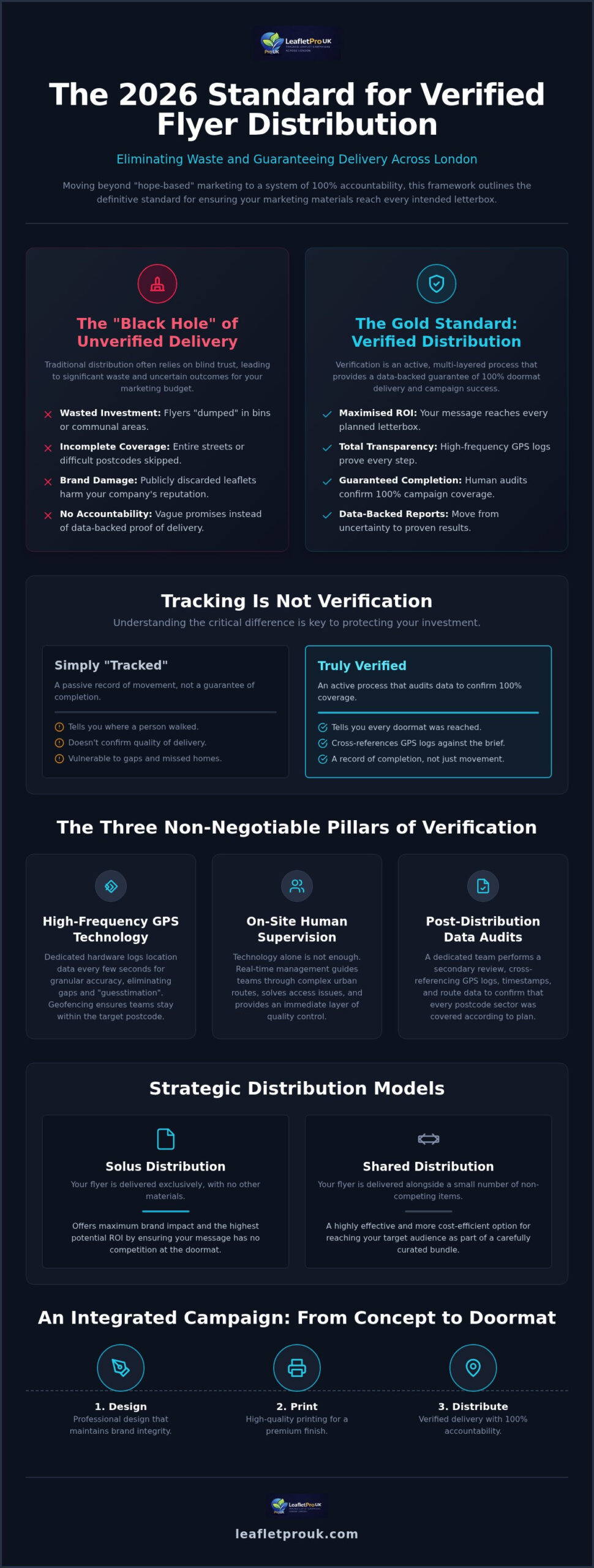
    London presents unique logistical challenges. From multi-storey council estates to high-security gated mews, the city’s residential layout is amongst the most complex in the world. A standard delivery person can easily miss difficult-to-reach letterboxes without the right guidance. This is why the modern standard rests on three non-negotiable pillars:

    • High-frequency GPS technology: Hardware that logs location data every few seconds for granular accuracy.
    • On-site human supervision: Real-time management to guide teams through complex urban routes.
    • Post-distribution data audits: A secondary review process to confirm that every postcode sector was fully covered.

    The Difference Between Tracked and Verified

    It’s a common mistake to assume that tracking and verification are the same thing. Tracking is the passive collection of data points as a distributor moves along a route. It tells you where a person walked, but it doesn’t necessarily confirm the quality of the delivery. It is a record of movement, not a record of completion.

    Verification is an active process. It involves cross-referencing GPS logs against the specific campaign brief to ensure 100% coverage. Whilst many agencies claim to “track” their staff, true verification requires a dedicated team to review that data and confirm every doormat was reached. This level of scrutiny ensures that your marketing materials don’t just end up on a street, but inside the homes of your target audience.

    Why “Cheap” Distribution Often Fails the London Test

    The hidden costs of unverified services often far outweigh the initial savings. Low-cost providers frequently cut corners to maintain their margins, which leads to “dumped” flyers or skipped streets in difficult postcodes. These actions don’t just waste your budget; they can actively damage your brand reputation if residents find bundles of your leaflets discarded in communal areas. Verification changes the game.

    There are several red flags to look for amongst unverified providers in the city. If an agency cannot provide high-frequency GPS logs or refuses to allow on-site audits, your investment is at risk. Choosing a professional verified flyer distribution London service provides the security you need. It ensures your message is delivered with precision, protecting your brand’s integrity and maximising your potential ROI. By partnering with a transparent expert like LeafletPro UK, you can move forward with total peace of mind.

    The Mechanics of GPS Verification: Precision Tracking Technology

    The hardware used in verified flyer distribution London is the foundation of accountability. We use high-sensitivity GPS loggers carried by every team member. Unlike standard smartphone tracking, which can drift amongst tall London buildings, these dedicated devices provide a stable and reliable signal. We set these loggers to “ping” every few seconds. This frequency is vital for urban accuracy. If a distributor skips a small side street or a hidden mews, the gaps in the data become immediately obvious to the auditing team.

    By overlaying this data onto detailed London postcode maps, we create a transparent record of activity. We also employ geofencing technology. This creates a digital boundary around your target sector. If a distributor moves outside the assigned area, the system flags the deviation in real-time. This level of control ensures your budget is spent exactly where you intended, preventing “bleed” into neighbouring postcodes that aren’t part of your strategy.

    How GPS Data Eliminates “Guesstimation”

    A GPS trace provides a literal breadcrumb trail of a distributor’s day. It removes the need for “guesstimation” or blind trust. The technology captures every individual door knock and letterbox drop with surgical precision. In complex London environments like large housing estates or gated communities, the trace proves the distributor accessed every level and block. Digital timestamps add another layer of proof. They show the duration of the drop and the pace of the distributor. A pace that’s too fast suggests “dumping,” whilst a steady, methodical pace indicates professional delivery. This data ensures that your postcode-targeted flyer distribution is executed with total integrity.

    Decoding Your GPS Campaign Report

    Receiving a report is one thing; understanding it is another. A professional verification report should be intuitive and data-rich. Look for heat maps that use colour coding to show delivery density across a postcode. Clear route lines should trace the distributor’s path through every street. These visual aids allow you to confirm 100% coverage at a glance without having to decipher complex spreadsheets. For a deeper look into these metrics, you can read our guide on Understanding GPS Reports. This technological rigour replaces vague updates with hard evidence, giving you the confidence that your message has truly arrived.

    Beyond the Map: Human Supervision and Back-Checking Audits

    Whilst high-frequency GPS tracking provides the data, it cannot replace the discernment of a professional supervisor. Data shows you where a distributor walked, but it doesn’t always show how the work was performed. Human accountability is the essential second layer of verified flyer distribution London. Our London-based supervisors act as the eyes and ears of your campaign, ensuring that the physical execution matches the digital report. They manage the boots on the ground, solving local logistical hurdles that technology might miss.

    Access is a skill. In areas like Canary Wharf or the gated mews of Kensington, supervisors manage the delicate process of gaining entry to communal areas whilst maintaining a respectful brand presence. They ensure that distributors don’t just reach the front gate of an apartment block but navigate the internal post rooms or concierge desks correctly. This hands-on management prevents the “dumping” of materials in lobbies, a common failure amongst less regulated providers.

    On-Site Supervision Protocols

    Our supervisors perform random spot-checks whilst the distribution is live. They don’t just follow the GPS trace; they physically observe the team’s behaviour. This includes checking for “clean” delivery. We ensure every flyer is pushed fully through the letterbox rather than left hanging out, which can look untidy and invite rain damage. Supervisors also re-organise teams in real-time to account for dense London postcodes where unexpected road closures or construction might block a standard route. This proactive approach ensures no street is ever skipped due to a minor local obstacle.

    The Back-Checking Audit Process

    The final stage of verification is the physical back-check. We use a statistical approach, visiting between 5% and 10% of households in a targeted sector within 24 to 48 hours of delivery. By knocking on doors and speaking with residents, we confirm that the materials were received and handled professionally. This resident feedback is vital for verifying the quality of the drop. It transforms a simple map into a verified success story. You can learn more about this process in our article on Ensuring Accountability in London Campaigns. By combining digital logs with physical spot-checks, we set the benchmark for verified flyer distribution London, giving you the peace of mind that your budget has been used effectively.

    Verified Flyer Distribution London: The Definitive Accountability Standard for 2026

    Maximising Coverage with Postcode Targeting and Solus Distribution

    Success in physical marketing depends on precision. You can ensure your message lands on the right doormats by running a verified flyer distribution London campaign that reaches the specific demographics most likely to convert. Rather than using a broad “blanket” approach, professional campaigns rely on postcode sector targeting. This granular strategy allows you to focus your resources on the streets and neighbourhoods that align with your business goals.

    The Power of Postcode-Targeted Delivery

    You can protect your marketing budget by avoiding blanket coverage, which is often a recipe for wasted spend. In a city as diverse as London, customer profiles can change from one street to the next. You can align your campaign with your Ideal Customer Profile (ICP) by using detailed postcode data to focus your distribution. Saturation is the primary objective. You create a local “echo chamber” effect by ensuring every household in a targeted area receives your flyer, which significantly boosts brand recall and response rates.

    You achieve 100% coverage by tailoring your approach to the unique logistics of different boroughs. Reaching residents in high-rise apartment blocks in Canary Wharf or gated mews in Marylebone involves more than just walking a route. It requires knowledge of local access patterns, such as trade button hours or concierge protocols. A professional distributor ensures that your materials aren’t just left at a gate but are placed directly into the internal letterboxes where they’ll be seen and read.

    Solus vs Shared: Which Offers Better Verification?

    Choosing the right distribution model is a balance between budget and impact. Solus distribution, where your flyer is the only one delivered, represents the premium standard for verified flyer distribution London. Because the distributor is focused on a single item, the GPS logs and human audits are exceptionally clean and easy to verify. This model offers the highest visibility and ensures your brand isn’t competing for attention on the doormat.

    Shared distribution involves delivering your flyer alongside two or three non-competing materials. This is often a suitable choice for budget-conscious SMEs looking to maintain a consistent presence in London postcodes. You gain the most rigorous reporting and the highest possible ROI by choosing Solus distribution, but shared drops are still fully tracked. Solus remains the preferred choice amongst brands requiring total accountability and maximum impact with the highest level of verification.

    Implementing a Verified Campaign with LeafletPro UK

    Launching a marketing campaign in the capital requires a partner who understands that accountability starts long before the first letterbox is reached. LeafletPro UK provides an end-to-end service that integrates design support, high-quality printing, and verified flyer distribution London. By managing every stage of the process, we eliminate the communication gaps that often lead to logistical errors. This comprehensive model ensures that your brand’s integrity is maintained from the initial concept to the final doormat delivery.

    We’ve built our reputation as a London-exclusive specialist because we understand the city’s unique residential landscape. We don’t dilute our focus with national coverage; instead, we concentrate our resources on mastering the complex logistics of London’s diverse boroughs. This local expertise allows us to navigate high-density areas with a level of precision that generalist providers simply cannot match. When you work with us, you’re partnering with a diligent expert who values evidence over vague promises.

    Integrated Design and Print Support

    Professional design is the foundation of a successful verified drop. If a flyer is poorly designed or printed on low-quality paper, it risks being dismissed as “junk mail” before the resident even reads the headline. Our design support ensures your message is clear, engaging, and tailored to the London market. We combine this with high-quality printing on premium paper stocks to ensure your materials have the physical weight and visual appeal needed to stand out amongst the daily post.

    The convenience of a single point of contact cannot be overstated. By handling the design, print, and distribution under one roof, we maintain a strict chain of custody for your marketing assets. You won’t have to coordinate between multiple agencies or worry about print deadlines clashing with distribution schedules. This integrated approach simplifies the customer journey and ensures the “verification” of your brand image starts the moment the flyer is produced.

    Your Journey to 100% Accountability

    We’ve streamlined the process of launching a verified flyer distribution London campaign into a clear, methodical sequence. Your journey begins with a consultation to identify your target postcode sectors based on your business goals. Once the postcodes are selected and the materials are printed, our supervised teams begin the deployment. Every step is logged via high-frequency GPS, and our on-site supervisors conduct real-time audits to ensure the highest standards of “clean” delivery.

    The process concludes with the delivery of a comprehensive verification report. This document provides the tangible proof you need to measure your ROI with confidence. You’ll see exactly where your flyers were delivered, supported by GPS traces and back-checking data. This commitment to transparency provides the peace of mind that your investment has been handled with the utmost care and professional scrutiny.

    Securing Your Brand’s Future in the London Market

    Establishing a new standard for physical marketing requires a shift from vague promises to systematic proof. You can now replace the uncertainty of unverified delivery with a model built on total transparency. By integrating high-frequency GPS data with on-site human supervision, your campaign achieves a level of precision that protects your budget and your brand reputation. This methodology ensures that every flyer is handled with care and delivered exactly where it matters most.

    Relying on verified flyer distribution London services allows you to focus on your business whilst we handle the complex local logistics. Our end-to-end model simplifies your journey by providing professional design, high-quality printing, and GPS-tracked route data for every campaign. This structured approach provides the data-backed reporting you need to measure success with absolute confidence. You no longer have to guess about your coverage when you have the evidence of a well-executed process.

    You deserve the peace of mind that comes from a diligent and transparent partner. We look forward to helping you reach every London doormat with precision and integrity.

    Frequently Asked Questions

    What exactly is verified flyer distribution in London?

    Verified flyer distribution London is a delivery standard that uses high-frequency GPS tracking and human audits to prove every item reached its intended doormat. It moves beyond simple tracking by actively cross-referencing location data against your specific campaign brief. This systematic approach ensures that your marketing investment isn’t based on guesswork but on tangible, data-backed evidence. It’s the most secure way to manage physical marketing in a complex urban environment.

    How do I know my leaflets weren’t just thrown away?

    You can confirm the integrity of your delivery through detailed GPS route maps and physical back-checking reports. Our loggers record movement every few seconds, making it impossible to hide the gaps that occur when materials are dumped. Additionally, our supervisors perform random house-to-house audits to verify receipt directly with residents. This multi-layered verification process provides the transparency needed to ensure your materials are inside homes rather than in communal bins.

    Can I see the GPS tracking data for my London campaign live?

    We provide comprehensive GPS reports once the distribution is complete and the data has been audited for accuracy. Whilst some systems offer live views, we prioritise the verification of that data to ensure the report you receive is a true reflection of the finished work. This thorough review process allows us to catch and correct any local access issues before the final data is presented, giving you a cleaner and more reliable overview.

    What happens if a distributor cannot gain access to a London apartment block?

    Our distributors are trained to use trade buttons and concierge protocols to gain legitimate entry to communal areas. If access is restricted during the initial attempt, the supervisor is notified immediately to find a solution or reschedule the drop for a more appropriate time. We never leave bundles in lobbies or at external gates. Every missed letterbox is logged, ensuring that your final report accurately reflects the total reach achieved in that sector.

    Is solus distribution always better than shared distribution for verification?

    Solus distribution offers the highest level of accountability because the distributor is focused on a single item. This focus results in cleaner GPS traces and simpler auditing, making it the gold standard for verified flyer distribution London. Shared drops are still fully tracked and verified, but they are generally better suited for brands with lower budgets who can accept their flyer being delivered alongside two or three other non-competing materials.

    How long does a typical GPS-tracked leaflet drop take in London?

    The duration of a campaign depends on the volume of flyers and the density of the targeted postcodes. A standard drop of 5,000 to 10,000 leaflets usually takes between three and five working days to complete professionally. We prioritise a methodical pace over speed to ensure every doormat is reached correctly. This steady approach allows for the rigorous supervision and back-checking that define our high accountability standards for the capital.

    Does LeafletPro UK provide design and printing as part of the verified service?

    Yes, we offer an integrated model to streamline your entire London campaign. By handling the creative and production stages in-house, we maintain a consistent standard of quality that supports the final delivery. This end-to-end service provides you with a single point of contact and ensures that your flyers are designed and printed to the specific requirements of a high-impact, door-to-door campaign. It’s a convenient way to maintain brand integrity throughout the journey.

    What postcodes in London do you cover for verified distribution?

    We provide comprehensive coverage across all London postcodes, from the central business districts to the outer residential boroughs. Our expertise includes navigating the unique challenges of every sector, whether it’s the high-rise flats of East London or the affluent mews of the West End. This city-wide focus ensures that your brand can reach any target demographic within the Greater London area with the same high standard of GPS-tracked verification and professional reporting.

  • Leaflet Distribution Prices in London: The 2026 Guide to Reliable Delivery

    Leaflet Distribution Prices in London: The 2026 Guide to Reliable Delivery

    The cheapest quote you receive for your next marketing campaign is often the most expensive mistake your business will ever make. It’s frustrating to navigate the wide variations in leaflet distribution prices London agencies offer, especially when you’re worried about “skip-dumping” or wasted materials. You deserve to know that your investment is being handled with precision and that every single flyer actually reaches a potential customer’s doormat.

    This guide will teach you how to evaluate distribution costs whilst ensuring your campaign achieves 100% verifiable delivery through rigorous GPS-tracked accountability. We’ll move beyond confusing price lists to focus on the systematic proof that protects your budget. You will learn how to identify fair pricing for reliable service, understand the logistical factors that influence costs across different boroughs, and see how transparent reporting drives a higher ROI. We’re providing a clear framework to end the uncertainty of local logistics, allowing you to plan your 2026 campaigns with total confidence in the results.

    Key Takeaways

    • Understand why suspiciously low quotes often lead to “skip-dumping” and how to identify fair leaflet distribution prices London based on verifiable delivery standards.
    • Discover how 1-second GPS tracking provides the logistical evidence needed to ensure your marketing materials reach the correct letterboxes with precision.
    • Learn why postcode-specific targeting is more effective than blanket London drops for reaching your ideal audience and achieving a higher return on investment.
    • Evaluate potential partners based on their staffing models and the level of on-site supervision provided during the delivery process.
    • Streamline your campaign by integrating professional design and high-quality printing with a supervised, London-focused distribution service.

    Understanding Leaflet Distribution Prices in London: Value vs. Risk

    Evaluating leaflet distribution prices London agencies offer requires looking far beneath the surface of a quote. The market often presents a stark choice between professional accountability and the high-risk “skip-dumping” economy. When you encounter suspiciously low prices, it usually indicates a lack of supervision or the use of unverified subcontractors. These providers cut costs by ignoring the logistical realities of London’s complex streets, which directly jeopardises your campaign’s success. A Flyer (or flier) is only a valuable marketing tool if it actually reaches the intended doormat; otherwise, it’s merely a wasted printing expense.

    Several factors influence the cost of a reliable campaign in the capital. Housing density varies significantly between high-rise inner boroughs and sprawling outer suburbs, affecting the time required for delivery. Volume also plays a role, as larger campaigns allow for better logistical planning. In 2026, London brands are increasingly prioritising accountability over the base cost. They recognise that the integrity of the delivery process is the only way to protect their brand reputation and ensure a tangible return on their investment.

    To better understand how professional delivery transforms your business reach, watch this helpful video:

    The Hidden Costs of Unverified Flyer Drops

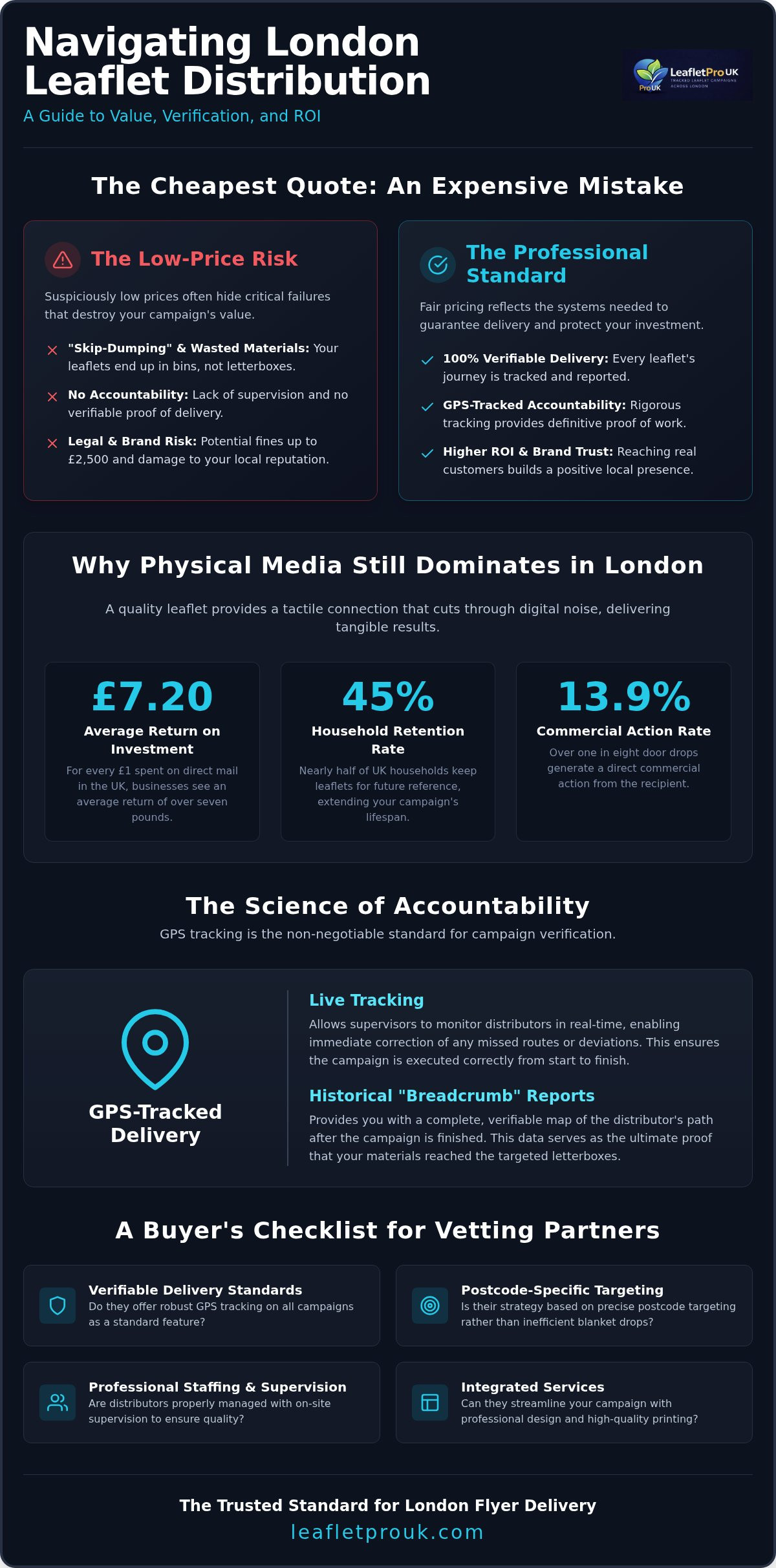
    Choosing a provider based solely on the lowest leaflet distribution prices London offers can lead to significant financial loss. If your materials are dumped in communal bins or fly-tipped, you lose the potential revenue from thousands of households. Beyond lost sales, there are legal risks involved. Distributing printed material without proper oversight can lead to fixed penalties or fines of up to £2,500 if your materials are found discarded illegally. Poor delivery also erodes trust amongst local residents, who may view your brand as a source of litter rather than a professional service provider.

    Why Physical Media Still Dominates London Marketing

    Physical marketing remains a powerhouse because it bypasses digital ad fatigue. In high-density urban centres, a high-quality leaflet on a doormat provides a tactile connection that digital banners cannot match. Research from Brandnation in August 2026 shows that direct mail in the UK delivers an average ROI of over £7.20 for every £1 spent. Furthermore, 45% of UK households keep leaflets for future reference, and 13.9% of door drops generate a commercial action. By using LeafletPro UK, you ensure these statistics work for your business through precise, London-only expertise and verified delivery routes.

    The Science of Accountability: Decoding GPS Tracked Delivery

    Accountability is the bridge between a marketing expense and a business investment. In the flyer delivery industry, GPS tracking has evolved from a premium add-on to a non-negotiable standard for professional campaigns. This technology provides a digital footprint of every distributor’s movement, ensuring that your materials are actually reaching letterboxes rather than being discarded. When you compare leaflet distribution prices London agencies provide, you are often paying for the level of visibility and security that these tracking systems offer. It’s a logistical safeguard that transforms an invisible process into a verifiable data set.

    There is a significant difference between “Live” tracking and “Historical” breadcrumb reports. Live tracking allows supervisors to monitor progress in real-time, facilitating immediate corrections if a route is missed. Historical reports are provided to you after the campaign, offering a complete map of the distributor’s path. To ensure your campaign remains compliant with local regulations, always verify that your provider adheres to the official government guidelines regarding the distribution of printed materials. This legal compliance, combined with GPS data, creates a robust foundation for brand security.

    Why 1-Second Precision is the London Gold Standard

    London’s unique geography, characterised by narrow mews, terraced housing, and high-density apartment blocks, demands extreme tracking precision. Many standard GPS devices use a 5-second or 10-second “ping” interval. On a map, this creates straight lines that may appear to cut through buildings, making it impossible to tell if the distributor actually visited every door. A 1-second ping interval records every human step. It captures the turn into a small courtyard or the walk up a specific driveway. This level of detail is vital in central London boroughs where missing a single street corner could mean bypassing dozens of potential customers.

    How to Read and Interpret Your GPS Distribution Data

    A professional distribution report should be easy to audit. Most reports use heat maps or “breadcrumb” trails to show delivery density across your target postcode. When reviewing this data, look for consistent coverage without large gaps or erratic lines. You can cross-reference these reports with your incoming sales leads or website traffic to see if specific areas are performing as expected. If you notice a cluster of enquiries from a particular street, your GPS data should confirm that a thorough drop occurred there. For businesses seeking this level of transparency, choosing a partner that specialises in GPS Tracked Leaflet Distribution is the most effective way to guarantee campaign integrity. This data-backed proof allows you to refine future drops, focusing your budget on the postcodes that yield the highest engagement.

    Strategic Targeting: Mastering London Postcodes for ROI

    You achieve a higher response rate by prioritising targeting precision over sheer volume. Whilst some businesses seek the lowest leaflet distribution prices London agencies offer by requesting massive, un-targeted drops, this often leads to a diluted ROI. Strategic targeting allows you to focus your budget on the specific streets where your ideal customers actually live. This precision ensures your message resonates with the right demographic, turning a broad campaign into a surgical strike. It’s about understanding that a thousand leaflets in the right postcode are worth more than ten thousand in the wrong ones.

    Brand protection is guaranteed when you operate within UK government guidelines regarding letterbox delivery. London’s diverse landscape requires a nuanced approach that national providers often lack. Whether you’re targeting the affluent terraces of West London or the modern developments in the East, local street-level knowledge is essential for effective route planning. This legal compliance protects your reputation whilst ensuring your materials are distributed responsibly across the capital’s varied residential zones.

    Identifying Your “Goldmine” London Postcodes

    High-spending households are reached more effectively through targeting ABC1 demographics in specific London postcodes, ensuring your leaflet distribution prices London investment is concentrated where it matters most. Identifying these high-conversion areas requires more than just a map; it requires deep local data. By using LeafletPro UK, businesses gain access to London-only expertise that national agencies simply don’t possess. We analyse postcode-level demographics to ensure your flyers reach homes with the highest propensity to spend. This focused strategy minimises waste and maximises your ROI, allowing you to scale your business through evidence-based marketing rather than guesswork.

    Navigating London’s Complex Residential Geography

    Maximum household engagement is secured when you account for London’s unique logistical hurdles. Gated communities and high-rise City flats often present barriers that lead to materials being left in communal lobbies rather than reaching individual doormats. To combat this, campaigns must be planned around London’s “village” structures and complex one-way systems. Professional distributors understand how to navigate these challenges, ensuring that every piece of mail stays in the home for the average eight days that households typically keep physical marketing. This attention to detail ensures your brand achieves the tactile presence required to drive commercial action in a crowded marketplace.

    Leaflet Distribution Prices in London: The 2026 Guide to Reliable Delivery

    Vetting Your Distribution Partner: A Buyer’s Checklist

    Selecting a partner requires a critical look at their operational model. You shouldn’t just compare leaflet distribution prices London agencies list on their websites; you need to audit their delivery infrastructure. A common red flag is a price that seems too good to be true. In the capital, the cost of living and logistical complexities mean that quality delivery requires a fair investment in staff and supervision. If a quote is significantly lower than the market average, it’s likely that the agency is cutting corners on staff wages or skipping the supervision process entirely.

    Staff Accountability: Direct Employees vs. Gig Economy Workers

    The “bag-and-drop” model relies on unvetted subcontractors who often lack a direct connection to the agency. This gig economy approach creates a significant risk of materials being discarded because there’s no chain of command or accountability. In contrast, directly employed staff are trained and held to professional standards. These teams take pride in the cleanliness of their work, ensuring leaflets are pushed fully through letterboxes rather than left hanging. High-performance delivery is secured when GPS tracked leaflet distribution is used to verify every route in real-time. Understanding how these factors influence leaflet distribution prices London providers charge will help you avoid low-quality “gig” models that offer no security.

    The Value of an Integrated End-to-End Service

    Quality control is significantly easier to maintain when you use an integrated service. Managing separate designers, printers, and distributors often leads to logistical headaches and brand inconsistencies. By choosing an agency that handles everything in-house, you ensure that your brand colours remain consistent and the paper weight is exactly what you ordered. Professional design support is also vital; a poorly designed flyer won’t convert regardless of how well it’s delivered. A single London-based point of contact simplifies the process, saving you time and reducing the risk of communication errors across your campaign.

    Use this checklist when vetting your next partner:

    • Employment Status: Are the distributors directly employed or subcontractors?
    • Supervision: Is there an on-site supervisor for every team in the field?
    • Tracking Precision: Do they provide 1-second GPS ping data for every route?
    • Production: Can they manage design and high-quality printing to ensure colour consistency?
    • Reporting: Will you receive a comprehensive delivery report within 48 hours of completion?

    LeafletPro UK: The Trusted Standard for London Flyer Delivery

    LeafletPro UK operates with a singular focus on the London market. This specialisation allows us to offer a level of logistical precision that national providers cannot match. When evaluating leaflet distribution prices London businesses often find that our integrated approach provides the best long-term value. We don’t just deliver paper; we deliver peace of mind through a system built on 1-second GPS verification and direct on-site supervision. Our commitment to transparency means that your investment is protected by tangible data, ensuring that every household in your target postcode receives your message with systematic reliability.

    From Concept to Doormat: Our Seamless Process

    Successful campaigns begin long before the first letterbox is reached. By collaborating with our design team, you can create high-conversion London layouts that are tailored to the specific aesthetics of your target boroughs. We help you choose the right paper stock to ensure your materials stand out amongst the morning post, maintaining a tactile quality that reflects your brand’s professionalism. Timing is equally critical. We coordinate your drop with seasonal peaks and local London events to maximise engagement. This end-to-end management eliminates the friction of dealing with multiple vendors, ensuring that your brand colour and print quality remain consistent from the initial concept to the final doormat.

    Requesting Your Verified Distribution Quote

    Every business has unique goals, which is why we build bespoke postcode plans tailored to your specific London audience. We don’t believe in “blanket” drops that waste your budget. Instead, we use local demographic data to identify the streets most likely to respond to your offer. This strategic approach ensures that the leaflet distribution prices London companies pay result in a measurable commercial action. Our process is designed to be logical and thorough, guiding you from the initial postcode selection to the final delivery report.

    After your campaign concludes, you’ll receive a comprehensive GPS tracking report that records every human step taken by our team. This document serves as your proof of delivery, allowing you to audit the campaign with total confidence. You won’t have to guess if your flyers were delivered; you’ll have the data to prove it. This level of accountability is what sets us apart as a diligent partner for your local marketing needs.

    Secure Your Brand’s Future with Accountable London Distribution

    Navigating the various leaflet distribution prices London providers quote is ultimately about balancing budget with verifiable results. True campaign success in the capital’s complex market depends on the integrity of the delivery process and the precision of your targeting. By insisting on 1-second GPS tracking data and directly supervised staff, you eliminate the anxieties of “skip-dumping” whilst ensuring your investment is handled with professional scrutiny. This level of accountability transforms a standard drop into a reliable marketing engine.

    An integrated approach that combines bespoke design and high-quality printing with postcode-targeted delivery provides the most steady path to a high ROI. You don’t need to manage multiple vendors or worry about inconsistent brand quality when you partner with experts who understand London’s unique residential geography. With the right systems in place, your physical marketing becomes a powerful, transparent tool for local engagement and business growth.

    Your next campaign is an opportunity to build lasting trust with your local audience through reliable, door-to-door delivery that you can see and verify.

    Frequently Asked Questions

    Is GPS tracking really accurate for London leaflet distribution?

    GPS tracking is highly accurate when using a 1-second ping interval to record every movement. This frequency captures the exact path into courtyards and up to terraced doormats. Standard 5-second pings often create straight lines that miss the nuances of London’s narrow streets. By using high-precision tracking, we provide a digital footprint that verifies every single delivery, giving you total visibility over your campaign’s progress and integrity.

    How much does leaflet distribution cost in London in 2026?

    Current market rates for shared distribution in London typically range between £35 and £55 per thousand leaflets. For solus delivery, where your material is delivered alone, prices generally fall between £45 and £70 per thousand. These leaflet distribution prices London agencies quote reflect the logistical complexity of the capital. Factors like housing density and the level of GPS verification provided will influence the final cost of a reliable, accountable campaign.

    What is the difference between solus and shared distribution in London?

    Solus distribution involves your leaflet being delivered entirely on its own to every household. Shared distribution places your flyer alongside a maximum of two or three non-competing materials. Whilst shared delivery is more cost-effective, solus distribution offers maximum impact and flexibility for your specific timing. Both methods benefit from the same high standards of GPS tracking and direct supervision to ensure your materials reach the doormat safely.

    Can you deliver to high-rise flats and gated communities in the City?

    Delivering to high-rise flats and gated communities is a core part of our London-only service. These environments require experienced distributors who understand how to navigate security systems and communal entrances. Our teams are trained to ensure leaflets reach individual letterboxes rather than being left in lobbies. We use local street-level knowledge to plan routes that account for these residential complexities, ensuring your campaign achieves comprehensive coverage across the City.

    How do I know my leaflets aren’t being delivered to businesses instead of homes?

    We use residential-only route planning to ensure your materials reach households rather than commercial premises. Our postcode-targeted maps are specifically designed to exclude industrial estates and business parks unless they’re part of a mixed-use residential area. You can verify this through your GPS reports, which show the exact path taken by our staff. This focus ensures your budget is spent on reaching potential customers in their own homes.

    Do you provide proof of delivery reports after the campaign finishes?

    You will receive a comprehensive proof of delivery report within 48 hours of your campaign’s completion. This document includes 1-second GPS tracking maps that show the precise route taken by every distributor. It provides the logistical evidence needed to verify that every street in your target postcode was covered. This transparent reporting system is designed to provide peace of mind and a clear data set for auditing your ROI.

    How long does it typically take to distribute 10,000 leaflets in London?

    Distributing 10,000 leaflets in London typically takes between five and seven working days for a supervised team. The exact duration depends on the housing density of your chosen postcodes; outer London suburbs with larger gardens take longer than high-density inner-city blocks. We prioritise delivery quality and accuracy over speed, ensuring that every flyer is pushed fully through the letterbox. We provide regular updates so you can track the campaign’s steady progress.

    Can you help with the design and printing of my flyers as well?

    We provide an integrated service that includes professional design support and high-quality printing. Our design team creates layouts specifically optimised for high-conversion letterbox marketing in the London market. By managing the entire process from concept to doormat, we maintain brand colour consistency and paper quality. This end-to-end model simplifies your logistics, saving you time and ensuring your campaign is ready for distribution without any communication gaps.

  • Leaflet Distribution with GPS Proof: Ensuring Accountability in London Campaigns

    Leaflet Distribution with GPS Proof: Ensuring Accountability in London Campaigns

    How much of your marketing budget is currently sitting at the bottom of a recycling bin before it ever reaches a potential customer’s hands? For many London business owners, the fear of “dumped” flyers is a genuine barrier to growth. You recognise that physical mail creates a lasting impression, yet you deserve to know that your investment is actually reaching letterboxes. Professional leaflet distribution with GPS proof addresses this anxiety directly by providing a transparent, digital audit trail for every single drop.

    We’ll demonstrate how this data-driven approach transforms traditional marketing into a verifiable, high-ROI strategy for your business. By the end of this article, you’ll understand how satellite tracking ensures 100% coverage in high-density postcodes and provides the peace of mind that comes from total visibility. We’ll also explore the logistical benefits of integrated campaign management and how verifiable proof leads to the higher response rates you expect from a premium, professional service.

    Key Takeaways

    • Eliminate the uncertainty of unverified delivery by establishing a transparent digital audit trail for every campaign.
    • Understand the mechanics of ‘snail trail’ mapping and how it provides visual confirmation that every street in your target postcode was reached.
    • Discover how leaflet distribution with GPS proof acts as a non-negotiable security standard that protects your marketing investment and drives higher response rates.
    • Learn to interpret professional distribution reports, focusing on date and time stamps to verify that your schedule was executed with precision.
    • Recognise the value of London-specific expertise in navigating complex local logistics compared to generic national coverage.

    The Trust Gap: Why GPS Proof is Essential for Modern Leaflet Marketing

    Traditional physical marketing has often been described as a “black hole” where business owners invest significant capital and hope for the best. Without a verifiable system, you’re left wondering if your promotional materials actually reached their intended destination or ended up discarded in a skip. Professional leaflet distribution with GPS proof changes this dynamic entirely. It transforms a logistical process into a system of digital accountability, providing a transparent record of every distributor’s movements. This technology ensures that your physical marketing is as measurable and trackable as a digital ad campaign.

    For many SMEs, the anxiety regarding “dumped” flyers is the single greatest deterrent to using direct mail marketing. When you cannot see where your investment went, you cannot accurately measure your return on investment. GPS-tracked distribution eliminates this industry-wide trust gap by replacing vague promises with hard evidence. Knowing that your leaflets have reached the doormat allows you to plan your business growth with confidence; you can finally link a spike in enquiries to a specific street or postcode with absolute certainty.

    The Financial Risk of Untracked Distribution

    Choosing a distribution partner based solely on the lowest price often results in a false economy. If you commission a run of 5,000 leaflets, your total investment includes not just the distribution fee, but also the costs of professional design and high-quality printing. When these leaflets are “lost” or poorly delivered by an untracked service, that entire budget is effectively erased. Beyond the immediate financial loss, poor delivery practices can damage your brand’s local reputation. If residents see bundles of your flyers discarded in public spaces, it reflects poorly on your business’s professional standards and environmental responsibility.

    Establishing a Security Standard for London Brands

    London’s high-density postcodes and competitive market conditions require a more sophisticated approach than a simple “trust-based” model. Local brands now view leaflet distribution with GPS proof as a non-negotiable security standard rather than an optional extra. This shift toward evidence-based marketing allows marketing departments to maintain a professional audit trail for every campaign they execute. By utilising satellite data to confirm 100% coverage, London businesses can ensure they aren’t leaving money on the table in key catchment areas. This level of precision is exactly what distinguishes a diligent partner from a generic delivery service, providing the grounded confidence necessary for high-stakes local engagement.

    How GPS Tracking Technology Verifies Every Single Letterbox

    The transition from manual delivery to leaflet distribution with GPS proof relies on high-frequency data collection. As a distributor moves through a London postcode, a dedicated GPS logger records their precise coordinates every few seconds. This creates a digital breadcrumb trail that maps their journey with granular accuracy. Once the route is completed, this information is synchronised with mapping software to produce a comprehensive report for the client. Direct mail can be more effective when backed by this level of technical verification, as it removes the guesswork from campaign evaluation. This methodical approach ensures that the report you receive isn’t just a summary, but a line-by-line verification of work completed.

    The Precision of “Snail Trail” Reporting

    The “snail trail” is a visual representation of the distributor’s path overlaid onto a high-resolution map. Unlike basic “area tracking,” which merely confirms a presence in a general vicinity, doorstep precision data allows you to see the distributor approaching individual properties. The software is sophisticated enough to identify the specific pauses and movements associated with a physical delivery. If a street was missed or a cul-de-sac was ignored, the gap in the snail trail becomes immediately apparent. This visual audit ensures that your campaign achieves the 100% saturation required for maximum impact. By reviewing these trails, you can confirm that every home in your target demographic has been reached.

    Hardware vs. Software: Ensuring Data Integrity

    Whilst some providers rely on simple mobile phone apps, these are often prone to signal drops and battery failure. LeafletPro UK utilises professional-grade GPS loggers to maintain a consistent connection with satellite networks. These dedicated devices are essential for overcoming London’s “urban canyons,” where high-rise buildings in areas like Canary Wharf or the City can obstruct standard signals. Professional loggers use multi-constellation satellite tracking, which draws data from various systems to maintain accuracy amongst tall structures. A GPS logger is a tamper-proof device that ensures delivery honesty by recording immutable location data throughout the working day. If you want to organise a campaign with this level of technical rigour, choosing the right hardware is the first step toward a successful outcome.

    Leaflet Distribution with GPS Proof: Ensuring Accountability in London Campaigns

    GPS-Tracked vs. Traditional Delivery: A Comparative Analysis

    Traditional distribution methods often operate on a “trust but don’t verify” basis, leaving businesses vulnerable to incomplete campaigns. In contrast, leaflet distribution with GPS proof provides an objective layer of accountability that traditional “blind” drops simply cannot match. Whilst older methodologies rely on the word of a distributor, modern tracking offers post-campaign data that removes the need for guesswork. This shift from subjective reporting to objective evidence is fundamental for any brand looking to secure a measurable return on their marketing spend. It allows you to move away from a “hope-for-the-best” strategy and towards a professional, audited process.

    Why Traditional “Blind” Drops Fail in London

    London’s architectural landscape presents unique challenges for untracked delivery teams. Complex street layouts, sprawling estates, and secure gated communities often lead to distributors skipping properties that are difficult to access or time-consuming to navigate. Without tracking, a business owner has no way of knowing if a specific residential block or a tucked-away cul-de-sac was ignored. This lack of recourse means that if a campaign fails to generate leads, you cannot determine if the fault lay with the creative message or if the leaflets simply never reached the doormat. Traditional drops often result in “patchy” coverage, which dilutes the effectiveness of your local outreach and leads to wasted print costs.

    The GPS Advantage for High-Density Postcodes

    In high-density postcodes such as SW1 or E14, precision is essential for managing costs and ensuring maximum impact. Advanced satellite technology allows for postcode-targeted distribution that respects strict boundaries, ensuring you don’t waste budget on areas outside your primary catchment. This technical rigour is also balanced with ethical considerations. Current professional standards regarding Geolocation Tracking and Privacy highlight the importance of using data responsibly to build trust between service providers and clients. By providing leaflet distribution with GPS proof, we enable you to calculate your response rates with far greater accuracy. If you know with 100% certainty that 10,000 households received your flyer, your conversion data becomes a reliable metric for future campaign planning. This allows for data-driven adjustments; if one postcode underperforms despite verified delivery, you can refine your message rather than repeating the same logistical mistakes.

    Receiving a report for leaflet distribution with GPS proof is only the first step; the true value lies in your ability to audit that data effectively. A professional report acts as a tool for verification rather than a simple administrative document. By following a methodical review process, you can ensure that your marketing budget was utilised with the precision you were promised. This audit trail is what provides the peace of mind that your message has actually reached the doormats of your target audience.

    To interpret your data correctly, follow these five steps:

    • Step 1: Verify the date and time stamps against your agreed campaign schedule to ensure delivery occurred during optimal engagement windows.
    • Step 2: Assess the “snail trail” density to confirm the distributor’s path touched every street within the target postcode.
    • Step 3: Look for consistent movement patterns that indicate a methodical, zig-zagging pace as individual properties were visited.
    • Step 4: Cross-reference the map with your local knowledge, checking how the distributor navigated areas with complex access.
    • Step 5: Identify high-performing zones by matching incoming enquiries to verified delivery areas to inform future scaling.

    Identifying Quality Delivery Patterns

    A professional delivery is marked by its thoroughness and steady rhythm. You should be able to distinguish between a “drive-by” drop, where a distributor moves too quickly down a main road, and a genuine door-to-door service. A professional GPS report should show a distributor entering every street, not just the main roads. Look for signs of a diligent partner, such as a steady walking pace and a digital path that leaves no cul-de-sac or side street unvisited. This level of detail confirms that the distributor was on foot and physically approaching every letterbox.

    Spotting Red Flags in Distribution Reports

    Transparency allows you to identify when a campaign hasn’t met the required standards. Gaps in the snail trail are significant indicators; they might suggest missed residential blocks or unresolved gated access issues. Another major red flag is “impossible” speed on the report. If the data shows the logger moving at speeds over 10 mph, it suggests the distributor was in a vehicle, which typically results in poor delivery quality. If you find discrepancies, a reputable partner will provide a logistical explanation and work to resolve the issue. If you are ready to organise a leaflet distribution campaign with this level of accountability, choosing a partner who values evidence is essential.

    LeafletPro UK: Setting the Standard for Transparent Distribution in London

    While many agencies offer national coverage, LeafletPro UK remains dedicated exclusively to the capital. This focus allows us to provide a level of leaflet distribution with GPS proof that accounts for the city’s unique architectural and logistical complexities. We understand that navigating London isn’t just about reading a map; it’s about knowing which estates require specific access and which multi-occupancy flats have accessible letterboxes. Our commitment to 100% transparency ensures that from the first drop to the final digital report, your investment is monitored with professional scrutiny. We don’t just deliver flyers; we provide a verified link between your brand and your local community.

    London-Centric Expertise and Postcode Precision

    Successful campaigns in the capital rely on a deep understanding of residential geography. We organise our efforts around specific London postcodes to ensure maximum impact for local brands. This precision prevents wasted spend on non-residential areas or postcodes that fall outside your primary catchment. Our distributors are familiar with the local delivery restrictions that often hinder less experienced teams, particularly in areas with gated estates or secure apartment blocks. By leveraging this local knowledge, we ensure your flyers reach the most relevant households. This methodical approach to leaflet distribution with GPS proof ensures that no street is overlooked due to logistical difficulty.

    The End-to-End Solution: Design, Print, and Verified Delivery

    A flawless GPS report is a powerful tool, but the physical leaflet must also be capable of driving action. We provide an integrated service that combines verified delivery with high-quality printing and professional design support. This end-to-end approach streamlines your marketing workflow and reduces the logistical burden on your team. If a design fails to convert, even the most precise delivery won’t provide the ROI you expect. By managing every stage of the process, we maintain strict quality control over the final outcome. It’s this combination of creative excellence and technical accountability that makes us a diligent partner for London’s business community.

    Organise your next GPS-tracked London campaign with LeafletPro UK to experience a new standard in physical marketing. We help you turn traditional flyer drops into a transparent, data-driven strategy that delivers measurable results for your business.

    Secure Your Marketing ROI with Verifiable Data

    Physical marketing remains one of the most powerful ways to engage local customers, but its success depends entirely on the integrity of the delivery. By moving away from traditional untracked methods and adopting leaflet distribution with GPS proof, you ensure that every penny of your budget is accounted for. This digital audit trail provides the peace of mind that your flyers have reached their intended doormats, allowing you to focus on managing the resulting enquiries rather than questioning the logistics.

    Our specialist knowledge of London postcodes ensures your campaign navigates the city’s unique challenges with ease. When you combine this precision with our integrated design and high-quality printing services, you create a professional marketing workflow built for results. Every drop is backed by a comprehensive GPS report, removing the uncertainty of traditional distribution and replacing it with grounded, actionable data. Request a quote for GPS-tracked distribution in London today. We look forward to helping you grow your local presence with absolute confidence.

    Frequently Asked Questions

    Is GPS tracking 100% accurate for leaflet distribution?

    GPS tracking is highly accurate but can be affected by atmospheric conditions or tall buildings. Professional-grade loggers mitigate these issues by connecting to multiple satellite constellations. While a 100% signal lock is the goal, minor “drift” can occur in certain environments. We use sophisticated software to clean this data, ensuring the final report accurately reflects the distributor’s path through the target postcode.

    How do I receive the GPS reports for my London campaign?

    You will receive your digital reports via email once the campaign or specific distribution phase is finalised. These documents typically include a map overlay showing the “snail trail” of the distributor’s movements. This delivery method ensures you have a permanent record of your leaflet distribution with GPS proof. It allows your marketing team to review the coverage alongside your conversion data for better performance analysis.

    Does GPS tracking work in large blocks of flats or gated estates?

    Tracking technology confirms the distributor’s arrival at the entrance of gated estates and large residential blocks. While GPS signals may weaken inside high-rise buildings, the “snail trail” clearly shows the distributor approaching the main entrance or concierge. This provides verification that the property was reached, even if the individual movements between floors aren’t captured by satellite data. It remains a reliable standard for London’s unique property landscape.

    What happens if the GPS report shows a street was missed?

    We take immediate action to rectify any discrepancies identified in a GPS report. If the tracking data indicates that a specific street or cul-de-sac was overlooked, we investigate the cause and organise a supplementary drop to ensure 100% coverage. This accountability is the primary benefit of a tracked service; it allows us to identify and resolve logistical issues before they impact your campaign’s overall response rate.

    Is GPS-tracked distribution more expensive than traditional delivery?

    Tracked distribution typically carries a small premium compared to unverified services to cover hardware and data administration costs. However, it’s often more cost-effective in the long run because it eliminates the financial waste associated with “lost” or dumped flyers. By ensuring every leaflet reaches a doormat, you achieve a higher return on investment and a more accurate understanding of your customer acquisition costs.

    Can I see a sample GPS report before I book my campaign?

    We are happy to provide sample reports to demonstrate the level of detail you can expect for your campaign. Reviewing a sample allows you to see how the “snail trail” looks in practice and how the data is presented for easy auditing. This initial transparency helps build the trust necessary for a successful partnership and ensures you’re comfortable with the reporting format before any distribution begins.

    How often is the GPS data updated during a live campaign?

    Data is recorded continuously by the loggers and is typically processed for client review at the end of each working day or campaign phase. This methodical approach allows our management team to verify the data integrity before it reaches you. Whilst real-time tracking is possible, the post-distribution audit provides a more accurate and “cleaned” visual report that is easier for business owners to interpret and use for future planning.

    Why should I choose a London-specific distributor over a national one?

    London’s complex residential geography requires a distributor with deep local expertise rather than a generic national approach. A London-specific partner understands the nuances of local delivery restrictions and multi-occupancy housing that national franchises might overlook. This specialised knowledge, combined with leaflet distribution with GPS proof, ensures that your campaign is executed with a level of precision that respects the unique character of the capital’s postcodes.

  • Tracking Leaflet Distribution: A Verification Guide

    Tracking Leaflet Distribution: A Verification Guide

    What if the greatest threat to your marketing budget isn’t a poor design or a weak offer, but the simple uncertainty of whether your leaflets ever reached their destination? For many London business owners, the “trust gap” in physical marketing is a significant hurdle, often fuelled by the fear that thousands of printed materials might be discarded before they ever see a letterbox. It’s difficult to justify a marketing spend when the results feel untraceable and the process lacks visibility.

    We believe that transparency is the foundation of a successful partnership, and you deserve to know exactly where every penny of your investment is going. Learning how to track flyer distribution effectively turns a leap of faith into a data-driven strategy. By utilising precise GPS verification and professional reporting, you can eliminate the anxiety of “binning” and ensure every postcode in your campaign is covered with absolute precision.

    This guide provides a clear roadmap for interpreting tracking data and verifying doormat-level accountability. You’ll learn how to read route density maps, understand the logistics of professional distribution teams, and gain the confidence to reinvest in leaflet marketing as a reliable, measurable pillar of your business growth.

    Key Takeaways

    • Understand why transparent verification is essential to protect your marketing budget and eliminate the uncertainty of unverified door-to-door campaigns.
    • Discover the technical mechanics of how to track flyer distribution using satellite-linked devices that record the precise path of every distributor in real-time.
    • Learn how to interpret professional distribution maps by identifying route density and recognising human-specific walking signatures that confirm genuine delivery.
    • Explore the importance of a multi-layered verification approach that combines GPS data with independent supervisor spot-checks for maximum accountability.
    • Gain the confidence to reinvest in London-wide marketing by receiving clear, postcode-specific reports that provide total visibility of your campaign’s progress.

    The Trust Gap: Why You Must Track Flyer Distribution

    For years, door-to-door marketing felt like a “black box” for many London business owners. You’d invest in high-quality printing, hire a distribution team, and then simply wait for the phone to ring. If the enquiries didn’t materialise, you were left with a frustrating dilemma. Did the creative fail to resonate, or did the leaflets never actually reach the intended doormats? This lack of transparency creates a significant trust gap, often leading businesses to abandon a highly effective marketing channel because they can’t verify the work was completed.

    Understanding how to track flyer distribution has moved from being a technical curiosity to an absolute business necessity. In a competitive urban landscape, unverified distribution leads to skewed ROI and wasted marketing spend that most SMEs cannot afford to ignore. GPS tracking has transitioned from a premium add-on to an industry security standard, providing the objective evidence needed to bridge the trust gap. It offers a level of visibility that turns a leap of faith into a professional, data-driven operation.

    The Real Cost of “Binned” Leaflets

    When a distributor discards materials instead of delivering them, the financial damage is multifaceted. You don’t just lose the initial cost of the print and the distribution fee; you lose the potential lifetime value of every customer who never saw your message. If a Flyer (or flier) is never delivered, your response rate is guaranteed to be zero. Beyond the immediate loss of leads, there’s a serious risk to your brand reputation. Residents who find bundles of your branded leaflets dumped in communal areas or local parks will associate your business with litter and unprofessionalism. Choosing “cheap,” unverified distribution is frequently the most expensive mistake a business can make.

    Establishing Accountability with Your Distribution Partner

    Accountability begins long before the first leaflet is dropped. A professional partnership is built on clear expectations and a shared commitment to campaign integrity. By insisting on transparent reporting from the outset, you establish a framework where results are measured by data rather than vague promises. This transition from a “trust me” model to a “here is the evidence” approach fosters a much stronger long-term relationship. When you have access to precise route data, you gain the peace of mind required to scale your marketing efforts. Reliable verification ensures that your investment is handled with the same level of care and precision that you apply to every other area of your business.

    The Mechanics of GPS Leaflet Tracking Technology

    At its core, GPS tracking for physical marketing is the systematic use of satellite-linked devices to record the precise movements of a distributor. This technology removes the ambiguity of manual reporting by capturing coordinates at regular intervals whilst a team is on the ground. Understanding how to track flyer distribution requires a basic grasp of how these data points are transformed into a transparent record of work. The process begins with hardware that communicates with a network of satellites to log time, location, and speed, creating a digital breadcrumb trail of the entire delivery route.

    The hardware used in the field generally falls into two categories: dedicated portable data loggers or mobile application tracking. Whilst smartphone apps are convenient, professional logistics firms often prefer dedicated GPS loggers. These devices are built for a single purpose, offering superior battery life and more robust signal reception in dense London urban environments where high-rise buildings can sometimes interfere with satellite links. Once a shift is completed, the raw data is uploaded to a central server and processed into a visual map that provides clear evidence of coverage.

    Data Loggers vs. Live Tracking

    There’s a significant difference between receiving a post-campaign report and monitoring a live feed. Live tracking allows for immediate oversight, but the true value lies in the “ping interval” of the device. A high-frequency ping, occurring every five to ten seconds, is essential for doormat-level accuracy. If a device only pings every few minutes, the resulting map will show straight lines cutting through buildings and parks, failing to prove that the distributor actually walked up every driveway. By selecting a partner that utilises high-resolution GPS tracked leaflet distribution, you ensure the data is granular enough to verify every single letterbox visit.

    Geo-fencing and Postcode Boundaries

    Geo-fencing is a digital tool that creates virtual boundaries to ensure postcode-targeted precision during a campaign. This software is vital for maintaining the integrity of a London-specific drop, as it alerts supervisors if a distributor wanders outside the pre-authorised zone. It prevents “over-spill” into irrelevant areas, ensuring your marketing budget is concentrated exactly where your target demographic lives. This systematic approach is the most reliable way to learn how to track flyer distribution with absolute certainty, as it combines satellite data with strict geographical constraints to guarantee that no leaflets are wasted in non-targeted postcodes.

    Interpreting Your Flyer Delivery Tracking Data

    Receiving a GPS report is a significant milestone in any campaign, yet the real value lies in your ability to analyse the data provided. A series of lines on a digital map might look impressive at first glance, but you must look closer to verify that every household was reached. Learning how to track flyer distribution effectively means looking beyond the simple presence of a path and scrutinising the specific behaviours recorded by the hardware. A genuine, house-by-house delivery will produce a distinct pattern that reflects the physical reality of navigating London’s residential streets.

    One of the most vital indicators is the “walking pace” signature. A distributor who is actually visiting doors will move at a steady pedestrian speed, usually between two and three miles per hour, with frequent pauses at every letterbox. If the report shows a speed that remains consistently high or a path that never deviates from the centre of the road, it is a clear sign that the delivery was not completed to a professional standard. Time-stamped data adds another layer of security; it allows you to cross-reference the duration of the drop with the expected time required to cover that specific number of households.

    Spotting the Red Flags in a Report

    When you review your tracking data, stay alert for “straight-line” pings. These occur when a device loses signal or is purposefully turned off and then back on, resulting in a straight line that cuts through buildings or parks. Whilst occasional signal loss is possible in dense urban areas, frequent straight lines suggest a lack of accountability. Similarly, “street-only” walking patterns are a major concern. If the GPS track follows the road perfectly without showing the zig-zag movement into driveways and up to porches, it is highly likely that the distributor simply walked the route without delivering your materials. Don’t hesitate to question your provider if a certain street appears neglected or if the data doesn’t align with the physical layout of the neighbourhood.

    Verifying Route Density

    Counterintuitively, a “messy” map is often the hallmark of a successful campaign. A map filled with dense, overlapping lines indicates that the distributor was thorough, crossing the street repeatedly to ensure no door was missed. You should compare these GPS tracks against your targeted postcode list and the known household counts for those areas. This level of scrutiny allows you to confirm 100% coverage of specific London residential blocks, especially in high-density areas where letterboxes are close together. Understanding how to track flyer distribution involves more than just seeing a line on a screen; it requires a critical eye for detail to ensure the density of the tracking dots matches the density of the housing.

    Tracking Leaflet Distribution: A Verification Guide

    Beyond GPS: Multi-Layered Verification Methods

    Whilst GPS tracking provides an objective record of movement, it remains the foundation rather than the final word in campaign integrity. In the dense and often complex residential layouts of London, satellite data alone cannot always confirm the quality of a delivery. High-rise estates or Victorian conversions with communal entrances require a more nuanced approach to ensure every leaflet is placed correctly. Learning how to track flyer distribution effectively involves combining technical satellite data with human oversight and digital response metrics to create a fail-safe verification system.

    Professional distribution models now incorporate multi-layered strategies to bridge any remaining gaps in visibility. This includes physical spot-checks and back-checking, where managers verify the presence of materials shortly after a drop. These methods provide a level of qualitative proof that a GPS map cannot offer on its own. By layering these techniques, you move from simply knowing where a distributor walked to knowing exactly how your brand is being presented to the local community.

    The Importance of Physical Supervision

    Random site visits by independent supervisors are a critical component of a secure distribution model. These managers conduct unannounced inspections whilst a team is on the route, ensuring that distributors are diligent and respectful of “no junk mail” signs. This “supervisor effect” significantly improves distributor behaviour and accuracy, as staff are aware that their work is subject to physical scrutiny at any moment. Combining human oversight with satellite precision creates a total security framework that protects your marketing investment. This approach is particularly effective in high-density London postcodes where letterbox access can be challenging and requires a professional touch.

    Digital Response Tracking

    Integrating digital response tools like QR codes or unique URLs allows you to validate physical distribution through real-world engagement. When a resident scans a code on your flyer, it creates a timestamped digital hit that can be cross-referenced with your GPS reports. If a specific street shows high GPS density and a corresponding spike in digital traffic, you have definitive proof of a successful drop. This data allows you to create a “heat map” of success, overlaying satellite routes with conversion statistics to identify your most profitable neighbourhoods. To ensure your next campaign meets these rigorous standards, consider a partner that provides postcode-targeted flyer distribution with full verification.

    The 2026 trend in physical marketing is moving towards this total transparency model. Beyond satellite logs, some providers now conduct follow-up checks by knocking on a small percentage of doors to confirm receipt. This scientific framework replaces anecdotal evidence with hard data, giving you the confidence to scale your local London outreach with absolute certainty.

    Organising a Verified Campaign with LeafletPro UK

    At LeafletPro UK, we’ve built our reputation on the principle that transparency shouldn’t be a luxury. Every London campaign we manage includes 100% GPS-tracked distribution as standard. This commitment ensures that the trust gap discussed earlier is completely bridged. By choosing a partner that understands the intricate layout of the capital, you gain access to a service that values evidence over promises. We provide clear, understandable reports that show exactly where your marketing materials have landed, giving you the business-like confidence to scale your outreach.

    Our postcode-targeted approach is designed for local brand growth. We don’t just walk the streets; we target the specific neighbourhoods that match your ideal customer profile. Understanding how to track flyer distribution becomes simple when you are presented with a clean, professional report that mirrors your initial strategy. To complement our distribution, we offer integrated design and print services. This end-to-end oversight ensures that your flyer is doormat-ready, featuring the right weight, finish, and call-to-action to maximise your response rate.

    Our Process: From Postcode Selection to Proof of Delivery

    Our methodical process begins with a detailed consultation to identify the most profitable London postcodes for your business. Once the targeting is finalised, our door-to-door teams execute the drop using high-resolution GPS loggers. These devices provide the granular data necessary to prove doormat-level delivery in even the most complex urban environments. After the campaign, we use this GPS data to help you refine your future marketing strategies. By analysing the coverage maps against your enquiry levels, we can identify high-performing zones for repeat drops. London businesses favour our no-nonsense reporting because it provides tangible proof of work, allowing for a level of accountability that traditional marketing often lacks.

    Start Your Tracked Campaign Today

    Securing a verified drop for your business is a straightforward and professional process. You can request a quote based on your specific target area and volume requirements, knowing that every single leaflet is backed by satellite verification. The peace of mind that comes with a LeafletPro UK verified drop allows you to focus on handling new enquiries while we manage the complex local logistics. We act as a diligent partner, ensuring your investment is handled with precision and care. Organise your verified London leaflet drop with LeafletPro UK to ensure your message reaches every intended doormat with absolute certainty.

    Securing Your Marketing Investment Through Transparency

    Transitioning from unverified drops to a data-driven strategy is the most effective way to protect your marketing budget. By mastering how to track flyer distribution, you move beyond guesswork and establish a framework of total accountability. You’ve seen that while GPS tracking provides the essential foundation, the highest levels of security come from combining satellite precision with professional supervision and digital response metrics. This multi-layered approach ensures your materials are never discarded and always reach their intended audience.

    At LeafletPro UK, we specialise exclusively in London residential postcodes to ensure your campaign benefits from deep local expertise. We include GPS tracking as standard on all campaigns and provide detailed delivery reports for every drop we complete. This methodical approach ensures that your message reaches the correct doormat, allowing you to scale your business with absolute peace of mind. Our transparent reporting turns your physical marketing into a measurable, reliable growth engine for your brand.

    Don’t leave your local outreach to chance. Book your GPS-tracked London leaflet distribution today and experience the confidence of a fully verified campaign. We’re ready to help you turn your next drop into a documented success.

    Frequently Asked Questions

    Can GPS tracking data for leaflet distribution be faked?

    While raw digital files can theoretically be manipulated, professional tracking systems use encrypted logs and high-frequency pings that are extremely difficult to replicate. Authentic reports display a distinct “human” walking signature, including subtle speed variations and pauses at every letterbox. We scrutinise these patterns to ensure the data represents genuine physical activity, providing you with a credible and transparent record of your London campaign’s progress.

    How often are GPS locations updated during a flyer delivery?

    Professional-grade GPS loggers typically record coordinates every five to ten seconds. This high-frequency “ping interval” is essential to prove that a distributor actually walked up to each individual letterbox rather than simply walking down the centre of the road. Lower frequencies result in straight lines that fail to provide the granular evidence needed for a fully verified distribution across complex residential streets.

    What should I do if a GPS report shows a street was missed?

    If a report indicates a coverage gap, you should contact your distribution partner immediately to investigate the discrepancy. Professional firms use these reports as a vital quality control tool and will typically arrange a “top-up” drop to ensure the targeted postcode is fully covered. This is the primary benefit of learning how to track flyer distribution; it allows for objective resolution based on hard data.

    Is GPS tracking necessary for small, local leaflet drops?

    Yes, satellite verification is vital regardless of the campaign size. Even for a small drop of 1,000 leaflets, the cost of the print and the potential value of lost leads are significant. Verification provides the security required to confirm your marketing is actually reaching your local neighbours, ensuring your budget isn’t wasted on unverified services that rely solely on a “trust me” model.

    How do I access my distribution reports after the campaign?

    Reports are typically delivered via email as a comprehensive PDF or accessible through a secure client portal once the data has been processed. These files include a visual map overlay and timestamped logs of the routes taken. We ensure our reporting is transparent and easy to interpret, providing you with a permanent, professional record of the delivery work completed across your targeted London areas.

    Does GPS tracking work in high-rise London flats and estates?

    GPS tracking remains highly effective in urban environments, though signal “drift” can occasionally occur near exceptionally tall buildings. Professional distributors manage this by using dedicated hardware loggers which are more robust than standard smartphone apps. While the signal confirms the distributor entered the estate, we often use multi-layered verification, such as supervisor spot-checks, to guarantee that internal delivery to individual flats was completed.

    What is the difference between solus and tracked shared distribution?

    Solus distribution means your flyer is the only one being delivered to a household, whereas shared distribution involves your leaflet being delivered alongside two or three non-competing brands. Both methods must include how to track flyer distribution data as standard. The difference lies in the exclusivity and cost of the drop, but the verification process remains identical to ensure every doormat is reached.

    How long does it take to receive the tracking data once the drop is finished?

    You can typically expect to receive your verified tracking reports within 24 to 48 hours of the campaign’s completion. This short window allows time for the raw satellite data to be uploaded, cross-referenced with supervisor logs, and formatted into a readable map. This methodical processing ensures the information you receive is accurate, professional, and ready for your internal marketing ROI analysis.

  • GPS Tracked Leaflet Distribution: The Complete Guide to London Campaigns

    GPS Tracked Leaflet Distribution: The Complete Guide to London Campaigns

    A marketing campaign is only as effective as its weakest link; in physical advertising, that link is too often a recycling bin at the end of a quiet London street. It’s a common anxiety for business owners who invest heavily in high-quality print only to wonder if their message ever reaches its destination. You deserve to know exactly where your investment goes. You can replace guesswork with granular data by using GPS tracked leaflet distribution, ensuring that every flyer is delivered to a verified letterbox across your targeted postcodes.

    We understand the frustration of traditional marketing methods that lack transparency and make it difficult to measure ROI. It’s a challenge to feel confident in a campaign when you can’t see the work being done with precision. This guide will show you how to secure total peace of mind by using verifiable delivery reports and professional oversight. We will explore the mechanics of GPS verification, the benefits of London-focused targeting, and how an end-to-end partner can streamline your design, print, and distribution into one reliable, professional workflow.

    Key Takeaways

    • Understand the history of the “trust gap” in London and why modern accountability is essential to prevent your marketing materials from being wasted.
    • Learn how GPS tracked leaflet distribution works as a real-time monitoring tool to provide absolute certainty that your message is delivered.
    • Compare the long-term costs of “cheap” unverified drops against the security of verified delivery to protect your business budget.
    • Discover how to read professional heat maps and delivery reports to verify that every house in your chosen postcode has been reached.
    • See how combining professional design and print with tracked distribution creates a seamless, end-to-end campaign focused on tangible results.

    The Evolution of Leaflet Distribution: Why GPS Tracking is Essential in London

    For decades, the London distribution industry suffered from a significant “trust gap.” Business owners spent substantial budgets on design and print, only to hand their assets to distributors with no way of knowing if those flyers actually reached a letterbox. This lack of oversight led to the notorious problem of “fly-tipping,” where bundles of marketing material were dumped in bins or hidden in bushes to save time. For a long time, traditional leaflet distribution relied on blind faith, which often resulted in wasted capital and missed opportunities.

    The Risks of Unverified Distribution

    Choosing unverified delivery means gambling with your marketing budget. Common pitfalls like “skimming,” where a distributor delivers only to every third house, or complete dumping can decimate your response rates. Without data, it’s impossible to calculate a true ROI. If you can’t verify which streets were covered, you can’t correlate a spike in enquiries with a specific postcode. This financial leak makes physical campaigns feel like an expensive risk rather than a strategic investment. It’s a problem that has plagued the industry for years, leaving businesses hesitant to commit to large-scale drops.

    Restoring Business Confidence Through Transparency

    Modern London brands are moving away from blind faith and toward data-driven accountability. The shift to GPS tracked leaflet distribution has transformed physical marketing from a speculative tactic into a precision tool. By providing verifiable delivery evidence, we eliminate the anxiety of the “unknown.” There’s a profound psychological benefit to seeing a digital trail of your campaign’s progress. You can see exactly where your distributors have walked, ensuring total coverage of your target area and protecting your marketing spend from unreliable practices.

    Maintaining professional standards protects your reputation amongst London residents. A well-executed, respectful delivery reflects the quality of your brand. When residents see that your materials are handled with care rather than scattered carelessly, it builds immediate credibility. Using GPS tracked leaflet distribution ensures your investment is protected and your brand’s integrity remains intact throughout the capital. This level of scrutiny is no longer a luxury; it’s the gold standard for any business serious about local engagement.

    How GPS Tracked Leaflet Distribution Works: A Technical Overview

    GPS tracked leaflet distribution is a sophisticated logistical process designed to provide absolute visibility over your marketing campaign. At its core, it is a real-time monitoring system that records every step a distributor takes. The journey begins with a signal transmitted from a GPS device carried by the delivery team. This signal is processed by satellites and recorded as a precise data point. For high-precision mapping, these pings must occur at high frequencies, typically every five to ten seconds, to ensure that the digital path reflects a genuine door-to-door walk rather than a vague street-level summary.

    This technical precision is particularly important for London-wide campaigns. The city’s complex layout requires a methodical approach to ensure every letterbox is reached. By integrating GPS data with postcode targeting, we can ensure that your flyers are delivered exactly where they are intended to go, whether that is a specific street in Chelsea or a wider residential area in Greenwich.

    The Hardware and Software Behind the Track

    Professional campaigns often rely on dedicated GPS loggers rather than simple mobile apps. Whilst mobile phones are convenient, dedicated loggers offer superior battery life and more robust signal retention amongst London’s tall buildings and narrow mews. These “urban canyons” can sometimes interfere with satellite signals, but high-quality hardware is designed to maintain accuracy in dense environments. Every delivery point is time-stamped, creating a chronological record of the campaign’s progress. This level of detail is vital for postcode-targeted flyer distribution where accuracy is the primary measure of success.

    Mapping the Distributor’s Path

    The resulting data is visualised as a “breadcrumb trail” on a digital map. This allows us to synchronise the distributor’s actual path with specific London postcode boundaries. By overlaying this data, our software can instantly identify any gaps in coverage or streets that were inadvertently missed. This systematic approach ensures that every household in your target area receives your message. It turns a complex city-wide drop into an organised and verifiable operation, providing the transparency that modern businesses require. This mapping process creates an undeniable link between the logistical effort and the final delivery outcome.

    Comparing Distribution Methods: GPS-Verified vs. Traditional Drops

    Choosing between unverified delivery and GPS tracked leaflet distribution is the difference between hoping for a result and planning for one. Traditional methods often leave businesses in a state of uncertainty. You might receive a brief email stating an area is “complete,” yet you have no way to verify the claim. This lack of evidence is where marketing budgets often disappear. In contrast, a verified service provides a digital footprint that establishes a clear standard of accountability for every member of the delivery team.

    Whilst “cheap” unverified services might look appealing on a quote, they frequently prove to be the most expensive option in the long run. If a significant portion of your flyers never reaches a letterbox, your cost per lead increases dramatically. You’ve already paid for the design, the paper, and the ink; failing to ensure delivery at the final stage is a costly oversight. Professional, tracked teams are managed with a focus on diligence, knowing that their performance is recorded and reviewed against specific postcode targets.

    Accountability and Reporting Standards

    Traditional reporting is often anecdotal and vague. You’re left to trust the word of a distributor you’ve never met. A professional GPS report, however, is a comprehensive PDF document that provides empirical evidence of coverage. These reports include detailed maps showing the exact route taken by the distributor. This level of scrutiny directly influences distributor behaviour. When staff are aware that their progress is being monitored, they are far more likely to be thorough, ensuring that even the most tucked-away London mews or high-density flat blocks receive your message.

    Precision Targeting in the London Market

    London’s residential landscape is diverse and complex. Using GPS history allows you to refine your future campaigns based on actual coverage data from previous drops. This prevents the issue of “over-saturation,” where the same households are targeted too frequently, which can damage brand reputation. Bespoke London knowledge is vital here. Unlike national services that might treat every city the same, a London-specialist partner understands the nuances of specific boroughs. By combining this local expertise with precise tracking data, you can make informed decisions about where to focus your next campaign for the best possible ROI.

    GPS Tracked Leaflet Distribution: The Complete Guide to London Campaigns

    Interpreting Your Campaign Data: What a Professional GPS Report Should Show

    Receiving a report is the final step in the GPS tracked leaflet distribution process, providing the tangible proof needed to validate your marketing spend. A professional report shouldn’t be a simple list of streets. Instead, it should present a comprehensive visual and data-driven summary of the distributor’s activity. At the centre of this document is the heat map, a colour-coded overlay of your targeted London postcode. This map allows you to see the density of coverage at a glance, with the distributor’s path clearly marked as a continuous line through every residential road.

    A legitimate report must include specific chronological data. You should be able to identify the exact start and end times for each day of the delivery. If a report lacks these timestamps, or if the route appears as a series of disconnected dots rather than a fluid path, it may indicate low-quality tracking or manual data entry. Transparency is the priority here; a credible partner will provide the raw data that proves their team was physically present at every letterbox.

    Key Metrics for Marketing Managers

    To evaluate the success of your drop, focus on three primary metrics:

    • Percentage of Postcode Coverage: This confirms how much of your intended area was actually reached.
    • Total Households Reached: This figure should align with your initial print run and target demographic data.
    • Average Distribution Speed: A distributor walking at a steady pace usually covers a predictable number of houses per hour. If the speed appears excessively high, it’s a significant red flag that suggests the distributor may have skipped houses or “skimmed” the street.

    Auditing Your Distributor’s Performance

    While the data provides security, you can further protect your brand by cross-referencing GPS tracks with your own spot checks. If you notice a specific street has been missed on the map, a professional provider will address the discrepancy immediately and rectify the coverage. A high-quality report is one that provides 100% verification through a continuous, time-stamped digital trail that matches the physical boundaries of your targeted London postcode. By insisting on this level of detail, you ensure that your flyer distribution London campaign is handled with the integrity your business requires.

    Maximising ROI: Integrating Design, Print, and Tracked Distribution

    Whilst GPS tracked leaflet distribution provides the necessary evidence that your flyers have reached their destination, the quality of the physical material determines the final response rate. A verified delivery is a significant milestone, but the campaign’s ultimate success depends on what happens once the leaflet is picked up from the doormat. Integrating professional design and high-quality printing with a tracked delivery strategy ensures that your message doesn’t just arrive; it resonates with the recipient.

    Even the most precise tracking data cannot compensate for a leaflet that fails to engage. The “letterbox experience” is a brief but critical window of opportunity. If a flyer feels flimsy or looks cluttered, it’s likely to be discarded regardless of how accurately it was delivered. By coordinating the entire lifecycle of your campaign through a single London partner, you ensure a consistent level of quality from the initial concept to the final delivery report.

    The Power of Professional Leaflet Design

    A clear, compelling call-to-action is the foundation of a successful campaign. In a busy city like London, your design must compete with a high volume of daily post. Professional design support helps you create a layout that guides the reader’s eye toward your most important information. This includes choosing the right paper weight and finish to convey a premium feel. A 170gsm or 250gsm silk finish provides a tactile sense of authority that cheaper, thinner papers lack. It is also essential to align your design with the specific demographics of your target postcode, ensuring the tone and imagery reflect the local community’s expectations.

    Streamlining the Campaign Process

    The “Design-Print-Distribute” model is the most efficient way to manage a London campaign. This integrated approach reduces logistical headaches by removing the need to coordinate between multiple third-party vendors. When one team handles the entire process, there is less risk of delays or miscommunications regarding print specifications and delivery deadlines. It allows for a seamless transition from production to the street, ensuring your GPS tracked leaflet distribution begins exactly when planned.

    Managing your campaign through a unified workflow provides a level of oversight that fragmented services cannot match. You receive the peace of mind that every stage is being handled with professional scrutiny and a focus on your specific ROI goals. Ready to organise a verified London campaign? Contact LeafletPro UK today.

    Secure Your London Campaign with Data-Driven Precision

    Transitioning from traditional, unmonitored drops to a verified model is the most effective way to protect your marketing budget. Technical transparency eliminates the historical “trust gap” that has long affected the London market. By prioritising GPS tracked leaflet distribution, you replace uncertainty with empirical evidence, ensuring every flyer reaches a verified letterbox across your target postcodes. This level of scrutiny turns a speculative tactic into a precision marketing tool.

    Success in the capital requires more than just delivery; it demands a synergy of specialist London postcode knowledge and high-quality production. We provide a comprehensive, integrated service that combines professional design support and print with 100% GPS-tracked routes. This end-to-end approach ensures your brand message is delivered with the precision and care it deserves. By choosing a partner who values accountability over vague promises, you secure the peace of mind that every penny of your budget is working to reach your audience.

    Request a quote for GPS-tracked distribution in London today to start planning a campaign built on transparency and professional integrity. We look forward to helping you achieve a reliable and measurable return on your marketing investment.

    Frequently Asked Questions

    What is GPS tracked leaflet distribution?

    GPS tracked leaflet distribution is a professional delivery method where distributors carry digital loggers to record their precise movements. This process creates a verifiable digital record of every street and letterbox visited during a campaign. It provides businesses with the transparency needed to confirm that their marketing materials have reached their intended destinations across London, effectively replacing the traditional reliance on blind faith.

    How accurate is the GPS tracking for door-to-door delivery?

    Modern GPS loggers are highly precise, typically recording a data point every five to ten seconds. This frequency allows for street-level mapping that shows the distributor’s path right up to individual letterboxes. Whilst environmental factors can occasionally influence signal strength, these systems are designed to maintain a reliable breadcrumb trail through even the most densely populated London residential areas.

    Can I see the GPS reports whilst the campaign is still in progress?

    Reports are finalised and provided once a specific postcode or campaign phase is complete to ensure total data integrity. This allows our team to verify the logs and create a comprehensive PDF summary for your review. Waiting for the completed data ensures you receive a clean, accurate heat map that reflects the total coverage of your targeted London postcodes without the confusion of incomplete logs.

    Does GPS tracking guarantee that my leaflets won’t be dumped?

    Tracking acts as a powerful deterrent against dumping because distributors are aware that their every movement is being recorded and reviewed. Whilst no technology can physically stop a person’s actions, the presence of a GPS logger ensures that any significant gaps or suspicious activity are immediately visible. We use this data to maintain a high standard of integrity across our entire delivery team.

    Is GPS tracked distribution more expensive than standard delivery?

    GPS tracked leaflet distribution is a security measure that protects your marketing investment. Whilst traditional unmonitored drops might appear cheaper on a quote, the risk of wasted materials often leads to a much higher cost per lead. Tracking ensures your entire budget is used effectively by providing empirical proof that your message reached your target audience in the most efficient way possible.

    What happens if the GPS signal is lost in a high-rise London building?

    London’s architecture can occasionally cause brief signal interruptions, often referred to as urban canyons. Professional loggers are equipped to handle these temporary drops by reconnecting as soon as a line of sight to satellites is restored. Our team cross-references these brief gaps with the distributor’s overall route and time-stamps to ensure the delivery process remained consistent and thorough throughout the block.

    How do I know the GPS report hasn’t been faked by the distributor?

    Faking a professional GPS report is extremely difficult because the data includes specific chronological time-stamps and continuous path logs. Sophisticated software identifies disconnected paths or impossible walking speeds that would suggest manual tampering. We review all route data against expected delivery timeframes to ensure the reports represent genuine, physical walks through your target streets rather than fabricated data.

    Do you provide GPS tracking for hand-to-hand distribution in London?

    We focus exclusively on door-to-door delivery to residential letterboxes to maintain a high standard of quality and precision. We don’t offer hand-to-hand distribution in public areas or transport hubs as part of our service. This specialisation allows us to provide more detailed postcode-targeted reports and ensure that your marketing materials reach the homes of your potential customers with absolute reliability.