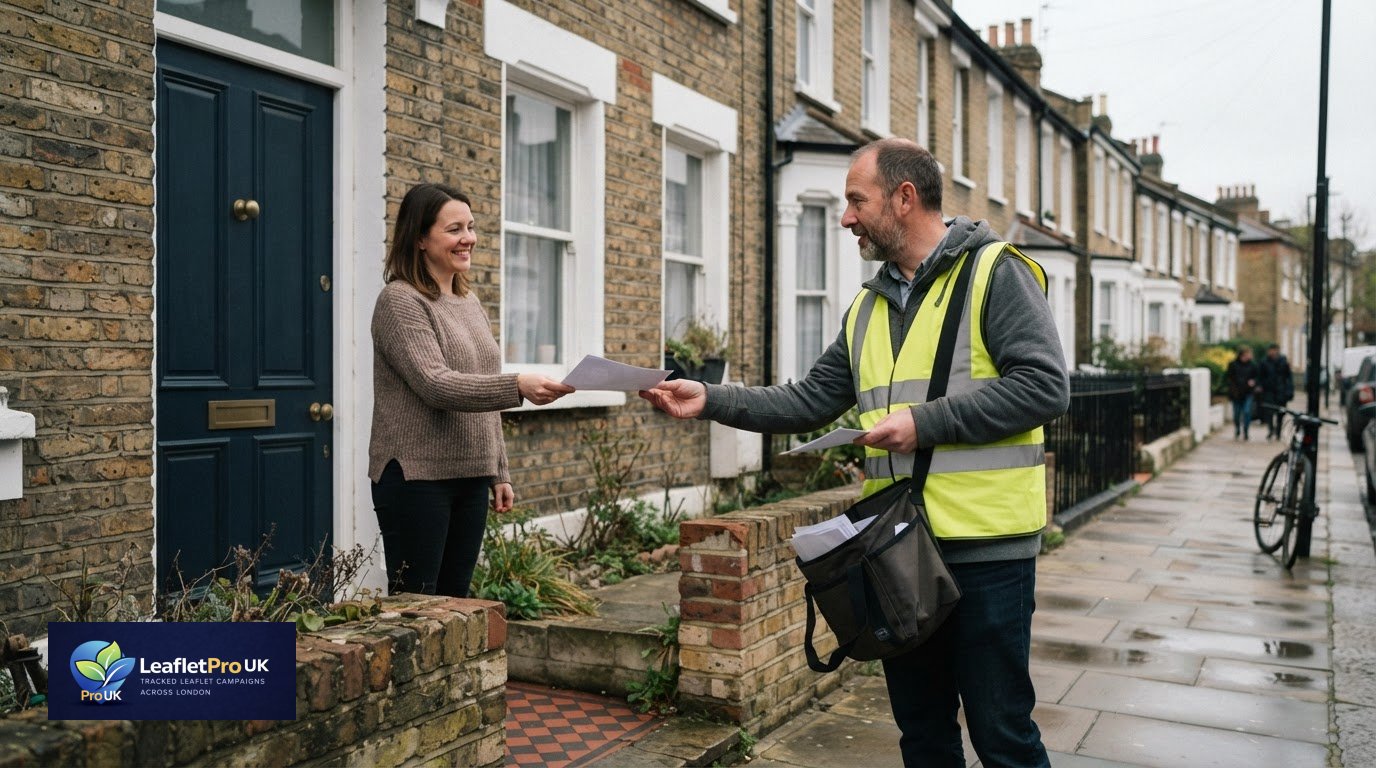
A doorstep sale and a cold call reach you in different ways, but both can leave you needing clear advice if something goes wrong.
It’s reasonable to want time to consider an offer rather than feel pressured to decide during an unexpected conversation. Knowing how doorstep sales compare with cold calling can help you recognise what happened and choose a sensible next step.
This article explains the difference between the two approaches, what to consider when a salesperson visits, and how to report problems with goods or services. It also outlines how consumer complaints help identify recurring issues in Camden, so you can understand where to turn for impartial advice.
Key Takeaways
- Doorstep selling involves direct conversations, while leaflet delivery puts the message in residents’ hands without requiring a sales discussion.
- Before planning in-person sales, identify the activity involved and the permissions that may apply in Camden.
- Choose neighbourhoods by how well their households match your audience and campaign goals, rather than assuming one area is always best.
- Measure delivery, enquiries and sales as separate stages to see where a campaign is gaining traction.
- Learn how to report problems with goods or services and how complaint reports can help Camden Trading Standards identify local issues.
What door-to-door marketing agencies operate in Camden, London?
In Camden, a doorstep approach might involve a business selling goods or offering trade work at your home. A salesperson may ask you to consider a product, while a tradesperson might offer repairs. These are direct sales conversations, not simply the delivery of printed advertising. The business, offer and action requested help you identify the type of visit.
A sales representative speaks with residents and may seek an order or agreement. A leaflet distributor delivers printed material, such as a restaurant menu or a local service flyer, without needing a doorstep conversation. Businesses may use either approach, but each has a different purpose and level of interaction.
Don’t assume that someone at your door represents Camden Council. According to the London Borough of Camden, Camden Trading Standards advises businesses and enforces laws intended to help ensure fair trading in the borough. This is a consumer-protection role, not a commercial marketing service. If a visitor claims to represent a public body, note the organisation they name and their reason for visiting.
If you’re planning a campaign, first define what it involves. Decide whether representatives will discuss or sell goods, offer trade work, or leave printed material. A home-improvement company seeking appointments, for example, needs a different approach from a café distributing menus. Record the business, message, intended audience and action you want people to take.
Residents who have concerns about goods or services can contact the Citizens Advice consumer service on 0808 223 1133. Its telephone advice line is open Monday to Friday, 9am to 5pm. People who cannot hear or speak on the phone can use Relay UK by typing 18001 followed by 0808223113. The service provides free, confidential and impartial consumer advice.
Reporting a concern can help reveal recurring problems. Camden Trading Standards uses complaints reported to the Citizens Advice consumer service on a national database to identify complaint trends and problem traders in the area. Keep details together, including the business name, what was offered and any paperwork. A clear account helps distinguish an unwanted sales visit from a dispute about a purchase or trade work.
What licences or permissions are required for door-to-door marketing in Camden?
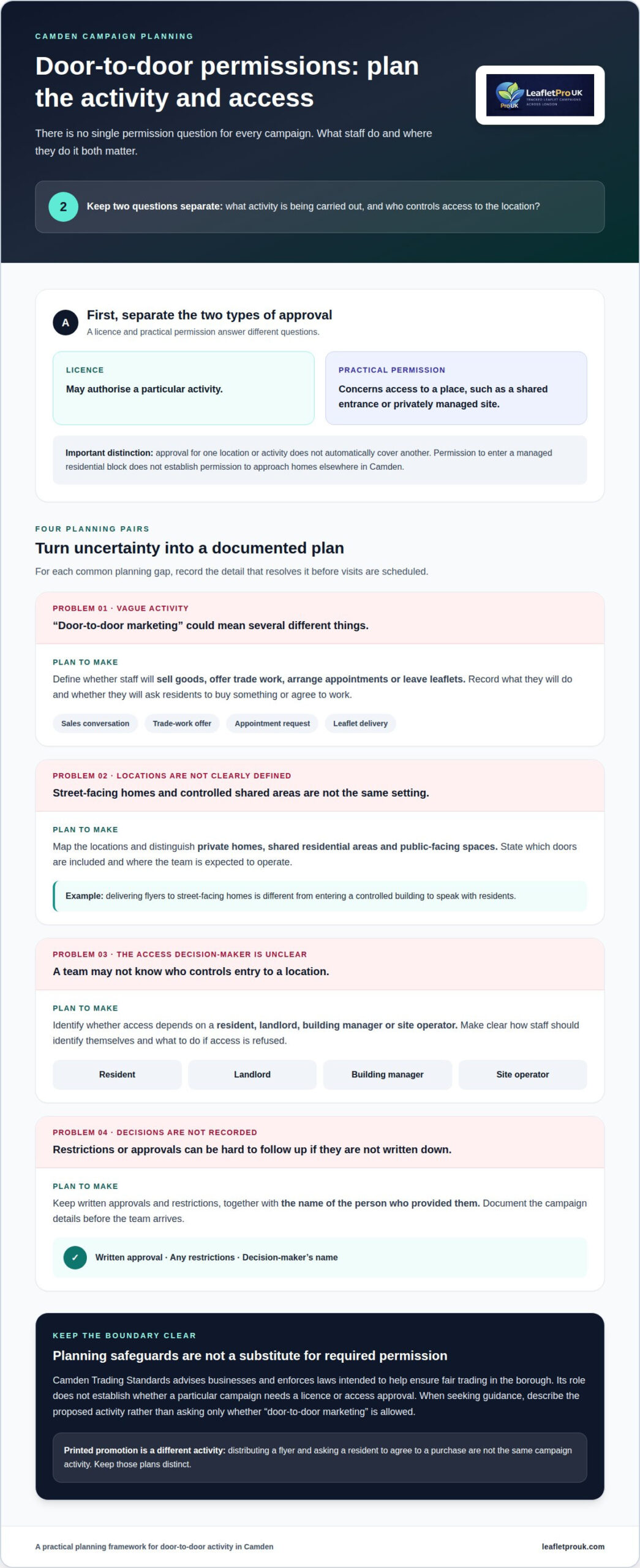
There is no single permission question for every campaign: the activity and location matter. A representative selling a product at someone’s home, a tradesperson offering work and a distributor leaving printed material involve different interactions. Describe what staff will do, where they will do it and whether they will ask residents to buy something or agree to work.
Distinguish a legal licence from practical permission. A licence may authorise a particular activity. Permission concerns access to a place, such as a building’s shared entrance or a privately managed site. Approval for one location or activity does not automatically cover another. For example, permission to enter a managed residential block does not establish permission to approach homes elsewhere in Camden.
Before scheduling visits, document the campaign details. The organiser can follow this sequence:
- Define the activity: record whether staff will sell goods, offer trade work, arrange appointments or leave leaflets.
- Map the locations: distinguish private homes, shared residential areas and public-facing spaces.
- Identify who controls access: note whether entry depends on a resident, landlord, building manager or site operator.
- Record the decision: keep written approvals, restrictions and the name of the person who provided them.
Planning this way can reveal gaps before a team arrives. Delivering flyers to street-facing homes is different from entering a controlled building to speak with residents. State which doors are included, how staff will identify themselves and what they should do if access is refused. These are useful safeguards, not substitutes for any permission required for the activity.
Camden Trading Standards advises businesses and enforces laws intended to help ensure fair trading in the borough, according to the London Borough of Camden. Its role does not establish whether a particular campaign needs a licence or access approval. When seeking guidance, describe the proposed activity rather than asking only whether “door-to-door marketing” is allowed. That phrase can mean sales, trade offers or leaflet delivery, each with different practical circumstances.
For businesses choosing printed promotion rather than doorstep sales conversations, postcode-targeted flyer distribution offers a way to define delivery areas by postcode. Keep that decision separate from permission for face-to-face selling: distributing a flyer and asking a resident to agree to a purchase are not the same campaign activity.
Which Camden neighbourhoods are best for door-to-door marketing?
No single Camden neighbourhood suits every campaign. Choose an area based on the offer, the people it serves and whether staff need conversations or simply want to leave printed information. A household service, for instance, has different targeting needs from a café promoting a nearby lunch menu. Define your audience and goal before selecting streets.
Camden Town may suit campaigns aimed at residents and local businesses, but its busy streets will not necessarily suit every doorstep activity. A team seeking longer conversations should identify suitable residential streets rather than assume high footfall means better access to households. For a printed promotion, consider the offer’s likely catchment: a nearby restaurant might focus on homes within practical reach of its premises.
Kentish Town is another area to consider for neighbourhood-focused campaigns. A local tradesperson might prioritise homes within the service area, while a community event could target streets near its venue. Define the relevant boundary, then plan a manageable route through streets that match it. This keeps distribution focused rather than treating the whole neighbourhood as one audience.
Hampstead and Belsize Park may suit a campaign if the offer is relevant to the households being approached. Avoid choosing these areas based on assumptions about residents. Instead, use evidence the business can substantiate, such as existing customer locations, enquiries from nearby streets or the geographic limits of its service. These indicators provide a clearer rationale than a neighbourhood’s reputation.
For campaigns connected to education, culture or local services, consider Bloomsbury and King’s Cross alongside residential areas. Let the intended audience and the service location guide your choice. A nearby venue might promote itself around its immediate area, while a home-visit service may need to focus on streets within its operating range. Keep these objectives distinct.
Use this short planning process to compare areas:
- Match the offer: name the customer most likely to need it, such as a household seeking local repairs.
- Set the catchment: identify which streets are realistically served by the business or venue.
- Choose the approach: decide whether the campaign needs a conversation or printed material.
- Review response: compare enquiries by area, using the same tracking method for each neighbourhood.
Start with a defined cluster in Camden Town, Kentish Town or another suitable area, then compare the response before expanding. Record the streets covered and enquiries received. This evidence helps you distinguish a suitable location from a campaign that simply reached more people, giving your next area choice a practical basis.
How can businesses measure door-to-door marketing results in Camden
Set a clear objective for each Camden campaign. A home-repair firm might seek qualified enquiries, while a local venue may want bookings. Keep that outcome separate from activity measures, such as homes visited or leaflets delivered. The number of visits shows work completed, not whether the campaign prompted a response.
Before launch, create a simple record for each area and approach. Note the streets covered, campaign dates, offer and response route. If teams use different leaflets or scripts, label each version clearly. A unique phone number, web form field or printed response code can help link an enquiry to its source.
Track the steps between distribution and a completed sale. A useful campaign record can include:
- Coverage: streets visited or delivery areas completed.
- Engagement: conversations held or residents requesting further information.
- Enquiries: calls, form submissions or visits linked to the campaign.
- Outcomes: appointments attended, bookings made or sales completed.
- Feedback: questions, refusals and reasons residents give for declining.
Compare like with like. For example, assess the same offer and response method in two Camden areas rather than changing the message partway through. Calculate the enquiry rate by dividing attributed enquiries by the homes reached. Use the same calculation method each time, so any differences reflect campaign performance rather than changes in reporting.
For doorstep sales, record when interest becomes a meaningful outcome. A conversation may lead to a follow-up appointment, but that is not a completed sale. With a leaflet campaign, a resident may respond later through a booking form. Ask customers how they heard about the business, then compare their answer with any campaign code or dedicated response route.
Review results after the campaign’s response period. Separate untracked enquiries from those clearly attributed to a specific area or version. Camden Trading Standards uses complaints reported to the Citizens Advice consumer service on a national database to identify complaint trends and problem traders locally. For campaign reporting, the practical lesson is to keep accurate records and review customer feedback alongside response figures.
Use your findings to make one controlled change at a time. If Camden enquiries are strong but bookings are low, review the follow-up process. If a leaflet version attracts more relevant enquiries, keep its message for the next test. Accurate records of coverage, source and outcome make the next decision more grounded.
What are the risks and complaints associated with door-to-door marketing
An unexpected visit can make it harder to consider an offer calmly. Camden residents are warned about door-to-door salespeople who try to persuade them to buy goods or accept trade work at their doorstep. A concern might involve the sales approach, the quality of goods, completed work or a disagreement about what was agreed.
Pressure to decide immediately is a reason to pause. Ask the visitor to explain the business name, offer and any proposed work in plain language. If the explanation changes, the price or scope is unclear, or the visitor discourages you from taking time, end the conversation. Don’t hand over money or agree to work just to avoid an awkward exchange.
Be especially cautious if someone claims to represent a known organisation but cannot explain their role. A badge or leaflet that looks genuine does not, on its own, establish who the visitor represents. Note the name given, the business they claim to represent and the reason for the visit. Don’t share personal or payment details unless you understand who is asking and why.
Keep records if a visit leads to a dispute. Save receipts, written estimates, messages, contracts and paperwork describing the goods or work. Write down what the salesperson said, what you agreed to and when the conversation took place. If a promised repair differs from the written description, for example, compare the two records before raising the issue with the business.
Fake goods are a serious concern. Selling fake goods in Camden is a crime that can carry a prison sentence. If you suspect an item is counterfeit, keep the item and its packaging where possible, and preserve proof of purchase. A doorstep seller’s verbal assurance is not proof of a product’s origin.
To complain about goods or services, explain the problem clearly to the business and keep a copy of your message. State what you bought or agreed to, what went wrong and what outcome you’re seeking. If the issue remains unresolved, Camden residents can seek consumer advice through the Citizens Advice consumer service. Its information can help clarify practical next steps.
According to the London Borough of Camden, Camden Trading Standards advises businesses and enforces laws intended to help ensure fair trading in the borough. Complaints can help identify concerns about traders operating locally. Give a factual account, distinguish what you witnessed from what you suspect, and include supporting documents where available. Clear records make it easier to explain the issue accurately.
LeafletPro UK: GPS Tracked Leaflet Distribution
LeafletPro UK helps businesses reach selected local households through GPS Tracked Leaflet Distribution and Postcode-Targeted Flyer Distribution across London. This is a practical option when you want to promote an offer without relying on a doorstep sales conversation. Postcode targeting defines the campaign area, and GPS tracking is included for visibility over distribution activity.
For a Camden campaign, make sure the message and delivery area work together. Leaflet Design Support can help prepare your flyer, and High-Quality Printing provides the finished materials for distribution. Design and printing are optional parts of an all-in-one service, suitable for sharing local offers, event details or service information with households in relevant postcodes.
To discuss a leaflet campaign, contact LeafletPro UK through leafletprouk.com.
Plan your next local campaign with purpose
Effective door-to-door marketing in Camden starts with a clear choice: do you need a direct conversation, or should your message reach households without a sales visit? Let that decision shape your audience, delivery area and response method. A focused plan helps you learn from each campaign and refine the next one.
If reaching selected local households is the better fit, LeafletPro UK can support your campaign with GPS Tracked Leaflet Distribution, Postcode-Targeted Flyer Distribution and Leaflet Design Support. Set out the areas you want to reach and the response you hope to encourage, then take the next step with a clear brief.
A well-planned local campaign can help you communicate with residents in a way that suits your business and audience. Start with a clear purpose, then build your approach around it.
For door-to-door marketing in Camden, residents can call the Citizens Advice consumer service on 0808 223 1133, Monday to Friday, from 9am to 5pm. If you can’t hear or speak on the phone, contact Citizens Advice through Relay UK by typing 18001 followed by 0808223113.
Frequently Asked Questions
Which local marketing services can businesses use in Camden?
LeafletPro UK provides GPS-tracked leaflet and flyer distribution across London for businesses seeking to reach households in Camden. For example, a local venue could promote an event, while a trades business could introduce its services to nearby residents. For door-to-door marketing in Camden, decide what action readers should take, such as visiting a venue or making an enquiry, and make that next step clear on the material.
What are the rules for sales visits and leaflet delivery in Camden?
For door-to-door marketing in Camden, make the purpose of each visit or delivery clear. A sales conversation asks someone to consider goods or trade work; leaflet delivery shares printed information without requiring a conversation. If an offer leads to a purchase or service dispute, keep the relevant paperwork and explain the specific problem when seeking consumer advice. The activity and location determine what permissions may be relevant.
How does door-to-door marketing compare with leaflet distribution and local online advertising in Camden?
Door-to-door sales involve a direct conversation and may seek an order or agreement. Leaflet distribution delivers printed material without requiring a conversation. The article does not provide a basis for comparing either approach with local online advertising.