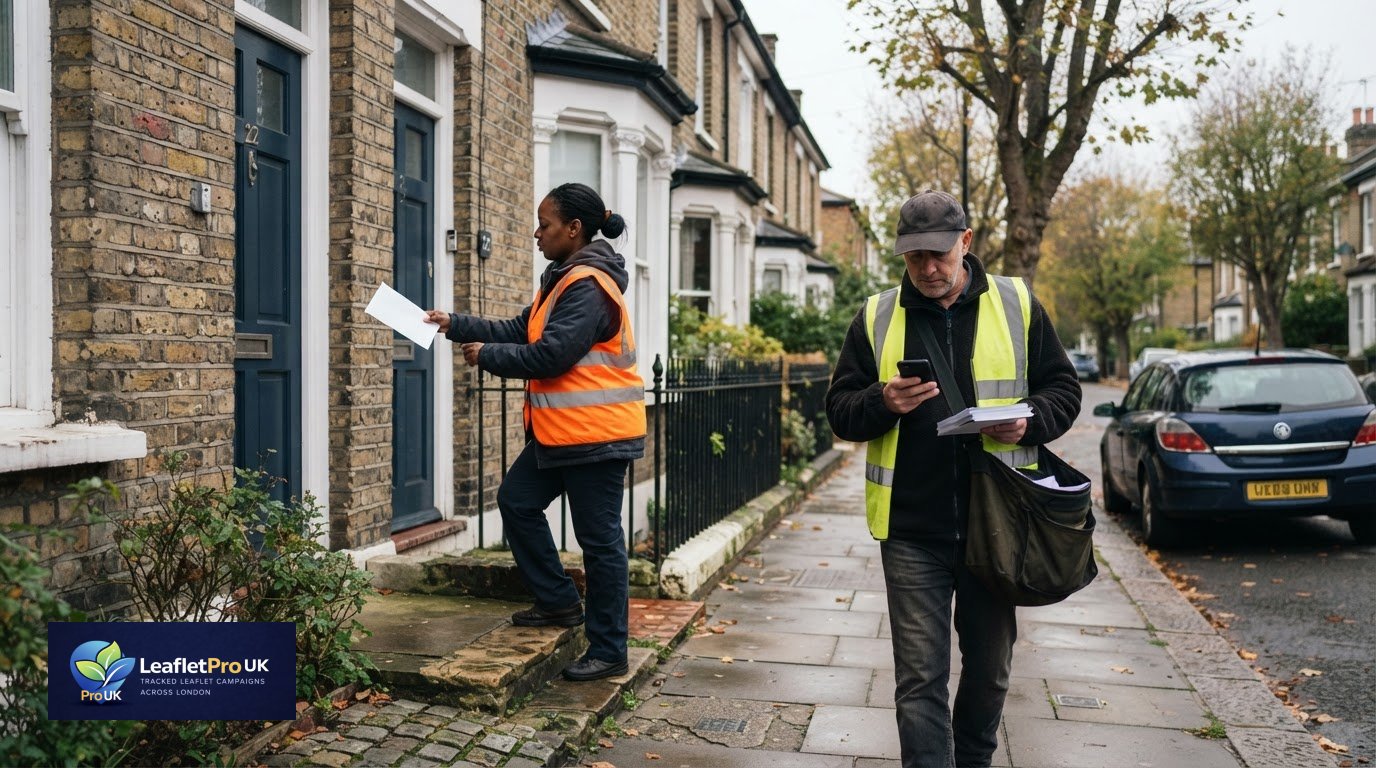
A polished design is not enough if the print size or quantity does not suit the campaign. A leaflet campaign planning checklist should cover the objective, audience, message, artwork, finished size, print quantity, distribution area and response tracking. Check these details before printing to keep the campaign clear, consistent and easier to measure.
It is easy to focus first on wording and visuals, but practical print decisions matter too. A size that works on screen may not leave enough room for your message in print, while an unsuitable quantity can leave you with too few or too many leaflets for the planned distribution.
This guide explains how to shape a focused message, check artwork and print details, estimate quantities from your distribution plan and choose practical ways to track responses. Use it as a sequence to follow before your materials go to print and into local circulation.
Key Takeaways
- Set a clear campaign goal first, then choose a response measure that connects directly to it.
- Build the design around one main message, with supporting details that help readers take the next step.
- Match print size and quantity to the artwork, audience and distribution plan before approving production.
- Keep colours, fonts and logo use consistent so printed materials remain recognisable across campaign formats.
- Choose distribution areas by considering your target audience, visibility and likely opportunities to encounter the leaflet.
Tracking responses to printed materials
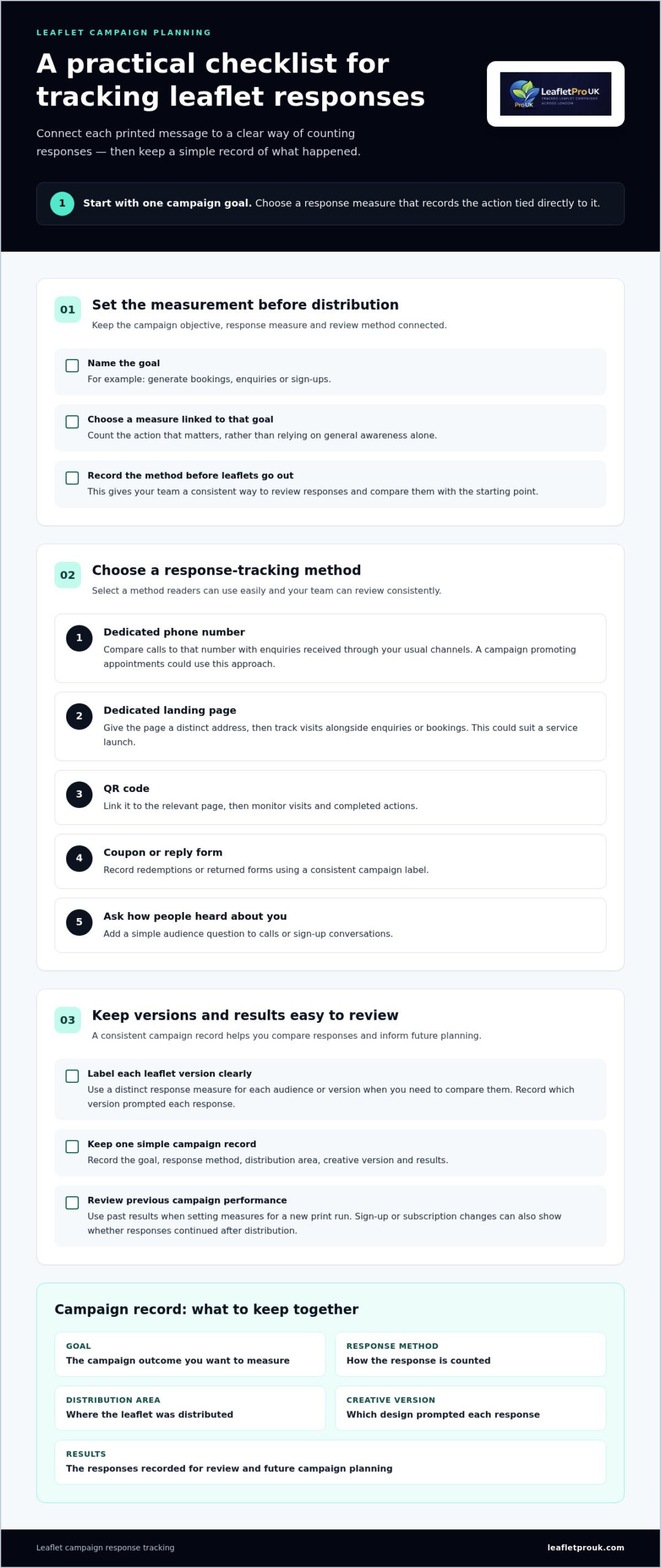
Start with one campaign goal, such as generating bookings, enquiries or sign-ups. Then choose a response measure that records the action tied to that goal. A leaflet campaign planning checklist should link each printed message to a clear way of counting responses, rather than relying on general awareness alone.
Choose a tracking method that readers can use easily and your team can review consistently. For example, a campaign promoting appointments could use a dedicated phone number, while a service launch could use a campaign-specific landing page. Record the method before distribution so you can compare responses with your starting point.
- Use a dedicated phone number. Compare calls to that number with enquiries received through your usual channels.
- Create a dedicated landing page. Give the page a distinct address and track visits alongside enquiries or bookings.
- Add a QR code. Link it to the relevant page, then monitor visits and completed actions.
- Include a coupon or reply form. Record redemptions or returned forms using a consistent campaign label.
- Ask how people heard about you. Add a simple audience question to calls or sign-up conversations.
Use a distinct call to action for each audience or leaflet version when you need to compare them. If your campaign has multiple designs, label each version clearly and record which one prompted each response. Review past campaign performance before setting measures for a new print run. Sign-up or subscription changes can also show whether responses continued after distribution.
How do I choose between door-to-door, hand-to-hand and direct mail distribution? Match the method to your audience and campaign objective: door-to-door reaches households in selected areas, hand-to-hand suits contact at a specific location, and direct mail addresses named recipients. Compare expected reach, placement and how each method supports your chosen response measure.
What are the environmental considerations for leaflet printing and distribution? Set the quantity according to your planned audience to limit surplus, consider paper and print choices, and plan how to reuse or recycle unused leaflets. Keep distribution areas focused to avoid unnecessary printing and delivery.
Supply the logo as a vector file for sharp, scalable artwork across print sizes. Unlike a small raster image, vector artwork can be resized without losing quality, preserving clean edges on compact leaflets and larger formats. Include the approved logo version with the final artwork, then check its placement and legibility in the proof.
Keep a simple campaign record of the goal, response method, distribution area, creative version and results. This gives each campaign a consistent basis for review and makes your next planning decision more informed.
Using campaign questions to shape design and messaging
Start with the decision you want the reader to make. A leaflet promoting a new service, for example, should explain what it does and how to enquire. This keeps the headline, supporting copy and visual focus aligned with a specific campaign purpose.
Use these questions to turn your campaign goal into clear content:
- Who needs this message? Describe the audience through relevant needs, such as homeowners seeking a local repair service.
- What do they need to know first? Put the most useful benefit or offer in the headline, not buried in body copy.
- Why should they respond? Explain the practical value, such as booking an appointment or finding out more.
- What action should they take? Use a direct instruction, such as “Call to book” or “Visit our website”.
- What could stop them responding? Address a likely concern with a concise detail, such as the service area or appointment process.
Keep the leaflet focused on one main message. Supporting details can add context, but should not compete with the central point. For example, a café promoting a new lunch menu could lead with the menu, then add its opening times and address. A separate promotion can have its own leaflet or a clearly distinct version.
Coordinate every campaign format around the same central message. If a poster introduces a new service, the leaflet can explain its benefits while a landing page provides more detail. Readers should recognise the same offer and next step across each item, without conflicting headlines or instructions.
Before approving the copy, compare the headline, offer and call to action across each format. Check that the service name is consistent, any dates or terms match, and the destination is correct. For example, a leaflet and poster advertising the same event should direct readers to the same booking page and use the same event title.
When should I schedule a leaflet campaign and how long should it run? Schedule it around the event, offer or decision point, leaving time for printing and planned distribution beforehand. Set the run according to how long the message remains relevant and when your audience can act.
Finally, review the design as a recipient would. Give someone unfamiliar with the campaign the leaflet and ask what it offers and what action to take. If they cannot identify both quickly, simplify the wording or strengthen the visual hierarchy before approving the artwork.
Treat the main message as the anchor for every campaign material. Decide which item will introduce it, then give each other format a supporting role. A poster can present the central point, while a leaflet or other media provides further information without introducing a different theme. Keep secondary details in service of the main message, so readers can encounter the campaign across formats and find what they need without facing competing priorities.
As the materials take shape, check what each piece contributes. Remove details that distract from the central point and place useful explanations where they support it. This keeps the campaign coherent while allowing supporting materials to add information rather than simply repeat the main message.
Checking poster size and leaflet quantities
Confirm the finished dimensions before approving artwork or ordering print. A design prepared for a small leaflet may not suit a large poster: text, logos and images can become difficult to read when resized. Record the intended format and check that the final proof matches it.
Use this pre-print sequence to catch avoidable errors:
- Confirm the size. Compare the artwork dimensions with the printer’s agreed finished format.
- Review the logo. Check that it remains clear at the intended size and appears in its approved form.
- Proof every line. Check spelling, phone numbers, email addresses, dates and calls to action.
- Check the layout. Make sure essential information is legible and not too close to an edge or fold.
- Approve the final version. Compare the proof with the campaign copy before production begins.
Set the quantity according to your distribution plan, not an arbitrary round figure. Start with the selected streets, buildings or locations, then estimate how many materials each area needs. For example, a campaign covering a small group of local streets has different requirements from one spanning several postcode areas. Allow for replacements or agreed placement needs, without printing surplus by default.
Match each print quantity to its distribution route. If two areas receive different offers, keep their quantities and artwork versions separate. Label files and print instructions with the area name and version so the correct leaflet reaches each planned location. This also makes leftover stock easier to identify after distribution.
What UK rules apply to leaflet distribution, including permissions and fly-posting? UK print advertising is governed by legislation and industry self-regulation, including the UK Code of Non-broadcast Advertising and Direct & Promotional Marketing. Treat unauthorised poster placement as separate from leaflet delivery, and get permission to use display locations.
Do I need permission to distribute leaflets in town centres or on private property? Plan town-centre activity around the relevant site’s access and distribution conditions, and obtain permission from the responsible authority or manager where required. For private property, agree access and placement with the owner or occupier before distribution.
What risks and common mistakes should I check for before launching a leaflet campaign? Check dimensions, spelling, contact details, artwork versions, quantities and poster locations for errors or mismatches. A final proofing pass and a location-by-location distribution plan can help catch issues before printing or delivery.
Use the final sign-off as a controlled handover: record the approved proof, print quantity and distribution areas together. This helps prevent a correct design from being printed in the wrong size or sent to the wrong locations.
Consistent brand colours and fonts
Consistent visual choices help readers recognise your business across a leaflet, poster and website. Start with your brand guidelines, then use the same approved colours, typefaces and logo treatment throughout the campaign. A leaflet and matching poster, for example, should look like parts of the same promotion, not unrelated designs.
Write down the colour references used in existing brand materials before preparing print artwork. A screen preview can look different from the printed result, so review a physical proof where possible. Check that the main colour, background and text remain distinguishable together. A pale yellow headline on a white background, for instance, may be difficult to read.
Use colour to organise information, not just decorate the page. Keep the brand’s primary colour for recognisable elements, then use supporting colours to separate details such as opening times or a response instruction. If a campaign has several leaflet versions, apply the same colour roles to each. This helps readers identify the brand even when the offer changes.
Choose typefaces that suit your existing identity and remain legible at the finished print size. Give each style a clear role: a prominent heading, readable body copy and a distinct call to action. Avoid decorative fonts that conflict with the brand’s established character. For example, an ornate script headline may make a formal professional service harder to understand.
- Use approved font files. Check that the chosen typeface displays correctly in the final artwork.
- Keep heading styles consistent. Apply the same weight and alignment across campaign formats.
- Preserve contrast. Make sure text stands out against its background in the print proof.
- Review small details. Check contact information and supporting copy at actual size.
- Compare campaign versions. Confirm that each leaflet follows the same visual rules.
Create a simple artwork handover record with the approved colour references, font names, logo file and final design version. This helps prevent an outdated file being used. If a font must be substituted, compare the revised proof with the original layout, as changed letter widths can alter line breaks and spacing.
Before approval, place the leaflet beside other current materials, such as a business card or website screenshot. Check that the logo, colours and type styles feel coherent, then make sure the call to action has clear contrast. A consistent identity should support the campaign message without making essential information harder to find.
A consistent look should carry through to distribution planning. Consider footfall, visibility, leaflet placement, expected audience and competing campaigns when planning where printed materials will go. Matching the artwork to these conditions helps keep the brand recognisable wherever the leaflets appear.
How do I define a target audience and choose areas for leaflet distribution?
Start with the people most likely to need your offer, then identify where they live, work or spend time. A London café promoting weekday lunches might focus on nearby workers and residents, while a home-improvement service could prioritise households in suitable neighbourhoods. A defined audience makes area selection more purposeful.
Turn your audience description into practical criteria before selecting streets or locations:
- Describe the likely customer. Note relevant needs, habits and the reason they might respond.
- Connect the offer to place. Choose locations near the service, venue or audience activity.
- Identify suitable distribution points. Consider homes, shops or public locations based on the campaign.
- Record the reason for each area. Link every chosen location to an audience trait or campaign goal.
Next, consider how people will encounter the leaflet. A residential campaign depends on household coverage, while a public-facing promotion may rely on footfall and visible placement. For a local fitness studio, nearby homes and routes past the premises could be relevant; a business event might suit locations where intended attendees already gather.
Check visibility as well as audience fit. A high-footfall location may still be unsuitable if leaflets are difficult to see or access. Note where materials will be placed, how people move through the area and whether competing campaigns could distract from yours. A simple area map with marked distribution points can reveal gaps or unnecessary overlap.
Estimate the audience realistically for each selected area. Use expected audience, placement and the likelihood of encounters to guide the plan. Separate areas with different characteristics rather than treating a whole district as uniform. For example, a high street and nearby residential streets may attract different audiences and need distinct distribution choices.
Keep a record for each area, including the audience rationale, delivery method and planned quantity. Compare these details with the results after the campaign. If responses cluster around one neighbourhood, that can inform future area selection. If an area produces little engagement, review audience fit, visibility and message relevance before repeating the plan.
Local knowledge can sharpen your selection. Consider whether the offer depends on proximity, convenient access or a particular community interest. A restaurant might focus on people close enough to visit, whereas a service covering several postcodes may need a wider, clearly mapped area. Tie your criteria to the offer, not assumptions about a neighbourhood.
Before finalising the plan, compare every chosen location with your target audience, visibility, expected exposure and other campaigns in the area. This gives each distribution decision a clear rationale and makes the eventual review more useful.
LeafletPro UK: GPS Tracked Leaflet Distribution
LeafletPro UK supports London businesses that have planned their message, artwork and target areas and are ready to organise distribution. Its GPS Tracked Leaflet Distribution and Postcode-Targeted Flyer Distribution reach selected local households across London, with GPS tracking included in every campaign.
For a more joined-up process, Leaflet Design Support and High-Quality Printing can prepare campaign materials alongside distribution. This all-in-one option brings design, print and delivery planning together around your campaign requirements, with GPS tracking included in every distribution campaign.
Share your campaign goals and chosen areas with LeafletPro UK to discuss the next step.
Turn your plan into a measured next step
Make the leaflet campaign planning checklist a working document, not a file that gets put away once the artwork is approved. Assign responsibility for the final proof, print handover and response review, then record what each person needs to complete. This creates a clear route from campaign idea to learning for future activity.
For London campaigns, LeafletPro UK offers GPS Tracked Leaflet Distribution and Postcode-Targeted Flyer Distribution, alongside Leaflet Design Support and High-Quality Printing. GPS tracking is included in every distribution campaign. The service reaches selected areas across London, and design and printing are optional parts of the all-in-one offering.
Set a review point before distribution begins. Decide who will gather response information and how the team will assess the campaign. A documented review can help shape future decisions about your audience, message and distribution areas.
With a clear plan and practical review process, you can move ahead confidently and make each campaign more purposeful.
Frequently Asked Questions
What are the steps for planning a leaflet campaign?
Connect the campaign goal, audience, creative and distribution in one workable brief. For example, a local restaurant promoting a new menu can define its intended customer, set a clear response action, prepare matching artwork and allocate leaflets to relevant nearby streets. Before printing, assign responsibility for artwork approval and response recording. After distribution, compare recorded enquiries with the original goal and note what to adjust next time.
How many leaflets should I print for a UK campaign?
Base the print quantity on your actual distribution plan, rather than choosing a figure by habit. Map the streets, buildings or locations you intend to cover, then estimate the materials needed for each area and delivery method. If your campaign targets selected London postcodes, keep each postcode’s quantity identifiable in your plan. This aligns printing with the intended audience and makes leftover stock easier to assess after distribution.
How can I measure leaflet campaign results using codes, URLs or response tracking?
Give each leaflet version a distinct response route, such as a QR code, campaign code or dedicated landing page. For example, use separate codes for London neighbourhoods, then record redemptions or enquiries against the correct version. Make the code easy to read and explain clearly what readers should do. Review completed actions, not just page visits, and record the campaign source when enquiries arrive by phone or in person.